Direct Proportion Formula and Examples
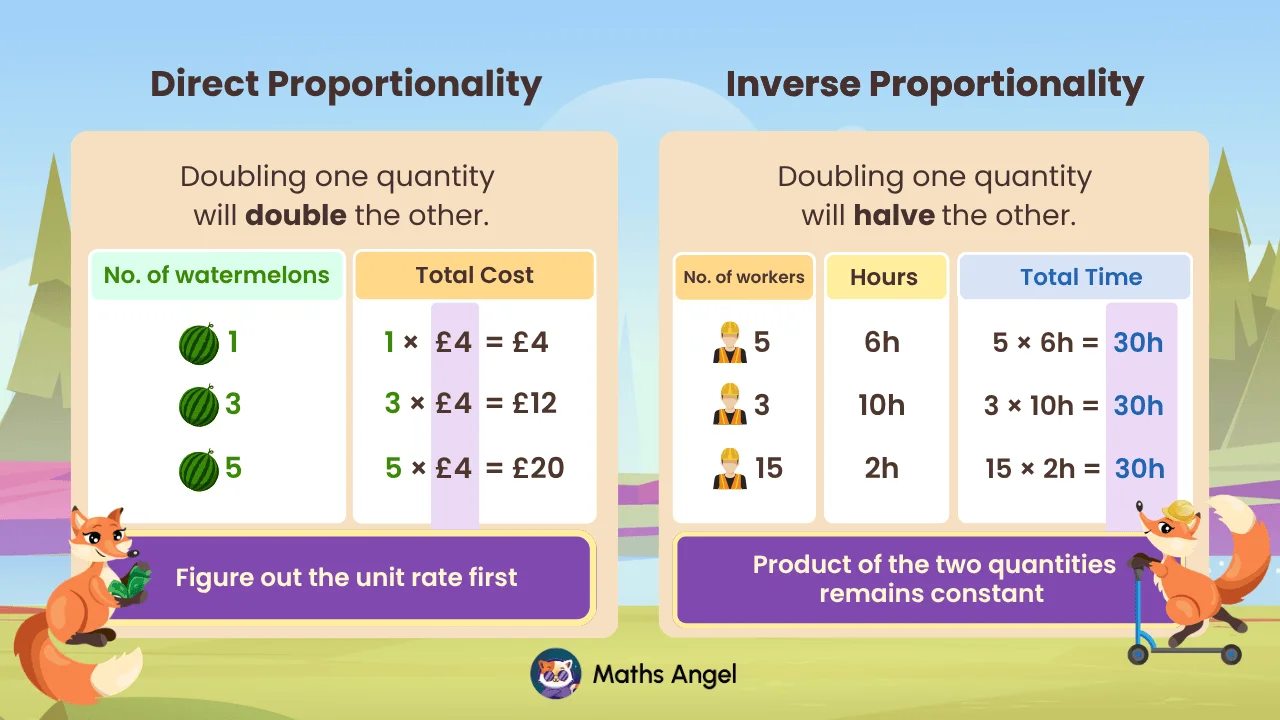
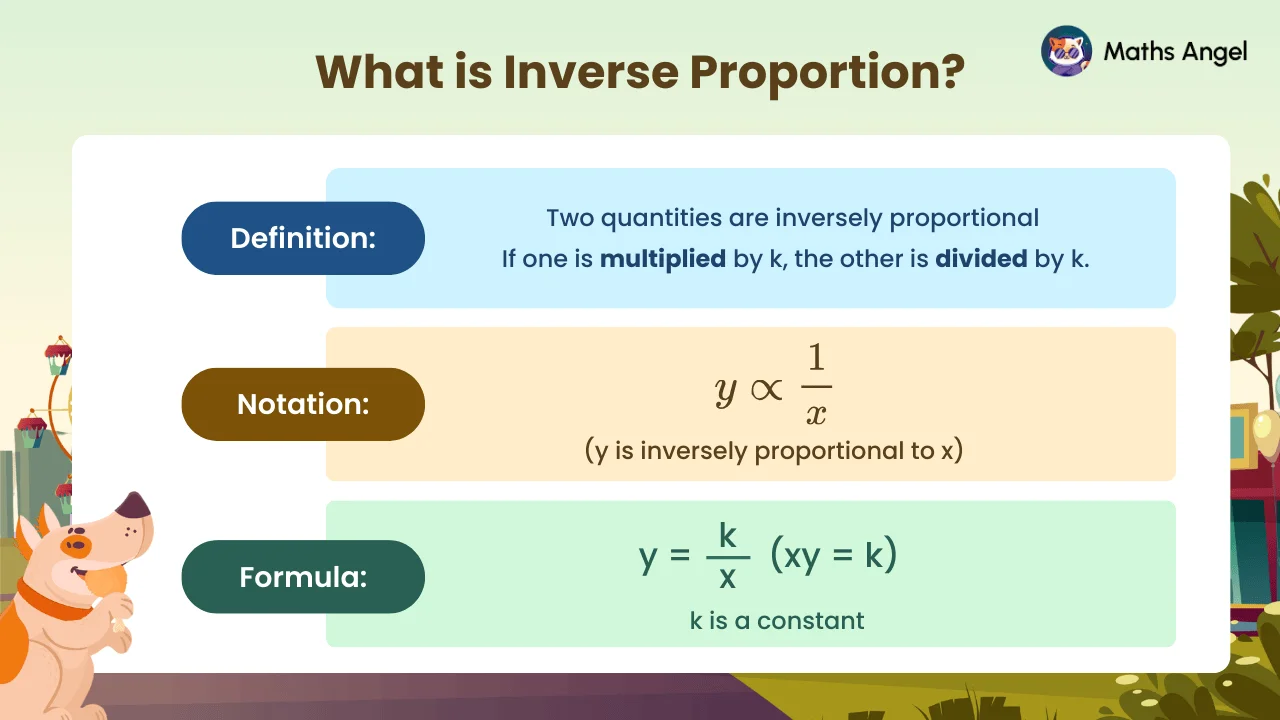
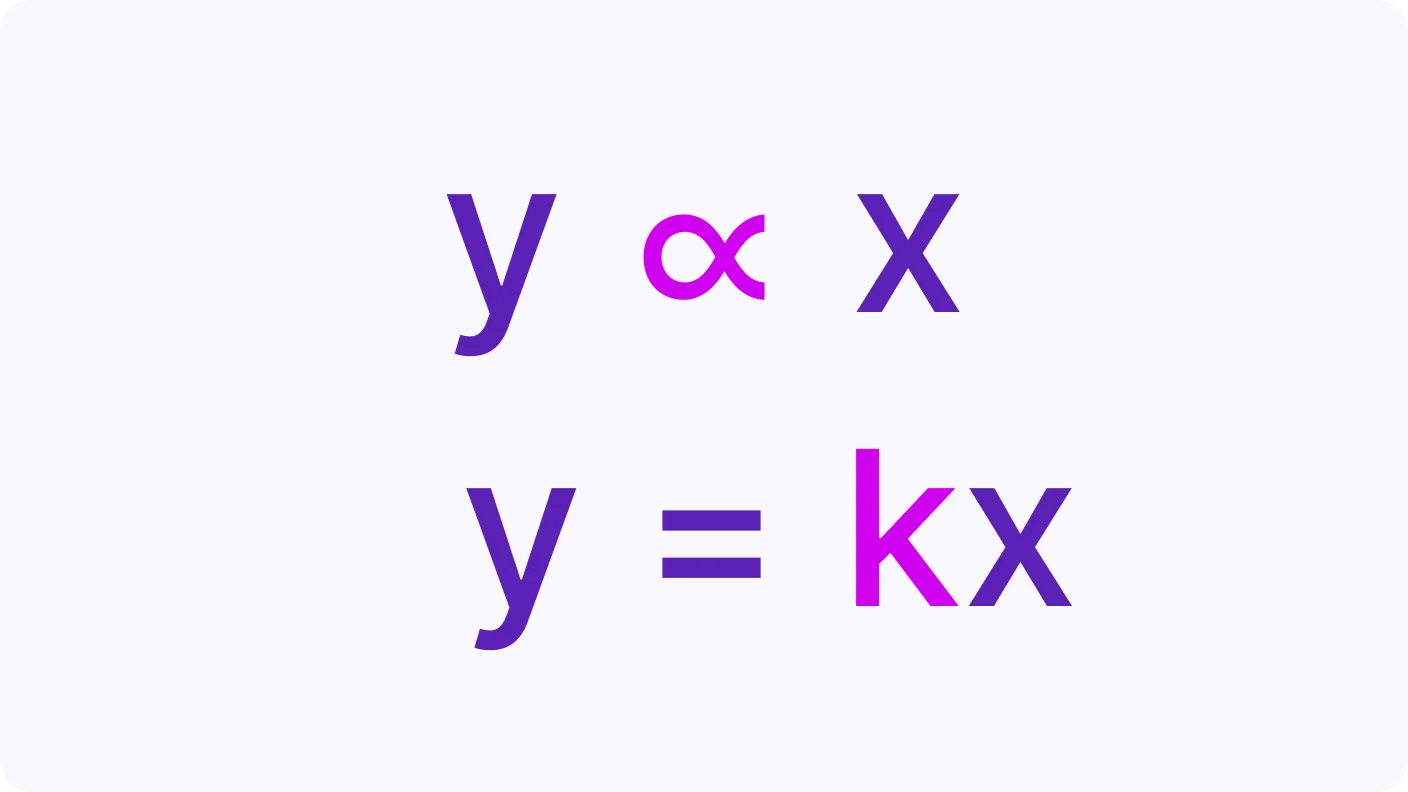
Direct proportion means two amounts change together by the same factor, so if x doubles, y doubles too. The direct proportion formula is y = kx. First find the constant k by dividing y by x, such as k = 20 ÷ 4 = 5.
Video Lesson
Watch and learn the basics
🎬 Did this video explain it clearly?
Flashcards
Review key concepts visually
%20What%20Is%20Direct%20Proportion.webp)
%20Direct%20Proportion%20Formula%20Example%201.webp)
%20Direct%20Proportion%20Formula%20Example%202.webp)
%20Direct%20Proportion%20Formula%20Example%203.webp)
What Is Direct Proportion?
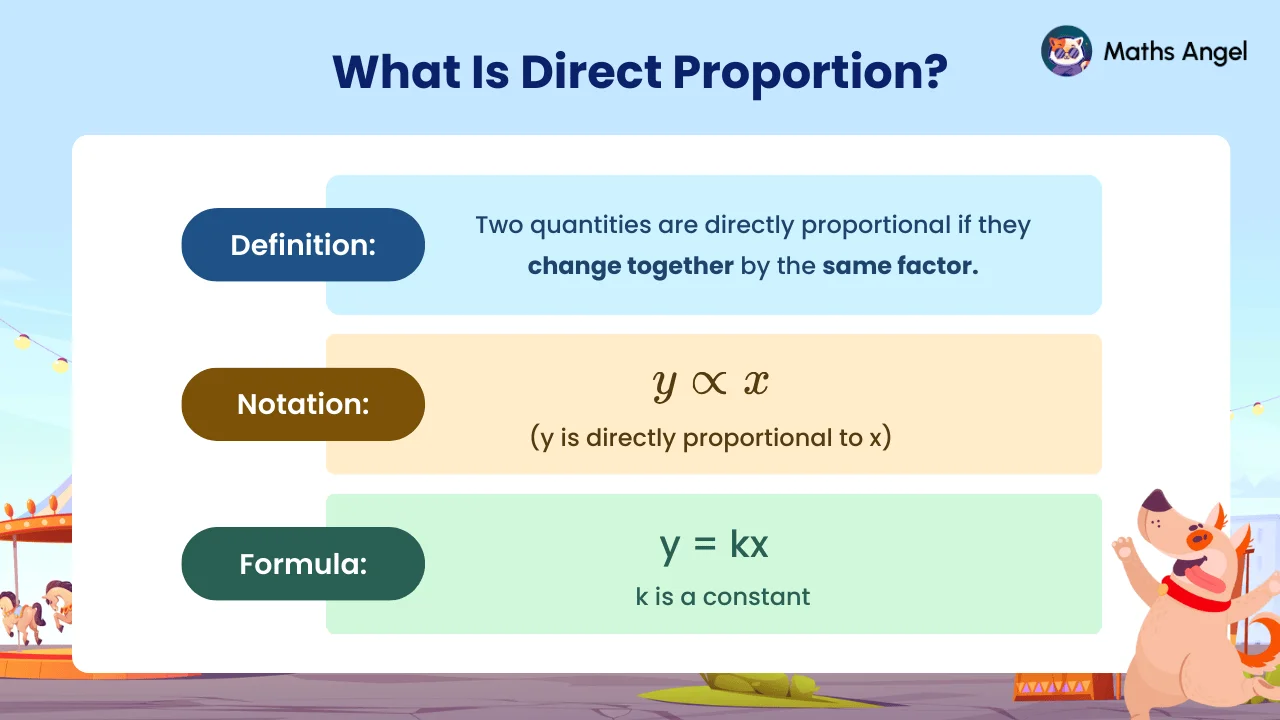
- Two quantities are in direct proportion if they increase or decrease together.
- If x doubles, then y also doubles.
Direct Proportion Formula
- We use the formula y = kx, where k ≠ 0.
- A constant means k stays the same, when x and y change.
Example: Direct Proportion to x²
- If y is directly proportional to x², we write y = kx².
- Find k first using given pairs, then substitute the x value to find the wanted y value.
Example: Direct Proportion to √x
- If y is directly proportional to √x, we write y = k√x.
- Find the constant k first, then use the formula to calculate the wanted y value.
Practice Questions
Test your understanding
Which formula shows is directly proportional to ?
Correct! 🎉 +10 pointsCorrect! 🎉 Worth 10 XPNot quite right
Direct proportion is always written , where is a fixed constant. Doubling doubles , and the graph is a straight line through the origin. adds a constant instead of multiplying, is inverse proportion, and is a straight line that misses the origin, so doubling does not double .
is directly proportional to , and when , . What is when ?
Correct! 🎉 +10 pointsCorrect! 🎉 Worth 10 XPNot quite right
Direct proportion means . Find by dividing: . So , and when , .
is directly proportional to , and when , . What is when ?
Correct! 🎉 +20 pointsCorrect! 🎉 Worth 20 XPNot quite right
Start with . Find : , so . Substitute : .
is directly proportional to , and when , . What is when ?
Correct! 🎉 +20 pointsCorrect! 🎉 Worth 20 XPNot quite right
Start with . Find by dividing 15 by , giving . So , and when , .
is directly proportional to , and when , . What is when ?
Correct! 🎉 +20 pointsCorrect! 🎉 Worth 20 XPNot quite right
Start with . Find by dividing 32 by , giving , so . Set : , so . Square-rooting gives , and the positive value is .
is directly proportional to , and when , . What is when ?
Correct! 🎉 +30 pointsCorrect! 🎉 Worth 30 XPNot quite right
Start with . Find by dividing 18 by , giving , so . Set : , so . Square both sides to undo the root: .
Want to see the full working?
Interactive Activity
Explore direct proportion by solving y = kx problems step-by-step
Loading interactive widget...
Frequently asked questions
The questions students bump into most on this topic
Two quantities are in direct proportion when they change together by the same factor: if one doubles, the other doubles; if one triples, the other triples. In GCSE maths you write y = kx, where k is a constant. If y = 20 when x = 4, then k = 5, so y = 5x and when x = 10, y = 50.
y ∝ x reads “y is directly proportional to x”. The symbol is the proportionality sign, not the infinity sign, which is a closed loop. It says the two quantities change by the same factor, and it can always be rewritten as the equation y = kx, where k is a constant that you find from a known pair of values.
Substitute a pair of values you know into y = kx and solve for k. If y = 20 when x = 4, then 20 = k × 4, so k = 20 ÷ 4 = 5 and the formula is y = 5x. k is a constant: it stays the same for every pair of x and y, and it is never 0.
Three steps: find k, write the formula, substitute. y is directly proportional to x, and y = 20 when x = 4; find y when x = 10. First k = 20 ÷ 4 = 5. Then the formula is y = 5x. Finally y = 5 × 10 = 50. Always find k first; without it the formula is incomplete.
Yes, and the method is the same. For y ∝ x², write y = kx²: if y = 18 when x = 3, then 18 = k × 9, so k = 2 and y = 2x²; when x = 6, y = 2 × 36 = 72. For y ∝ √x, write y = k√x: if y = 14 when x = 49, then k = 14 ÷ 7 = 2; when x = 100, y = 2 × 10 = 20.
What's next?
Found this one hard? Go one step back first. Feeling confident? Carry on to the next lesson.