
Rounding Calculator
Round to decimal places, significant figures, or the nearest 10, 100 or 1000 with clear explanations. Free rounding calculator for GCSE and IGCSE maths.
Round to Decimal Places
Round a number to a given number of decimal places
Enter a number and click Calculate
Your result will appear here with step-by-step working
Rounding Rules
Everything you need to learn rounding, broken down into simple, bite-sized cards.
1. What Does Rounding Mean?
Rounding makes numbers simpler and easier to work with. We round up or down depending on the digits in the number.
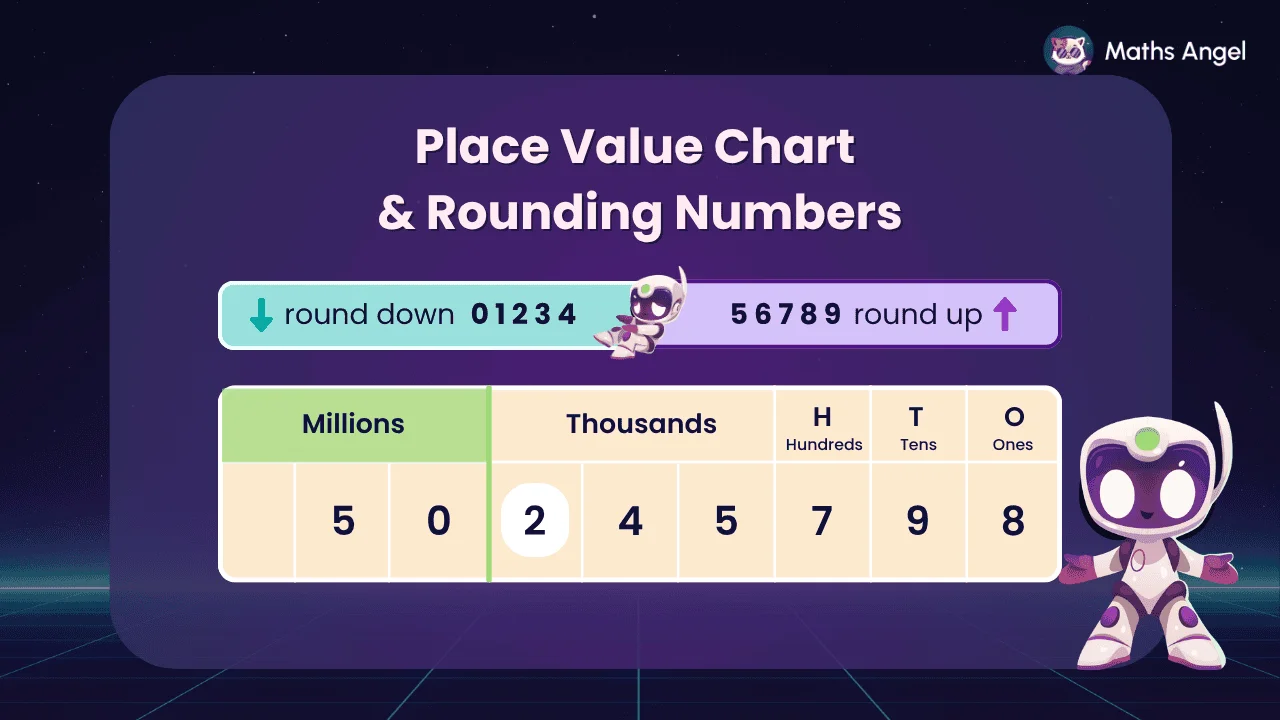
Look at the digit right after the place you're rounding to. If it's 5 or more, round up. If it's 4 or less, round down.
2. What Does Place Value Mean?
Place value is the value a digit has based on its position in a number. For example, in 456.78, the 7 is in the Tenths column so it's worth 0.7, while the 4 is in the Hundreds column so it's worth 400.
Knowing place value helps you round correctly. When a question says "round to the nearest tenth", you know to look at the Tenths column and check the digit after it.
3. What Are Significant Figures?
Significant figures (s.f.) are the important digits in a number, starting from the first non-zero digit. Zeros before it don't count. For example, in 0.00456, the significant figures are 4, 5, and 6.
Round 0.004562 to 3 s.f.:
- Skip the leading zeros (0.00...)
- The first three s.f. are 4, 5, 6
- Next digit is 2 (less than 5), so round down → 0.00456
4. How to Round to the Nearest 10 or 100?
To round to the nearest 10, look at the units digit. To round to the nearest 100, look at the tens digit. If that digit is 5 or more, round up. If it's 4 or less, round down.
5. How to Round to Decimal Places?
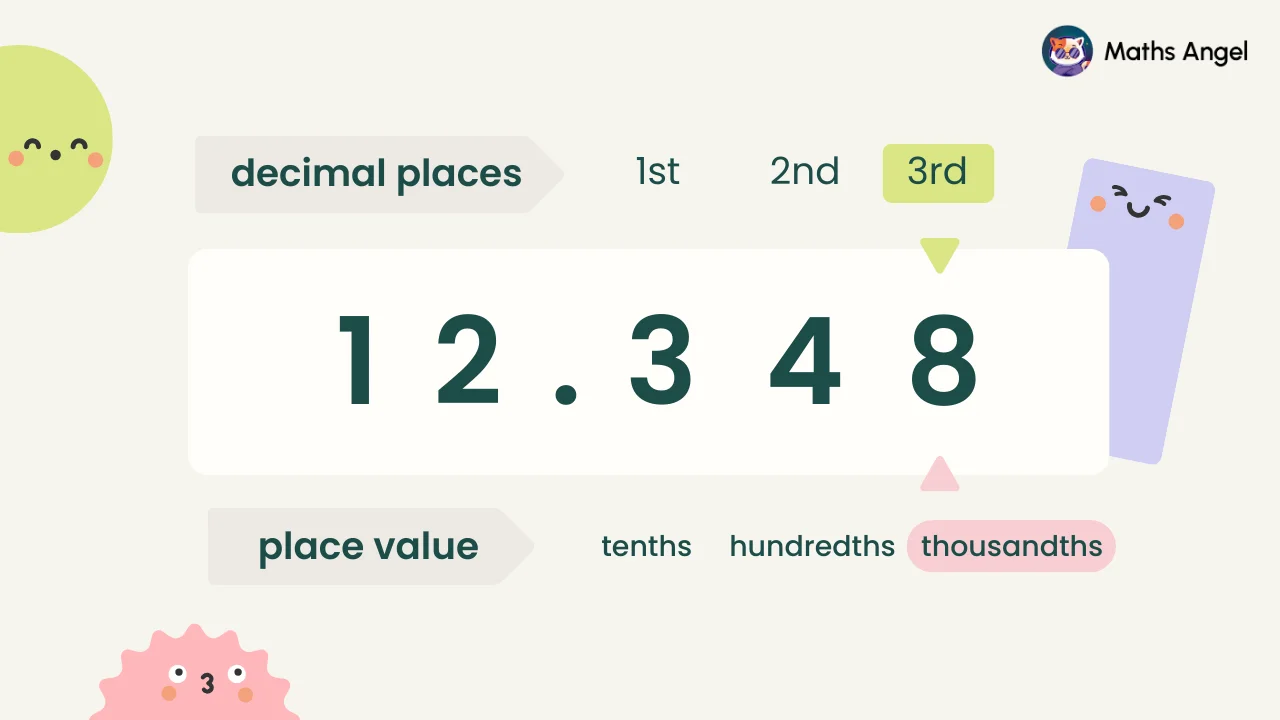
"Decimal places" (d.p.) means the number of digits after the decimal point. To round, find the digit in that place, look at the next one, and decide whether to round up or down.
6. How Do You Estimate in an Exam?
When a GCSE question says "estimate", round each number to 1 significant figure first, then do the calculation. Always show your rounded values.
Students often lose marks by not showing their rounded values. Always write 4.8 → 5, 19.2 → 20 and 0.53 → 0.5 before calculating.
Test Your Understanding
Try a quick question with ChatCat, your AI maths study buddy.

Hi! I'm ChatCat. What topic would you like to practise today?
Let's practise! Try this one.
Correct!
The 2nd decimal place is 3. The next digit is 9 (5 or more), so round up: 4.84.
Not quite right
Look at 2 digits after the decimal point: 8, 3. The next digit is 9 (5 or more), so round up to 4.84.
- Tell ChatCat your topic
- Get practice questions with solutions
- Ask for hints, judgement-free!
Explore More Maths Tools
Fractions Calculator
Add, subtract, multiply, divide and simplify fractions step by step. Convert between fractions and decimals. Free calculator for GCSE and IGCSE maths.
Percentage Calculator
Calculate percentages of amounts, percentage change, reverse percentages and more. Free percentage calculator for GCSE and IGCSE maths.
Unit Converter
Convert between metric and imperial units for length, mass, volume and more. Free unit converter with step-by-step working for GCSE and IGCSE maths.