
Number
The complete number curriculum for ages 10 to 16, with every topic taught in its own bite-sized video lesson. Learn at your own pace, with an AI tutor to help the moment you get stuck.
%20Decimal%20and%20Decimal%20Point.webp)
%20Converting%20Units%20of%20Length.webp)
Explore every Number topic
Fractions, decimals, powers and standard form. Learn with short videos and flashcards that make it stick.
Number Types and Place Value
%20Types%20of%20Numbers.webp)
Natural Numbers, Whole Numbers, and Integers
What is an integer? Any whole number, positive, negative or zero, so −3, 0 and 7 all count.
Number Line and Comparing Numbers
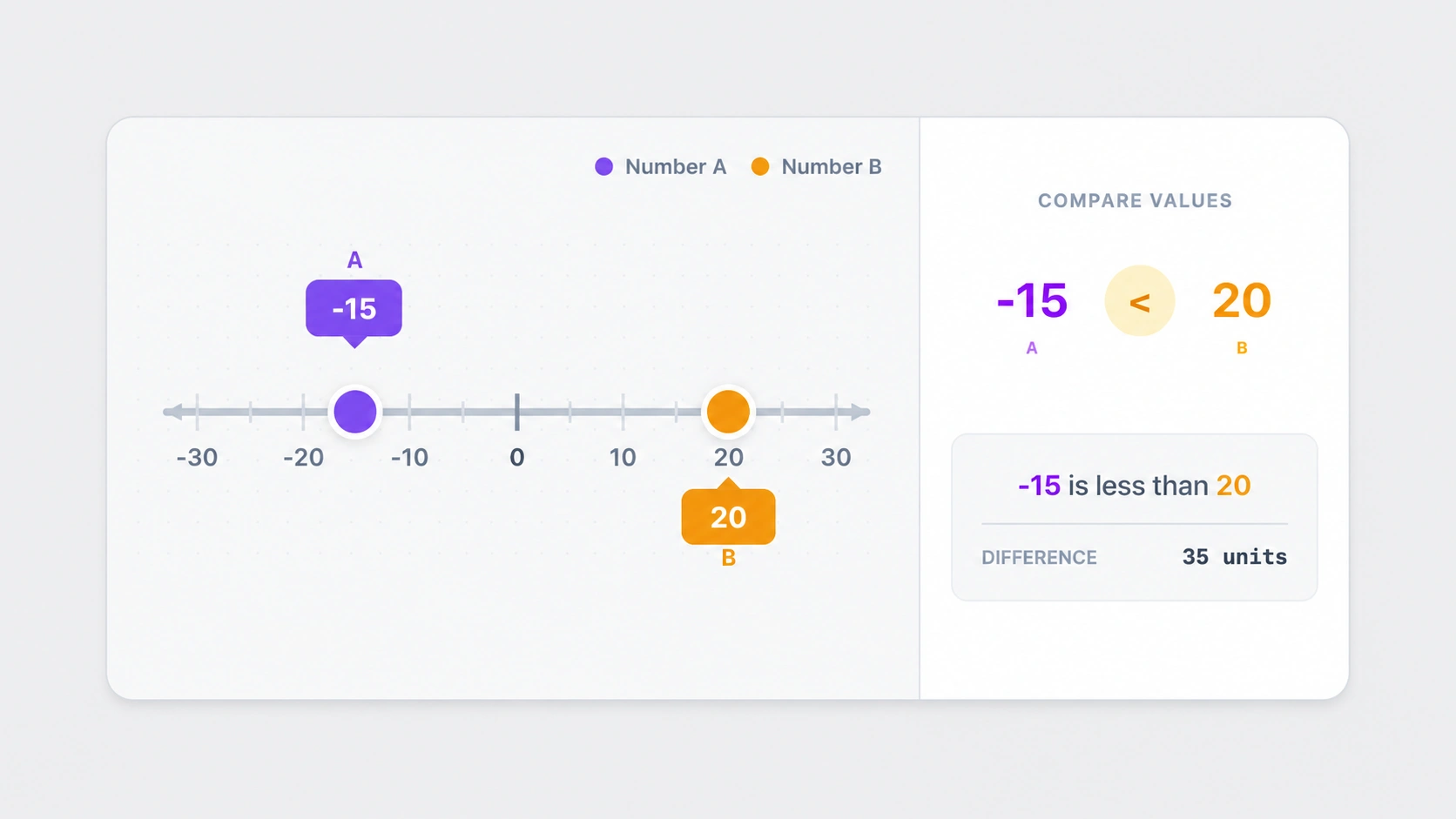
Compare numbers on a number line with the inequality symbols: −2 < 1 because it sits further left.
Place Value and Rounding Numbers
A place value chart shows the 4 in 3452 is worth 400; then round to the nearest 10 or 100.
Absolute Value
The absolute value is the distance from zero, so |−5| = 5 and |5| = 5.
Rational Numbers and Their Location on a Number Line
What is a rational number? One you can write as a fraction, like 0.75 = 3/4 or −2 = −2/1.
Basic Calculations
%20Addition.webp)
Basic Arithmetic and Inverse Operations
Inverse operations undo each other: 7 + 5 = 12, so 12 − 5 = 7, and the same for × and ÷.
Column Addition and Column Subtraction
Column addition and subtraction: line up the digits by place value, then carry or exchange.
Long Multiplication
Long multiplication step by step: 34 × 12 is 34 × 2 plus 34 × 10, so 68 + 340 = 408.
Long Division
How to do long division: divide, multiply, subtract, bring down, so 156 ÷ 12 = 13.
BIDMAS - Order of Operations
What does BIDMAS stand for? Brackets, Indices, Division, Multiplication, Addition, Subtraction: 2 + 3 × 4 = 14.
Commutative and Associative Laws
The commutative law: order does not matter for + and ×, so 3 + 5 = 5 + 3, but 5 − 3 ≠ 3 − 5.
Adding and Subtracting Negative Numbers
Adding and subtracting negative numbers: 5 − (−3) = 8, because subtracting a negative is adding.
Multiplying and Dividing Negative Numbers
Multiplying negative numbers: same signs give a positive, different signs a negative, so −4 × −2 = 8.
Movement of the Decimal Point
Multiplying by 10, 100 and 1000 moves every digit left, so 3.6 × 100 = 360; dividing moves them right.
Fractions
%20Introduction%20to%20Fractions.webp)
Introduction to Fractions
What is a fraction? The numerator and denominator show parts of a whole: 3/4 is 3 of 4 equal parts.
Equivalent Fractions
Equivalent fractions have the same value: multiply top and bottom by the same number, so 1/2 = 3/6.
Comparing Fractions
Comparing and ordering fractions: use the same denominator, so 3/4 = 9/12 beats 2/3 = 8/12.
Adding and Subtracting Fractions
How to add fractions with different denominators: 1/3 + 1/4 = 4/12 + 3/12 = 7/12.
Multiplying Fractions
How to multiply fractions: tops together, bottoms together, so 2/3 × 3/5 = 6/15 = 2/5.
Dividing Fractions
How to divide fractions: keep, flip, change, so 1/2 ÷ 1/4 = 1/2 × 4/1 = 2.
Fractions and Decimals
Decimals and Fractions
Decimal to fraction and back: 0.25 = 25/100 = 1/4, and 1/5 = 0.2.
Comparing and Rounding Decimals
Ordering decimals: 0.72 beats 0.7 because 0.7 = 0.70; and 3.456 rounds to 3.46.
Multiplying Decimals
How to multiply decimals: ignore the points, multiply, then count decimal places: 0.3 × 0.2 = 0.06.
Adding and Subtracting Fractions and Decimals
Adding decimals and fractions together: change 1/4 to 0.25, then 0.25 + 0.5 = 0.75.
Calculating Fractions and Decimals
Calculate with fractions and decimals in one go: pick the easier form, so 1/2 × 0.6 = 0.3.
Convert Fraction to Decimal Using Long Division
How to convert a fraction to a decimal with long division: 3/8 means 3 ÷ 8 = 0.375.
Convert Recurring Decimals to Fractions
Turn recurring decimals to fractions with algebra: x = 0.333…, so 10x − x = 3 and x = 1/3.
Powers, Roots and Standard Form
%20Introduction%20to%20Powers%20(indices).webp)
Powers and Indices
Indices are the small raised numbers: 2⁵ means 2 × 2 × 2 × 2 × 2 = 32.
Laws of Indices (Same Base, Same Indices)
The laws of indices: same base, add powers to multiply and subtract to divide, so 2³ × 2⁴ = 2⁷.
Negative Indices and Power of a Power
Negative indices mean one over: 2⁻³ = 1/8, and a power of a power multiplies: (2³)² = 2⁶.
Basics of Square Roots
Square roots undo squaring: √400 = 20 because 20² = 400.
Multiplying and Dividing Square Roots
Multiplying and simplifying surds: √2 × √8 = √16 = 4, and √50 = 5√2.
The nth Root and Fractional Indices
Fractional indices are roots: 81/3 = ∛8 = 2, and 161/2 = √16 = 4.
Standard Form
Standard form writes big and small numbers as a × 10ⁿ: 3400000 = 3.4 × 10⁶.
Factors, Multiples and Primes
%20Divisibility.webp)
Divisibility and Divisibility Rules
Divisibility rules save time: 2751 divides by 3 because its digits add up to 15, a multiple of 3.
Prime Numbers and Prime Factorisation
Prime numbers have exactly two factors; any number is a product of prime factors, so 60 = 2² × 3 × 5.
How to Find HCF and LCM
HCF and LCM: the highest common factor of 12 and 18 is 6, and the lowest common multiple is 36.
Units, Money and Time
Converting and Calculating Units of Length
Convert units of length by × or ÷ 10, 100 or 1000: 2.5 km = 2500 m and 45 mm = 4.5 cm.
Converting and Calculating Units of Mass
Grams to kilograms: divide by 1000, so 750 g = 0.75 kg; multiply by 1000 to go back.
Calculating Money
Money word problems: work in pence or in pounds, not both, so £3.20 + 85p = £4.05.
Converting Time and Calculating Time
Convert units of time by × or ÷ 60: 2 h 15 min = 135 minutes; to add or subtract times, work on the minutes and seconds separately.
Explore other Maths categories
Maths Angel covers the whole maths curriculum for ages 10 to 16. Number is one of six categories, so jump into any of the others.