Absolute Value
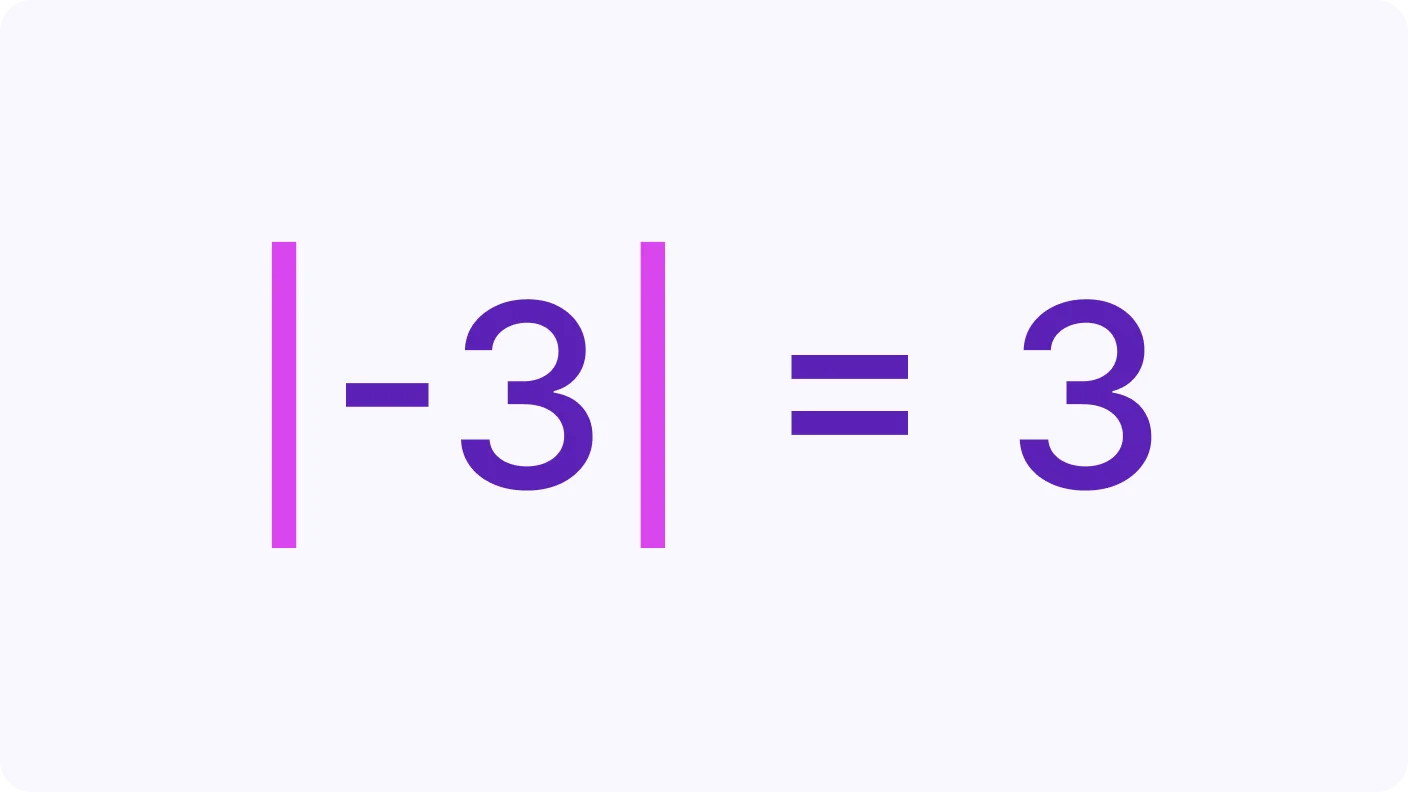
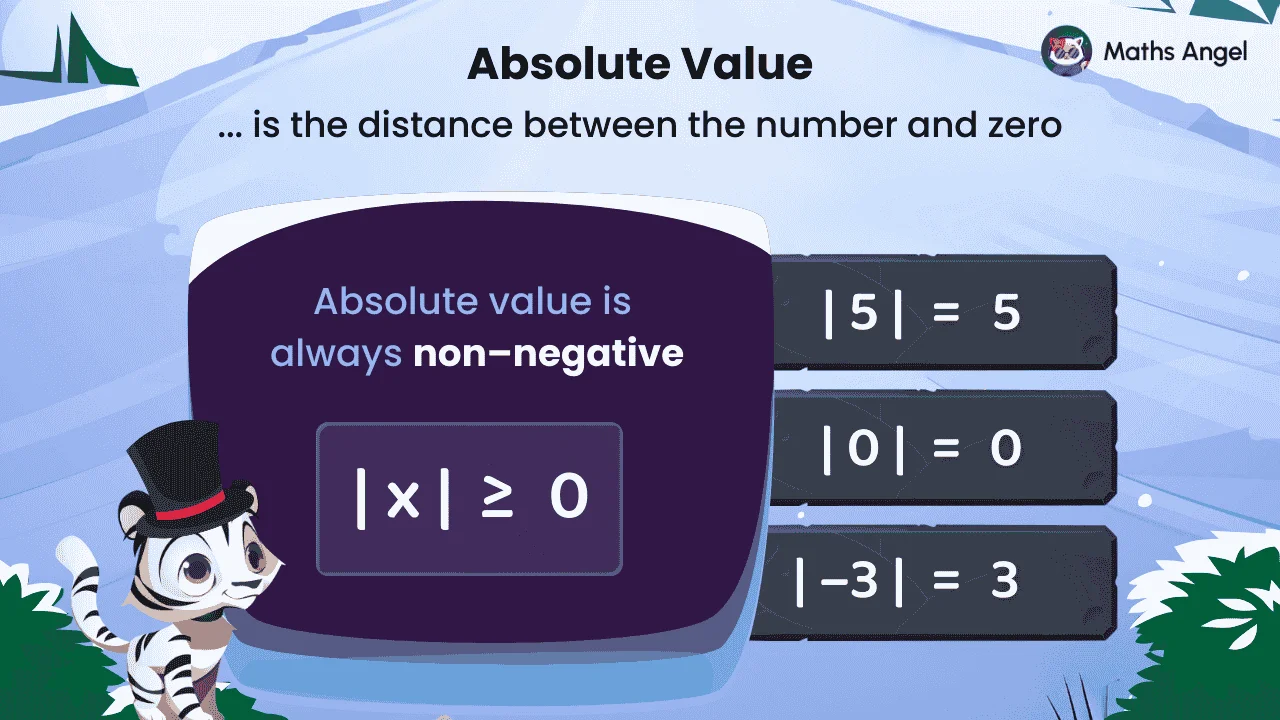
Absolute value is the distance from zero on the number line. Because distance is never negative, the answer is always positive or zero. A positive number stays as it is, while a negative number drops its minus sign, so |−3| = 3.
Video Lesson
Watch and learn the basics
🎬 Did this video explain it clearly?
Flashcards
Review key concepts visually
%20What%20Is%20Absolute%20Value.webp)
%20Simplifying%20Absolute%20Values.webp)
%20Calculating%20Negative%20Numbers%20Case%201.webp)
%20Calculating%20Negative%20Numbers%20Case%202.webp)
What is Absolute Value?
- Absolute value is the distance from zero on the number line.
- Absolute value is never negative, even for negative numbers.
How to Simplify Absolute Values?
- Always calculate inside the bars first.
- Then apply absolute value to get a non-negative answer.
How to Add Negatives with the Same Signs?
- When both numbers are negative, add their absolute values.
- Keep the negative sign in the final answer.
How to Add Negatives with Different Signs?
- Subtract the smaller absolute value from the larger.
- Keep the sign of the larger absolute value.
Practice Questions
Test your understanding
Calculate .
Correct! 🎉 +10 pointsCorrect! 🎉 Worth 10 XPNot quite right
Work out what is inside the bars first: .
The absolute value strips the sign, so .
Finally add the 5: .
What is the absolute value of −17?
Correct! 🎉 +10 pointsCorrect! 🎉 Worth 10 XPNot quite right
The absolute value of a number is its distance from zero, so it is never negative. For a negative number you simply drop the minus sign.
So .
Solve: .
Correct! 🎉 +20 pointsCorrect! 🎉 Worth 20 XPNot quite right
Work out each modulus first. .
Inside the second pair of bars, , so .
The bars turn each value positive before you subtract, so the calculation is .
What is the result of this expression: ?
Correct! 🎉 +20 pointsCorrect! 🎉 Worth 20 XPNot quite right
You start at −70, which is already below zero, and subtracting 85 moves you 85 further below zero.
So add the two distances from zero, , and the answer stays below zero: .
What is the result of this expression: ?
Correct! 🎉 +20 pointsCorrect! 🎉 Worth 20 XPNot quite right
You are taking away more than you started with, so you cross zero and finish below it.
The gap between the two numbers is , and because 115 was taken away from only 80 the answer is negative: .
Solve: .
Correct! 🎉 +30 pointsCorrect! 🎉 Worth 30 XPNot quite right
Work out what is inside each pair of bars first, then make it positive.
, and .
The expression is now . Addition and subtraction are done left to right, so and .
Want to see the full working?
Interactive Activity
Explore how to evaluate absolute value expressions step-by-step
Loading interactive widget...
Frequently asked questions
The questions students bump into most on this topic
The absolute value of a number is its distance from zero on the number line, whichever direction it is in. It is written with two vertical bars, and because a distance is never negative, it is always positive or zero. The absolute value of 5 is 5, the absolute value of −3 is 3, and the absolute value of 0 is 0.
The same number without its minus sign. So the absolute value of −8 is 8, of −2 is 2, of −6 is 6, and of −120 is 120. You are measuring how far the number is from zero, and −8 is 8 steps away. For a positive number there is nothing to remove: the absolute value of 17 is 17.
It can never be negative, because it measures distance from zero and a distance is positive or nothing. It is zero only for the number 0, which sits on zero and is no distance away. Every other number, positive or negative, has a positive absolute value: both 9 and −9 have an absolute value of 9.
Work out everything inside the bars first, then make the result non-negative. Where the bars sit changes the answer. In |−2 × 6 + 3|, inside the bars is −12 + 3 = −9, and the absolute value is 9. In |−2 × 6| + 3, the bars hold only −12, whose absolute value is 12, and then 12 + 3 = 15.
When both numbers are negative, ignore the signs, add the absolute values, then put the minus sign back. For −30 − 120: 30 + 120 = 150, and both numbers are negative, so the answer is −150. For −25 − 60: 25 + 60 = 85, so the answer is −85. Two negatives together make a bigger negative.
Subtract the smaller absolute value from the larger one, then give the answer the sign of the number with the larger absolute value. For 25 − 130: 130 − 25 = 105, and 130 is the larger and it is negative, so the answer is −105. For 15 − 65: 65 − 15 = 50, and the answer is −50.
What's next?
Found this one hard? Go one step back first. Feeling confident? Carry on to the next lesson.