Basic Arithmetic and Inverse Operations
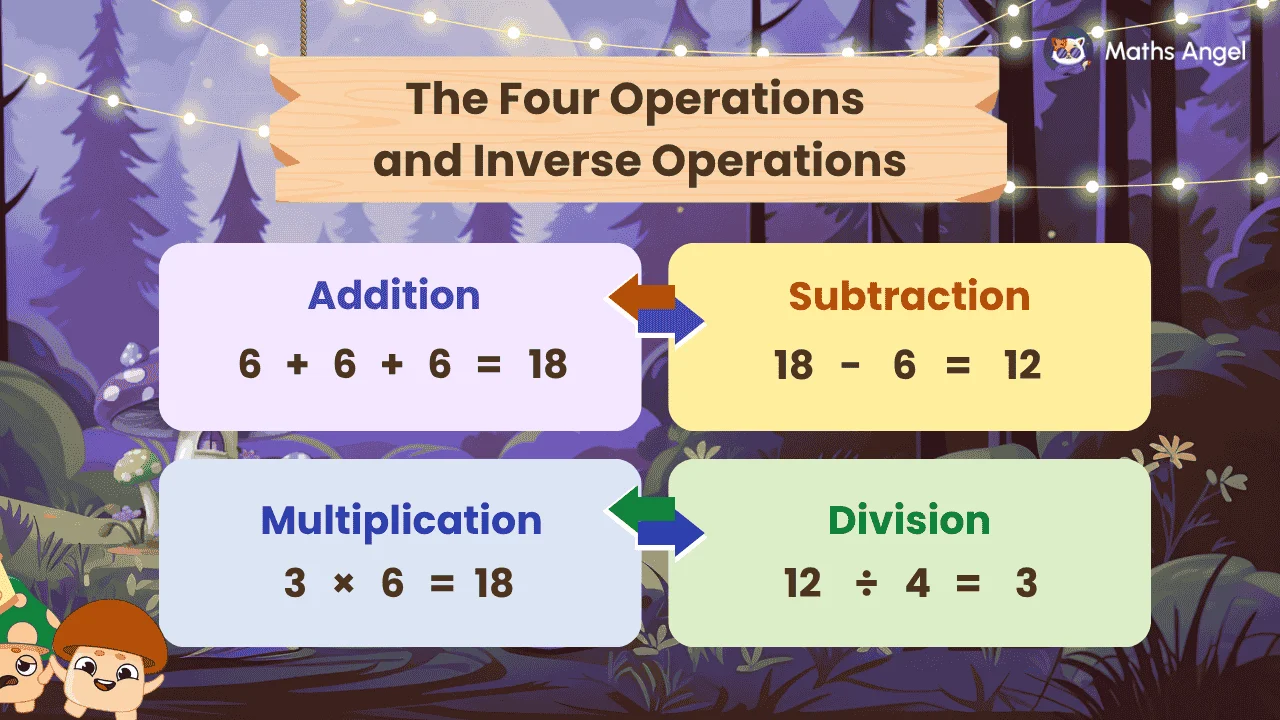
Basic arithmetic covers all four operations: addition, subtraction, multiplication and division. Inverse operations are two operations that undo each other. For example, addition is reversed by subtraction.
Video Lesson
Watch and learn the basics
🎬 Did this video explain it clearly?
Flashcards
Review key concepts visually
%20Addition.webp)
%20Multiplication.webp)
%20Subtraction.webp)
%20Division.webp)
%20Inverse%20Operations.webp)
What is Addition?
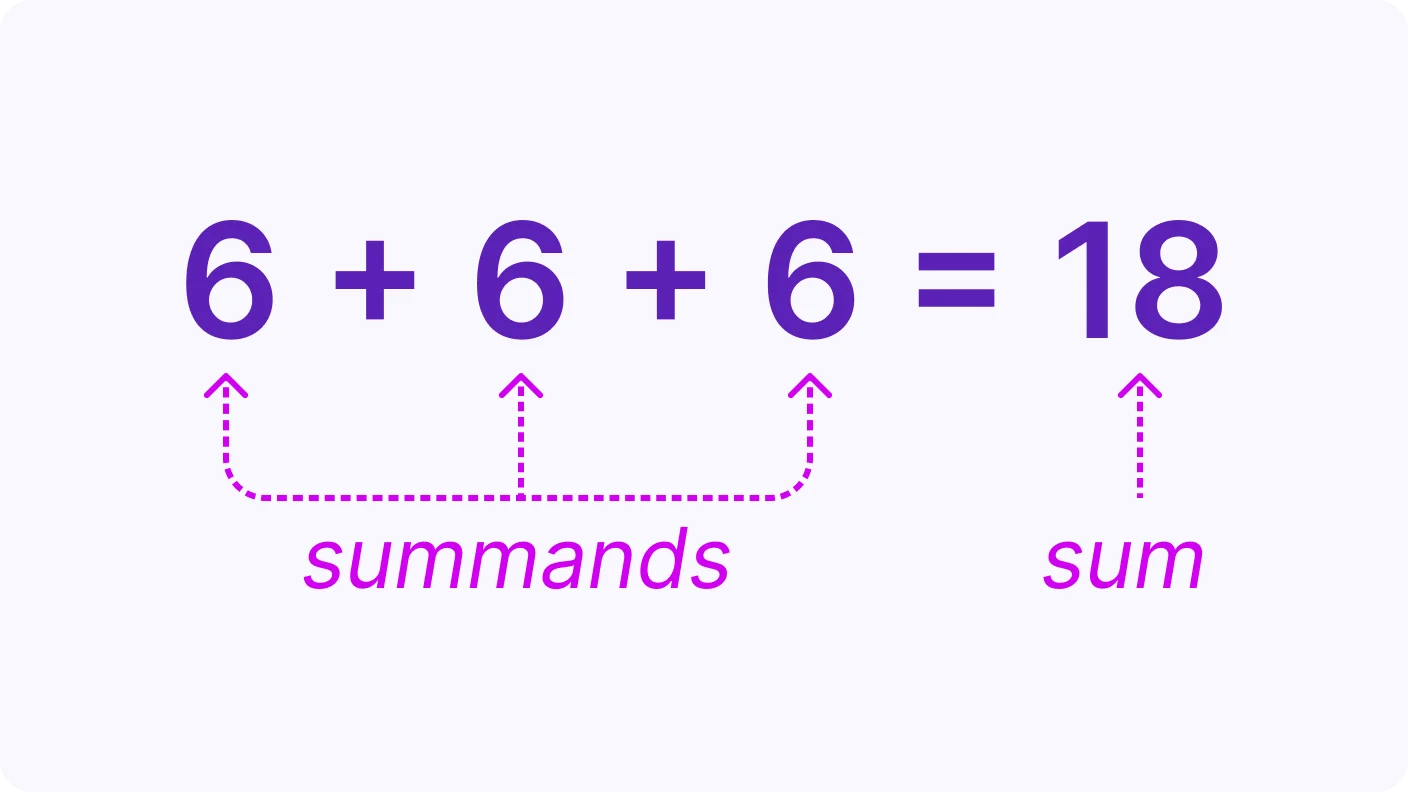
- Addition is the process of combining numbers to find a total.
- For example, , where the answer is called the sum.
What is Multiplication?
- Multiplication is repeated addition of the same number.
- For example, means adding 6 three times (6 + 6 + 6).
What is Subtraction?
- Subtraction is the process of taking away one number from another.
- For example, , where the answer is called the difference.
What is Division?
- Division means sharing a total equally into groups.
- For example, , imagine sharing 12 apples equally into 4 groups, each group has 3 apples.
What are Inverse Operations?
- Inverse operations undo each other.
- Addition undoes subtraction, and multiplication undoes division.
Practice Questions
Test your understanding
What is the product of 3 and 5?
Correct! 🎉 +10 pointsCorrect! 🎉 Worth 10 XPNot quite right
The product of two numbers means the result of multiplying them.
Counting in 3s five times gives 3, 6, 9, 12, 15.
So .
If you have 150 points and lose 45 points, what is your new score?
Correct! 🎉 +10 pointsCorrect! 🎉 Worth 10 XPNot quite right
Losing points means subtracting, so work out 150 − 45.
A quick mental method: , then .
The new score is 105.
Which operation gives a shorter way of writing 5 + 5 + 5 + 5?
Correct! 🎉 +20 pointsCorrect! 🎉 Worth 20 XPNot quite right
5 + 5 + 5 + 5 is four lots of 5, and multiplication is the short way of recording repeated addition: .
Addition is the long form we started with, so naming it does not shorten anything. Subtraction is the inverse of addition and division is the inverse of multiplication: each undoes a total rather than building one from equal groups.
If , what would 12 × 7 equal?
Correct! 🎉 +20 pointsCorrect! 🎉 Worth 20 XPNot quite right
Multiplication and division are inverse operations, so the fact can be rearranged as .
There is nothing new to work out: 12 sevens are exactly the 84 we started with before dividing. You can check the same fact family the other way round, .
If a group of 5 people share £125 equally, how much does each person receive?
Correct! 🎉 +20 pointsCorrect! 🎉 Worth 20 XPNot quite right
Sharing equally means dividing: £125 ÷ 5.
, leaving 25, and , so each person gets £25. Check with the inverse operation: .
What is 5 + 123456 − 123456?
Correct! 🎉 +30 pointsCorrect! 🎉 Worth 30 XPNot quite right
Subtraction is the inverse of addition, so adding 123456 and then subtracting it again leaves the starting number unchanged.
, so the expression is . You never have to work out 5 + 123456 at all: spotting the inverse pair does the whole job.
Want to see the full working?
Interactive Activity
Play with basic arithmetic operations
Frequently asked questions
The questions students bump into most on this topic
Addition, subtraction, multiplication and division. Addition combines numbers: 6 + 6 + 6 = 18, and the total is the sum. Multiplication is repeated addition, making copies: 3 × 6 = 18, and the result is the product. Subtraction takes away: 18 − 6 = 12, the difference. Division shares equally: 12 ÷ 4 = 3, the quotient.
Inverse operations undo each other, like opposite moves in a game. Addition and subtraction are a pair: 2 + 5 = 7, and 7 − 5 takes you back to 2. Multiplication and division are the other pair: 2 × 3 = 6, and 6 ÷ 3 returns to 2. Use them to check an answer or to undo a step in an equation.
In maths, dividing by zero is undefined. The divisor says how many equal parts to share a total into, so a divisor of zero means there is nobody to share with. Picture 12 doughnuts and zero friends: the question of how many each friend gets has no answer, so the calculation has no answer either.
The answer to a multiplication is called the product. In 3 × 6 = 18, the product is 18, and the two numbers being multiplied, 3 and 6, are the factors; 3 is the multiplier and 6 the multiplicand. For the other operations, the answers are the sum, the difference and the quotient.
Multiplication is making copies of the same group. If three friends each bring 6 doughnuts, there are 3 copies of 6, which is 18 doughnuts. Instead of adding 6 + 6 + 6, your child can say 3 × 6 = 18. Start with real objects in equal groups, then write the sum both ways.
What's next?
Found this one hard? Go one step back first. Feeling confident? Carry on to the next lesson.