BIDMAS - Order of Operations
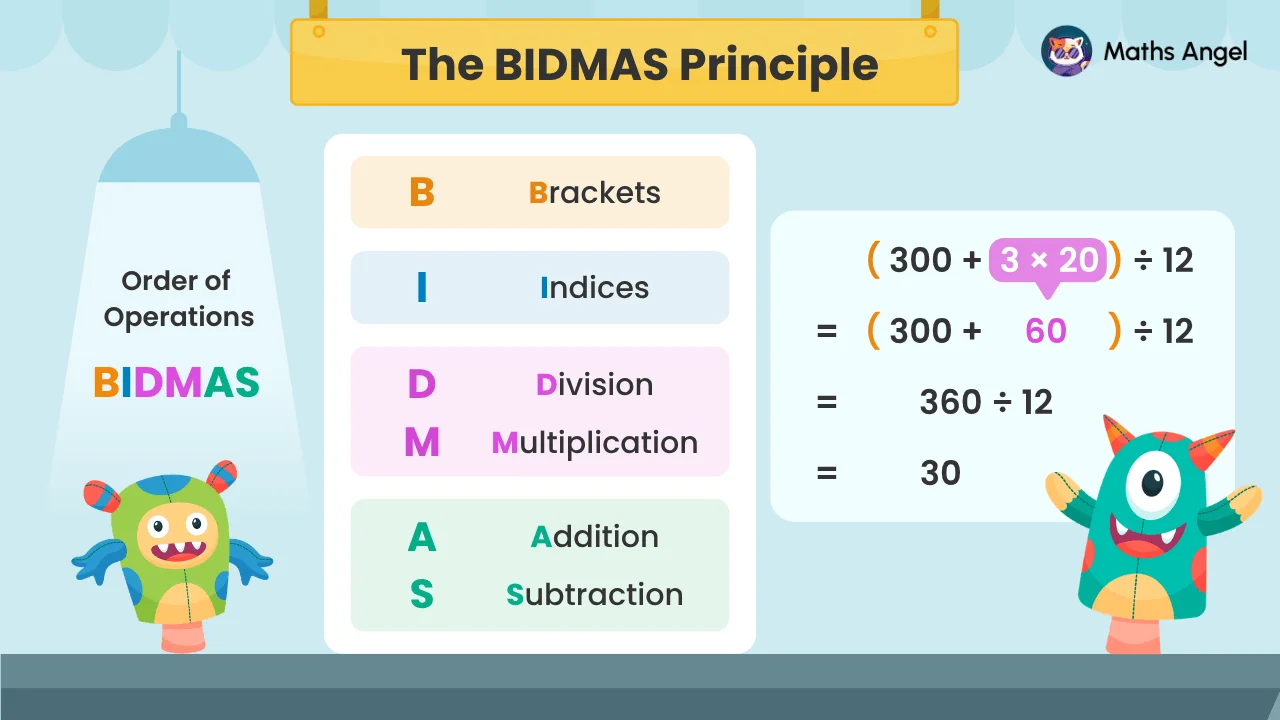
BIDMAS tells you the correct order of operations. It stands for Brackets, Indices, Division, Multiplication, Addition, Subtraction. When two operations are on the same level, work from left to right.
Video Lesson
Watch and learn the basics
🎬 Did this video explain it clearly?
Flashcards
Review key concepts visually
%20Mathematical%20Expression.webp)
%20BIDMAS.webp)
%20Applying%20BIDMAS.webp)
%20Dealing%20with%20Multiple%20Brackets.webp)
What is a Mathematical Expression?
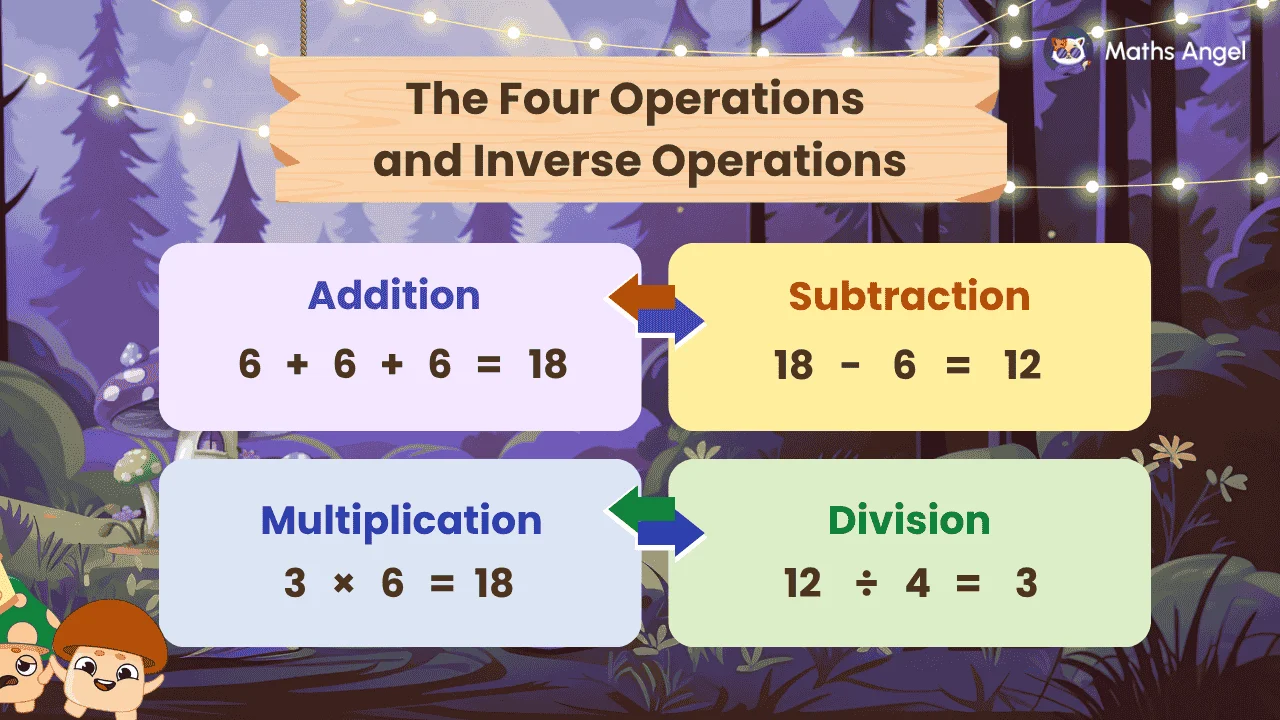
- A mathematical expression is a calculation made using numbers and operations (+, −, ×, ÷).
- For example, 3 + 4 × 2 is an expression, but is an equation.
What is BIDMAS?
- BIDMAS tells you the correct order to calculate.
- It stands for Brackets, Indices, Division, Multiplication, Addition, Subtraction.
How to Apply BIDMAS?
- If there are brackets, calculate what is inside them first.
- If two operations are at the same level, work from left to right.
How to Solve Multiple Brackets?
- If there is more than one set of brackets, start with the innermost brackets.
- Then continue working outwards, following BIDMAS.
Practice Questions
Test your understanding
?
Correct! 🎉 +10 pointsCorrect! 🎉 Worth 10 XPNot quite right
Multiplication is done before addition, whichever order the calculation is written in.
So work out first, then . Working straight from left to right would give , which is not what the calculation says.
?
Correct! 🎉 +10 pointsCorrect! 🎉 Worth 10 XPNot quite right
Division and multiplication rank equally, so they are done in the order they appear, left to right.
, then . Doing the multiplication first because M comes before D in some versions of the mnemonic would give , which is wrong.
?
Correct! 🎉 +20 pointsCorrect! 🎉 Worth 20 XPNot quite right
Brackets first: .
Next do the multiplication and the division: and .
The subtraction comes last: .
Working straight through from left to right instead would give and then , which is why the order of operations matters.
?
Correct! 🎉 +20 pointsCorrect! 🎉 Worth 20 XPNot quite right
Brackets first: and .
Then work through the addition and subtraction from left to right: , and .
Ignoring the brackets and working straight through from left to right would give , , , , which is wrong.
?
Correct! 🎉 +20 pointsCorrect! 🎉 Worth 20 XPNot quite right
BIDMAS applies inside brackets too. In the first bracket, multiply before you add: , so .
The second bracket gives .
Finally subtract: .
Adding 5 + 3 first inside the bracket would give and then , which is wrong.
?
Correct! 🎉 +30 pointsCorrect! 🎉 Worth 30 XPNot quite right
Work from the inside out. Inner brackets: and .
Outer brackets: and .
Finally subtract the whole of the second bracket: .
The minus applies to everything in the second bracket, so it is 24 − 8, not 24 − 4 + 4.
Want to see the full working?
Interactive Activity
Master the Order of Operations with simple practice
Loading interactive widget...
Frequently asked questions
The questions students bump into most on this topic
BIDMAS stands for Brackets, Indices, Division, Multiplication, Addition, Subtraction. It is the order in which to work through a calculation: brackets first, then indices such as powers and roots, then division and multiplication, which share a level, then addition and subtraction, which share a level too. The letters are the easiest way to remember the order.
Yes. BODMAS and BIDMAS are the same rule with one letter changed: the O stands for Orders, another word for indices such as squares and square roots. So BODMAS is Brackets, Orders, Division, Multiplication, Addition, Subtraction. Whichever word your school uses, the order of the steps is identical.
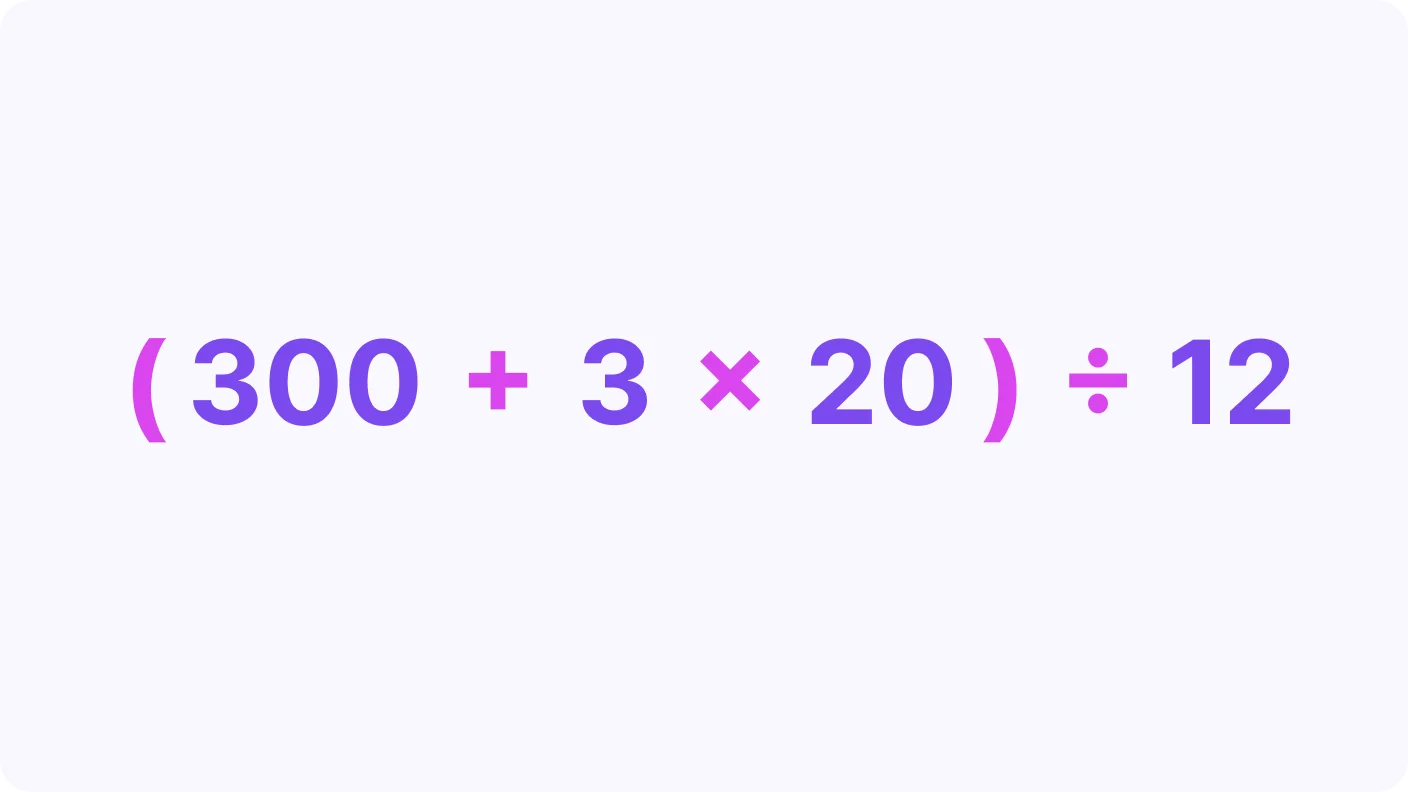
Work through the letters in order. Buying a £300 phone and three £20 accessories, paid over 12 months, is (300 + 20 × 3) ÷ 12. Brackets first, and inside them multiplication before addition: 20 × 3 = 60, then 300 + 60 = 360. Then divide: 360 ÷ 12 = £30 a month. Skipping the order gives the wrong answer.
Neither. Division and multiplication share the same level in BIDMAS, so you work them from left to right in the order they appear: in 20 ÷ 5 × 2, divide first to get 4, then multiply to get 8. Addition and subtraction share a level in the same way: 10 − 6 + 3 is 4, then 7.
Start with the innermost brackets and work outwards. In 50 − 2 × (2 + 4 × 5) − 3, the innermost bracket gives 4 × 5 = 20 and then 2 + 20 = 22. Remove that bracket, multiply 2 × 22 = 44, subtract 3 to get 41, and finally 50 − 41 = 9. Only after the brackets are gone do the remaining BIDMAS steps apply.
UK schools use BIDMAS or BODMAS; PEMDAS is the American version of the same rule: Parentheses, Exponents, Multiplication, Division, Addition, Subtraction. Parentheses are brackets and exponents are indices, so the steps are identical. Multiplication and division still share a level, as do addition and subtraction, so the answers come out the same.
What's next?
Found this one hard? Go one step back first. Feeling confident? Carry on to the next lesson.