
Commutative and Associative Properties
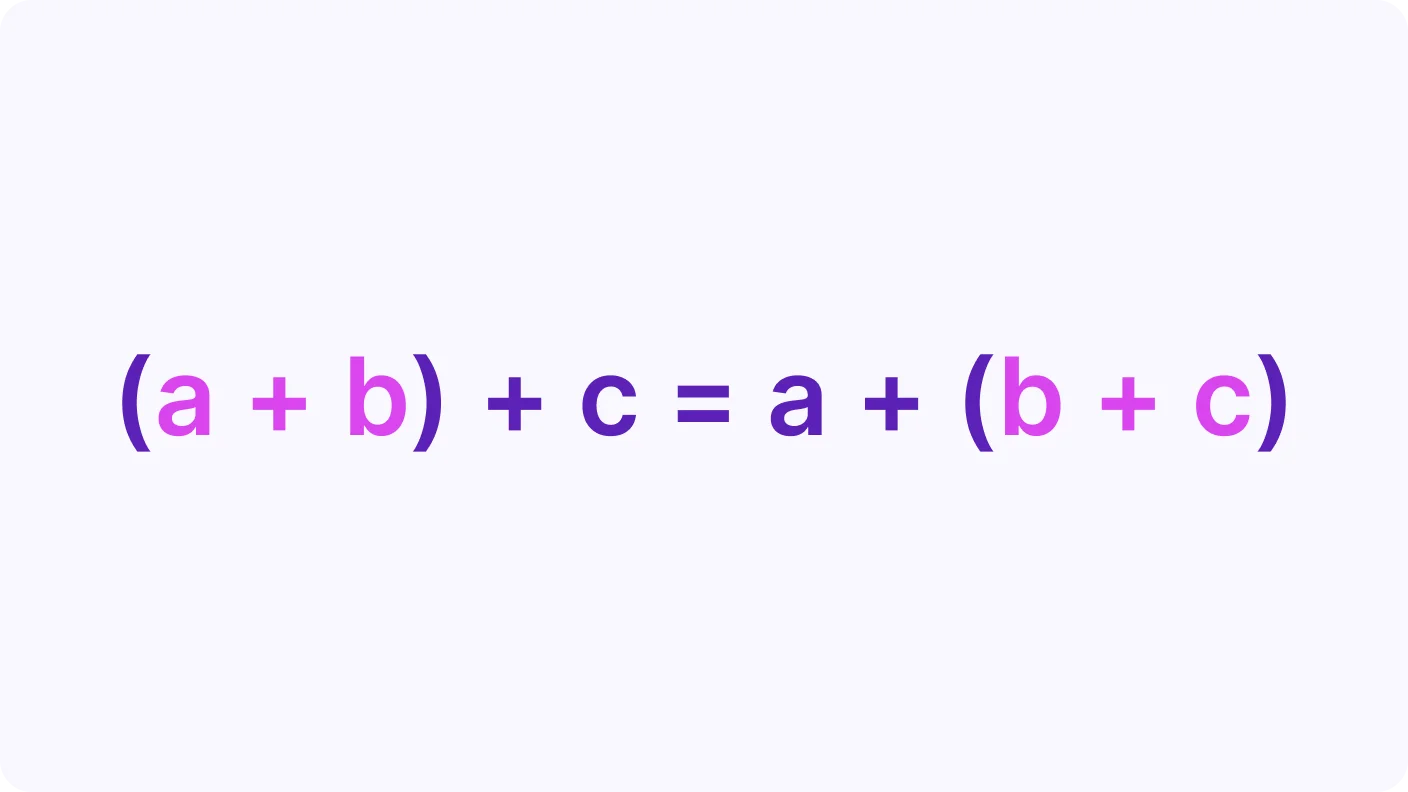
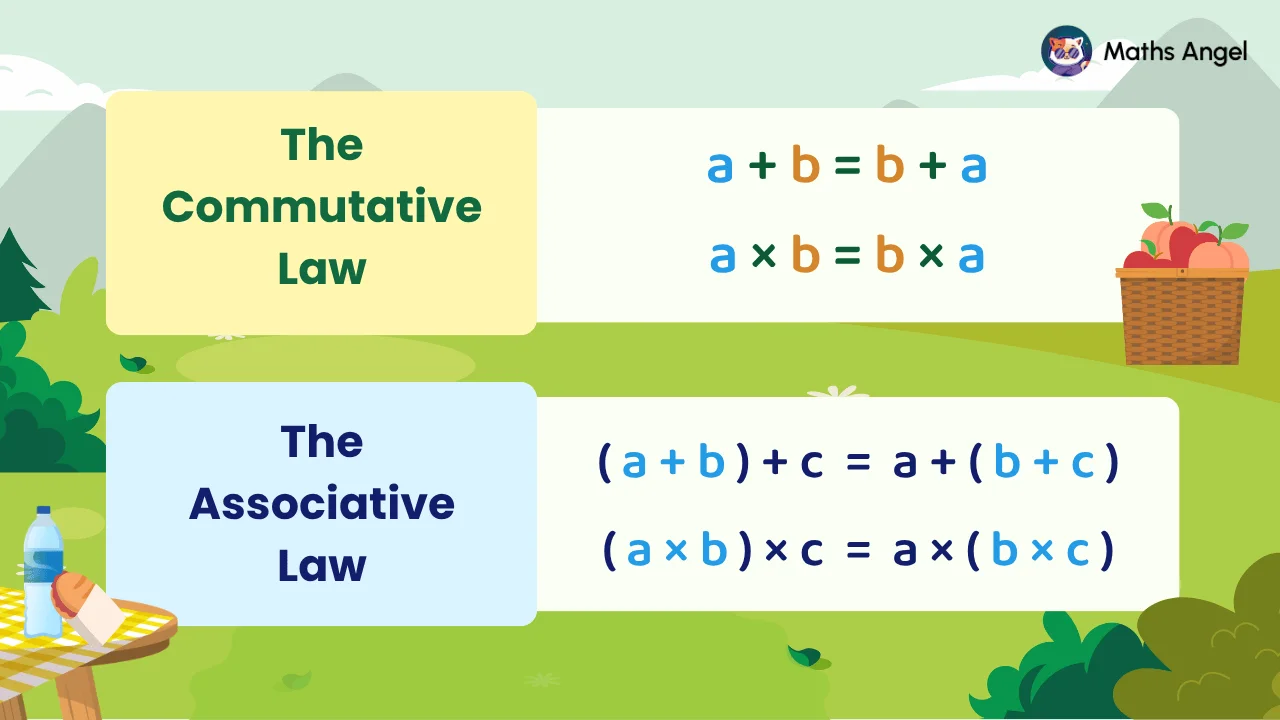
The commutative property lets you swap the order of numbers, like 3 + 5 = 5 + 3. The associative property lets you regroup them, like (2 × 5) × 4 = 2 × (5 × 4). Both keep the answer the same when you add or multiply.
Video Lesson
Watch and learn the basics
🎬 Did this video explain it clearly?
Flashcards
Review key concepts visually
%20The%20Commutative%20Law.webp)
%20Commutative%20Law%20Example.webp)
%20The%20Associative%20Law.webp)
%20Associative%20Law%20Example.webp)
%20Combining%20Commutative%20and%20Associative%20Law.webp)
What is the Commutative Property?
- The commutative property means you can swap the order of numbers
- It works for addition and multiplication, but not for subtraction or division
Commutative Property: Examples
- In addition, changing the order gives the same total
- In multiplication, changing the order gives the same product
What is the Associative Property?
- The associative property means you can change how numbers are grouped
- It works for addition and multiplication, but not for subtraction or division
Associative Property: Examples
- In addition, regrouping numbers does not change the total
- In multiplication, regrouping numbers does not change the product
Using Both Properties Together
- You can reorder and regroup numbers to make calculations easier
- This helps you with mental maths and simplifying expressions
Practice Questions
Test your understanding
Which of the following operations does the commutative law apply to?
Correct! 🎉 +10 pointsCorrect! 🎉 Worth 10 XPNot quite right
The commutative law applies to addition and multiplication. Division and subtraction do not follow this law.
?
Correct! 🎉 +10 pointsCorrect! 🎉 Worth 10 XPNot quite right
Using the commutative law, first add . Then add , making the calculation easier.
?
Correct! 🎉 +20 pointsCorrect! 🎉 Worth 20 XPNot quite right
Start by calculating . Then multiply .
?
Correct! 🎉 +20 pointsCorrect! 🎉 Worth 20 XPNot quite right
Start by adding . Then add .
?
Correct! 🎉 +20 pointsCorrect! 🎉 Worth 20 XPNot quite right
Adding the numbers step by step gives , and then .
?
Correct! 🎉 +30 pointsCorrect! 🎉 Worth 30 XPNot quite right
Using step-by-step multiplication: , then , and finally .
Want to see the full working?
Interactive Activity
Explore how numbers can move and group without changing the result
Loading interactive widget...
Commutative and Associative Properties frequently asked questions
The questions students bump into most on this topic
The commutative law lets you swap the order of numbers in an addition or multiplication. The associative law lets you change how the numbers are grouped with brackets. Both keep the answer the same. Neither rule applies to subtraction or division.
No. Both laws apply only to addition and multiplication. If you swap or regroup numbers in a subtraction or division, the answer changes. These shortcuts cannot be used on subtraction or division at all. Stick to addition and multiplication when applying either rule.
The commutative law of addition says you can add numbers in any order and still get the same total. For example, 77 + 246 + 23 equals 346. You can swap to 77 + 23 + 246 first. Then 100 + 246 = 346.
The associative law of multiplication says you can change which numbers are bracketed together first. You still get the same product. For example, 128 × 5 × 2 is easier as 128 × (5 × 2). Just multiply 5 × 2 = 10, then 128 × 10.
They turn awkward calculations into easier ones. Swap or group numbers to make a friendly pair like 100. You can then do part of the sum in your head. This saves time in mental maths and in the non-calculator GCSE paper.
The word "commute" means to move around, like commuting between two places. The commutative law gets its name from this idea. You can move the numbers around in an addition or multiplication. The answer does not change, whatever order you choose.