Column Addition and Column Subtraction
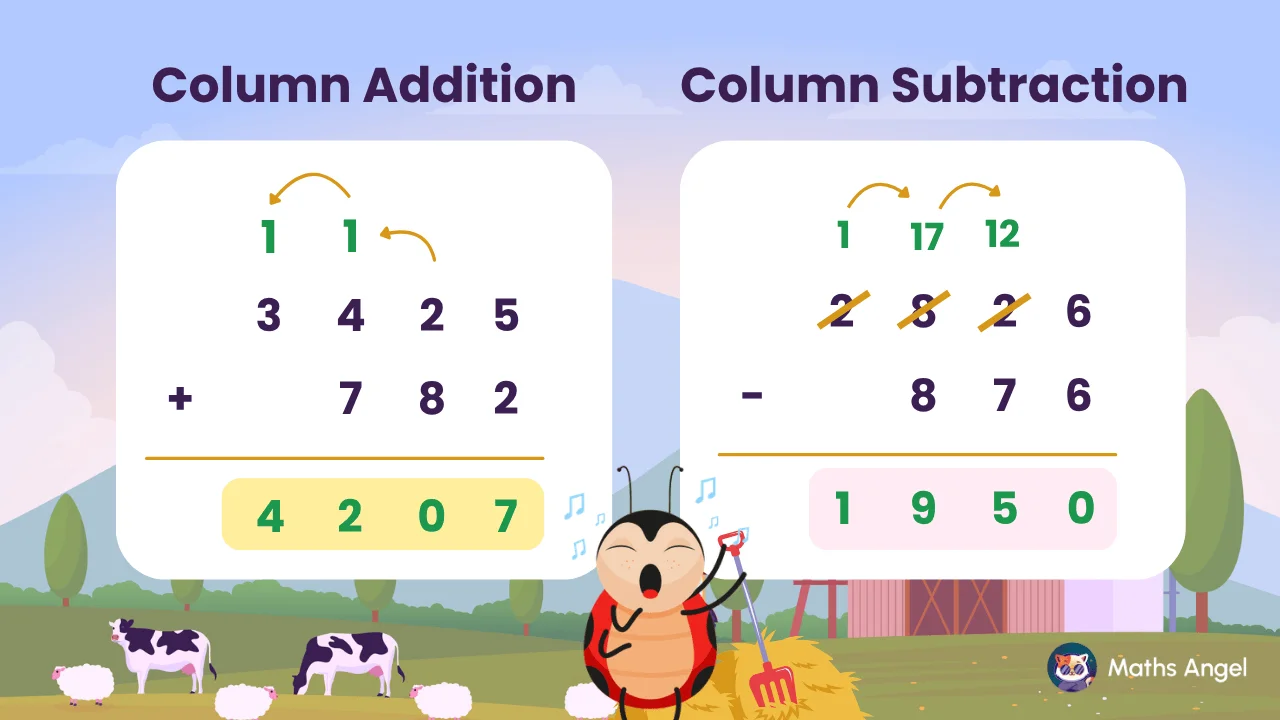
Column addition and subtraction line up numbers by place value and work from the right. If a column makes 10 or more, you carry 1. If the top digit is too small, you borrow 1 from the left.
Video Lesson
Watch and learn the basics
🎬 Did this video explain it clearly?
Flashcards
Review key concepts visually
%20Column%20Addition%20and%20Carrying%20Over.webp)
%20Column%20Subtraction%20and%20Borrowing.webp)
How to Do Column Addition
- Line up the digits vertically and start adding from the right
- If a column totals 10 or more, carry 1 to the next column on the left
How to Do Column Subtraction
- Write the larger number on top and subtract from the right
- If the top digit is smaller, borrow 1 from the next column on the left
Practice Questions
Test your understanding
?
Correct! 🎉 +10 pointsCorrect! 🎉 Worth 10 XPNot quite right
Set out 65 + 48 in columns, ones under ones and tens under tens.
Ones: , so write 3 and carry 1 into the tens.
Tens: 6 + 4 + 1 (the carried ten.
The answer is 113.
?
Correct! 🎉 +10 pointsCorrect! 🎉 Worth 10 XPNot quite right
Set out 54 − 29 in columns.
Ones: 4 − 9 is not possible, so exchange a ten. 54 becomes 4 tens and 14 ones, and .
Tens: the 5 tens are now 4 tens, so .
The answer is 25.
?
Correct! 🎉 +20 pointsCorrect! 🎉 Worth 20 XPNot quite right
Set out 354 + 123 in columns, lining up ones under ones, tens under tens and hundreds under hundreds.
Ones: . Tens: . Hundreds: .
No column total reaches 10, so nothing needs carrying: 477.
?
Correct! 🎉 +20 pointsCorrect! 🎉 Worth 20 XPNot quite right
Set out 752 − 428 in columns.
Ones: 2 − 8 is not possible, so exchange a ten. , and the 5 tens become 4 tens.
Tens: . Hundreds: .
The answer is 324.
?
Correct! 🎉 +20 pointsCorrect! 🎉 Worth 20 XPNot quite right
Set out 639 − 284 in columns.
Ones: .
Tens: 3 − 8 is not possible, so exchange a hundred. , and the 6 hundreds become 5 hundreds.
Hundreds: .
The answer is 355.
?
Correct! 🎉 +30 pointsCorrect! 🎉 Worth 30 XPNot quite right
Set out 1285 + 736 in columns, with the 7, 3 and 6 under the hundreds, tens and ones of 1285.
Ones: , write 1 and carry 1. Tens: , write 2 and carry 1. Hundreds: , write 0 and carry 1. Thousands: .
The answer is 2021.
Want to see the full working?
Interactive Activity
Master column addition and subtraction
Loading interactive widget...
Frequently asked questions
The questions students bump into most on this topic
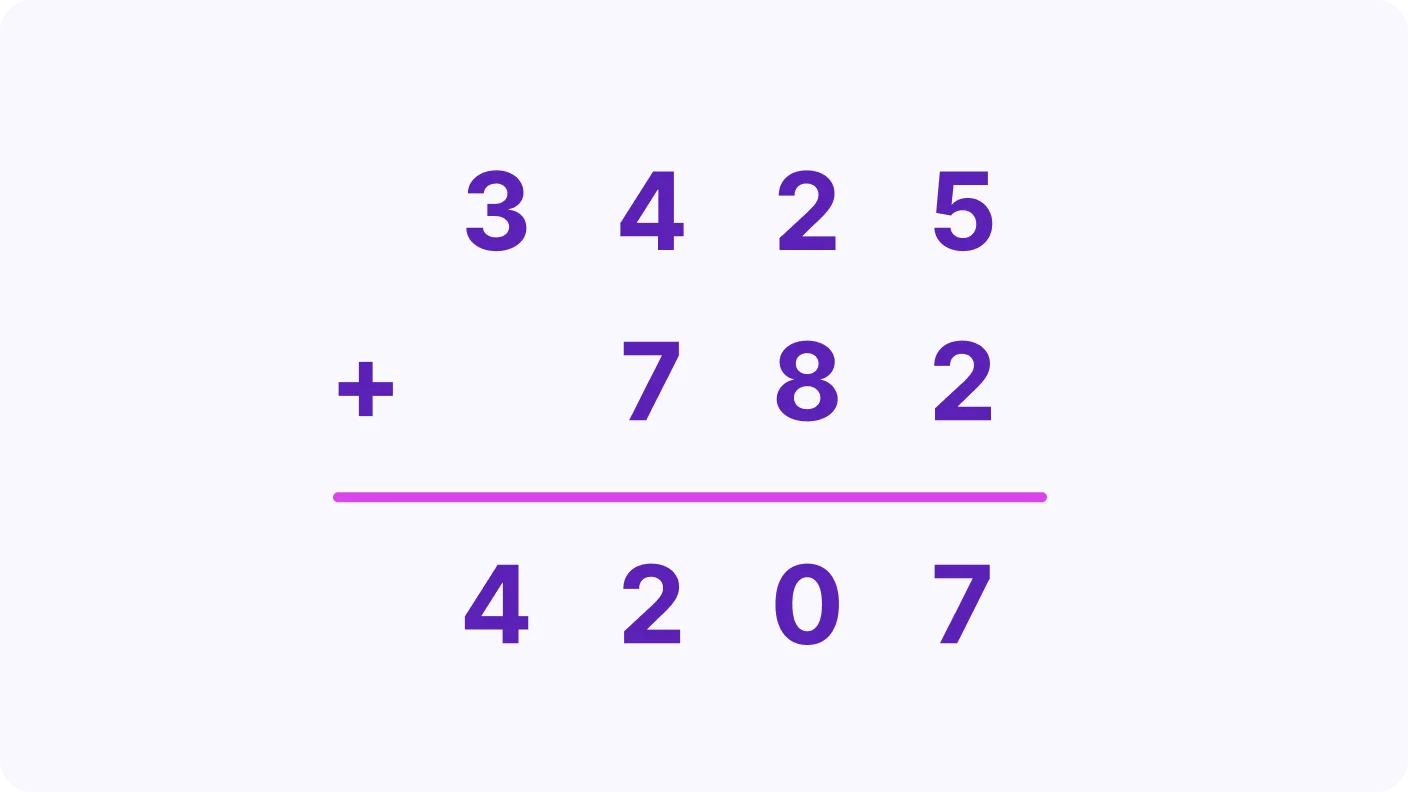
Column addition, also called long addition, is a way to add large numbers by lining them up by place value and adding one column at a time, starting from the right. If a column makes 10 or more, you carry 1 into the next column. A farmer with 782 cows and 3,425 sheep has 4,207 animals, found this way.
Write the larger number above the smaller one with ones under ones, tens under tens and so on. Add the right-hand column first: for 3,425 + 782, 5 + 2 = 7. Next, 2 + 8 = 10, so write 0 and carry 1. Then 4 + 7 + 1 = 12: write 2, carry 1. Finally 3 + 1 = 4, giving 4,207.
Write the larger number on top, lined up by place value, and subtract from the right. For 2,826 − 876: 6 − 6 = 0. Next, 2 is smaller than 7, so borrow 1 from the next column to make 12, and 12 − 7 = 5. Then the 8 has become 7, which is smaller than 8, so borrow again: 17 − 8 = 9. Finally 1 − 0 = 1, giving 1,950.
Carrying over is what you do when a column adds up to 10 or more. Write the ones digit of the total below the line and move the tens digit to the top of the next column on the left, where it is added in with that column. In 3,425 + 782, the 2 + 8 column makes 10, so you write 0 and carry the 1.
Borrowing is what you do when the top digit in a column is smaller than the bottom digit. Take 1 from the next column on the left, which drops by 1, and add 10 to the top digit so you can subtract. In 2,826 − 876, the 2 becomes 12 so that 12 − 7 = 5 works.
What's next?
Found this one hard? Go one step back first. Feeling confident? Carry on to the next lesson.