Long Multiplication
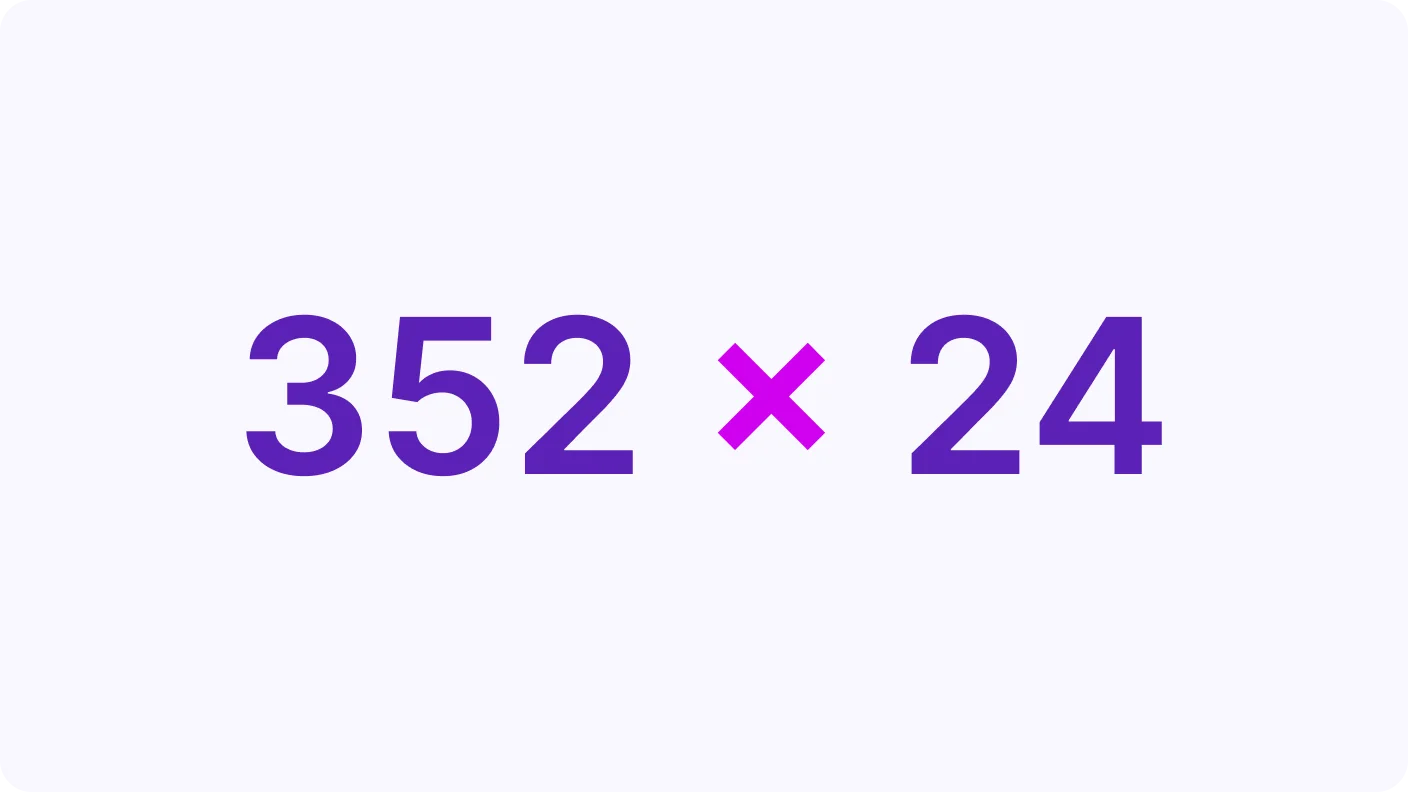
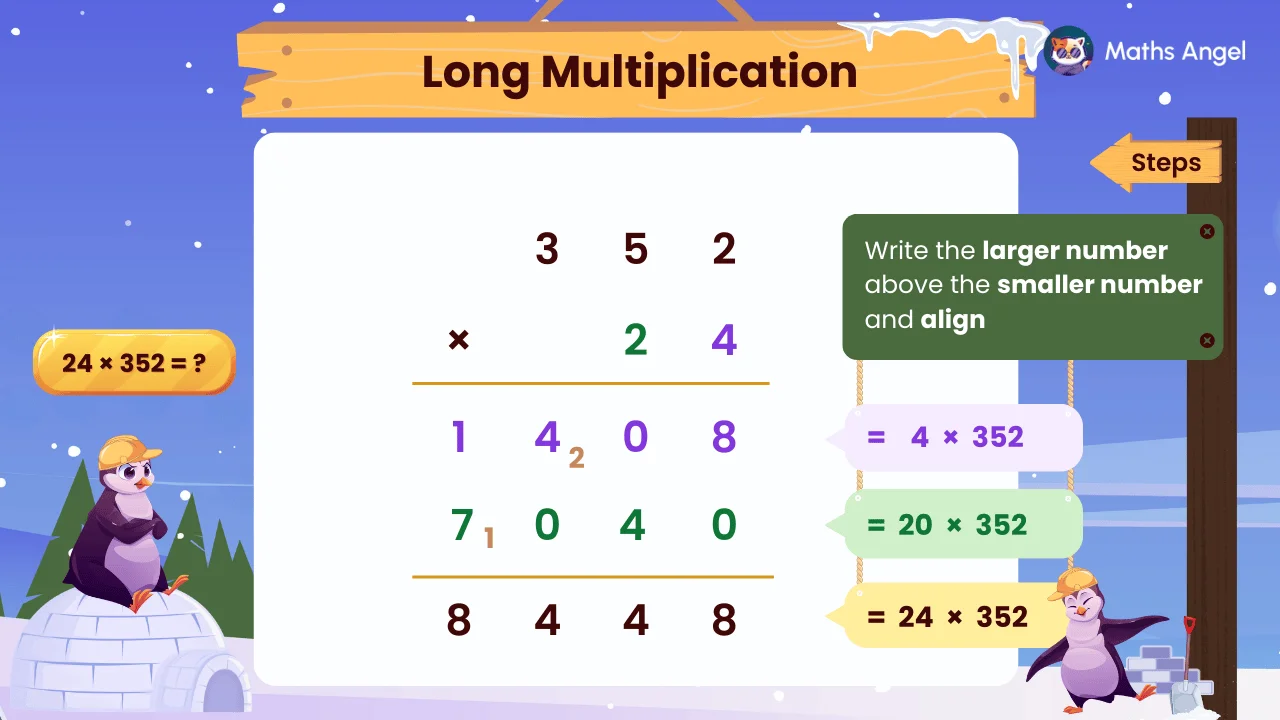
Long multiplication splits a large calculation into digit-by-digit steps. You multiply the top number by each bottom digit and add the partial products. This lets you multiply large numbers, like 352 × 24 = 8448.
Video Lesson
Watch and learn the basics
🎬 Did this video explain it clearly?
Flashcards
Review key concepts visually
%20Long%20Multiplication%20Example%201.webp)
%20Long%20Multiplication%20Example%202.webp)
What is Long Multiplication?
- Long multiplication splits a large multiplication into smaller digit-by-digit steps.
- You multiply each digit, then add the results together to get the final answer.
Key Reminders to Avoid Mistakes
- Each new row starts one place further left because the value is 10 times bigger.
- Always check column alignment. Misaligned columns give the wrong answer.
Practice Questions
Test your understanding
?
Correct! 🎉 +10 pointsCorrect! 🎉 Worth 10 XPNot quite right
Split 18 into 10 and 8 and multiply in two steps:
(from : write 4, carry 2; then , plus the carried 2 gives 18).
: the placeholder zero is what makes this row ten times bigger.
Add the rows: . So .
?
Correct! 🎉 +10 pointsCorrect! 🎉 Worth 10 XPNot quite right
Split 15 into 10 and 5 and multiply in two steps:
(from : write 0, carry 1; then , plus the carried 1 gives 26).
: the placeholder zero is what makes this row ten times bigger.
Add the rows: . So .
?
Correct! 🎉 +20 pointsCorrect! 🎉 Worth 20 XPNot quite right
Set it out as long multiplication.
First multiply by the units digit: , write 4 and carry 2; , plus the carried 2 gives 14).
Then multiply by the tens digit, remembering the placeholder zero: .
Add the two rows: .
?
Correct! 🎉 +20 pointsCorrect! 🎉 Worth 20 XPNot quite right
Set it out as long multiplication.
First multiply by the units digit: , write 3 and carry 6; , plus the carried 6 gives 13).
Then multiply by the tens digit, remembering the placeholder zero: .
Add the two rows: .
?
Correct! 🎉 +20 pointsCorrect! 🎉 Worth 20 XPNot quite right
Set it out as long multiplication.
First multiply by the units digit: , write 8 and carry 1; , plus the carried 1 gives 1; .
Then multiply by the tens digit, remembering the placeholder zero: .
Add the two rows: .
?
Correct! 🎉 +30 pointsCorrect! 🎉 Worth 30 XPNot quite right
Set it out as long multiplication.
First multiply by the units digit: , write 5 and carry 1; , plus the carried 1 gives 31, write 1 and carry 3; , plus the carried 3 gives 13).
Then multiply by the tens digit, remembering the placeholder zero: .
Add the two rows: .
Want to see the full working?
Interactive Activity
Solve long multiplication step by step
Loading interactive widget...
Frequently asked questions
The questions students bump into most on this topic
Long multiplication is a written method for multiplying numbers that are too big to work out in your head, such as 352 × 24. You multiply the top number by one digit of the bottom number at a time, write down each result, called a partial product, and add the partial products together at the end.
Write the larger number on top, digits lined up to the right. Multiply by the bottom units digit first: 4 × 352 gives 8, then 4 × 5 = 20 (write 0, carry 2), then 4 × 3 + 2 = 14, so 1,408. Then multiply by the tens digit, starting one place to the left: 2 × 352 = 704, written as 7,040. Add the partial products: 1,408 + 7,040 = 8,448.
Use the same steps. For 47 × 63: multiply by the 3 first, 3 × 7 = 21 (write 1, carry 2) and 3 × 4 + 2 = 14, giving 141. Then multiply by the 6, one place to the left: 6 × 7 = 42 (write 2, carry 4) and 6 × 4 + 4 = 28, giving 2,820. Add the partial products: 141 + 2,820 = 2,961.
Because the second digit of the bottom number stands for tens, not units, so its partial product is ten times bigger and must start one place further left. In 352 × 24, the 2 means 20, so 2 × 352 = 704 is written as 7,040. You can leave the end space empty or write a zero in it as a placeholder; either way, line the columns up.
What's next?
Found this one hard? Go one step back first. Feeling confident? Carry on to the next lesson.