Long Division
Long division is a method for dividing large numbers in small steps. You repeat divide, multiply, subtract, bring down until no digits are left. Anything left over is the remainder.
Video Lesson
Watch and learn the basics
🎬 Did this video explain it clearly?
Flashcards
Review key concepts visually
%20Long%20Division%20Example%201.webp)
%20Long%20Division%20Example%202.webp)
Understanding the Parts of Long Division
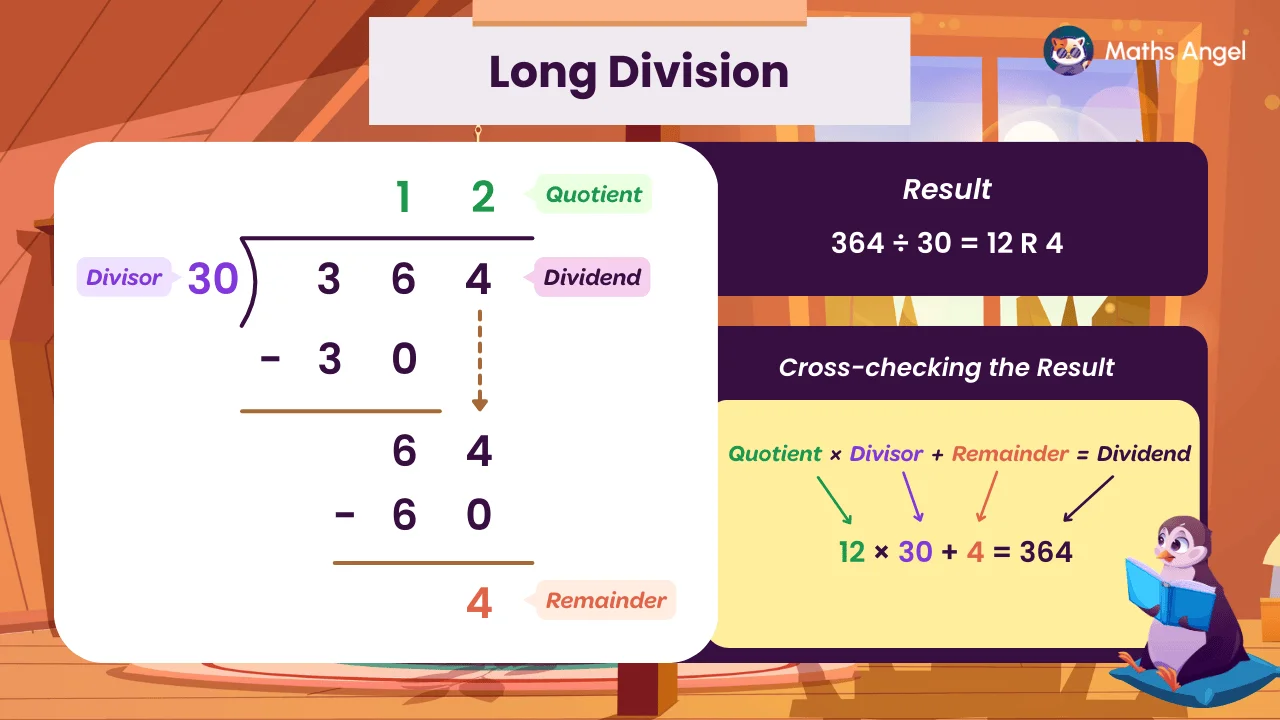
- The dividend is the number being divided, and the divisor is the number you divide by.
- The quotient is the answer on top, and the remainder is what is left at the end.
Checking a Long Division Answer
- You can check your answer using: Quotient × Divisor + Remainder = Dividend.
- For example, , so is correct.
Practice Questions
Test your understanding
? (whole number and remainder)
Correct! 🎉 +10 pointsCorrect! 🎉 Worth 10 XPNot quite right
Find the largest multiple of 9 that is not bigger than 75.
and , which is too big. So the whole-number part is 8.
The remainder is , giving 8 R 3. Check: . A remainder must always be smaller than the divisor (here, smaller than 9), and it is not a decimal: , so 8 R 3 and 8.3 are not the same answer.
? (whole number and remainder)
Correct! 🎉 +10 pointsCorrect! 🎉 Worth 10 XPNot quite right
Find the largest multiple of 6 that is not bigger than 53.
and , which is too big. So the whole-number part is 8.
The remainder is , giving 8 R 5. Check: . The remainder must be smaller than 6, and it is not a decimal: , so 8.5 is a different answer.
? (whole number and remainder)
Correct! 🎉 +20 pointsCorrect! 🎉 Worth 20 XPNot quite right
Find the largest multiple of 11 that is not bigger than 126.
and , which is too big. So the whole-number part is 11.
The remainder is , giving 11 R 5. Check: . The remainder must be smaller than 11, and it is not a decimal: , so 11.5 is a different answer.
? (whole number and remainder)
Correct! 🎉 +20 pointsCorrect! 🎉 Worth 20 XPNot quite right
Find the largest multiple of 15 that is not bigger than 325.
, and is too big. So the whole-number part is 21.
The remainder is , giving 21 R 10. Check: . Note that leaves 25, which is bigger than 15, so 20 is one lot too few. The remainder is also not a decimal place:
? (whole number and remainder)
Correct! 🎉 +20 pointsCorrect! 🎉 Worth 20 XPNot quite right
Work through the division: 14 goes into 28 exactly 2 times, so there is a 2 in the tens column. Then 14 goes into the remaining 9 zero times, so a 0 goes in the units column. The quotient is 20, not 2.
So , and the remainder is , giving 20 R 9. Check: . ( is too big.)
? (whole number and remainder)
Correct! 🎉 +30 pointsCorrect! 🎉 Worth 30 XPNot quite right
Find the largest multiple of 47 that is not bigger than 1053.
, , and , which is too big. So the whole-number part is 22.
The remainder is , giving 22 R 19. Check: . The remainder must be smaller than 47, and it is not a decimal:
Want to see the full working?
Interactive Activity
Visualise the long division process step-by-step
Loading interactive widget...
Frequently asked questions
The questions students bump into most on this topic
Long division is a written method for dividing a large number by another in small steps. You write the divisor to the left of the dividend, then repeat four moves, divide, multiply, subtract and bring down the next digit, until no digits are left. Whatever is left at the end is the remainder.
Nearly. The bus stop method is short division: the divisor sits to the left of the dividend and you carry each remainder in your head, which suits a one-digit divisor. Long division uses the same layout but writes every divide, multiply, subtract, bring down step underneath, so it works for two-digit divisors too.
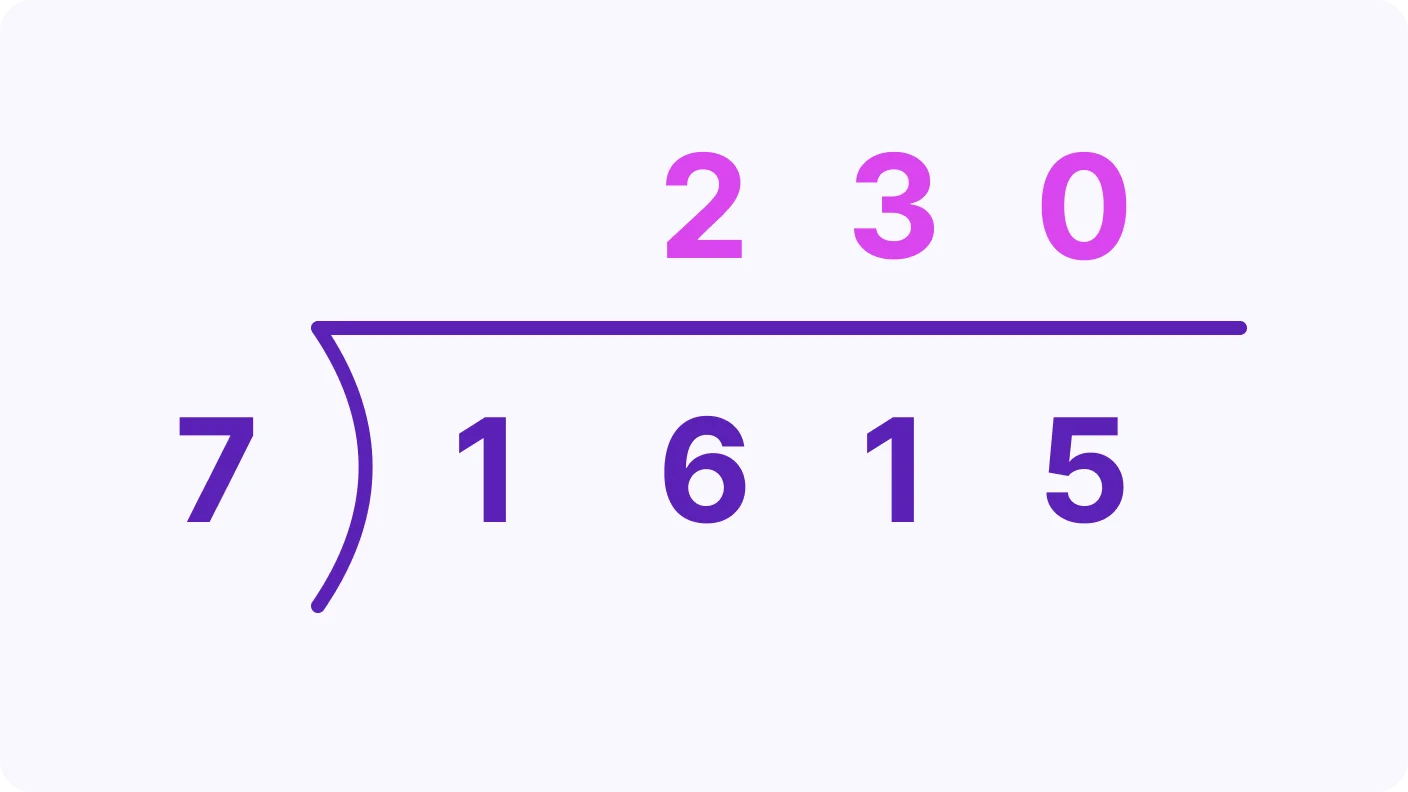
Repeat divide, multiply, subtract, bring down. For 1,615 ÷ 7: 7 does not fit into 1, so use 16: it fits 2 times, write 2, and 16 − 14 = 2. Bring down the 1 to make 21: 7 fits 3 times, remainder 0. Bring down the 5: 7 does not fit, so write 0 above it, and 5 is the remainder. The answer is 230 remainder 5.
The steps are the same; you just look at more digits at the start. For 364 ÷ 30: 30 does not fit into 3, so use 36: it fits once, write 1 above the 6, and 36 − 30 = 6. Bring down the 4 to make 64: 30 fits twice, write 2, and 64 − 60 = 4. No digits are left, so 364 ÷ 30 = 12 remainder 4.
The remainder is what is left when the divisor does not fit exactly: after 364 ÷ 30 you reach 12 with 4 left over, written 12 r 4. To check any answer, multiply the quotient by the divisor and add the remainder; you should get the dividend back: 12 × 30 + 4 = 364, and 230 × 7 + 5 = 1,615.
The dividend is the number being divided and the divisor is the number you divide by. In 364 ÷ 30, the dividend is 364 and the divisor is 30. The whole-number answer written above the line, 12, is the quotient, and the 4 left over is the remainder.
A 364-page book to finish in 30 days: how many pages a day? Write 30 outside and 364 inside, and say the four words each time: divide, multiply, subtract, bring down. Your child does the sums; you keep the rhythm. The answer, 12 pages a day with 4 left over, makes the remainder make sense.
What's next?
Found this one hard? Go one step back first. Feeling confident? Carry on to the next lesson.