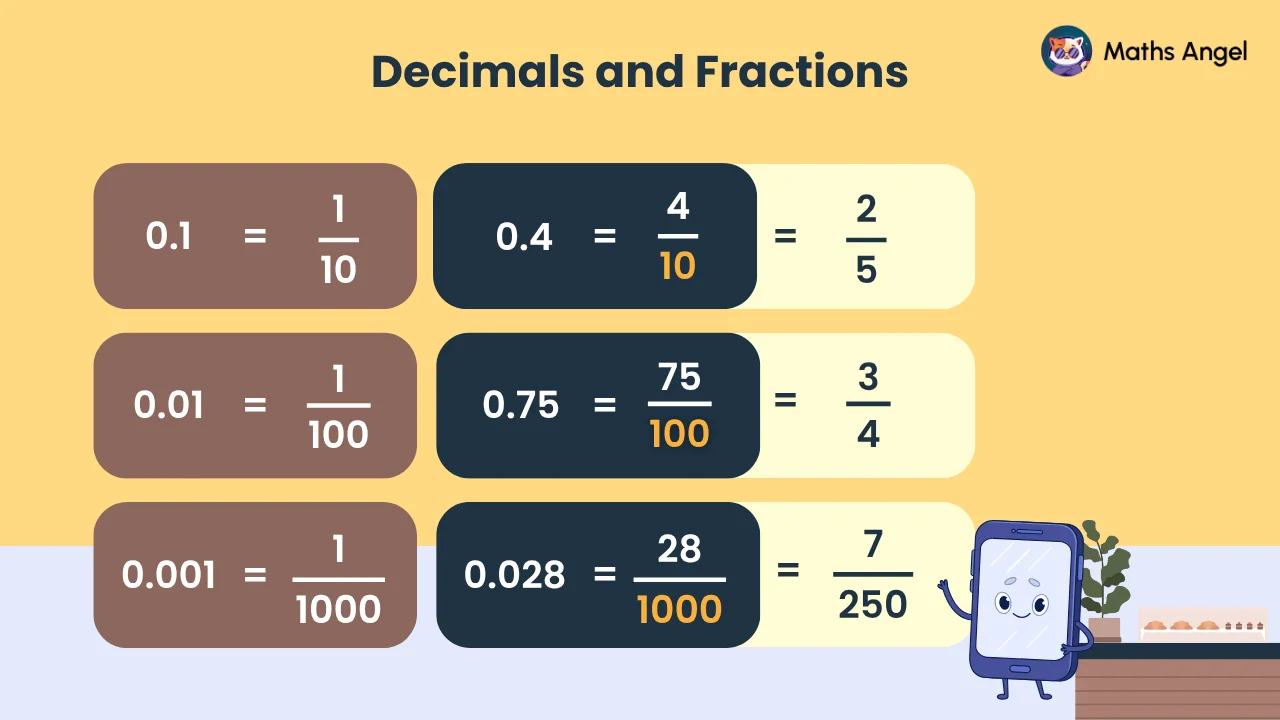
Movement of the Decimal Point
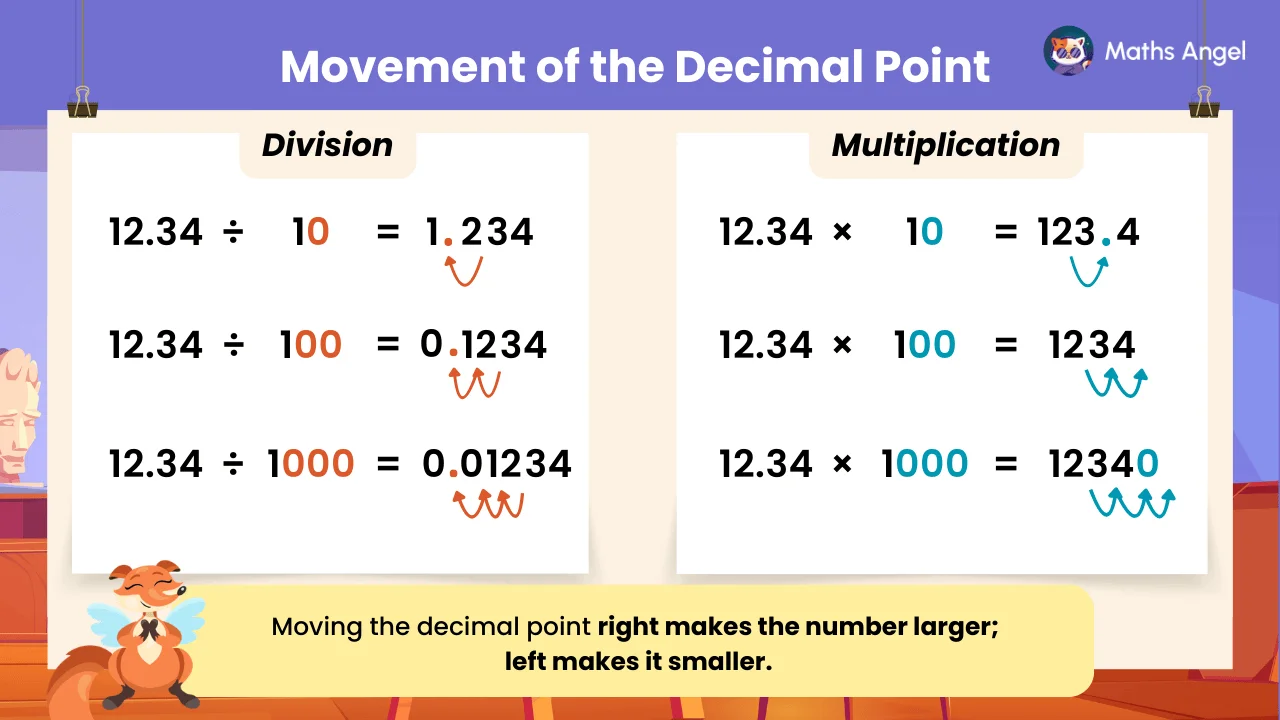
Decimal point movement multiplies or divides a number by powers of 10 like 10, 100 or 1000. Multiplying shifts the point right, making the number bigger. Dividing shifts it left, making the number smaller.
Video Lesson
Watch and learn the basics
🎬 Did this video explain it clearly?
Flashcards
Review key concepts visually
%20Movement%20of%20the%20Decimal%20Point.webp)
%20Movement%20of%20the%20Decimal%20Point%20Examples.webp)
%20Movement%20of%20the%20Decimal%20Point%20in%20Unit%20Conversion.webp)
Multiplying and Dividing by 10, 100, 1000
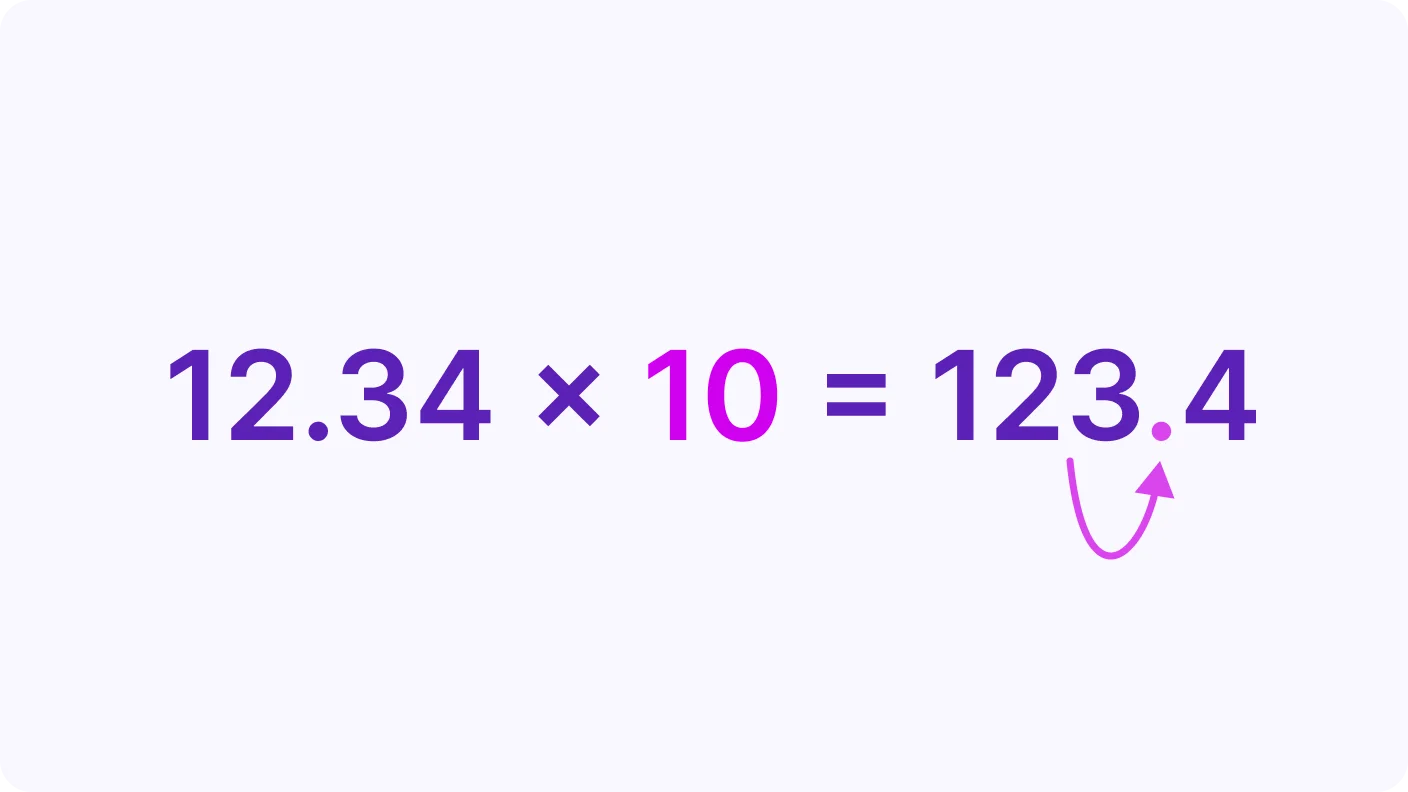
- Multiplying by 10, 100, 1000 moves the decimal right.
- Dividing by 10, 100, 1000 moves the decimal left.
How to Shift the Decimal Point
- Multiplying by 1000 means moving the decimal point 3 places to the right.
- Dividing by 100 means moving the decimal point 2 places to the left.
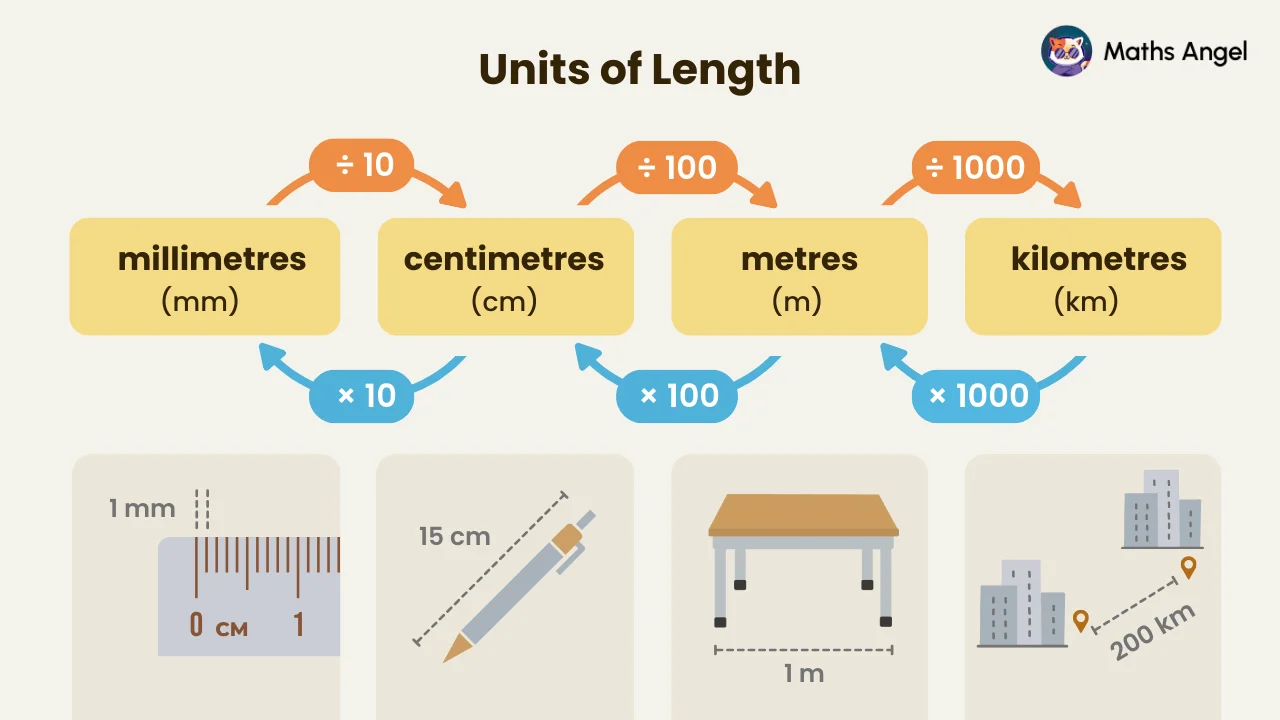
Using Decimal Movement to Convert Units
- When converting to smaller units, multiply by the conversion factor. For example,
- When converting to larger units, divide by the conversion factor. For example,
Practice Questions
Test your understanding
What is 7.3 multiplied by 10?
Correct! 🎉 +10 pointsCorrect! 🎉 Worth 10 XPNot quite right
Multiplying by 10 makes every digit ten times bigger, so each digit moves one place to the left (the decimal point looks as if it moves one place to the right): .
Watch out: with decimals you cannot just 'add a zero'. 7.30 is still 7.3.
What is 0.5 multiplied by 1000?
Correct! 🎉 +10 pointsCorrect! 🎉 Worth 10 XPNot quite right
Multiplying by 1000 makes every digit 1000 times bigger, so each digit moves three places to the left: 0.5 → 5 → 50 → 500.
So .
What is 8 divided by 100?
Correct! 🎉 +20 pointsCorrect! 🎉 Worth 20 XPNot quite right
Dividing by 100 makes every digit 100 times smaller, so each digit moves two places to the right: 8 → 0.8 → 0.08.
So .
Convert 8.9 metres into millimetres.
Correct! 🎉 +20 pointsCorrect! 🎉 Worth 20 XPNot quite right
There are 1000 millimetres in 1 metre, so multiply by 1000.
Multiplying by 1000 moves every digit three places to the left: 8.9 → 89 → 890 → 8900.
So .
What is 78.4 divided by 1000?
Correct! 🎉 +20 pointsCorrect! 🎉 Worth 20 XPNot quite right
Dividing by 1000 makes every digit 1000 times smaller, so each digit moves three places to the right: 78.4 → 7.84 → 0.784 → 0.0784.
So .
Convert to a decimal, then divide by 10.
Correct! 🎉 +30 pointsCorrect! 🎉 Worth 30 XPNot quite right
means 12.5 out of 100, so divide by 100: .
Now do the second step and divide by 10, moving every digit one more place to the right: .
Both steps are needed. Stopping at 0.125 only answers the first one.
Want to see the full working?
Interactive Activity
Movement of the Decimal Point
Loading interactive widget...
Frequently asked questions
The questions students bump into most on this topic
Multiplying by 10 makes a number ten times bigger: every digit moves one place-value column to the left, so the decimal point appears to move one place to the right, and 7.3 × 10 = 73. Dividing by 10 makes it ten times smaller and the point moves one place to the left, so 73 ÷ 10 = 7.3. The direction of the move tells you which happened.
Move the decimal point to the right: one place for 10, two places for 100 and three places for 1,000. If you run out of digits, fill the empty places with zeros. For 5.02 × 1,000, move the point three places to the right: 5.02 becomes 5,020. The more zeros you multiply by, the further the point moves and the bigger the number gets.
Move the decimal point to the left: one place for 10, two for 100 and three for 1,000. If there are not enough digits, fill the empty places with zeros and put a zero in front of the point. For 4.21 ÷ 100, move the point two places to the left: 4.21 becomes 0.0421. A percentage works the same way: 56.7% = 56.7 ÷ 100 = 0.567.
A whole number has a decimal point hidden after its last digit: 23 is the same as 23.0. Write the point in, move it the right number of places and fill the gaps with zeros, so 23 × 100 becomes 2,300. Dividing works the same way in the other direction: 8 ÷ 100 moves the point two places left, giving 0.08.
Metric units differ by powers of 10, so converting is a decimal-point move. There are 100 cm in 1 m, so 2.8 m × 100 moves the point two places right: 280 cm. There are 1,000 m in 1 km, so 2.8 m ÷ 1,000 moves it three places left: 0.0028 km. Changing to a smaller unit means multiply; to a larger unit, divide.
What's next?
Found this one hard? Go one step back first. Feeling confident? Carry on to the next lesson.