Adding and Subtracting Negative Numbers
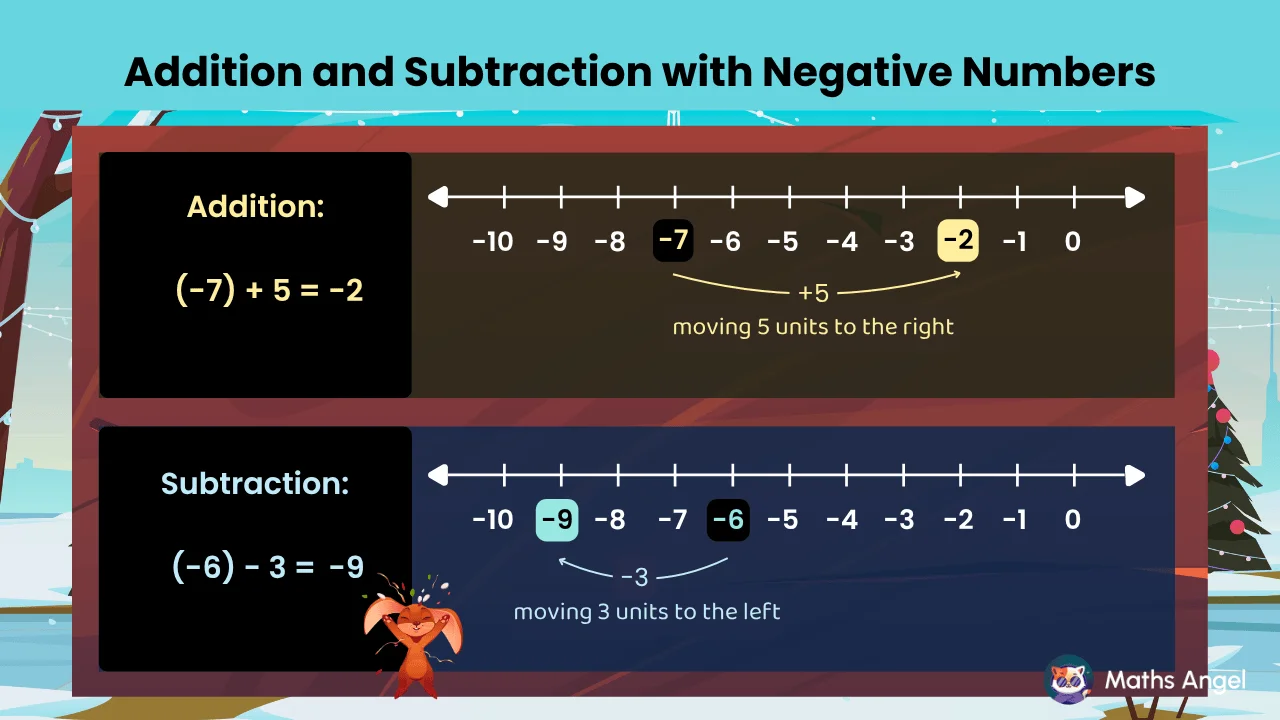
Adding and subtracting negative numbers follows two sign rules: same signs become a plus and different signs become a minus. On a number line, adding moves right and subtracting moves left.
Video Lesson
Watch and learn the basics
🎬 Did this video explain it clearly?
Flashcards
Review key concepts visually
%20Understanding%20Negative%20Numbers.webp)
%20Adding%20and%20Subtracting%20Negative%20Numbers%20Using%20Number%20Line.webp)
%20Application%20-%20Negative%20Numbers.webp)
%20Rules%20for%20Removing%20Brackets%20for%20Addition%20and%20Subtraction.webp)
%20Removing%20Brackets%20with%20Multiple%20Numbers.webp)
What Are Negative Numbers?
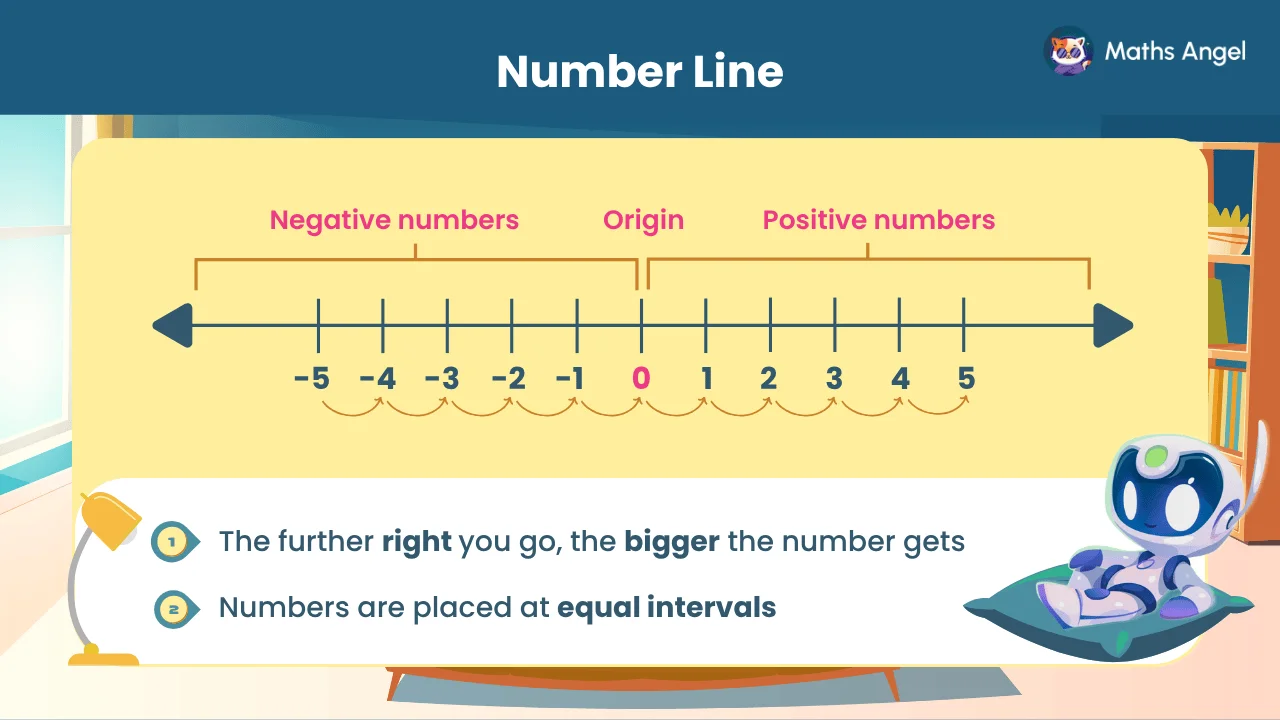
- Negative numbers are to the left of zero on a number line.
- Zero is neither positive nor negative.
How to Add and Subtract Using a Number Line?
- Adding a positive number means move right on the number line.
- Subtracting a positive number means move left on the number line.
How Are Negative Numbers Used in Real Life?
- A drop in temperature means you subtract.
- You may end with a negative answer if you go below zero.
How to Remove Brackets?
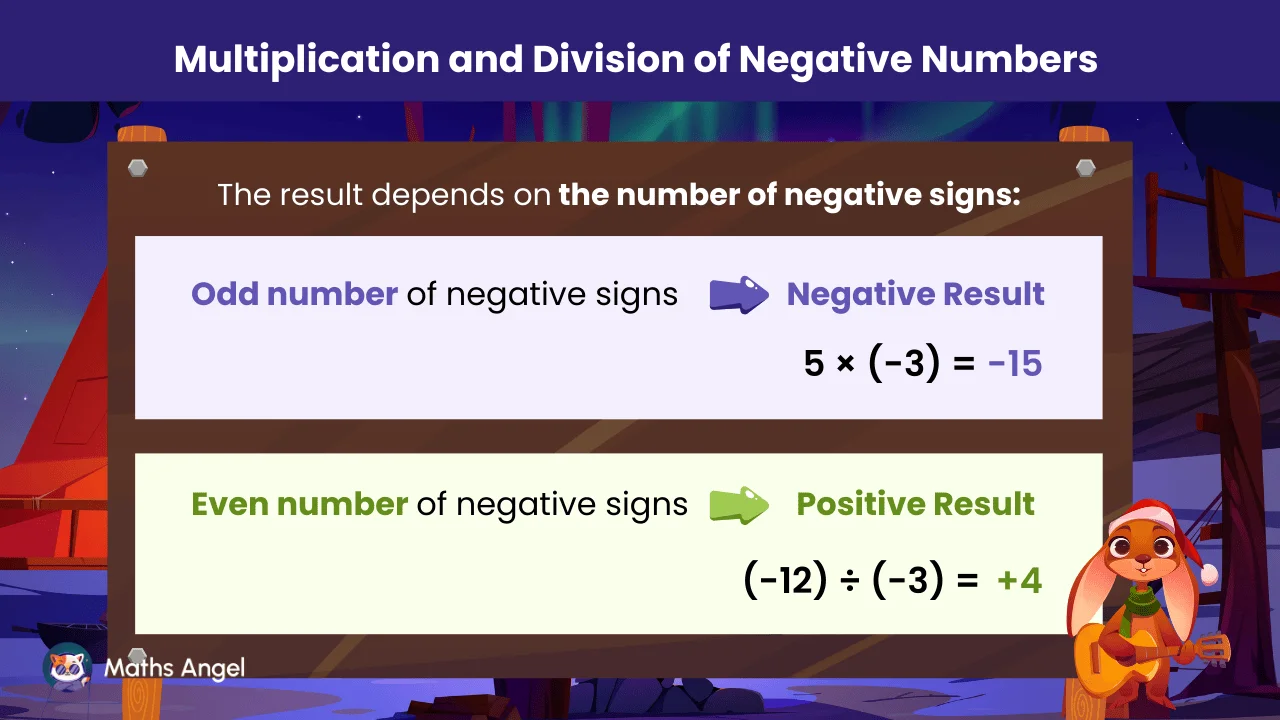
- Same signs next to brackets become a plus.
- Different signs next to brackets become a minus.
How to Remove Brackets with Several Numbers?
- If there is a minus before brackets, change all signs inside.
- You can also work out what is inside the brackets first.
Practice Questions
Test your understanding
If the temperature is −F and increases by F, what is the new temperature?
Correct! 🎉 +10 pointsCorrect! 🎉 Worth 10 XPNot quite right
An increase means adding, so start at −5 and add 12.
Counting up from −5: it takes 5 steps to reach 0, then 7 more steps of the 12, landing on 7.
So the new temperature is .
Work out −7 − (−4) + (−2).
Correct! 🎉 +10 pointsCorrect! 🎉 Worth 10 XPNot quite right
Subtracting a negative is the same as adding, so .
Adding a negative is the same as subtracting, so .
The answer is −5.
Work out −12 + (−8) − (−15).
Correct! 🎉 +20 pointsCorrect! 🎉 Worth 20 XPNot quite right
Adding a negative is the same as subtracting, so .
Subtracting a negative is the same as adding, so .
The answer is −5.
If you owe £20 and pay back £8, how much do you still owe?
Correct! 🎉 +20 pointsCorrect! 🎉 Worth 20 XPNot quite right
Owing £20 means starting at −20 on the number line.
Paying back £8 moves you 8 towards zero, so .
Being at −12 means you still owe £12.
Work out (−14 + 5) − (−10 − 7).
Correct! 🎉 +20 pointsCorrect! 🎉 Worth 20 XPNot quite right
Work out each bracket first: , and .
The calculation is now −9 − (−17). Subtracting a negative is the same as adding, so .
The answer is 8.
A submarine is at −120 metres. It ascends 50 metres and then descends 30 metres. What is its final position?
Correct! 🎉 +30 pointsCorrect! 🎉 Worth 30 XPNot quite right
Ascending means moving up, so add: .
Descending means moving down, so subtract: .
The submarine's final position is −100 metres.
Want to see the full working?
Interactive Activity
Add or subtract values to reach the target on the number line
Loading interactive widget...
Frequently asked questions
The questions students bump into most on this topic
Negative numbers have a minus sign in front and sit to the left of zero on the number line: −1, −2, −3 and so on. A number with no sign is positive. Zero is neutral, neither negative nor positive; it is the boundary between the two. Temperatures below freezing, such as −7°C, are everyday negative numbers.
Use a number line: adding moves right, subtracting moves left. For −7 + 5, start at −7 and move 5 to the right: −2. For −6 − 3, start at −6 and move 3 to the left: −9. If the temperature is 3°C and drops by 10°C, that is 3 − 10 = −7°C. When two signs sit together, use the rules in question 3.
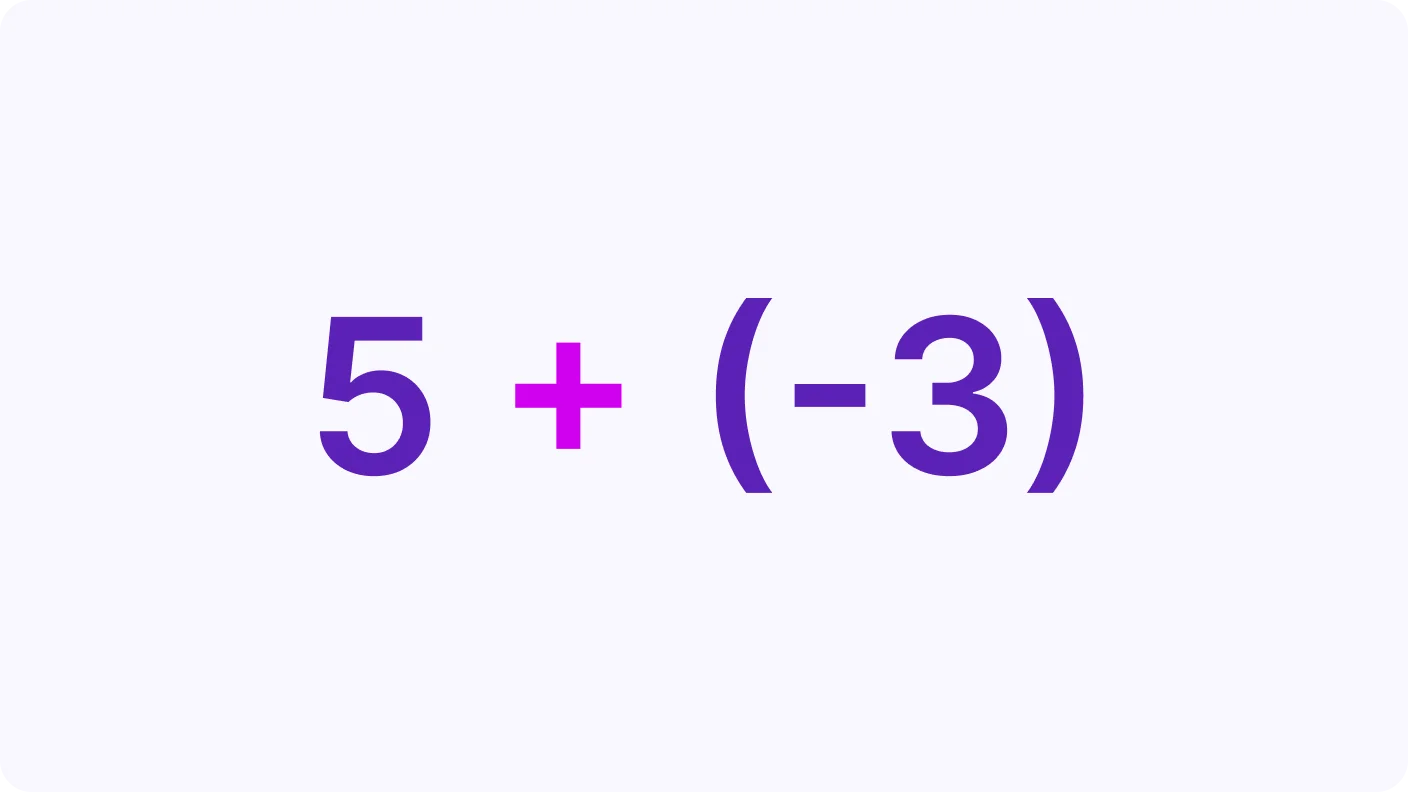
The two minus signs become a plus. Same signs together make a plus, different signs make a minus: 5 − (−3) is 5 + 3 = 8, and 5 + (+3) is also 5 + 3. On the number line, subtracting a negative moves you to the right. With two negatives, −7 − (−4) becomes −7 + 4 = −3.
No. Adding a negative number moves you further left, so two negatives added together make a bigger negative: −12 + (−8) is −12 − 8 = −20, because the different signs next to each other become a minus. It is only subtracting a negative that turns into a plus. Think of two debts: owing £12 and then another £8 means owing £20.
Flip the sign of every term inside, then drop the brackets. For −12 − (−12 + 5): minus −12 becomes +12 and minus +5 becomes −5, so it is −12 + 12 − 5 = −5. Or work out the bracket first: −12 + 5 = −7, then −12 − (−7) = −12 + 7 = −5. Both ways agree, so use one to check the other.
Temperature: 3°C that drops by 10°C is 3 − 10 = −7°C. Money: owing £20 is −20, and paying back £8 is −20 + 8 = −12, so you still owe £12. Depth: a submarine at −120 m that rises 50 m and then dives 30 m is at −120 + 50 − 30 = −100 m. The number line works the same in every case.
What's next?
Found this one hard? Go one step back first. Feeling confident? Carry on to the next lesson.