Multiplying and Dividing Negative Numbers
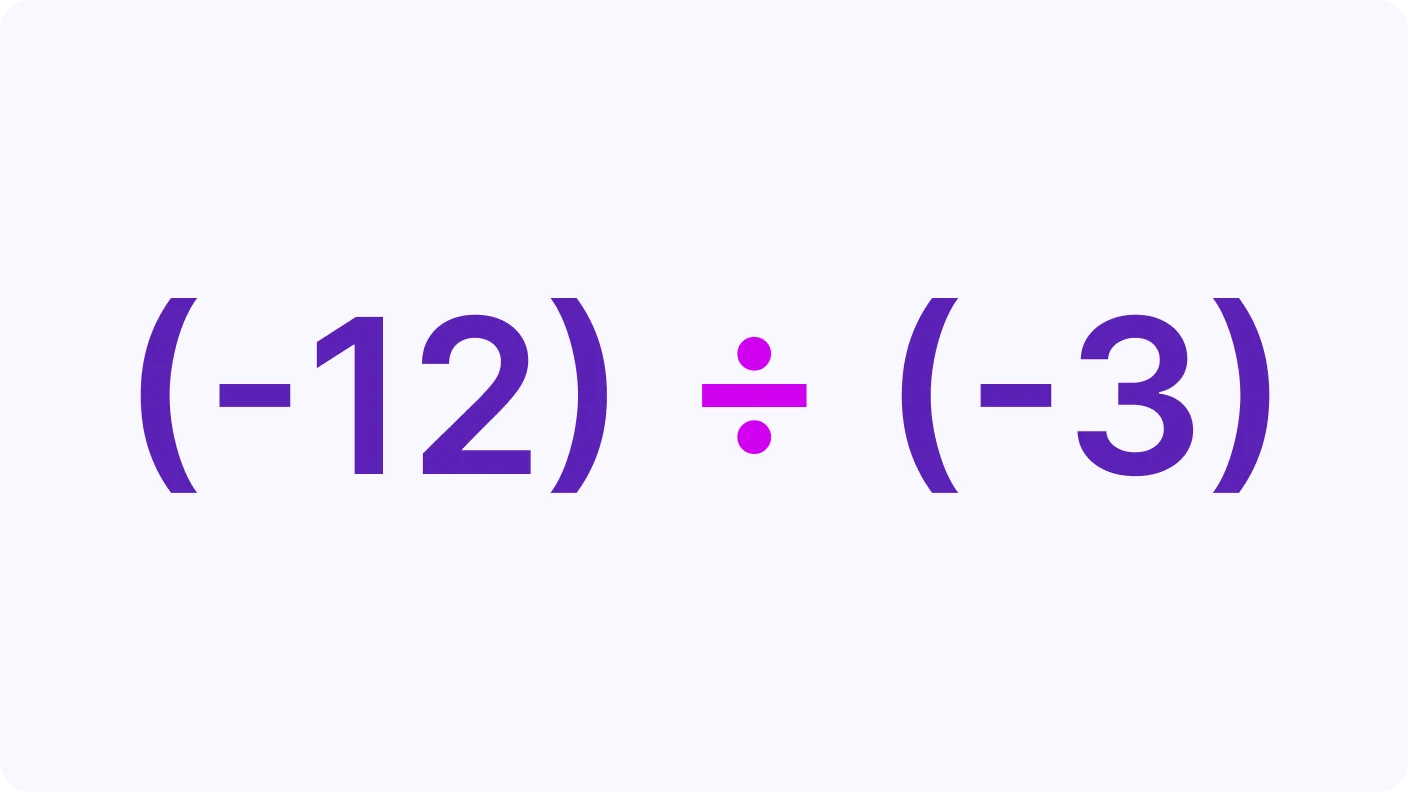
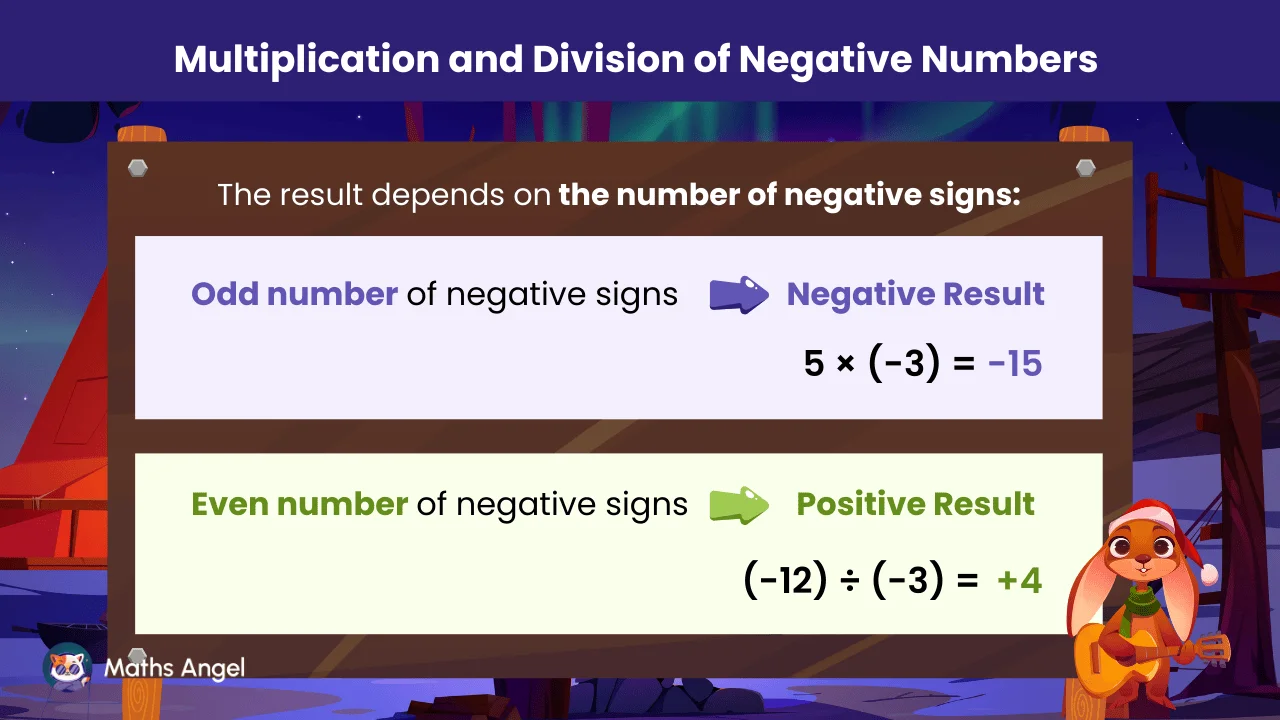
Multiplying and dividing negative numbers follows sign rules. An odd number of negatives gives a negative answer, while an even number gives a positive answer, like (−12) ÷ (−3) = +4.
Video Lesson
Watch and learn the basics
🎬 Did this video explain it clearly?
Flashcards
Review key concepts visually
%20Sign%20Rules%20of%20Multiplication%20and%20Division.webp)
%20Multiplying%20and%20Dividing%203%20Numbers.webp)
%20Combining%20Multiplication%20and%20Division.webp)
Sign Rules for Multiplication and Division
- An odd number of negative signs gives a negative answer, for example .
- An even number of negative signs gives a positive answer, for example .
Multiplying and Dividing Three Numbers
- You can work out two numbers at a time to make it easier.
- Count the negative signs to double-check the final sign.
Combining Multiplication and Division
- Multiply and divide from left to right.
- Count how many negatives there are to decide if the answer is positive or negative.
Practice Questions
Test your understanding
Simplify: 7 × (−2).
Correct! 🎉 +10 pointsCorrect! 🎉 Worth 10 XPNot quite right
A positive multiplied by a negative gives a negative.
Multiply the numbers first: . There is exactly one negative sign, so the answer is negative.
So .
Simplify: (−8) ÷ 4 × (−2).
Correct! 🎉 +10 pointsCorrect! 🎉 Worth 10 XPNot quite right
Division and multiplication have equal priority, so work from left to right.
First: , because a negative divided by a positive is negative.
Then: , because a negative multiplied by a negative gives a positive.
Take care with the last step: × (−2) means multiply by negative two, not subtract two. So the answer is 4.
Simplify: (−6) ÷ 2 × (−5).
Correct! 🎉 +20 pointsCorrect! 🎉 Worth 20 XPNot quite right
Division and multiplication have equal priority, so work from left to right.
First, (a negative divided by a positive is negative).
Then , because a negative multiplied by a negative gives a positive.
So the answer is 15. Both steps must be completed: stopping at , or dropping one of the minus signs, changes the answer.
Simplify: (−6) ÷ 2 × (−4) + (−3).
Correct! 🎉 +20 pointsCorrect! 🎉 Worth 20 XPNot quite right
Do the division and multiplication first, working from left to right, and leave the addition until last.
, then (negative × negative = positive).
Now the addition: .
Adding a negative number is the same as subtracting, so the answer is 9, not 15.
Simplify: (−15) ÷ (−3) × (−5) + (−4).
Correct! 🎉 +20 pointsCorrect! 🎉 Worth 20 XPNot quite right
Division and multiplication come first, left to right.
, because a negative divided by a negative is positive.
Then , because a positive times a negative is negative.
Finally the addition: . Adding a negative moves further down the number line, so the answer is .
Simplify: (−24) ÷ (−3) × (−2) + (−6) × (−1).
Correct! 🎉 +30 pointsCorrect! 🎉 Worth 30 XPNot quite right
Work out all the divisions and multiplications first, then add.
(negative ÷ negative = positive), then .
The second product is (negative × negative = positive).
Now add the two results: . Adding 6 to moves 6 places up the number line, so the answer is , not .
Want to see the full working?
Interactive Activity
Master multiplying and dividing negative numbers
Loading interactive widget...
Frequently asked questions
The questions students bump into most on this topic
Count the negative signs. An odd number of them gives a negative answer; an even number gives a positive answer. In the four rules: positive times positive is positive, positive times negative is negative, negative times positive is negative, and negative times negative is positive. So 5 × (−3) = −15 and (−12) ÷ (−3) = 4. Division follows exactly the same rules.
You get a positive answer: (−2) × (−5) = 10, because two negative signs is an even number. Dividing two negatives is positive too: (−6) ÷ (−2) = 3. Two negatives only make a positive when you multiply or divide; when you add them, the answer stays negative, which is the Adding and Subtracting Negative Numbers lesson.
Multiply the numbers as normal, then make the answer negative, because there is one negative sign and one is an odd number. So 5 × (−3) = −15 and 7 × (−2) = −14. The order does not matter: (−3) × 5 is also −15. A positive and a negative always give a negative when multiplied or divided.
Divide as normal, then use the sign count: one negative sign makes the answer negative, two make it positive. So (−24) ÷ 4 = −6, because there is one negative sign, and (−6) ÷ (−2) = 3, because there are two. The rule is the same as for multiplying.
Work from left to right, two numbers at a time, unless there are brackets. For (−2) × (−5) × (−3): (−2) × (−5) = 10, then 10 × (−3) = −30. For (−28) ÷ 4 × (−3): (−28) ÷ 4 = −7, then (−7) × (−3) = 21. To check, count all the negative signs: three gives a negative answer, two gives a positive one.
What's next?
Found this one hard? Go one step back first. Feeling confident? Carry on to the next lesson.