
Geometry and Measures
The complete geometry and measures curriculum for ages 10 to 16, with every topic taught in its own bite-sized video lesson. Build confidence one step at a time, with an AI tutor whenever you need it.
%20Polygons%20vs%20non-polygons.webp)
%20What%20is%20Line%20of%20Symmetry.webp)
Explore every Geometry topic
Angles, area, volume, Pythagoras and trigonometry. See each method on video, then explore it with hands-on interactive tools.
Angles and Lines
%20What%20is%20an%20angle.webp)
Measurement and Types of Angles
Types of angles: acute under 90°, right exactly 90°, obtuse between 90° and 180°, reflex over 180°.
Perpendicular and Parallel Lines
Perpendicular lines meet at 90°; parallel lines never meet and are marked with matching arrows.
Angle Relationships in Intersecting and Parallel Lines
Angles in parallel lines: alternate angles and corresponding angles are equal, as are vertically opposite angles.
Shapes and Properties
Polygons and Types of Quadrilaterals
Polygons and the properties of quadrilaterals: a rhombus has four equal sides, a kite two equal pairs.
Properties of Circles
Parts of a circle: radius, diameter, chord, arc, sector, segment and tangent, and how they relate.
Thales' Theorem
The angle in a semicircle is always 90°, a fact Thales proved more than 2500 years ago.
Triangles and Constructions
%20Triangle%20Components.webp)
Constructing Triangles
Constructing triangles with a ruler and compasses from three sides, or two sides and an angle.
Congruent Triangles
Congruent triangles are identical; prove it with SSS, SAS, ASA or RHS.
Angle Bisectors and Incircle
How to bisect an angle with compasses; the three angle bisectors meet at the centre of the incircle.
Perpendicular Bisectors and Circumcircle
A perpendicular bisector cuts a side in half at 90°; all three meet at the centre of the circumcircle.
Medians and Centroid of a Triangle
The centroid of a triangle is where the three medians meet, two thirds of the way along each one.
Area and Perimeter
%20Perimeter%20of%20Polygons%2C%20Quadrilaterals%2C%20Squares.webp)
Perimeter of a Polygon
How to find perimeter: add up every side, so a 5 by 3 rectangle has perimeter 16.
Units of Area
Units of area, including cm² to m²: 1 m² = 10000 cm², because 100 × 100.
Area of a Triangle
The area of triangle formula is ½ × base × height, so base 8 and height 5 give 20.
Area of Parallelograms and Triangles
The area of a parallelogram is base × perpendicular height, not the slanted side.
Area of a Trapezium
The trapezium area formula is ½(a + b)h: add the parallel sides, halve, then multiply by the height.
Area of Compound Shapes
Area of compound shapes: split into rectangles and triangles, find each area and add them up.
Circumference and Area of a Circle and a Sector
The area of a circle is πr² and the circumference of a circle is 2πr; a sector is a fraction of each.
3D Shapes and Volume
%20Solids.webp)
Solids and Units of Volume
Name 3D shapes and their units of volume: 1 litre = 1000 cm³ and 1 m³ = 1000000 cm³.
Volume of a Cuboid and Cube
The volume of a cuboid is length × width × height; a cube with 4 cm edges has volume 64 cm³.
Volume of Prisms and Cylinders
The volume of a prism is cross-section area × length, so the volume of a cylinder is πr²h.
Volume and Surface Area of Pyramids, Cones, Spheres
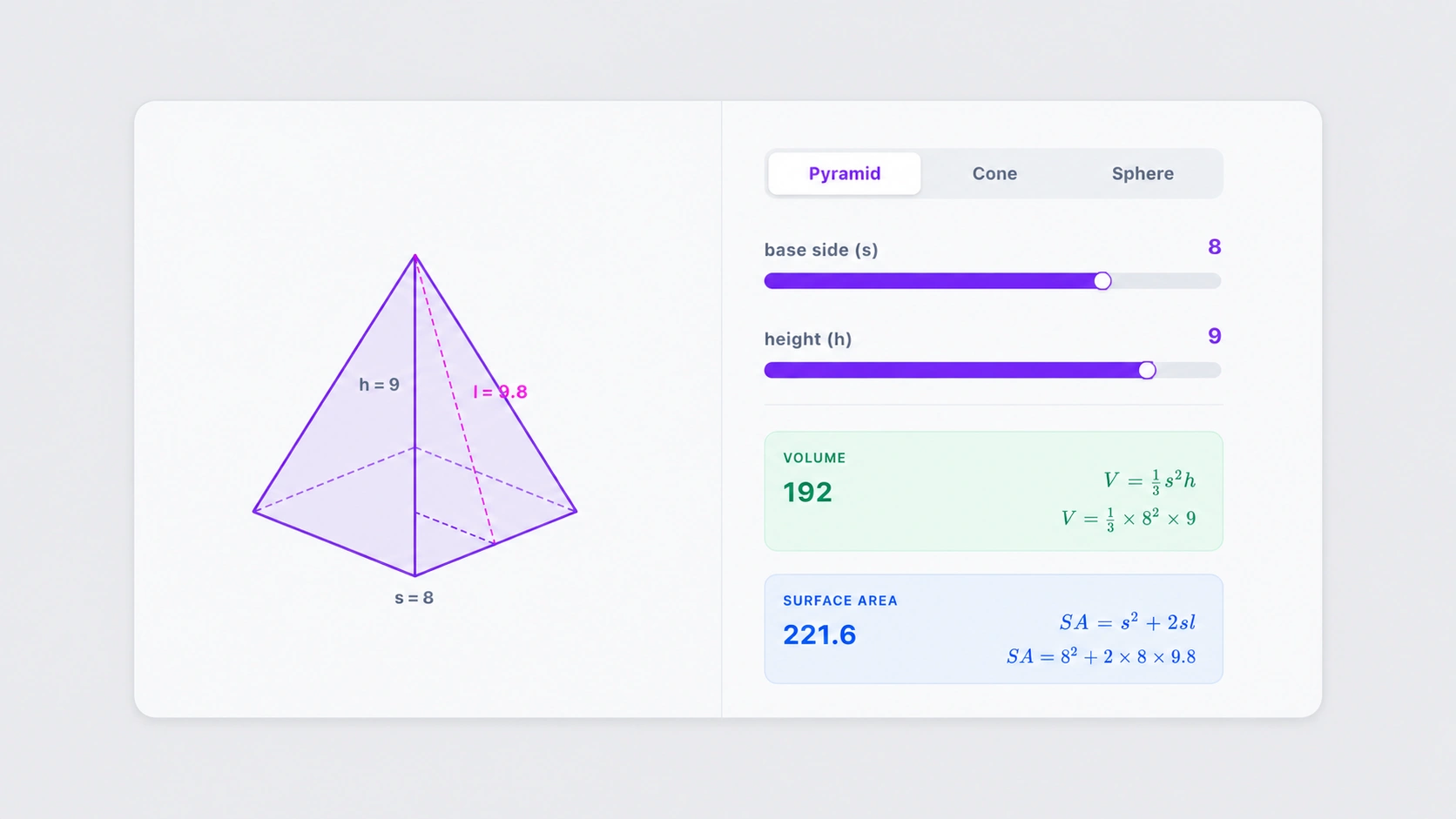
Volume of a cone: ⅓πr²h. Volume of a sphere: 4/3 πr³. Volume of a pyramid: ⅓ × base area × height.
Surface Area of Solids
The surface area of a cube is six times one face: 6 × a × a, so a 3 cm cube has 54 cm².
Cavalieri's Principle
Two solids with the same height and the same cross-section area at every level have the same volume.
Symmetry and Transformations
Line of Symmetry and Reflection Symmetry
Lines of symmetry: a square has four, a rectangle has two and a circle has infinitely many.
Rotational Symmetry
Order of rotational symmetry: how many times a shape fits onto itself in one full turn, 4 for a square.
Plotting and Reflecting Points on the Coordinate Plane
On the coordinate plane, reflecting (3, 2) in the x-axis gives (3, −2) and in the line y = x gives (2, 3).
Rotating Shapes
Rotation in maths needs a centre, an angle and a direction, clockwise or anticlockwise.
Translating Shapes
Translation in maths slides a shape without turning it: the vector (3, −2) means 3 right and 2 down.
Introduction to Enlargement
Enlargement in maths: a scale factor of 2 doubles every length, measured from the centre of enlargement.
Pythagoras and Trigonometry
%20Pythagoras%20Theorem.webp)
Pythagoras' Theorem
Pythagoras theorem: a² + b² = c², so a right-angled triangle with sides 3 and 4 has hypotenuse 5.
Trigonometry: Sine, Cosine, Tangent
SOHCAHTOA: sin = opposite ÷ hypotenuse, cos = adjacent ÷ hypotenuse, tan = opposite ÷ adjacent.
Sine Rule
The sine rule a/sin A = b/sin B = c/sin C works in any triangle, not just right-angled ones.
Cosine Rule
The cosine rule a² = b² + c² − 2bc cos A finds a side from two sides and the angle between them.
Explore other Maths categories
Maths Angel covers the whole maths curriculum for ages 10 to 16. Geometry and Measures is one of six categories, so jump into any of the others.