Polygons and Types of Quadrilaterals
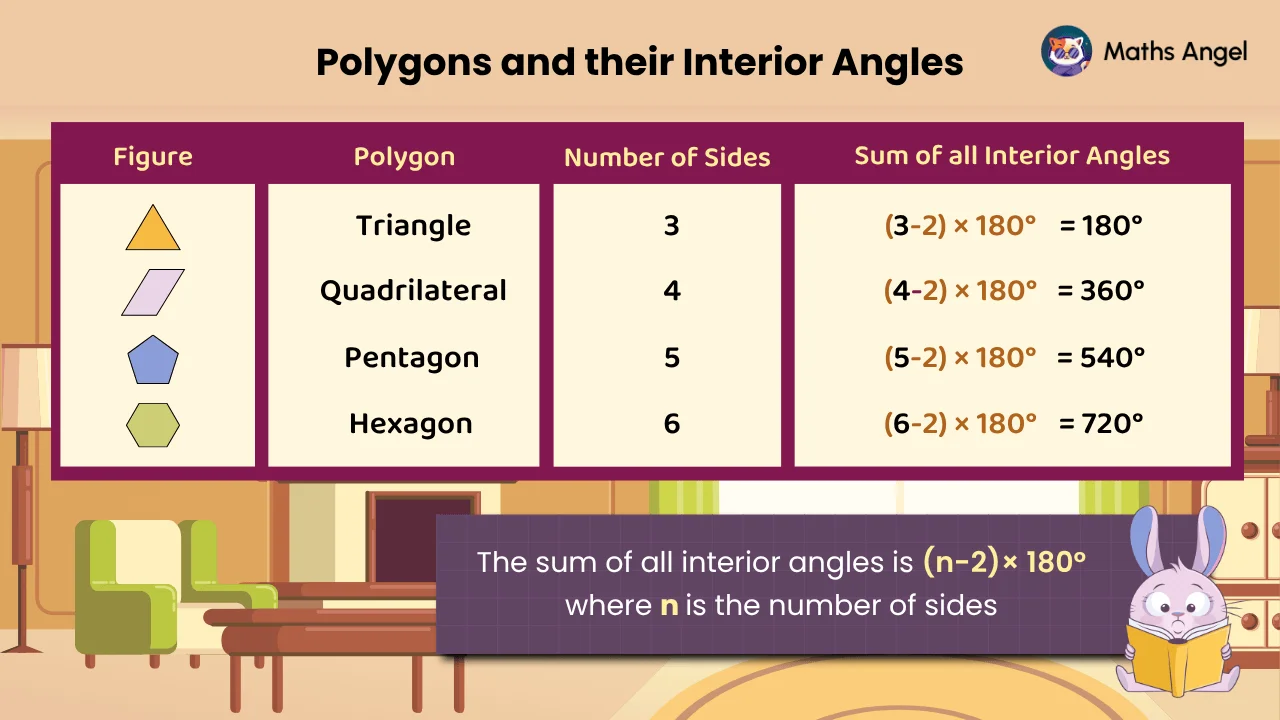
Polygons are 2D closed shapes made from straight line segments. They are named by their number of sides, like a triangle (3) or pentagon (5). A polygon with n sides has interior angles adding up to (n − 2) × 180°, so a quadrilateral (4) totals 360°.
Video Lesson
Watch and learn the basics
🎬 Did this video explain it clearly?
Flashcards
Review key concepts visually
%20Polygons%20vs%20non-polygons.webp)
%20Regular%20Polygons.webp)
%20Interior%20Angles%20of%20Polygons.webp)
%20Special%20Quadrilaterals.webp)
What is a Polygon?
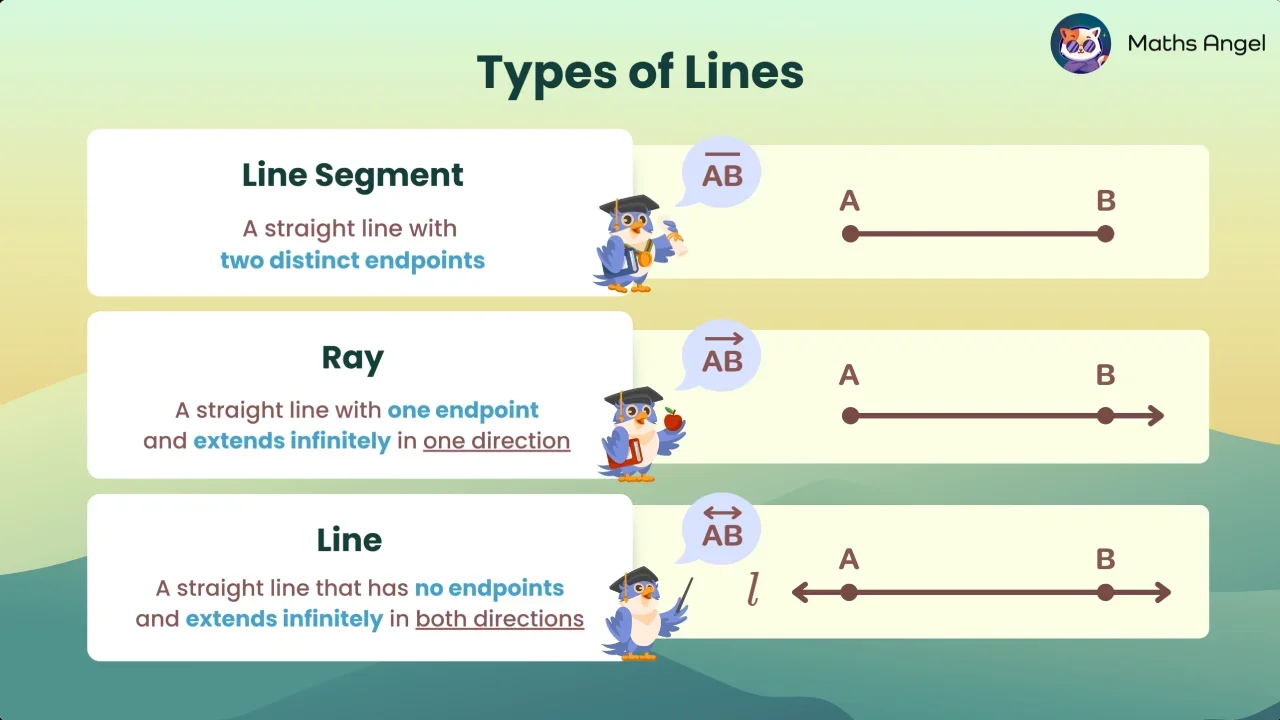
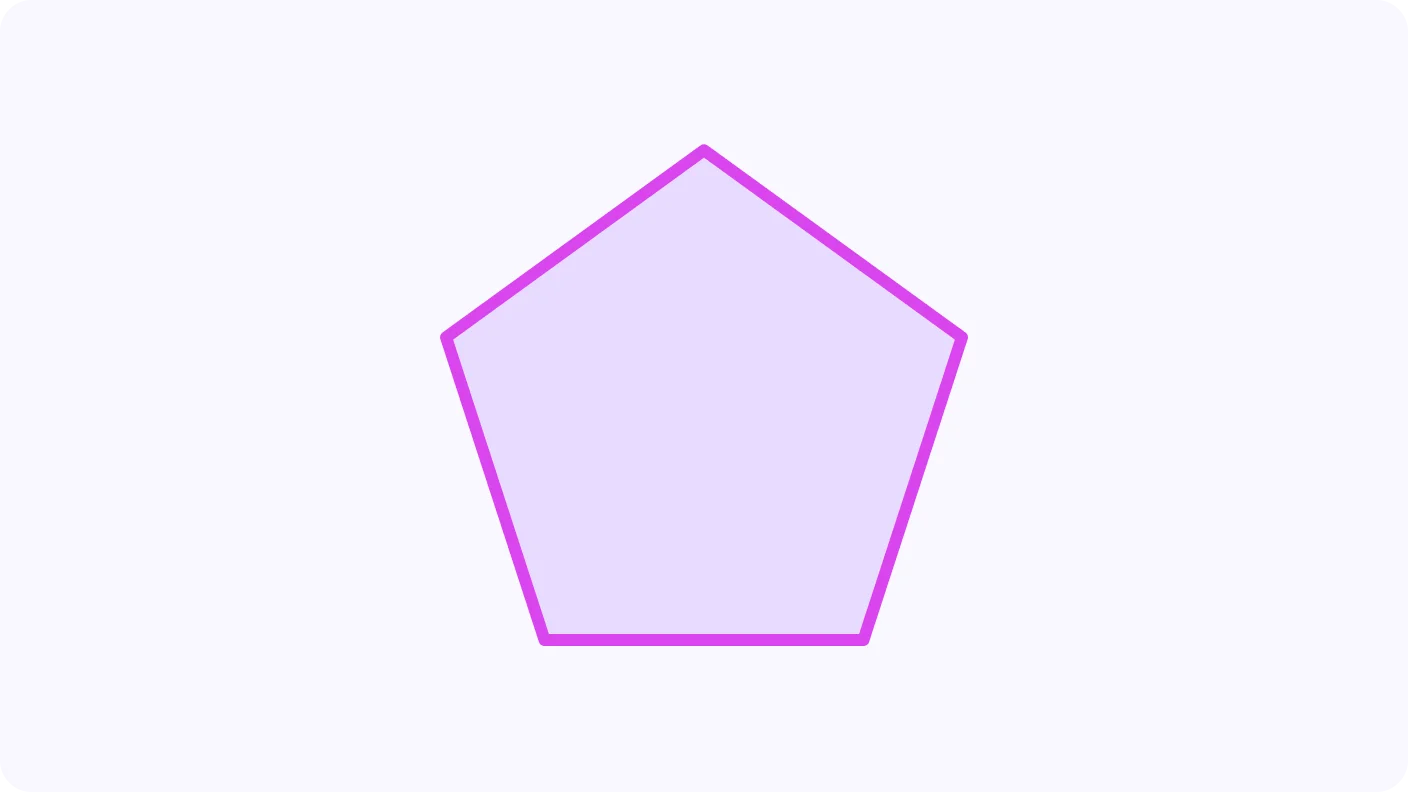
- A polygon is a 2D closed shape made from straight line segments.
- Tip: shapes that are open, curved, or 3D are not polygons.
Names of Polygons
- Polygons are named by their number of sides.
- For example: triangle (3), quadrilateral (4), pentagon (5), hexagon (6).
Interior Angles of Polygons
- The sum of interior angles depends on the number of sides.
- The formula is (n − 2) × , where n is the number of sides.
What is a Quadrilateral?
- A quadrilateral is a polygon with four sides.
- Parallelograms, rectangles, rhombuses, squares, and trapeziums are all quadrilaterals.
Practice Questions
Test your understanding
What is the general name for a polygon with four sides?
Correct! 🎉 +10 pointsCorrect! 🎉 Worth 10 XPNot quite right
Polygons are named by how many sides they have: 3 sides is a triangle, 4 sides is a quadrilateral, 5 sides is a pentagon.
Quadrilateral is the general name that covers every four-sided polygon: squares, rectangles, rhombuses, kites and trapeziums are all quadrilaterals.
True or False: A circle is a polygon.
Correct! 🎉 +10 pointsCorrect! 🎉 Worth 10 XPNot quite right
A polygon is a closed 2-D shape made only from straight sides that meet at vertices.
A circle's boundary is a single curve with no straight sides and no vertices, so a circle is not a polygon. The statement is False.
Which quadrilateral has all four sides of equal length but no right angles?
Correct! 🎉 +20 pointsCorrect! 🎉 Worth 20 XPNot quite right
A rhombus has four equal sides, with opposite sides parallel and opposite angles equal, but its angles are not right angles (two are acute and two are obtuse).
A square also has four equal sides, but all of its angles are right angles, so it does not fit the second condition.
What do you call a quadrilateral with opposite sides parallel and all angles at right angles?
Correct! 🎉 +20 pointsCorrect! 🎉 Worth 20 XPNot quite right
A rectangle is a quadrilateral with both pairs of opposite sides parallel and equal, and all four angles equal to .
A parallelogram also has opposite sides parallel, but its angles are not right angles, so 'parallelogram' alone does not describe this shape.
What is the sum of the interior angles of a pentagon (5-sided polygon)?
Correct! 🎉 +20 pointsCorrect! 🎉 Worth 20 XPNot quite right
A polygon with n sides splits into triangles from one vertex, and each triangle contributes , giving the formula .
For a pentagon, , so the sum is .
If a polygon has an interior angle sum of , how many sides does it have?
Correct! 🎉 +30 pointsCorrect! 🎉 Worth 30 XPNot quite right
Use .
Divide both sides by : .
Add 2 to both sides: .
The polygon has 7 sides (a heptagon). Check: . ✓
Want to see the full working?
Interactive Activity
Explore how the number of sides affects a polygon's shape and interior angles
Loading interactive widget...
Frequently asked questions
The questions students bump into most on this topic
A polygon is a flat, closed shape made only of straight line segments. Flat means two-dimensional, so a cube is not a polygon; closed means no gaps, so water poured in would not leak; straight means no curves, so a circle is not a polygon either. Triangles, squares and hexagons are all polygons.
At least three. Fewer than three straight sides cannot close a shape, and there is no upper limit. The number of sides gives the polygon its name: three make a triangle, four a quadrilateral, five a pentagon (penta is Greek for five) and six a hexagon, and so on.
A regular polygon has all its sides the same length and all its angles the same size, like a square or an equilateral triangle. It can have any number of sides from three upwards. A polygon whose sides or angles differ is irregular; a rectangle that is not a square is a familiar example.
A quadrilateral is a polygon with four sides. A trapezium has at least one pair of parallel sides; if both pairs are parallel it is a parallelogram, which makes a parallelogram a special trapezium. A rhombus is a parallelogram with equal sides, a rectangle one with right angles, and a square has both, so every square is also a rectangle.
Use the formula (n − 2) × 180°, where n is the number of sides. A triangle has n = 3, so its angles add up to 1 × 180° = 180°; a quadrilateral has n = 4, giving 2 × 180° = 360°; a pentagon gives 3 × 180° = 540°. For a regular polygon, divide that total by n to find one angle.
The four angles of any quadrilateral add up to 360°. The formula (n − 2) × 180° with n = 4 gives 2 × 180° = 360°, and it holds for every four-sided shape: squares, rectangles, parallelograms, rhombuses, kites and trapeziums alike. If you know three angles, subtract their total from 360° to find the fourth.
What's next?
Found this one hard? Go one step back first. Feeling confident? Carry on to the next lesson.