Properties of Circles
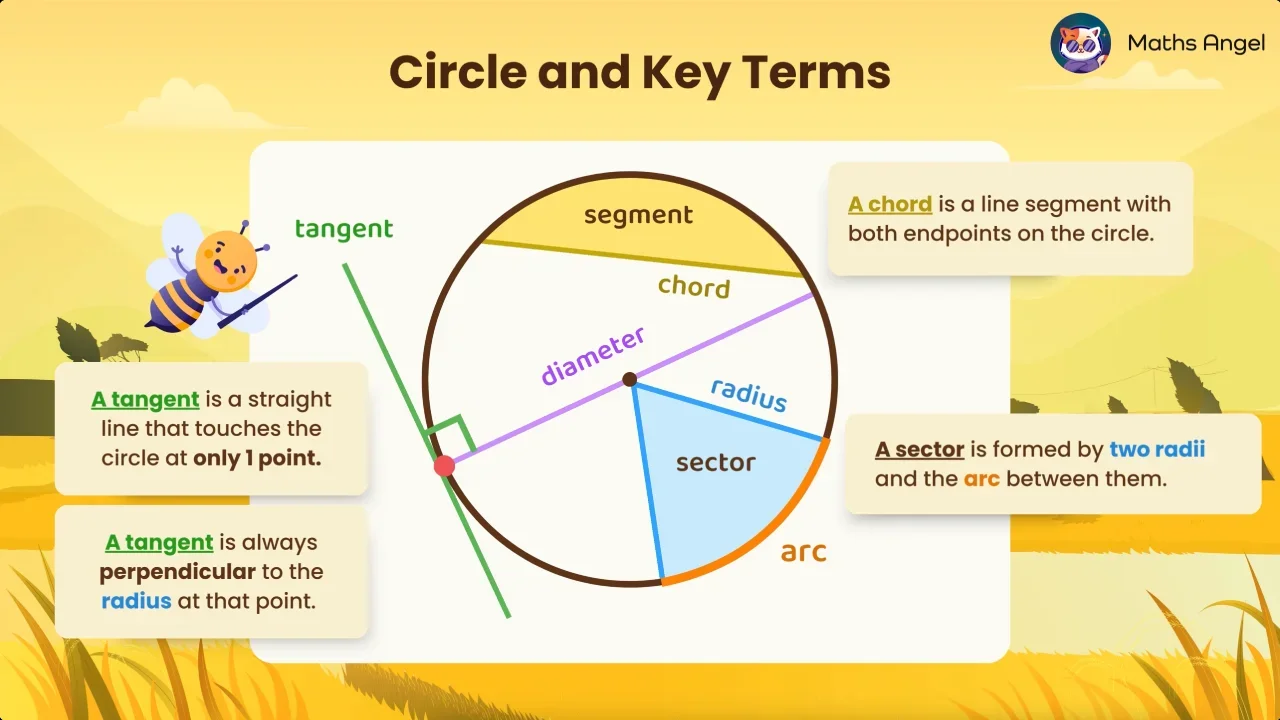
The properties of a circle are its key parts. The radius is the fixed distance from the centre to any point on the edge. The diameter goes through the centre, so it is twice the radius (a 16 cm diameter has an 8 cm radius).

Video Lesson
Watch and learn the basics
🎬 Did this video explain it clearly?
Flashcards
Review key concepts visually
%20Circles%20and%20Key%20Terms.webp)
%20Finding%20Points%20with%20Circles.webp)
Properties of a Circle
- The diameter goes through the centre and is twice the radius.
- A sector is made from two radii and the arc between them.
- A tangent touches the circle at one point and is perpendicular to the radius.
Finding Points with Circles
- All points the same distance from a point lie on a circle, and that distance is the radius.
- The intersections of circles show the possible answers.
Practice Questions
Test your understanding
What is the constant distance from the centre of a circle to any point on its edge called?
Correct! 🎉 +10 pointsCorrect! 🎉 Worth 10 XPNot quite right
The radius is the distance from the centre of a circle to any point on the circumference, and it is the same whichever point you choose.
The diameter is twice the radius and runs right across the circle through the centre.
What do we call a straight line that touches a circle at exactly one point?
Correct! 🎉 +10 pointsCorrect! 🎉 Worth 10 XPNot quite right
A tangent is a straight line that touches a circle at exactly one point (the point of contact) and does not cross it. At that point the tangent is perpendicular to the radius.
A chord is different: it is a straight line joining two points on the circumference, so it meets the circle twice.
What is the part of a circle enclosed by a chord and the arc above it called?
Correct! 🎉 +20 pointsCorrect! 🎉 Worth 20 XPNot quite right
A segment is the region enclosed by a chord and one of the two arcs that the chord cuts off. The arc above the chord gives the minor segment; the arc below it gives the major segment.
A sector is different: it is the region bounded by two radii and an arc, like a slice of pizza. A diameter and a tangent are lines, not regions, so neither can name an enclosed area.
A circle has a diameter of . What is its radius?
Correct! 🎉 +20 pointsCorrect! 🎉 Worth 20 XPNot quite right
The diameter is the chord that passes through the centre, and it is exactly twice the radius. So the radius is half the diameter: cm.
A tangent touches a circle at exactly one point. At this point, what is the angle between the tangent and the radius?
Correct! 🎉 +20 pointsCorrect! 🎉 Worth 20 XPNot quite right
A tangent meets the circle at exactly one point, and at that point of contact it is perpendicular to the radius drawn to it. Perpendicular means the two lines meet at a right angle, so the angle between the tangent and the radius is .
A circle has a radius of . What is the length of the longest chord in the circle?
Correct! 🎉 +30 pointsCorrect! 🎉 Worth 30 XPNot quite right
A chord is any straight line joining two points on the circle. The longest possible chord is the diameter, because it is the only chord that passes through the centre.
The diameter is twice the radius, so the longest chord is cm.
Want to see the full working?
Interactive Activity
Explore the fundamental parts and properties of a circle
Loading interactive widget...
Frequently asked questions
The questions students bump into most on this topic
The main parts are the centre, the radius, the diameter, a chord, an arc, a segment, a sector and a tangent. The one property every circle has is that each point on its edge is the same distance from the centre; that distance is the radius, which is why a wheel rolls smoothly. The diameter, through the centre, is twice the radius.
A chord is a straight line with both ends on the circle. The diameter is the special chord through the centre, and it is the longest chord you can draw; every other chord is shorter. A chord cuts off a segment, the area between the chord and the arc above it. In a circle with a radius of 7 cm, the longest chord is 14 cm.
The radius is the distance from the centre to any point on the edge, the same all the way round. The diameter is a line through the centre joining two points on the edge, so it is twice the radius. Double the radius to get the diameter and halve the diameter to get the radius: a 16 cm diameter means an 8 cm radius.
A sector is the slice-of-pie shape between two radii and the arc joining them, so it always reaches the centre. A segment is the area between a chord and the arc above it, so its straight side is a chord and it does not reach the centre. The arc is the part of the circle’s edge that each one uses.
A tangent is a straight line that touches the circle at exactly one point. At that point it is always perpendicular to the radius, meaning the tangent and the radius meet at a right angle of 90°. This is true for every tangent, whichever point on the edge it touches, and it is the fact that circle theorem questions use most.
Draw a circle around each place with the right radius. For the points 5 cm from A and 3 cm from B, set a compass to 5 cm and draw a circle centred on A, then 3 cm centred on B. Where the circles cross are the points that fit both. The same method places a car park a set distance from two shopping centres.
What's next?
Found this one hard? Go one step back first. Feeling confident? Carry on to the next lesson.