Thales' Theorem
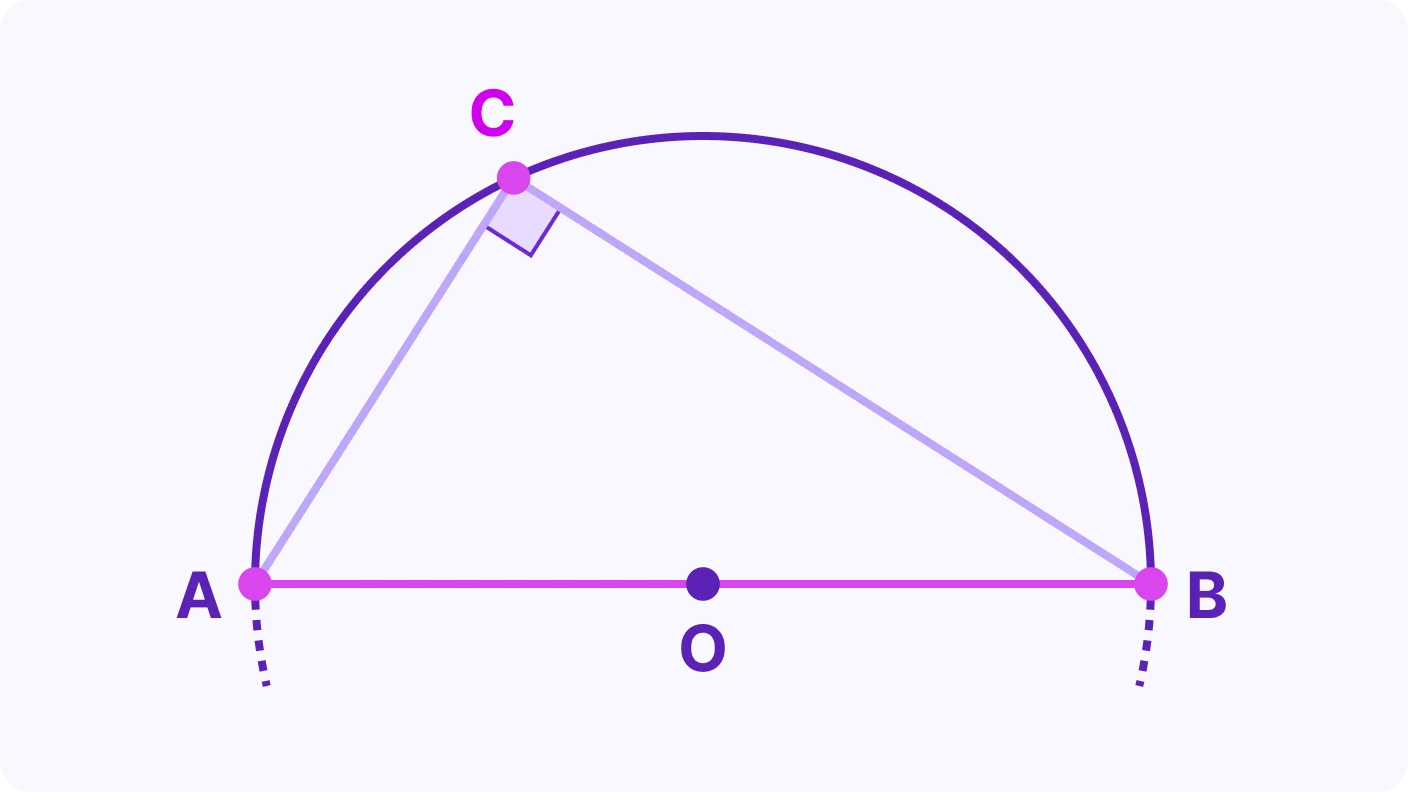
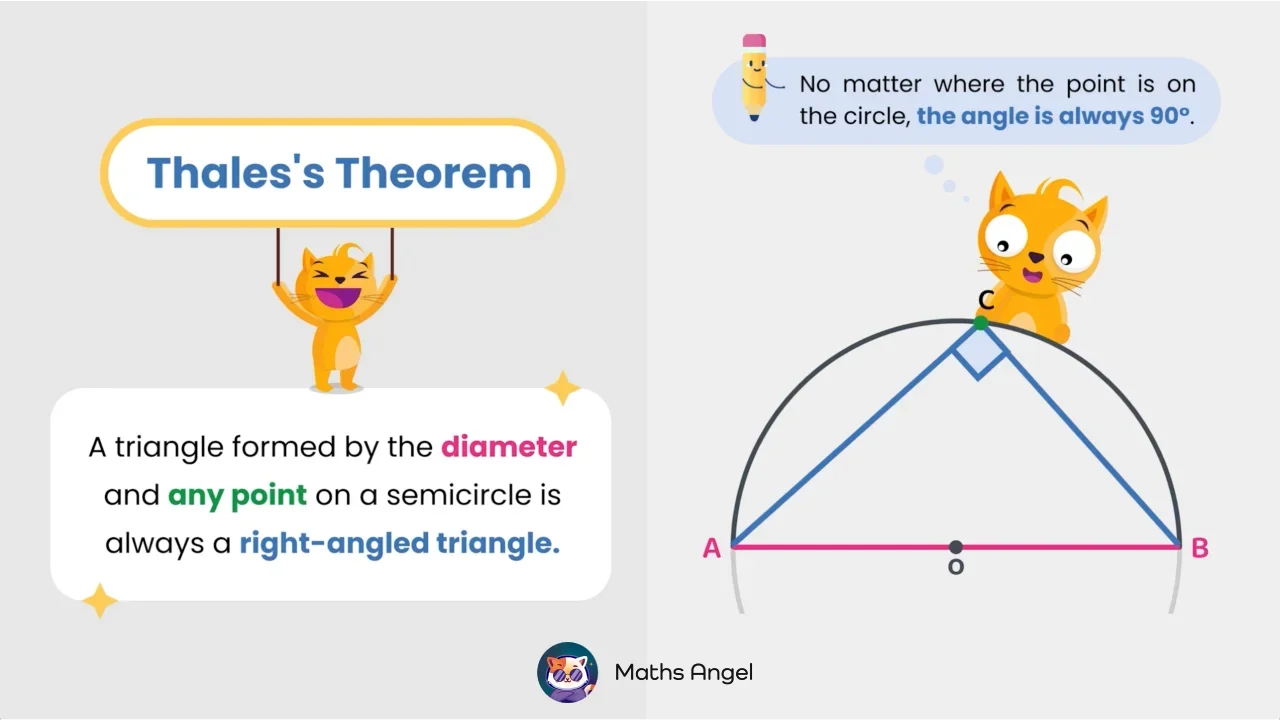
Thales' Theorem says a triangle formed by the diameter and any other point on the circle is always a right-angled triangle. Since a triangle's angles add to 180°, subtract the 90° and the known angle to find the missing angle.
Video Lesson
Watch and learn the basics
🎬 Did this video explain it clearly?
Flashcards
Review key concepts visually
%20What%20is%20Thales%27%20Theorem.webp)
%20How%20to%20Apply%20Thales%27%20Theorem.webp)
%20Thales%27%20Theorem%20Exercise.webp)
Thales’ Theorem: What It Says
- If one side of a triangle is the diameter of a circle, the opposite angle is .
- This angle is always a right angle, wherever the point is on the circle.
Thales’ Theorem: How to Use It
- First, find the diameter of the circle.
- Then mark the angle opposite the diameter on the circle as .
Thales’ Theorem: Finding Other Angles
- All angles in a triangle add up to .
- Subtract and the given angle to find the missing angle.
Practice Questions
Test your understanding
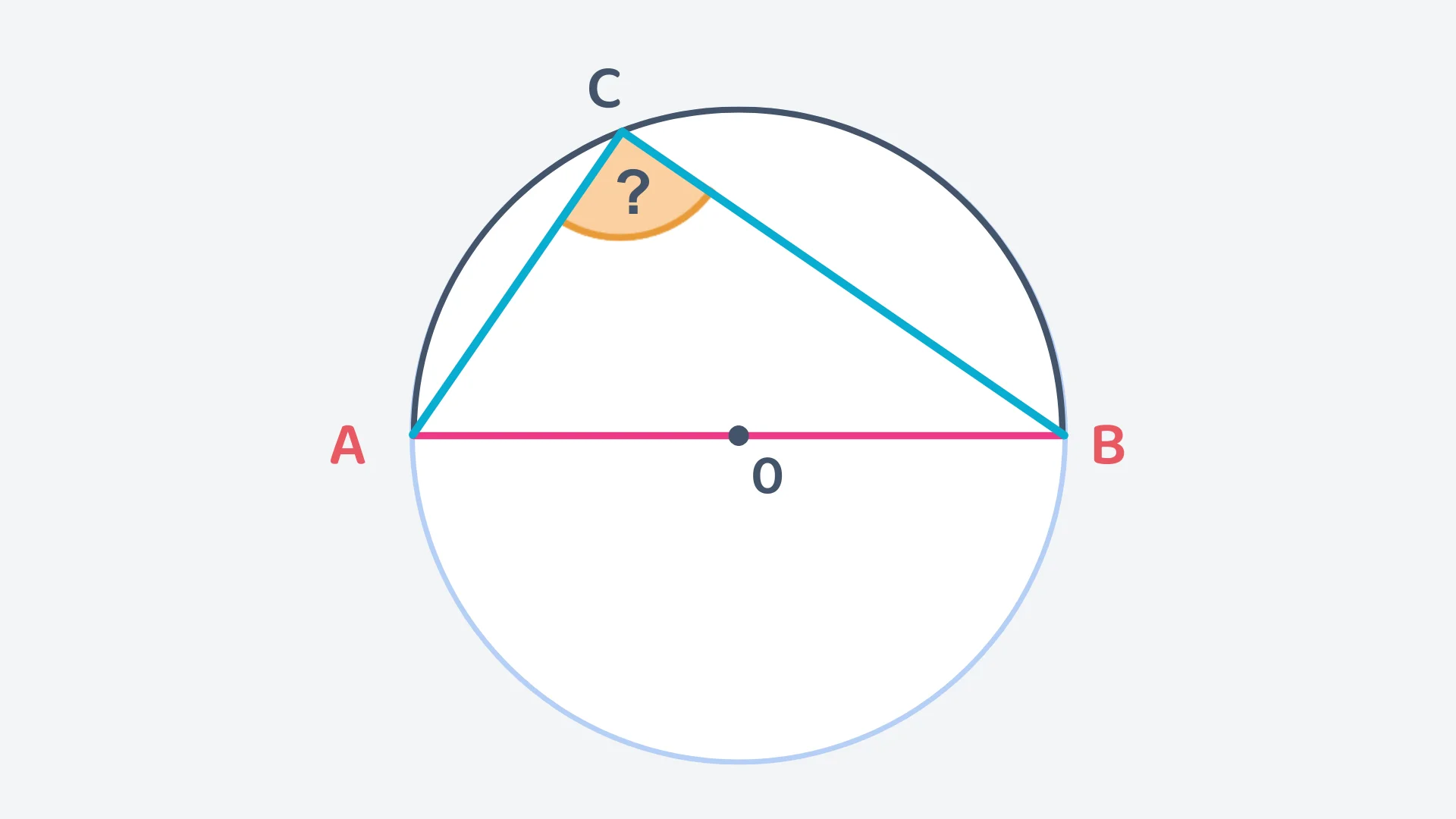
In the following diagram, AB is the diameter of a circle, and C is a point on the circle. What is ?
Correct! 🎉 +10 pointsCorrect! 🎉 Worth 10 XPNot quite right
By Thales' Theorem, if AB is a diameter and C is any other point on the circle, then .
One way to see why: the angle at the centre, , is a straight line, so it is . The angle at the circumference standing on the same arc is half of it, .
This is true wherever C sits on the circle, so no measuring and no assumptions about the triangle's shape are needed.
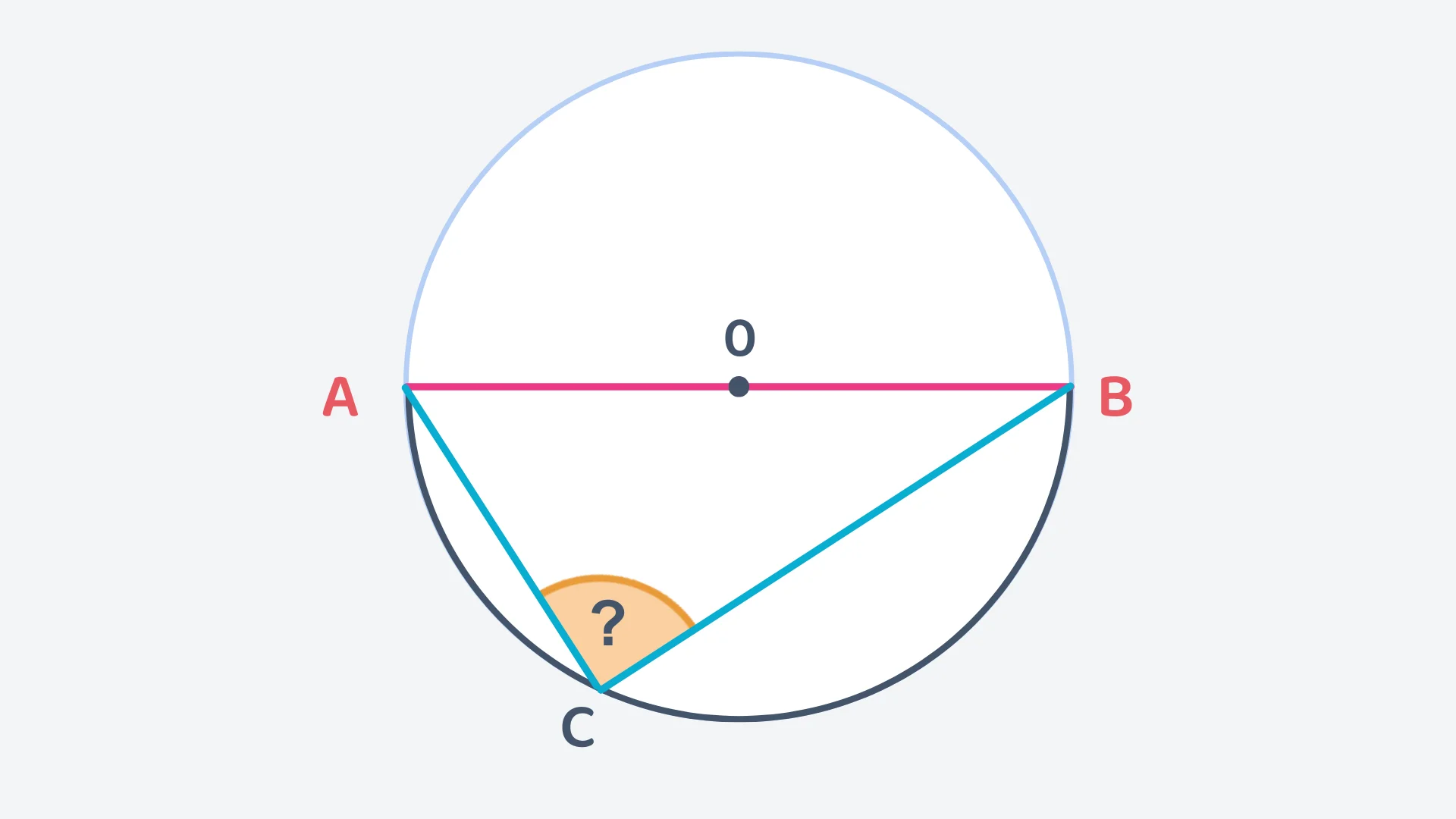
In the following diagram, AB is the diameter of a circle, and C is a point on the circle. What is ?
Correct! 🎉 +10 pointsCorrect! 🎉 Worth 10 XPNot quite right
By Thales' Theorem, if AB is a diameter and C is any other point on the circle, then .
The angle at the centre, , is a straight line and therefore ; the angle at the circumference on the same arc is half of it, so .
It makes no difference that C is on the lower arc here: the result holds wherever C sits on the circle, and needs no measuring.
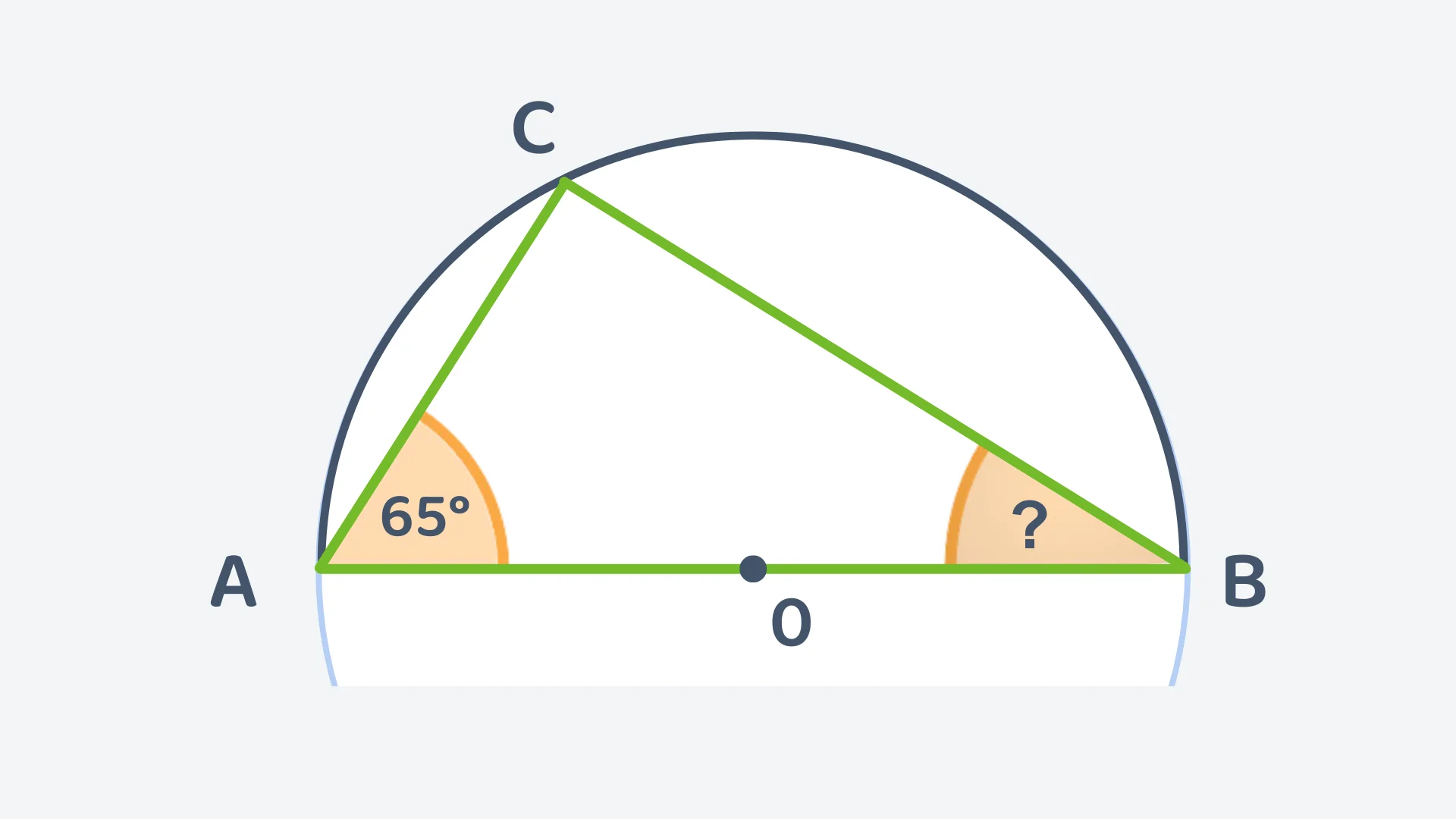
In the following diagram, AB is the diameter of a semicircle, and C is a point on the circle. If , find .
Correct! 🎉 +20 pointsCorrect! 🎉 Worth 20 XPNot quite right
Since AB is the diameter, Thales' Theorem gives .
The angles in triangle ABC add up to , so .
Two traps: the is only the first step (the question asks for the angle at B, not at C), and nothing says the triangle is isosceles. The angles at A and B are and , not equal.
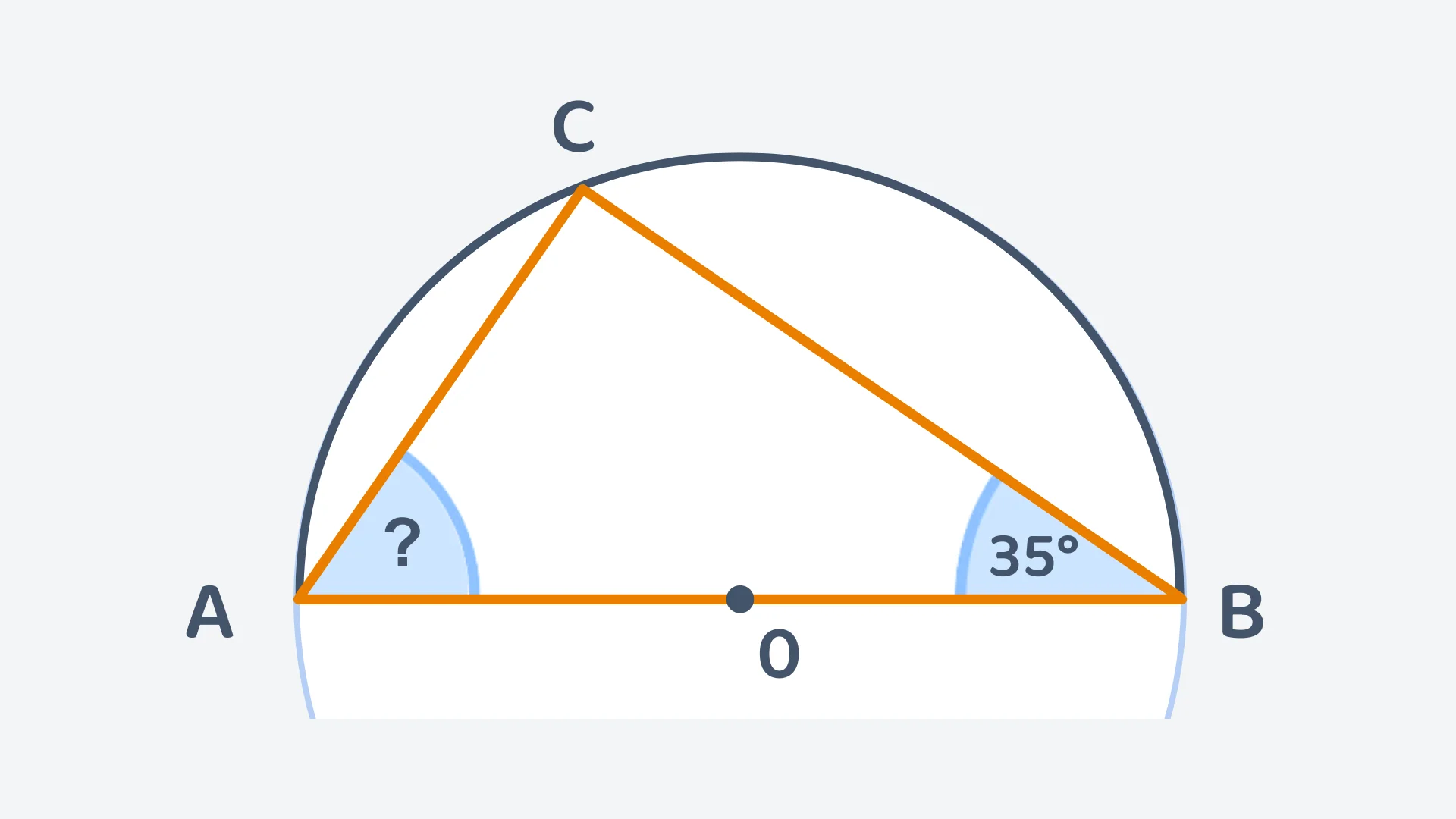
In the following diagram, AB is the diameter of a semicircle, and C is a point on the circle. If , find .
Correct! 🎉 +20 pointsCorrect! 🎉 Worth 20 XPNot quite right
Since AB is the diameter, Thales' Theorem gives .
The angles in triangle ABC add up to , so .
Check: . Notice the angles at A and B are not equal: nothing here says the triangle is isosceles.
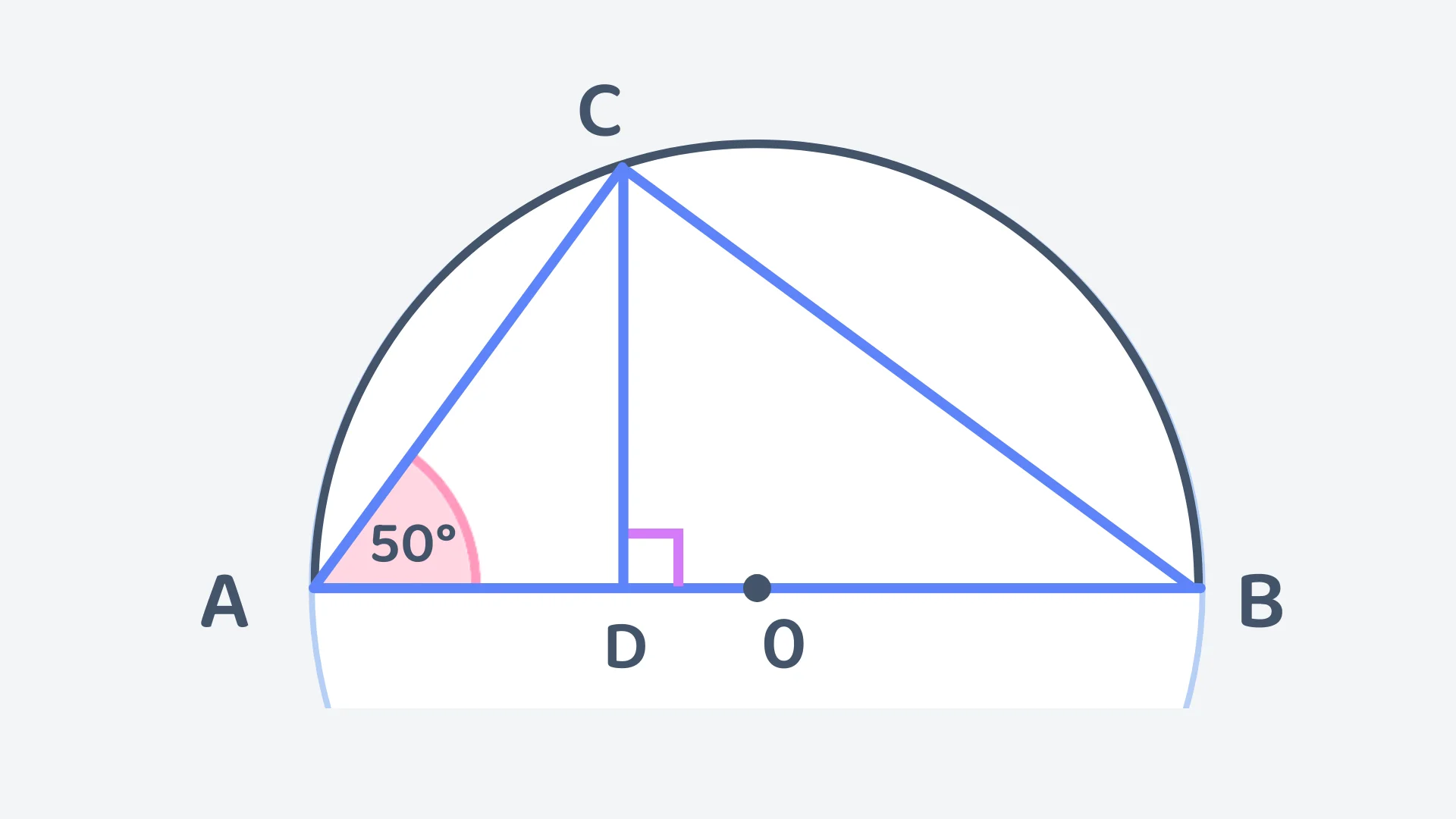
In the following diagram, AB is the diameter of a semicircle, and C is a point on the circle. If , find .
Correct! 🎉 +20 pointsCorrect! 🎉 Worth 20 XPNot quite right
Thales' Theorem says that when AB is the diameter and C is on the circle, , whatever the other angles are.
So the at A is not needed here. It would only be needed for the third angle: .
The answer is . The middle letter, C, tells you the angle is at C, not at A.
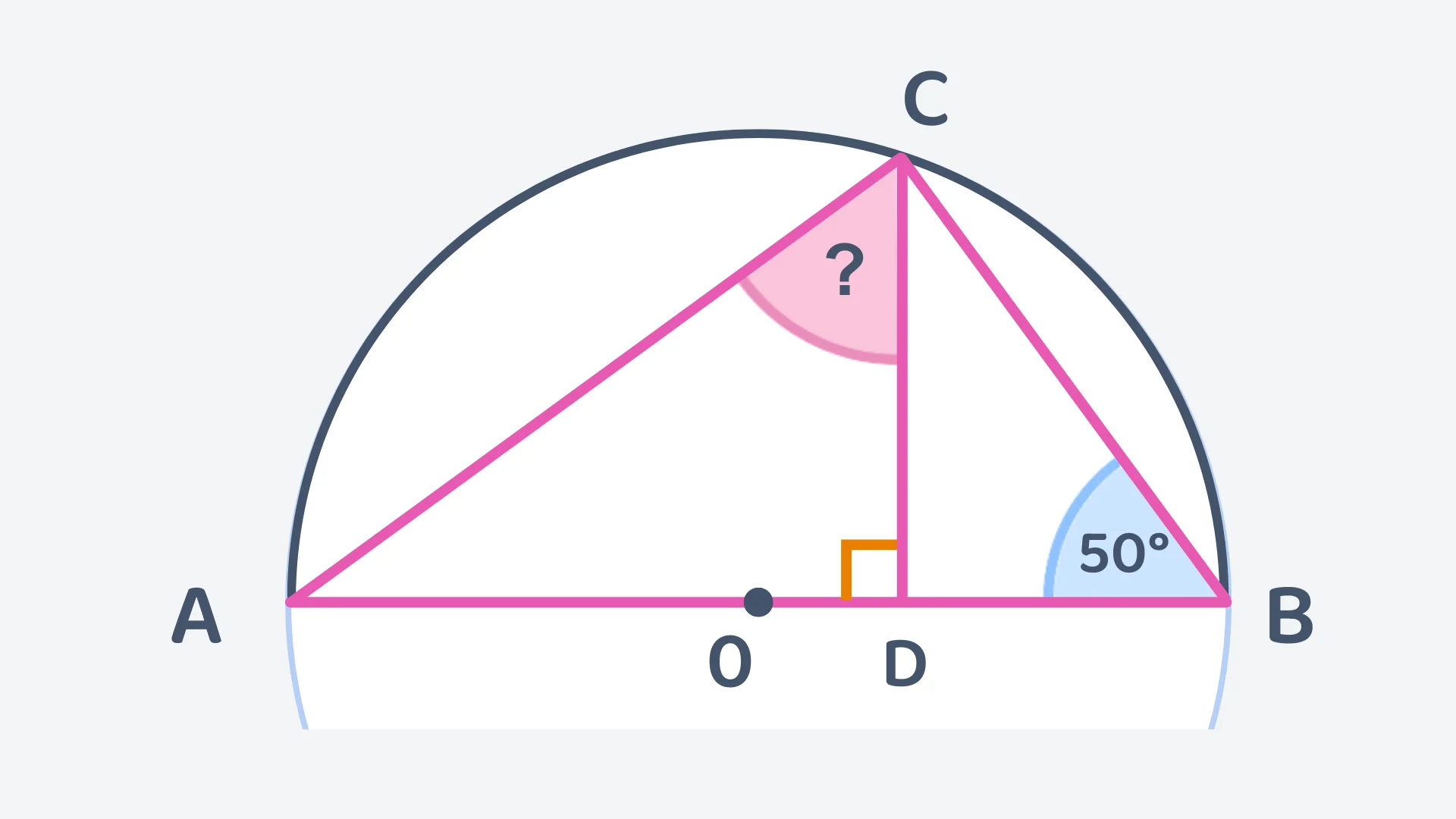
In the following diagram, AB is the diameter of a semicircle, and C is a point on the circle. If , find .
Correct! 🎉 +30 pointsCorrect! 🎉 Worth 30 XPNot quite right
By Thales' Theorem, AB is a diameter so .
In triangle ABC: .
CD is perpendicular to AB, so in triangle ACD we have and , giving .
Note that CD does not cut the right angle at C in half: while .
Want to see the full working?
Interactive Activity
Explore how right angles form on a semicircle
Loading interactive widget...
Frequently asked questions
The questions students bump into most on this topic
Draw a circle and its diameter, then join any point on the circle to the two ends of the diameter. The triangle you get is always right-angled, with the right angle at the point on the circle. That is Thales’ theorem. GCSE papers call it the circle theorem “the angle in a semicircle is 90°”, and all you need to use it is the diameter.
Yes, as long as the angle is drawn from the two ends of the diameter. Move the point anywhere along the curve and the angle at that point stays exactly 90°; each position gives a different right-angled triangle on the same diameter. If the chord is not a diameter, the angle is not 90°.
The angle at the point on the circle, the corner that is not on the diameter. With diameter AB and point C on the circle, angle ACB is the right angle, opposite the diameter. The two angles at A and B are not right angles; they add up to the other 90°.
Mark the angle at the circle as 90°, then use the fact that a triangle’s angles add to 180°. If angle A is 35°, angle B is 180° − 90° − 35° = 55°. With more unknowns, work one triangle at a time: in the video’s second example, angle B is 180° − 90° − 40° = 50°, and then the smaller right-angled triangle gives the last angle, 40°.
Thales of Miletus was a Greek mathematician who lived around 600 BC, roughly a generation before Pythagoras, which makes his theorem one of the oldest results with a name attached. He is credited with being the first to prove the angle in a semicircle is a right angle, rather than just noticing it.
What's next?
Found this one hard? Go one step back first. Feeling confident? Carry on to the next lesson.