Units of Area
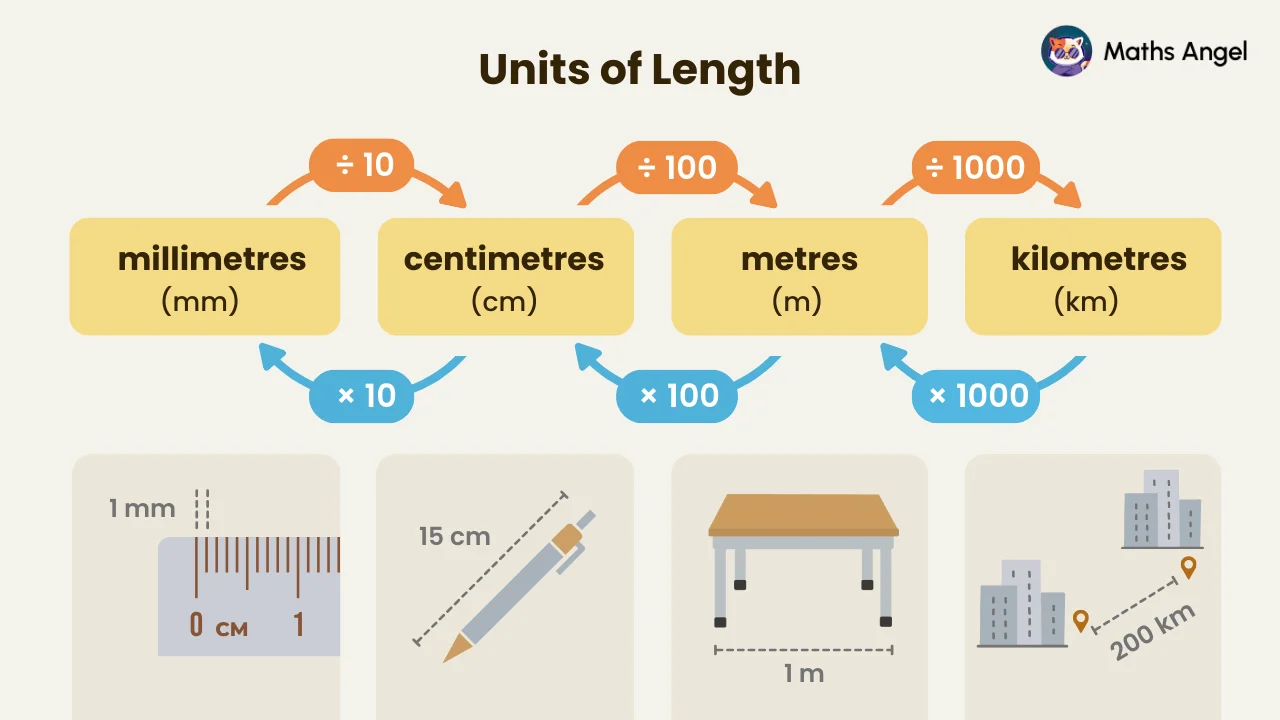
Units of area are square units that measure the space a shape covers, like mm², cm², m², and km². To convert between units of area, square the length conversion, so 1 cm² = 100 mm². Multiply for smaller units, divide for larger.
Video Lesson
Watch and learn the basics
🎬 Did this video explain it clearly?
Flashcards
Review key concepts visually
%20What%20is%20Area.webp)
%20Common%20Units%20of%20Area.webp)
%20Converting%20Units%20of%20Area%20(Chart).webp)
%20Converting%20Area%20Units%20(Examples).webp)
What is Area?
- Area measures how much space a flat shape covers.
- It is measured using square units.
Common Units of Area
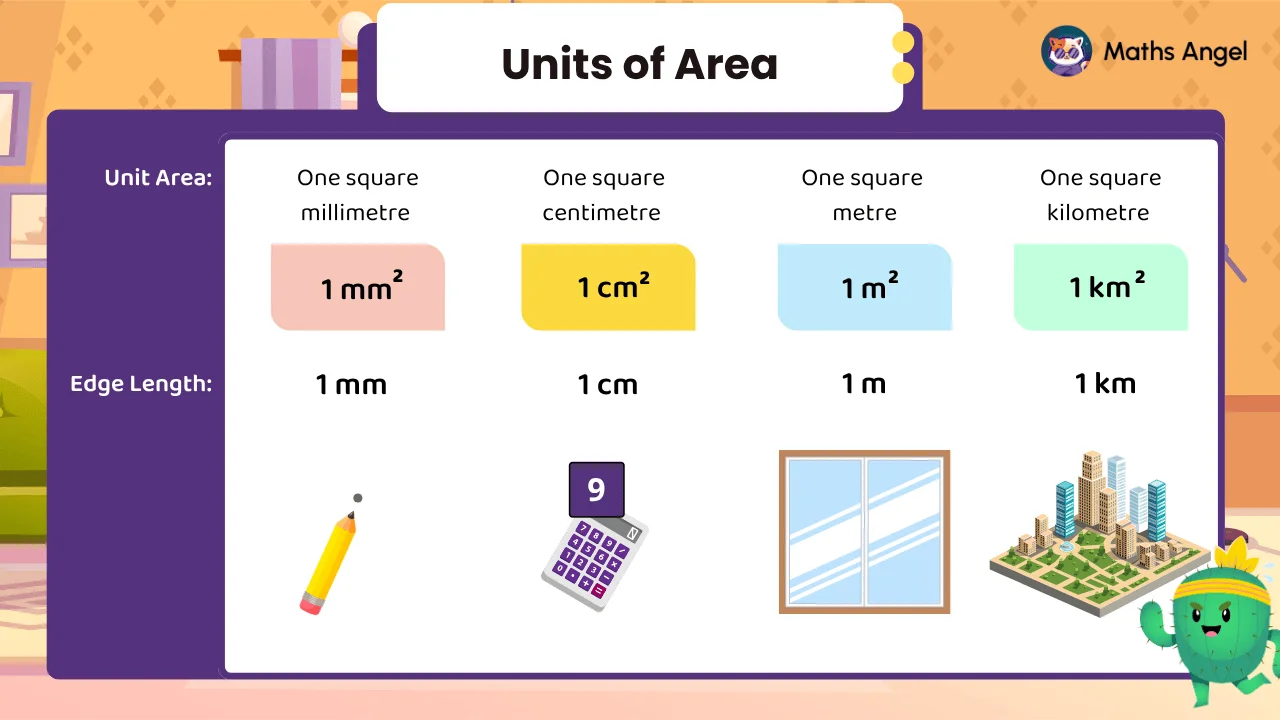
- Common units include mm², cm², m², and km².
- Each unit represents a square (e.g. .
Converting Units of Area
- When converting area, you must square the length conversion.
- For example, , so .
Using Area Conversions
- When converting to a smaller area unit (e.g. m² → cm²), multiply.
- When converting to a larger area unit (e.g. mm² → cm²), divide.
Practice Questions
Test your understanding
Which of the following is NOT a unit of area?
Correct! 🎉 +10 pointsCorrect! 🎉 Worth 10 XPNot quite right
Area is always measured in square units, written with a small 2, such as km², cm² and m². They measure very different sizes of space - a country, a stamp, a carpet - but all three are units of area.
A kilogram (kg) measures mass, which is how heavy something is, so it is the odd one out.
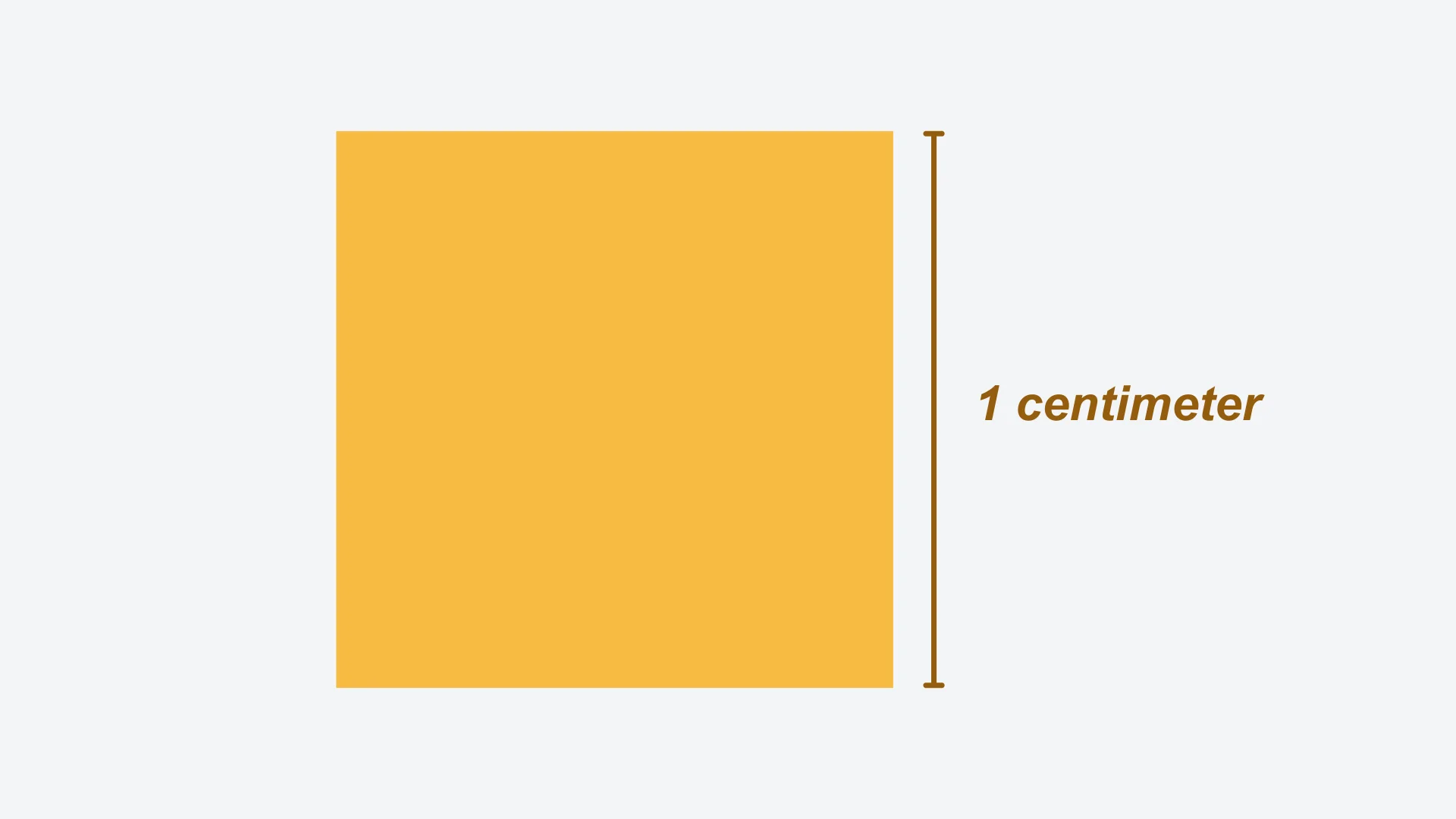
What is the area of a square with sides 1 centimetre long?
Correct! 🎉 +10 pointsCorrect! 🎉 Worth 10 XPNot quite right
The area of a square is side side.
Here each side is , so the area is .
This square is the standard one square centimetre - the unit used when finding area by counting squares.
If a room has an area of 15 square metres, what does this mean?
Correct! 🎉 +20 pointsCorrect! 🎉 Worth 20 XPNot quite right
Area measures how much surface something covers. An area of 15 square metres () means the floor covers the same space as 15 squares that each measure by .
It does not tell you any single length. A room could be by , or by , and its perimeter could be different again.
Convert 4500 square millimetres to square centimetres.
Correct! 🎉 +20 pointsCorrect! 🎉 Worth 20 XPNot quite right
, so a square is by , giving .
To change square millimetres into square centimetres, divide by 100: , so .
Convert 2500 square centimetres to square metres.
Correct! 🎉 +20 pointsCorrect! 🎉 Worth 20 XPNot quite right
, so a square is by , giving .
To change square centimetres into square metres, divide by 10 000: , so .
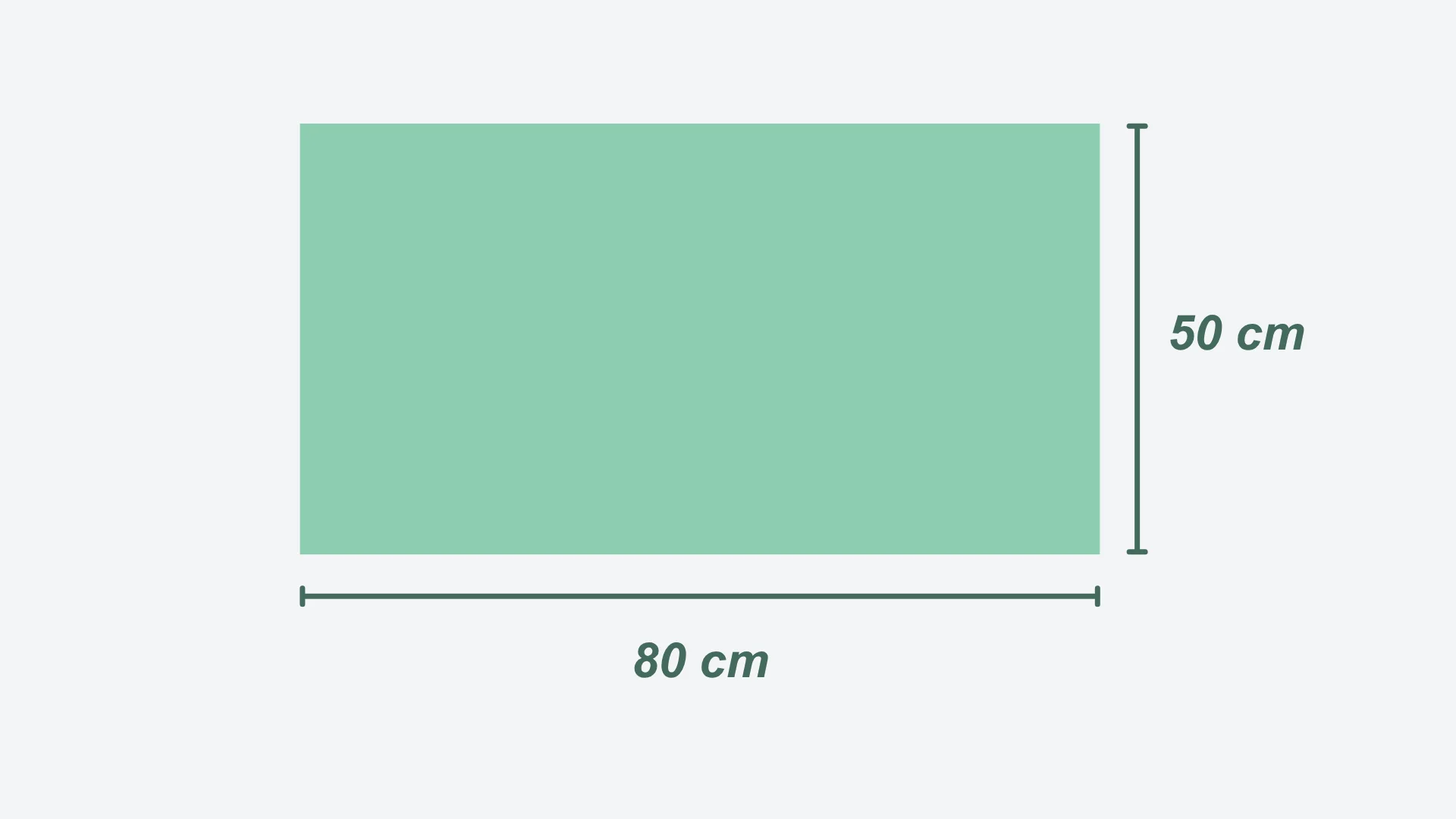
A rectangular room is long and wide. What is its area in square metres?
Correct! 🎉 +30 pointsCorrect! 🎉 Worth 30 XPNot quite right
First find the area in square centimetres: .
, so . Divide by 10 000: , so the area is .
Want to see the full working?
Interactive Activity
Convert between units of area
Loading interactive widget...
Frequently asked questions
The questions students bump into most on this topic
Units of area are square units: square millimetres (mm²), square centimetres (cm²), square metres (m²) and square kilometres (km²). Each is the area of a square with sides of that length: 1 cm² is a square 1 cm by 1 cm, about the size of a calculator button. Use a larger unit for a larger surface, such as km² for a city.
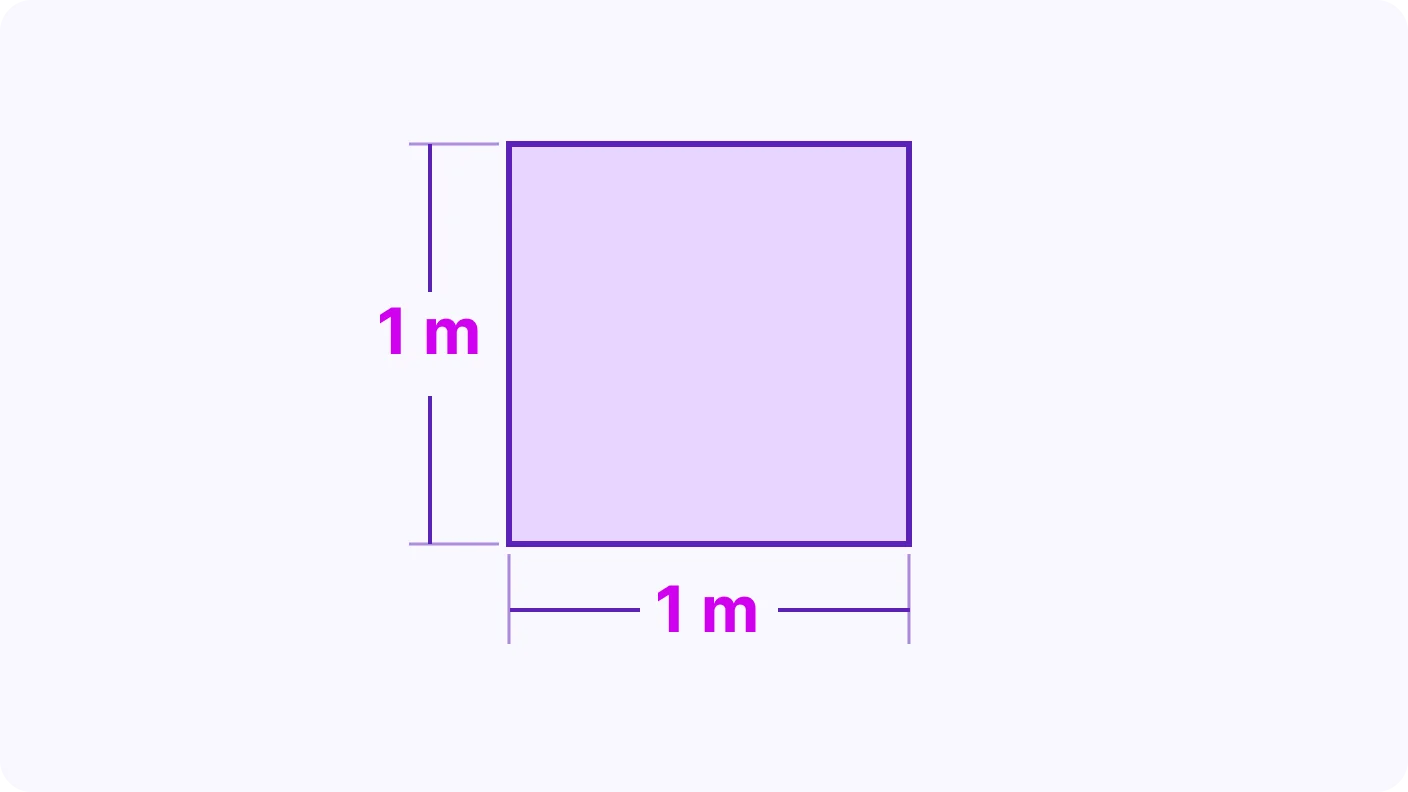
A square metre is the area of a square with sides that are each 1 metre long. It is the usual unit of area for windows, floors and rooms. A bedroom with an area of 25 square metres has room for 25 of these squares on its floor. In American English it is spelt “square meter”.
Square the length conversion. Since 1 cm = 10 mm, 1 cm² = 10 × 10 = 100 mm²; since 1 m = 100 cm, 1 m² = 100 × 100 = 10,000 cm². Then multiply to go to a smaller unit and divide to go to a larger one: 5,000 mm² ÷ 100 = 50 cm², and 3 m² × 10,000 = 30,000 cm².
Divide by 10,000, because 1 m² = 10,000 cm² (100 cm × 100 cm). So 30,000 cm² ÷ 10,000 = 3 m². To go the other way, from m² to cm², multiply by 10,000: 3 m² = 30,000 cm². You divide when moving to a larger unit and multiply when moving to a smaller one.
No. 1 m² = 10,000 cm², not 100, because both sides of the square are converted: 1 m = 100 cm, so 1 m² = 100 cm × 100 cm = 10,000 cm². 100 cm² is only a square 10 cm by 10 cm. Forgetting to square the conversion is the most common mistake with units of area.
What's next?
Found this one hard? Go one step back first. Feeling confident? Carry on to the next lesson.