Perpendicular and Parallel Lines
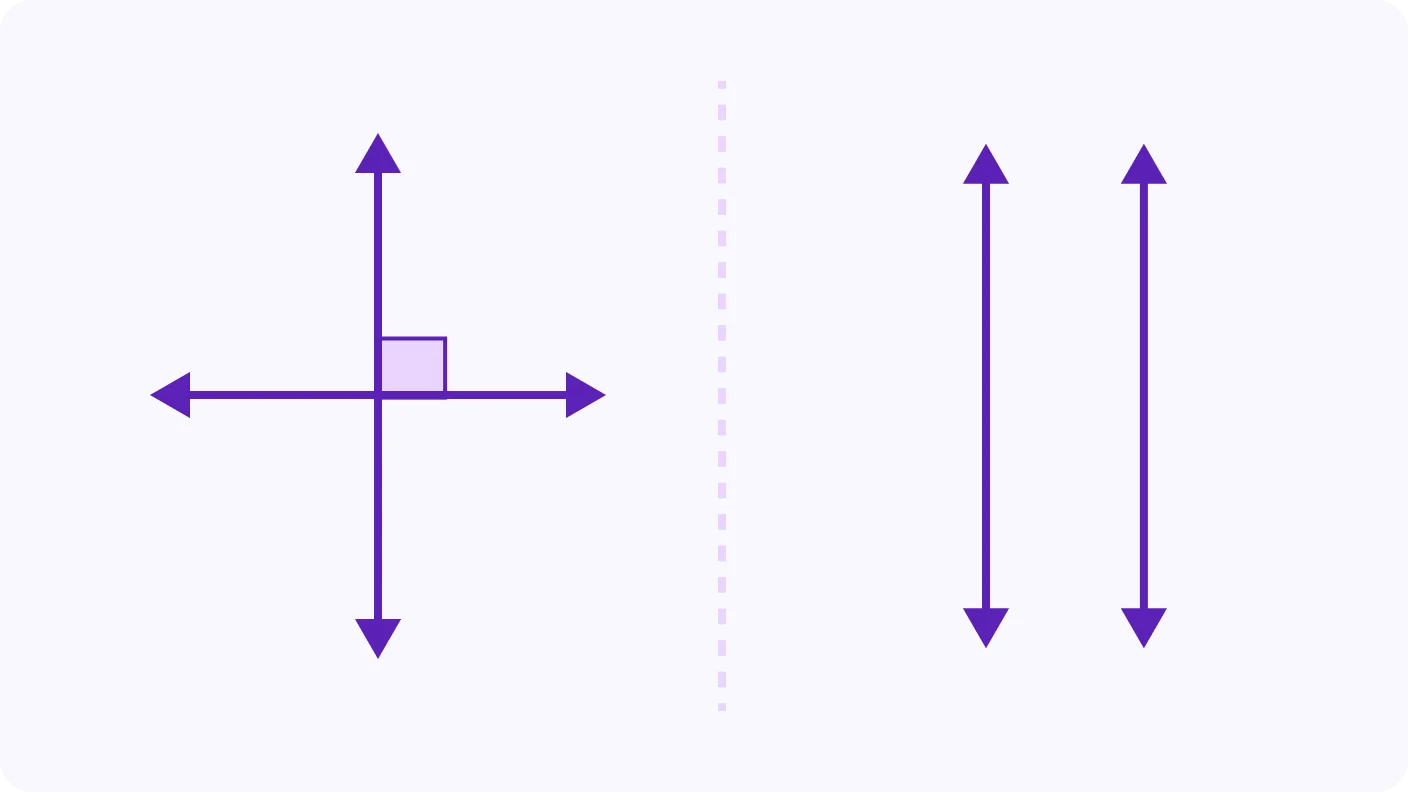
Perpendicular lines cross at a right angle of exactly 90°. Where they meet, they form a square corner, like the corner of a book. Parallel lines stay the same distance apart and never meet.
Video Lesson
Watch and learn the basics
🎬 Did this video explain it clearly?
Flashcards
Review key concepts visually
%20Segments%2C%20Rays%2C%20Lines.webp)
%20Perpendicular%20vs%20Parallel%20Lines.webp)
%20Measuring%20Distances.webp)
What are Different Types of Lines?
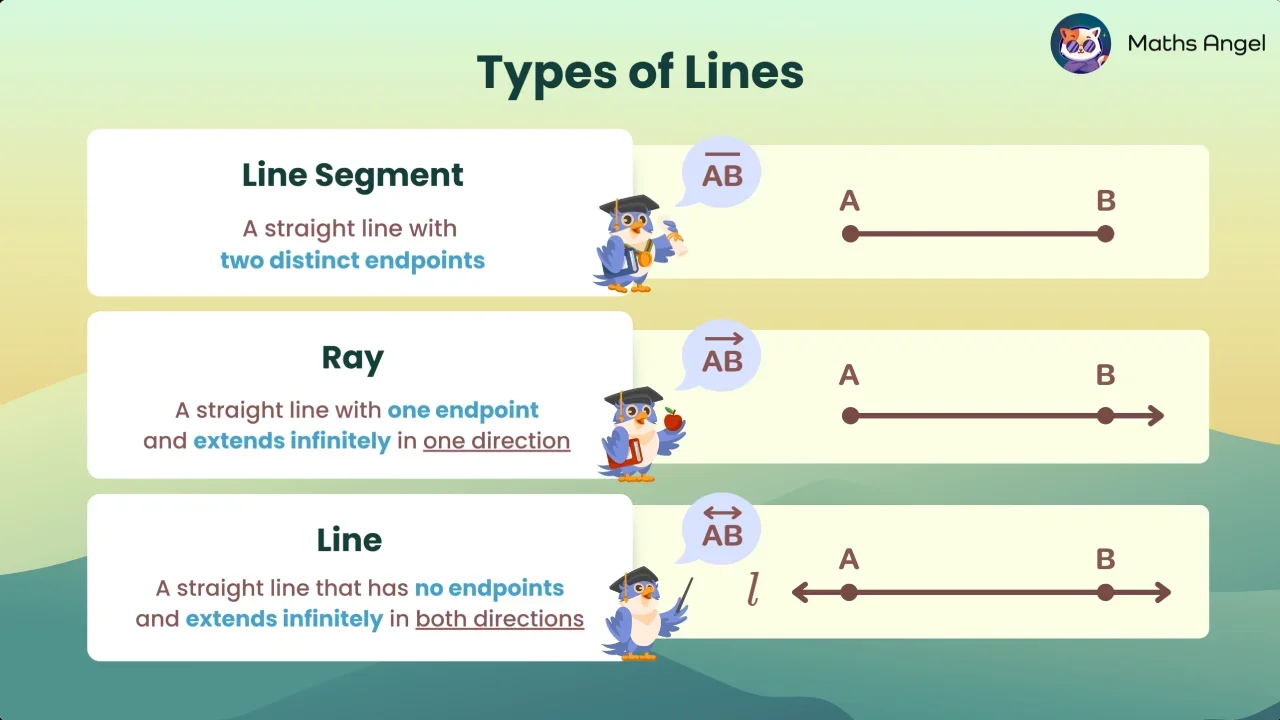
- A line segment has two endpoints, a ray has one endpoint, and a line has no endpoints.
- Rays and lines continue forever, but a line segment has a fixed length.
What are Perpendicular and Parallel Lines?
- Perpendicular lines meet at a right angle ().
- Parallel lines stay the same distance apart and never meet.
How to Measure Distance Between Points and Lines
- The distance between two points is the length of the line segment joining them.
- The distance between parallel lines is the length of the perpendicular line segment between them.
Practice Questions
Test your understanding
What do we call a straight line with two distinct endpoints?
Correct! 🎉 +10 pointsCorrect! 🎉 Worth 10 XPNot quite right
A line segment has two distinct endpoints, so it has a definite start and a definite end, and a length you can measure.
The others are different: a line has no endpoints and carries on forever in both directions, a ray has one endpoint and carries on forever in the other direction, and a vertex is a single point where lines meet, not a line at all.
Which of these lines never intersect and stay the same distance apart?
Correct! 🎉 +10 pointsCorrect! 🎉 Worth 10 XPNot quite right
Parallel lines never meet, however far they are extended, because they stay exactly the same distance apart all the way along.
Perpendicular lines do meet: they cross at a right angle. Lines can also be parallel even when they are different lengths, so length has nothing to do with it.
Two parallel lines are apart. A perpendicular line segment is drawn between them. What is the length of this line segment?
Correct! 🎉 +20 pointsCorrect! 🎉 Worth 20 XPNot quite right
The distance between two parallel lines is measured along a perpendicular segment, and that distance is the same everywhere along the lines.
So the perpendicular segment joining them is exactly . A segment that crosses at a slant would measure more than , because the perpendicular join is always the shortest one.
If you draw two lines that are perpendicular, what kind of angle do they form?
Correct! 🎉 +20 pointsCorrect! 🎉 Worth 20 XPNot quite right
Perpendicular lines cross at exactly , which is a right angle.
This stays true however the pair is turned on the page. A tilted pair of perpendicular lines still meets at , even though it no longer looks like the usual upright textbook picture.
If two lines are parallel, what is true about the distance between them?
Correct! 🎉 +20 pointsCorrect! 🎉 Worth 20 XPNot quite right
Parallel lines stay exactly the same distance apart all the way along. That constant perpendicular gap is what makes them parallel.
If the gap changed, the lines would eventually meet and would not be parallel. If the gap were zero, the two lines would be the same line, not a parallel pair. And the gap has nothing to do with how long the lines are drawn.
What is the shortest distance from a point to a line?
Correct! 🎉 +30 pointsCorrect! 🎉 Worth 30 XPNot quite right
The shortest distance from a point to a line is measured along the perpendicular from the point to the line.
Any other segment from the point to the line is the hypotenuse of a right-angled triangle whose shorter side is that perpendicular, so it must be longer. The distance is measured to the line itself, at right angles to it, not to any particular point on it such as an end or a midpoint. This is why loci and "distance from a line" questions are always measured at right angles.
Want to see the full working?
Interactive Activity
Explore perpendicular vs parallel lines and measure distances
Loading interactive widget...
Frequently asked questions
The questions students bump into most on this topic
Perpendicular lines are two lines that cross at a right angle, 90°, whatever direction they point in. The corner of a book or the edges of a triangle ruler are examples. To check or draw one, place the triangle ruler against the first line and draw along its other edge. The symbol ⊥ means perpendicular, so a ⊥ b says the lines cross at 90°.
Parallel lines are lines that stay the same distance apart all the way along and never meet, like railway tracks running side by side. Their direction does not matter, only that the gap never changes. The symbol ∥ means parallel, so a ∥ b says the two lines never cross.
A line segment has two endpoints and a fixed length you can measure, like a bridge between two signs. A ray has one endpoint and goes on forever in one direction, like the beam of a torch. A line has no endpoints and goes on forever both ways. All three are perfectly straight.
Perpendicular lines meet at one point, and at that point they cross at a right angle of exactly 90°. That is what makes them perpendicular, so it stays true however the pair is turned. Two lines that cross at any other angle are not perpendicular, just intersecting.
No. Parallel lines never meet, however far you extend them in either direction, because they stay exactly the same distance apart all the way along. If two lines are getting closer, they are not parallel and will eventually cross.
The shortest distance from a point to a line is along the perpendicular from the point to the line. Place the base of a triangle ruler along the line, draw the line from the point that meets it at 90°, and measure that segment. The distance between two parallel lines is measured the same way, from any point on one line.
What's next?
Found this one hard? Go one step back first. Feeling confident? Carry on to the next lesson.