Measurement and Types of Angles
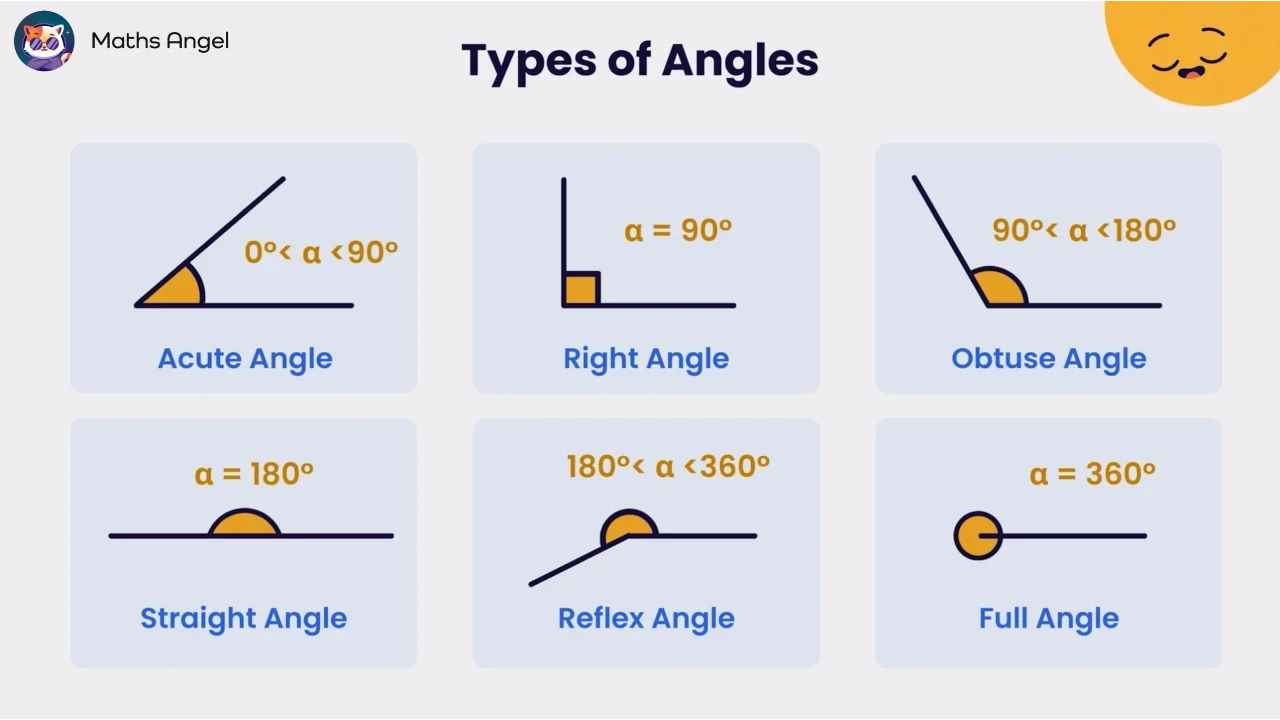
Types of angles are grouped by their size in degrees. An acute angle is under 90°, an obtuse angle is 90° to 180°, and a reflex angle is over 180°. You measure them with a protractor.
Video Lesson
Watch and learn the basics
🎬 Did this video explain it clearly?
Flashcards
Review key concepts visually
%20What%20is%20an%20angle.webp)
%20Categorising%20Angles.webp)
%20Measuring%20Angles.webp)
%20Measuring%20Angles%20over%20180%20degrees.webp)
%20Drawing%20Angles.webp)
%20Drawing%20Angles%20over%20180%20degrees.webp)
What is an Angle?
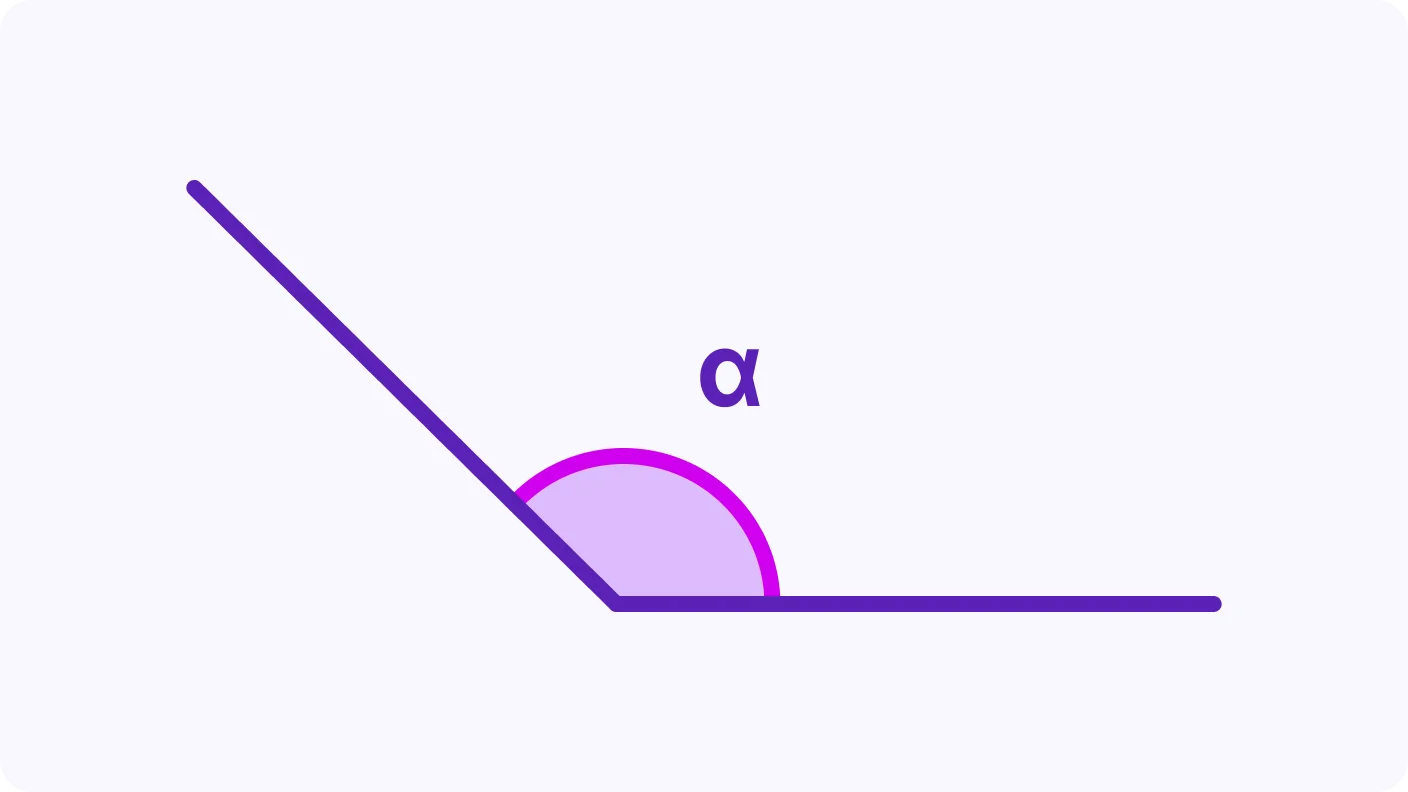
- An angle is formed when two lines meet at a point, called the vertex.
- Angles are measured in degrees (°).
Types of Angles
- Acute angle: < angle <
- Obtuse angle: < angle <
- Reflex angle: < angle <
How to Measure Angles?
- Place the centre of the protractor on the vertex.
- Align the zero line with one arm and read where the other arm crosses the scale.
Measuring Angles Greater Than
- Measure the smaller angle first using the protractor.
- Subtract from to find the reflex angle.
How to Draw Angles?
- Draw a straight line for one arm of the angle.
- Place the protractor, mark the required angle, then draw the second arm.
Drawing Angles Greater Than
- Subtract the given angle from to find the smaller angle.
- Draw the smaller angle, and the reflex angle is the one you need.
Practice Questions
Test your understanding
What is the measure of a straight angle?
Correct! 🎉 +10 pointsCorrect! 🎉 Worth 10 XPNot quite right
A straight angle is the half turn made when the two arms lie in opposite directions along a straight line. It measures .
For comparison, a quarter turn (a right angle) is and a full turn is . A straight angle is still a real angle: it is a half turn, not no turn at all.
Which of these is an acute angle?
Correct! 🎉 +10 pointsCorrect! 🎉 Worth 10 XPNot quite right
An acute angle is greater than and less than .
Only fits. is exactly a right angle, so it is not acute; is obtuse (between and ); and is a straight angle.
What is the sum of the angles in a full circle?
Correct! 🎉 +20 pointsCorrect! 🎉 Worth 20 XPNot quite right
The angles around a point make one complete turn, so they add up to .
Half a turn (a straight line) is and a quarter turn (a right angle) is . A circle is not split into 100 parts: that is percentages, not degrees.
A angle is too big to measure directly on a protractor. You draw a smaller angle first, then mark the as the reflex angle on the other side of its two arms. What smaller angle should you draw?
Correct! 🎉 +20 pointsCorrect! 🎉 Worth 20 XPNot quite right
is a reflex angle, so it cannot be measured directly on a protractor.
Subtract from a full turn: . Draw a angle; the angle on the other side of its two arms is then the you want.
An angle measures . What type of angle is it?
Correct! 🎉 +20 pointsCorrect! 🎉 Worth 20 XPNot quite right
is greater than but less than , so it is obtuse.
For comparison: an acute angle is less than , a straight angle is exactly , and a reflex angle is more than .
Two angles form a straight line. One angle is 5 times the size of the other angle. What is the measure of the larger angle?
Correct! 🎉 +30 pointsCorrect! 🎉 Worth 30 XPNot quite right
Angles on a straight line add up to .
Let the smaller angle be x. Then the larger is 5x, and , so .
The larger angle is . (Check: .)
Want to see the full working?
Interactive Activity
Explore different types of angles by rotating the arm
Loading interactive widget...
Frequently asked questions
The questions students bump into most on this topic
Angles are grouped by size. An acute angle is between 0° and 90°; a right angle is exactly 90°, the corner of a square; an obtuse angle is between 90° and 180°; a straight angle is exactly 180°, a straight line; a reflex angle is between 180° and 360°; and a full angle is 360°, a complete circle. That makes six types.
An acute angle is greater than 0° and less than 90°, so it looks sharp and narrow. Angles of 30°, 45° and 50° are all acute. It is smaller than a right angle, which is exactly 90°. On a protractor you read the smaller of the two numbers where the arm crosses the scale.
An obtuse angle is greater than 90° and less than 180°, so it is wider than a right angle but not yet a straight line. An angle of 110° or 130° is obtuse. On a protractor you read the larger of the two numbers where the arm crosses the scale.
A reflex angle is greater than 180° and less than 360°: bigger than a straight line but less than a full turn. An angle of 220° is reflex. A protractor only reaches 180°, so you measure the smaller angle on the other side and subtract it from 360°.
Put the protractor’s centre on the vertex and its zero line along one arm. Read where the other arm crosses the scale, extending the arm if needed: for an acute angle read the smaller number, 50°; for an obtuse angle the larger, 130°. To draw an angle, draw one arm, mark the number you need on the scale and join the mark to the vertex.
Use the smaller angle on the other side. To measure a reflex angle, measure its smaller partner, 140°, and subtract from a full turn: 360° − 140° = 220°. To draw 210°, subtract first, 360° − 210° = 150°, draw the 150° angle with the protractor, and the angle outside your mark is the 210° you need.
What's next?
Found this one hard? Go one step back first. Feeling confident? Carry on to the next lesson.