Angle Relationships in Intersecting and Parallel Lines
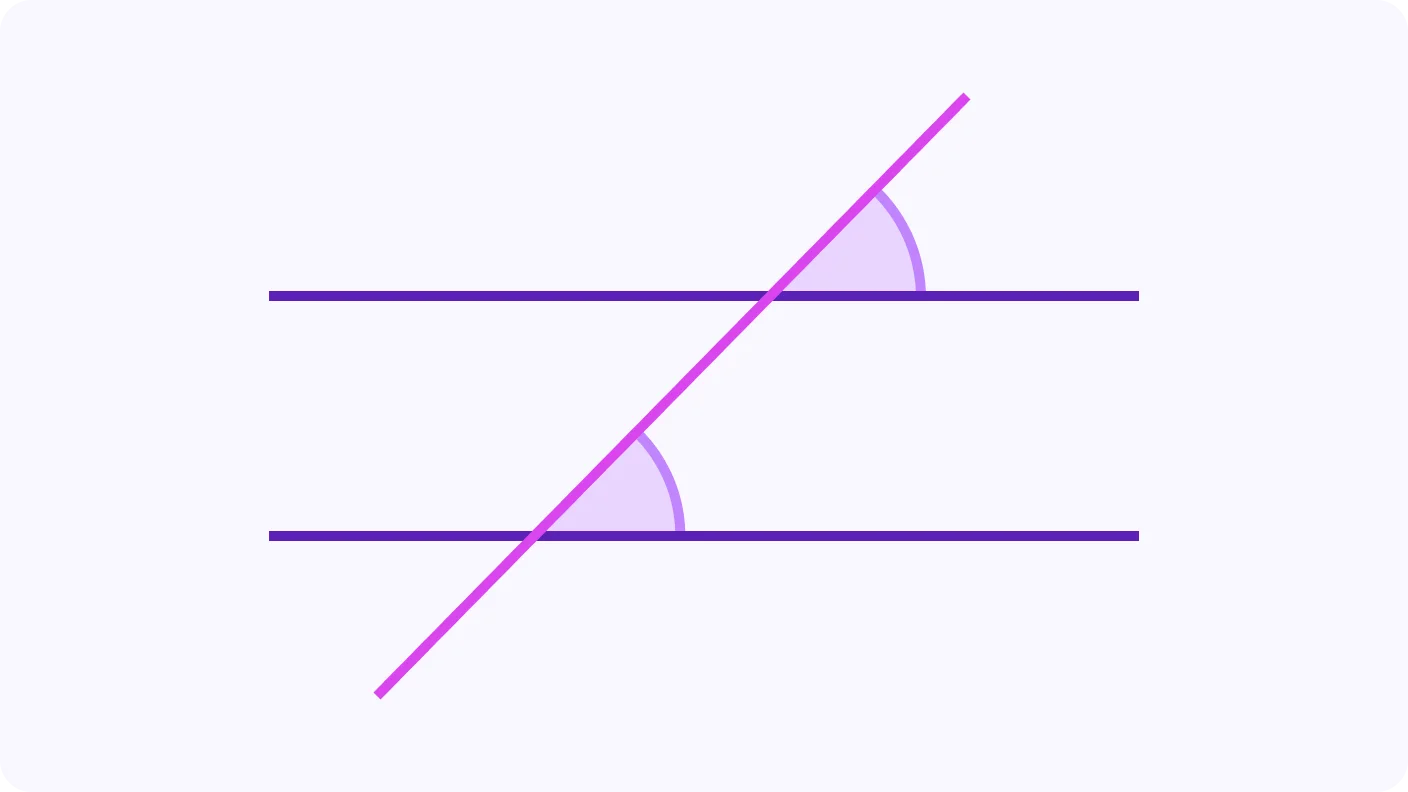
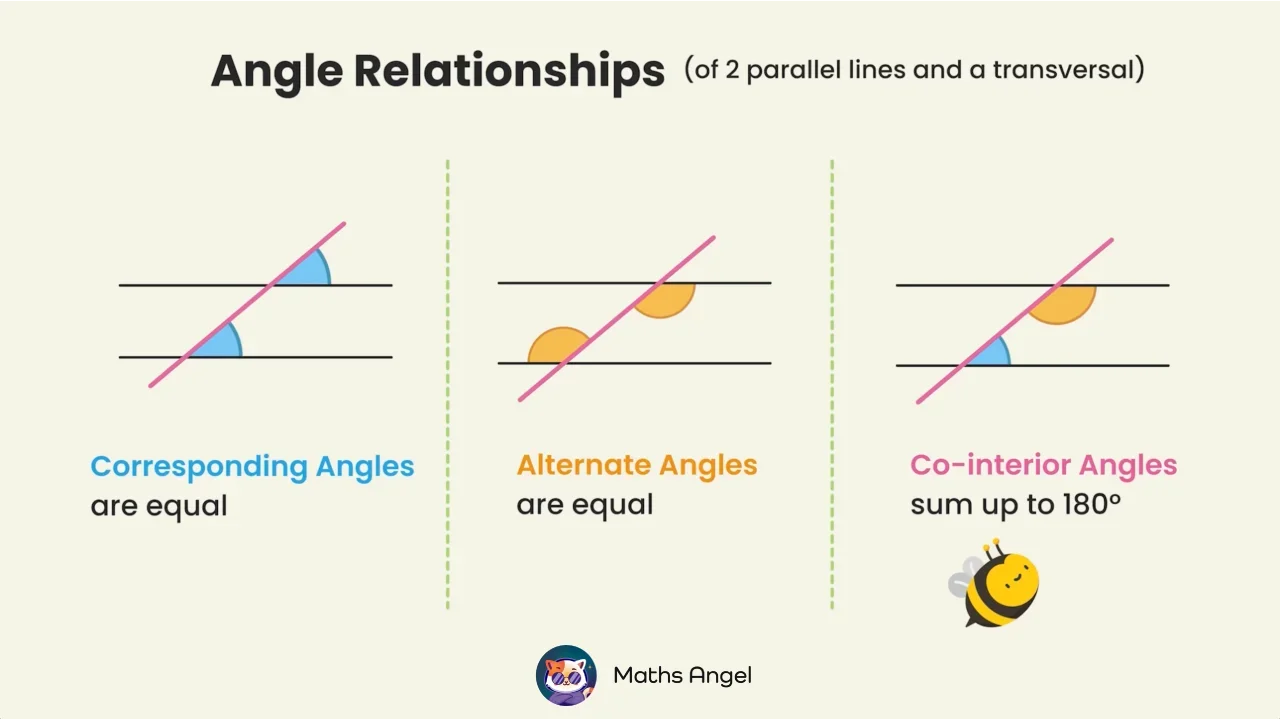
Angle relationships are the rules that link angles when lines cross. Across parallel lines, corresponding and alternate angles are equal, while co-interior angles sum to 180°.
Video Lesson
Watch and learn the basics
🎬 Did this video explain it clearly?
Flashcards
Review key concepts visually
%20Vertically%20Opposite%20and%20Adjacent%20Angles.webp)
%20Corresponding%2C%20Alternate%2C%20Co-Interior%20Angles.webp)
%20Finding%20the%20Missing%20Angles.webp)
Angles Formed by Intersecting Lines
- Vertically opposite angles are equal
- Adjacent angles on a straight line add to
Angles in Parallel Lines with a Transversal
- Corresponding angles are equal
- Alternate angles are equal
- Co-interior angles add to
How to Find Missing Angles
- Use equal angles (vertically opposite, corresponding, alternate)
- Use angles that add to (co-interior angles, supplementary angles)
Practice Questions
Test your understanding
If two lines intersect, and one angle measures , what is the measure of its vertically opposite angle?
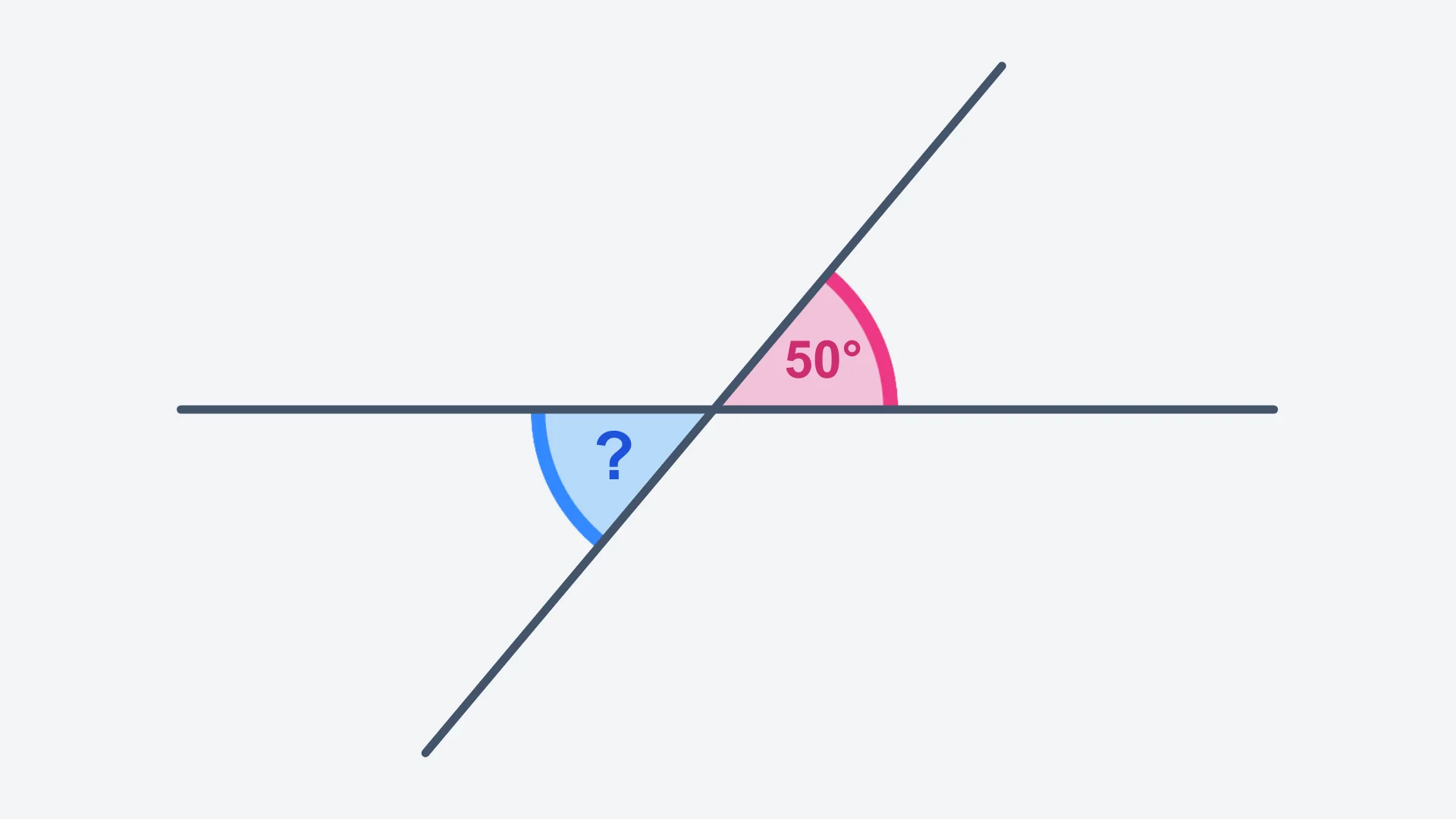
Correct! 🎉 +10 pointsCorrect! 🎉 Worth 10 XPNot quite right
Vertically opposite angles sit on opposite sides of the crossing point, and they are always equal. So the marked angle is .
Beware the two angles next to it: each of those makes a straight line with the , so each is . The four angles round the crossing point do add to , but that is a fact about all four together - you do not subtract from here. Nothing says the two lines cross at right angles either.
Two adjacent angles on a straight line are and . If , what is ?
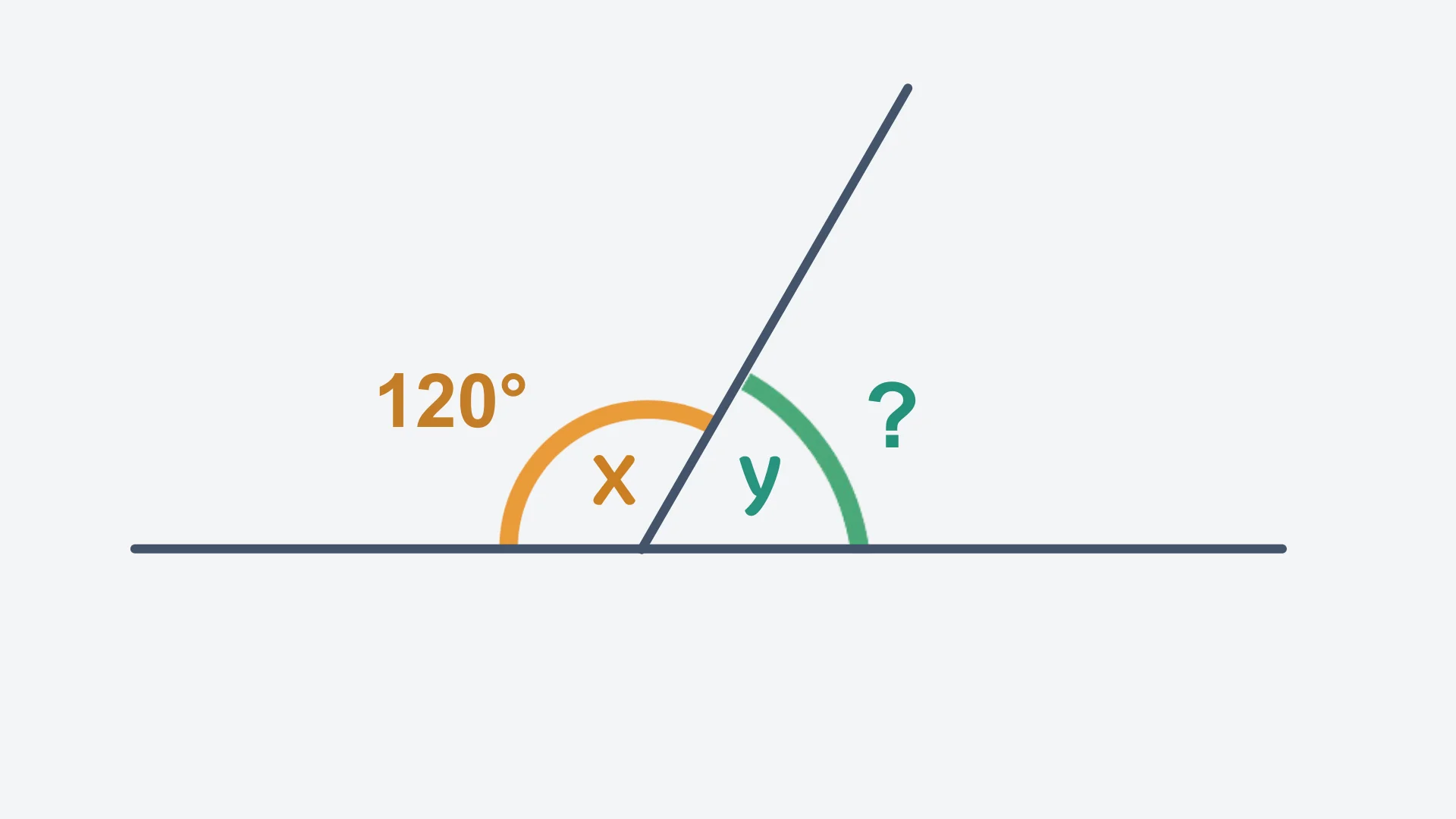
Correct! 🎉 +10 pointsCorrect! 🎉 Worth 10 XPNot quite right
Adjacent angles on a straight line are supplementary: they add to . So .
They are not equal - that is the rule for vertically opposite angles, which is a different pair. And the total here is , not the you get all the way round a point; nothing says the ray is perpendicular to the line either.
Two parallel lines are intersected by a transversal. If one co-interior angle is , what is the measure of the other co-interior angle?
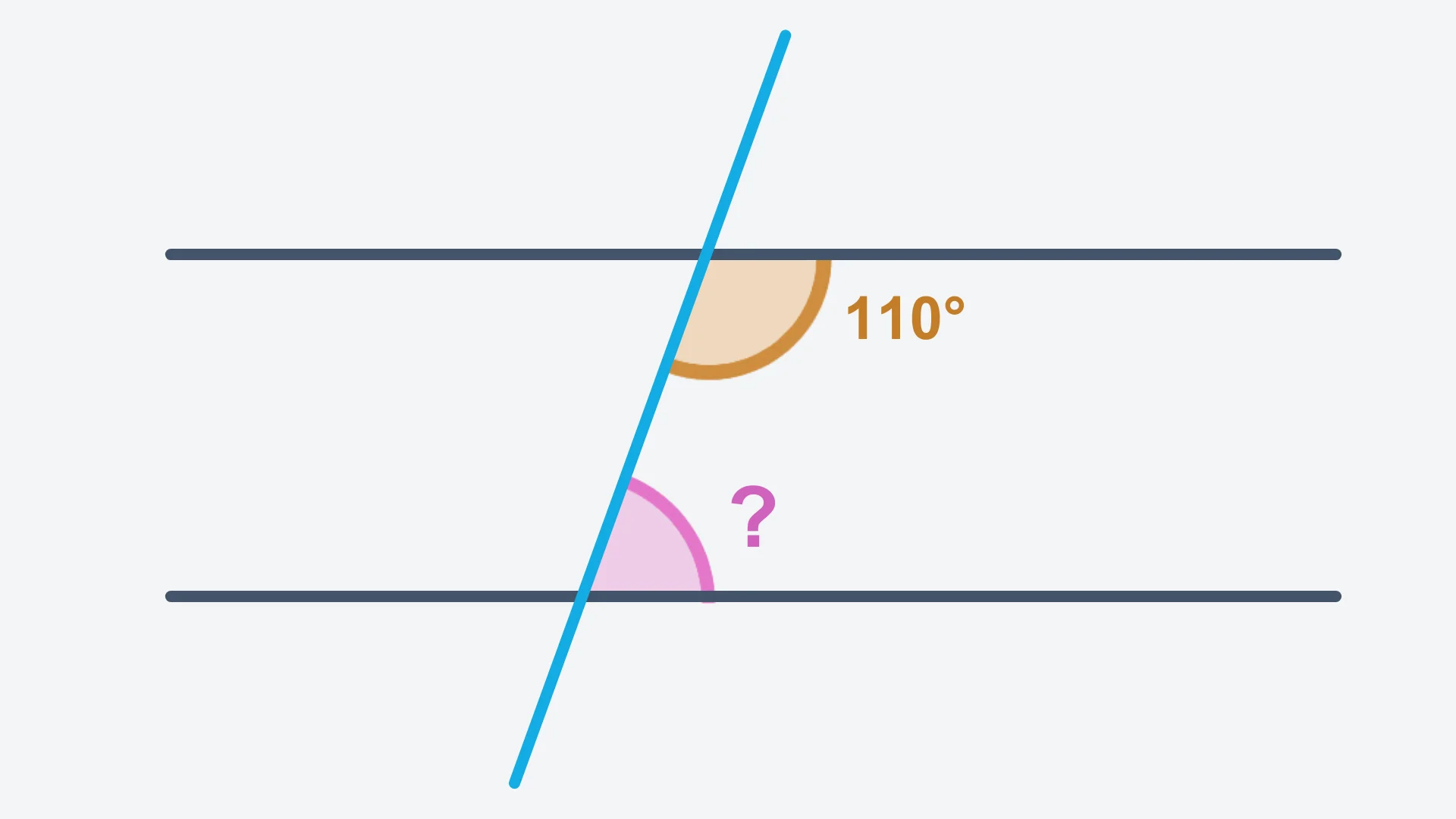
Correct! 🎉 +20 pointsCorrect! 🎉 Worth 20 XPNot quite right
Co-interior angles are the pair inside the parallel lines on the same side of the transversal. They are supplementary, so they add to - they are not equal.
So the other angle is . As a check, is obtuse and is acute, which matches the diagram.
Two parallel lines are intersected by a transversal. If one alternate angle measures , what is the measure of the other alternate angle?
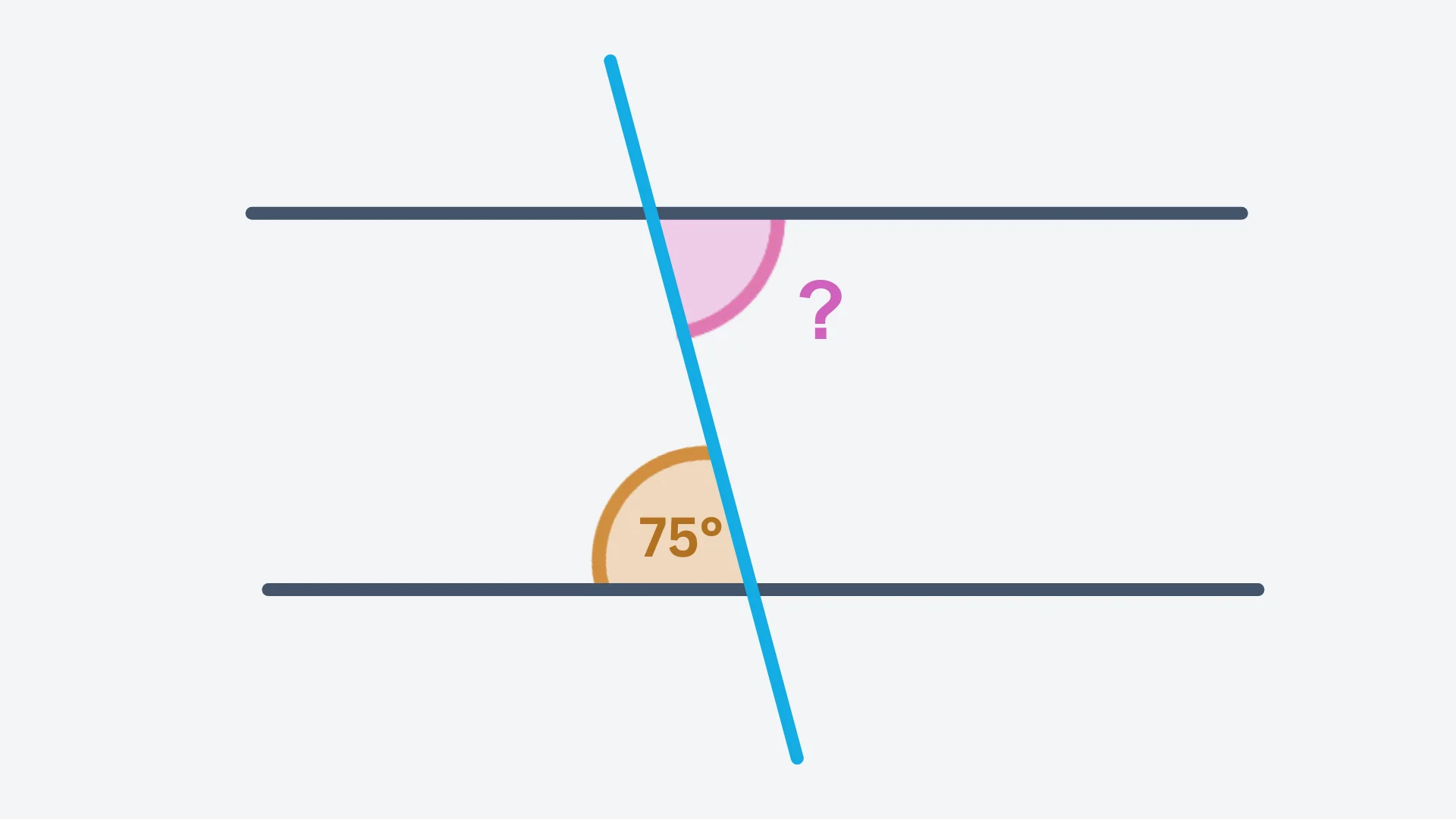
Correct! 🎉 +20 pointsCorrect! 🎉 Worth 20 XPNot quite right
Alternate angles are the pair inside the parallel lines but on opposite sides of the transversal, forming a Z shape. They are always equal, so the other angle is also .
Do not subtract from here: that rule is for two angles that meet at the same point on a straight line, and these two angles are at different crossing points.
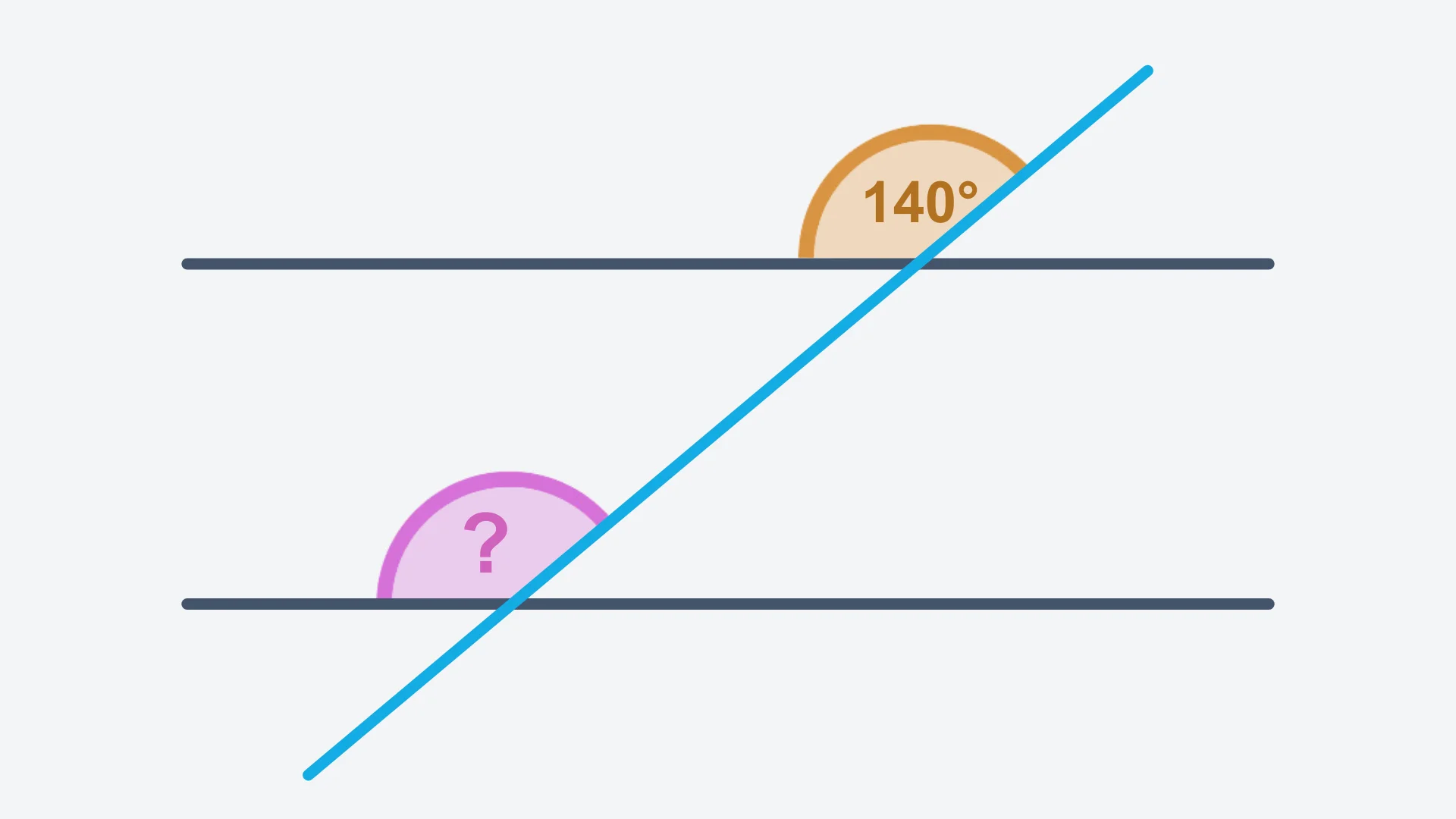
Two parallel lines are intersected by a transversal. One angle is . What is its corresponding angle?
Correct! 🎉 +20 pointsCorrect! 🎉 Worth 20 XPNot quite right
Corresponding angles are the pair in matching positions at the two crossing points, forming an F shape. They are always equal, so the corresponding angle is .
The angle next to it at the same crossing point would be , but that is a different angle, not the corresponding one.
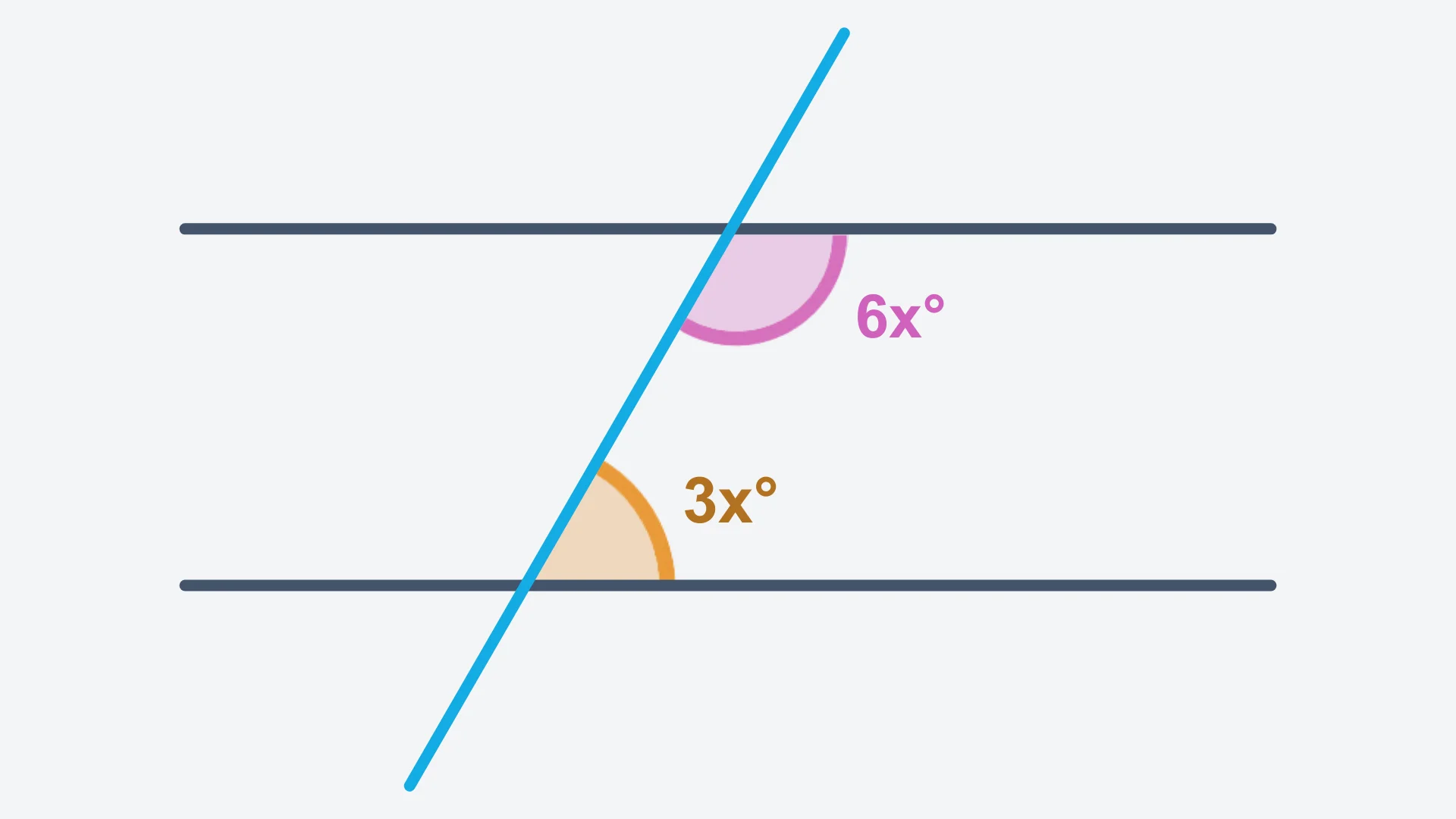
Two parallel lines are intersected by a transversal. One angle is , and its co-interior angle is . What is the larger angle?
Correct! 🎉 +30 pointsCorrect! 🎉 Worth 30 XPNot quite right
Co-interior angles add to , so . That gives and .
The question asks for the larger angle, so substitute back into : the answer is . Check it - the smaller angle is , and .
Do not stop at , and do not use : that total is for the angles all the way round a point. Nothing here says the transversal is perpendicular either, so neither angle is a right angle.
Want to see the full working?
Interactive Activity
Click angles to discover their relationships
Loading interactive widget...
Frequently asked questions
The questions students bump into most on this topic
When two straight lines cross they make four angles. The two directly opposite each other are vertically opposite angles, and they are always equal. The two next to each other sit on a straight line, so they add up to 180°; angles that add to 180° are called supplementary. If one angle is 140°, the one opposite is 140° and the ones beside it are 40°.
When a line called a transversal crosses two parallel lines, corresponding angles are the pair on the same side of the transversal that open in the same direction, one at each parallel line. They are always equal. They do not add up to a fixed total: if one is 140°, so is the other.
Alternate angles sit on opposite sides of the transversal and open in opposite directions, one at each parallel line, and they are always equal. In the video, angle 1 is 140°, so its alternate angle, angle 4, is also 140°. The rule only holds when the two lines are parallel.
180°. Co-interior angles sit on the same side of the transversal and between the two parallel lines. They are not equal, except when both are 90°; one is 180° minus the other, so a 40° angle pairs with a 140° one. American sites call them same-side interior angles; the rule is the same.
Start from the angle you know and use one rule at a time. Angle 1 is 140°. Angle 2 is on a straight line with it, so 180° − 140° = 40°. Angle 3 is vertically opposite angle 2, so 40°. Angle 4 is alternate to angle 1, so 140°. Angle 5 is corresponding to angle 1, so 140°. One angle gives you all of them.
A transversal is a straight line that crosses two other lines. When the two lines are parallel, the transversal makes eight angles, and three rules link them: corresponding angles are equal, alternate angles are equal, and co-interior angles add up to 180°. Spot the transversal first and the pairs are easier to name.
What's next?
Found this one hard? Go one step back first. Feeling confident? Carry on to the next lesson.