Constructing Triangles
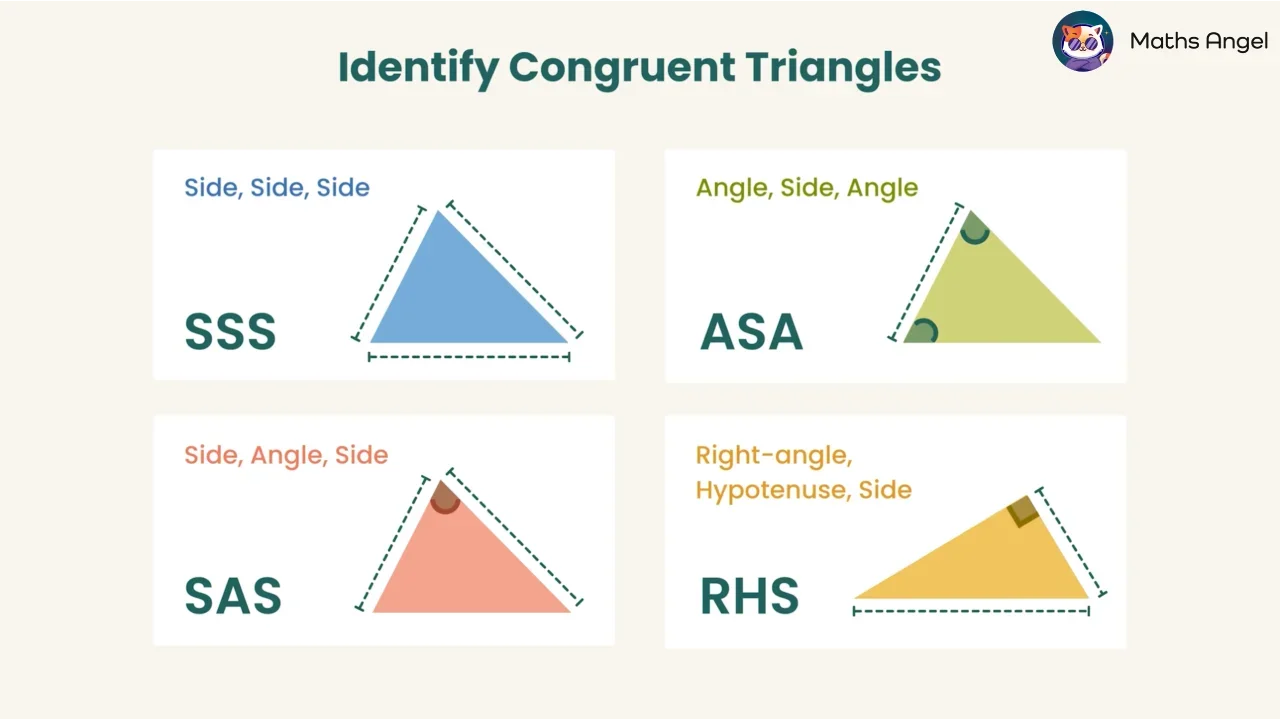
Constructing triangles means drawing them accurately with a compass, ruler, and protractor. You measure and copy each given side and angle exactly. Use SSS, SAS, or ASA to match the sides and angles given.
Video Lesson
Watch and learn the basics
🎬 Did this video explain it clearly?
Flashcards
Review key concepts visually
%20Triangle%20Components.webp)
%20Construct%20Triangle%20(ASA).webp)
%20Construct%20Triangle%20(SAS).webp)
%20Constructing%20Triangles(Common%20Pitfall).webp)
%20Construct%20Triangle%20(SSS).webp)
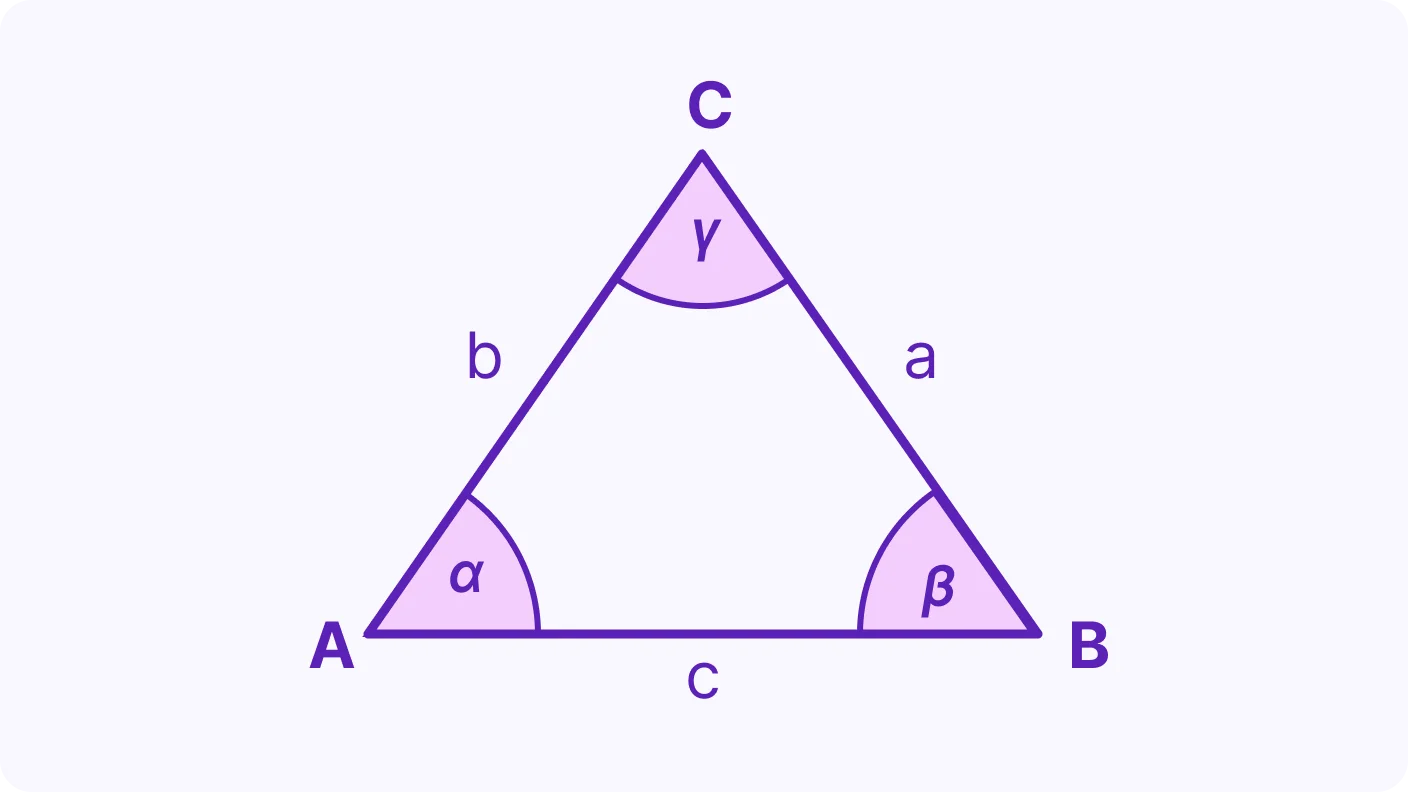
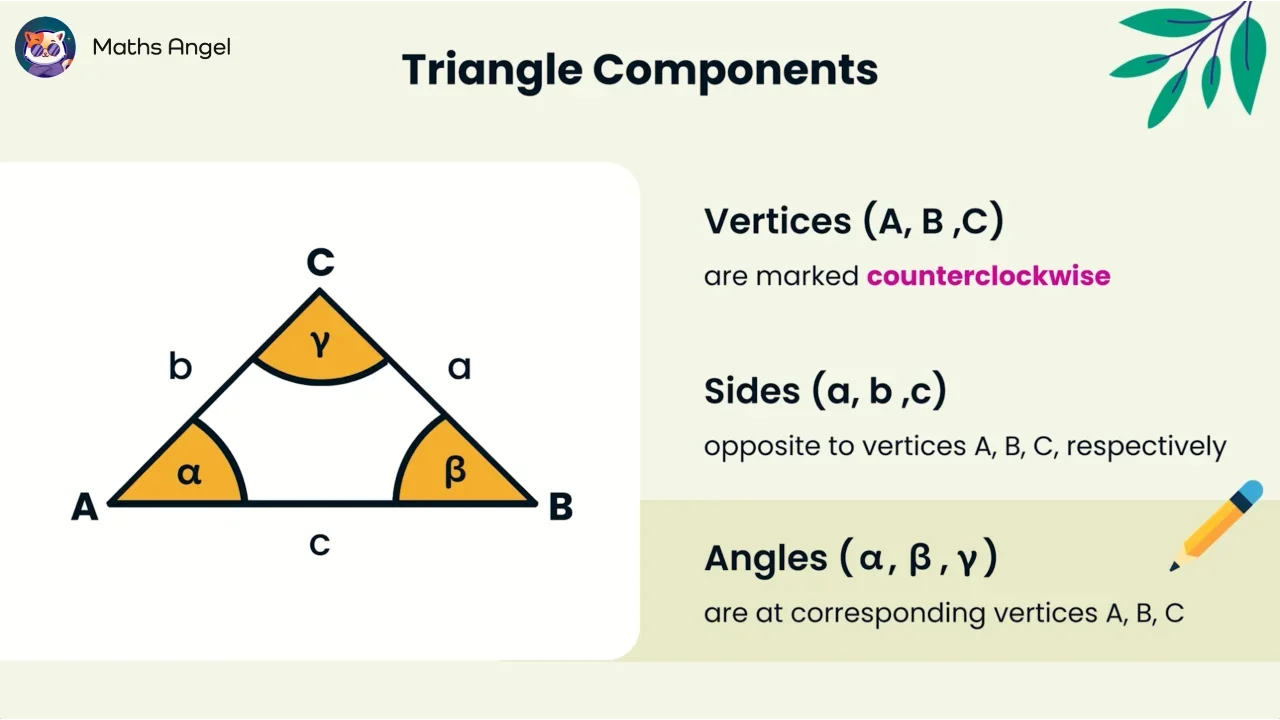
Parts of a Triangle Explained
- The vertices A, B and C are labelled in an anticlockwise direction.
- Each side a, b and c is opposite its matching angle.
Constructing a Triangle with Two Angles and the Included Side (ASA)
- The given side is the side between the two known angles.
- Draw the side first, then measure each angle at the ends so they meet at C.
Constructing a Triangle with Two Sides and the Included Angle (SAS)
- Draw one side, then use a protractor to draw the angle at one end.
- Measure the second side along the angle to find point C.
Common Pitfall: Two Possible Triangles
- With two sides and a non-included angle, there may be two triangles.
- This is called the ambiguous case and both triangles can be correct.
Constructing a Triangle with Three Sides (SSS)
- Draw the longest side first to make construction easier.
- Use a compass to draw arcs from each end that meet at point C.
Practice Questions
Test your understanding
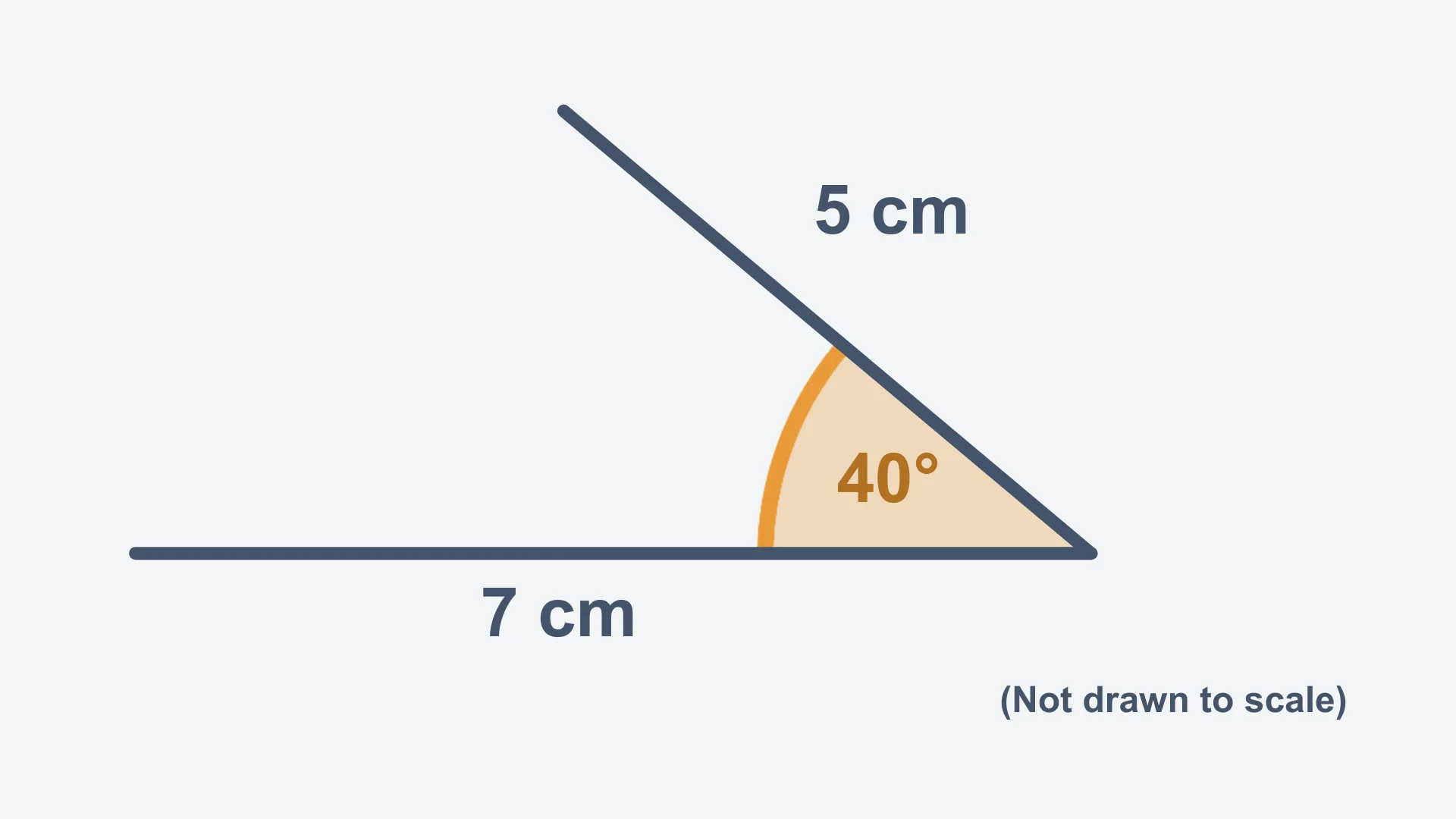
You are given two sides ( and ) and the angle between them (). Can a unique triangle be constructed?
Correct! 🎉 +10 pointsCorrect! 🎉 Worth 10 XPNot quite right
The angle is between the and sides, so this is Side-Angle-Side.
Draw the side, measure at one end, mark along the new arm and join the two ends. The third side is then forced to be cm, and the other two angles are fixed as well, so exactly one triangle can be built.
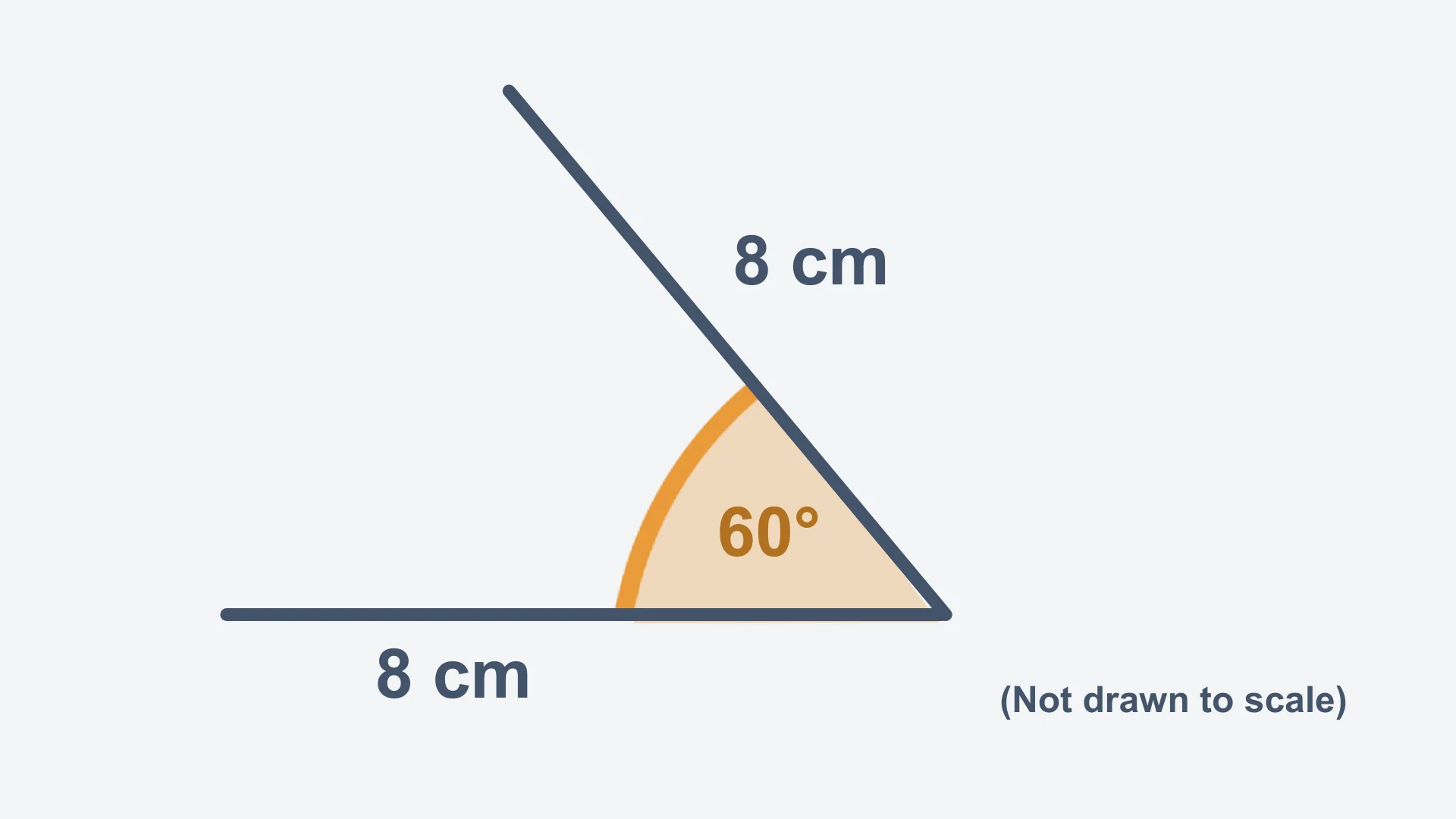
You are given two sides ( and ) and the angle between them (). Can a unique triangle be constructed?
Correct! 🎉 +10 pointsCorrect! 🎉 Worth 10 XPNot quite right
The angle is between the two sides, so this is Side-Angle-Side and only one triangle can be built.
You are not told the third side - you work it out: cm. So the triangle is in fact equilateral, with all three angles , and there is only one such triangle. Flipping the drawing over gives a mirror image - the same triangle, not a second one.
You are given three angles: , , and . Can a triangle be constructed?
Correct! 🎉 +20 pointsCorrect! 🎉 Worth 20 XPNot quite right
Add the angles: .
The interior angles of every triangle add to exactly , no matter how big or small the triangle is drawn. Since is not , no triangle at all can have these three angles.
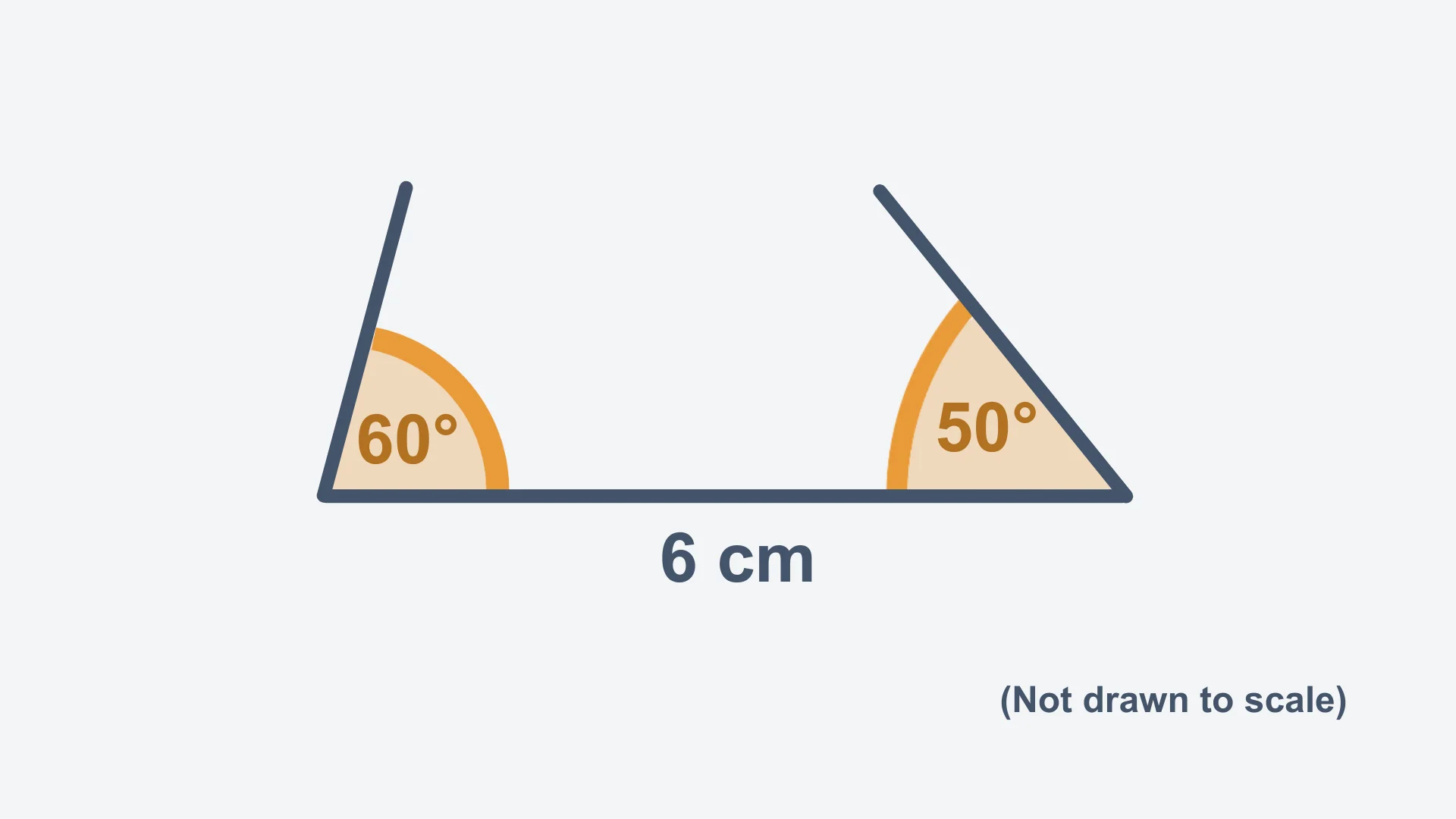
You are given two angles ( and ) and the side between them (). Can you construct a unique triangle?
Correct! 🎉 +20 pointsCorrect! 🎉 Worth 20 XPNot quite right
The side lies between the and angles, so this is Angle-Side-Angle.
The third angle is forced: . Drawing the base and the two arms at and from its ends, the arms cross at exactly one point, so only one triangle can be constructed. Drawing it on the other side of the base only gives a mirror image - the same triangle, not a second one.
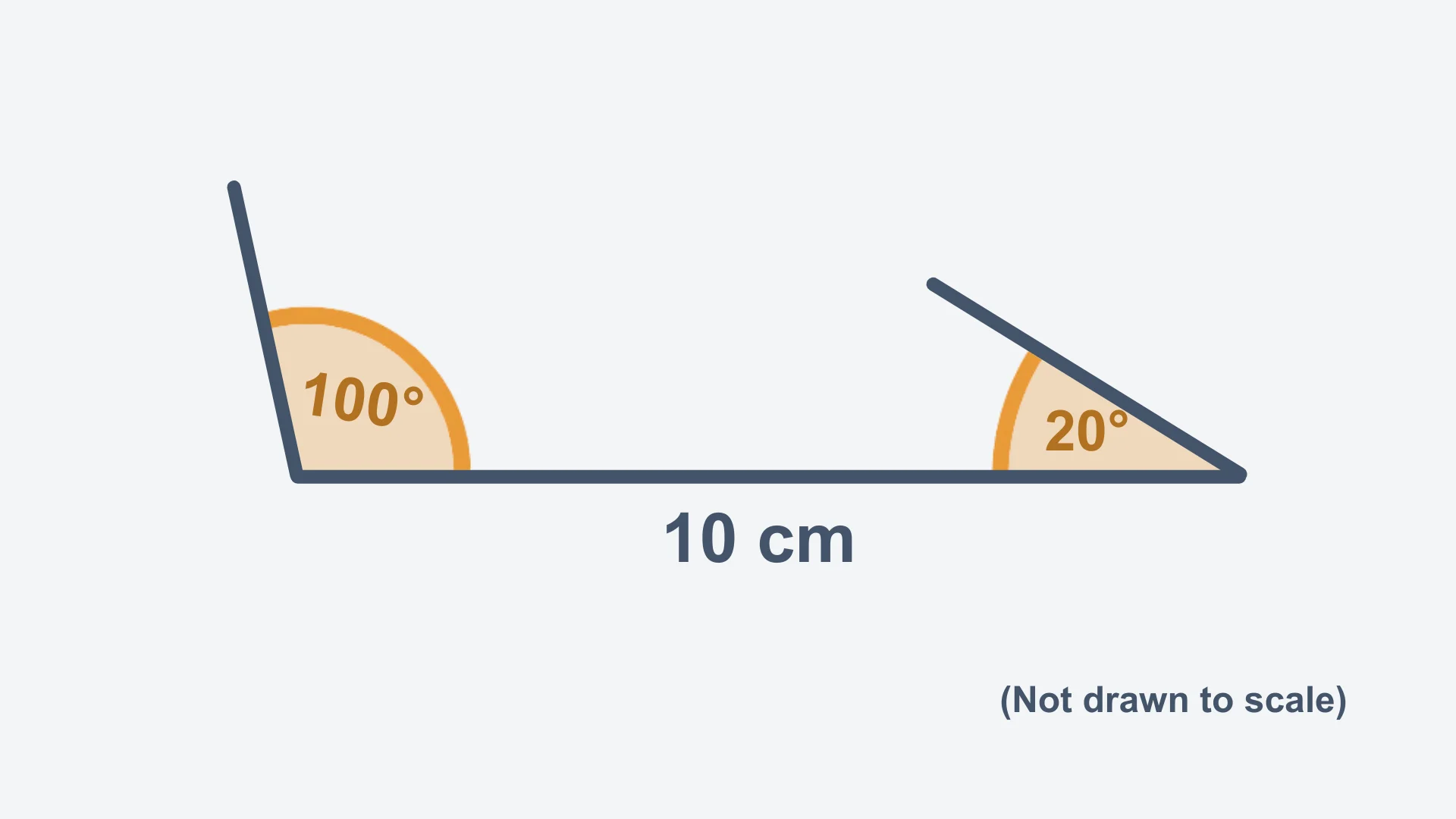
You are given two angles ( and ) and the side between them (). Can a unique triangle be constructed?
Correct! 🎉 +20 pointsCorrect! 🎉 Worth 20 XPNot quite right
The side lies between the and angles, so this is Angle-Side-Angle.
The third angle is forced: . Drawing the base and the two arms at and from its ends, the arms meet at exactly one point, so only one triangle can be constructed. Flipping the drawing over gives a mirror image - the same triangle, not a second one.
You are given three angles: , , and . Can a triangle be constructed?
Correct! 🎉 +30 pointsCorrect! 🎉 Worth 30 XPNot quite right
The angles add to , so triangles with these angles certainly exist.
But angles fix only the shape, not the size. Enlarging one of these triangles gives another triangle with exactly the same three angles but different side lengths, so infinitely many triangles can be drawn - they are all similar, but not congruent.
Want to see the full working?
Interactive Activity
Practice identifying and constructing triangles
Loading interactive widget...
Frequently asked questions
The questions students bump into most on this topic
Start with a sketch, labelling the vertices A, B, C anticlockwise and the sides a, b, c opposite them. Then draw one side, because angles and arcs need a line to start from. Finish with a protractor for any angles you are given and a compass for lengths, depending on whether you know three sides, two sides and an angle, or two angles and a side.
Draw the longest side first and label its ends A and B. Set the compass to side b, put the point on A and draw an arc; set it to side a, put the point on B and draw another. Where the arcs cross is C; join it to A and B. Use the crossing above the line so the vertices run anticlockwise.
The side you are given is the one between the two angles, so draw it first and label its ends A and B. Put the protractor on A and draw the first angle, 60°; put it on B and draw the second, 70°. Extend the two new lines until they cross: that point is C, and the triangle is complete.
Draw one of the given sides, c, and label its ends A and B. With the protractor at B, draw the given angle, 50°, so its arm is a new line from B. Measure the second given side, 5 cm, along that arm to find C. Join C to A. This works whenever the angle is between the two sides you know.
When you know two sides and an angle that is not between them. Draw side a, make the 40° angle at B, then set the compass to side b and draw an arc from C: it can cut the other arm in two places, giving two different positions for A. Both triangles fit the information, so both are correct.
A protractor measures and draws angles in degrees. A compass marks a length along a line or draws an arc to find a vertex at a known distance. Use the protractor whenever an angle is given and the compass whenever only lengths are. A right-angled triangle is the two-sides-and-an-angle case with the angle set to 90°.
What's next?
Found this one hard? Go one step back first. Feeling confident? Carry on to the next lesson.