Congruent Triangles
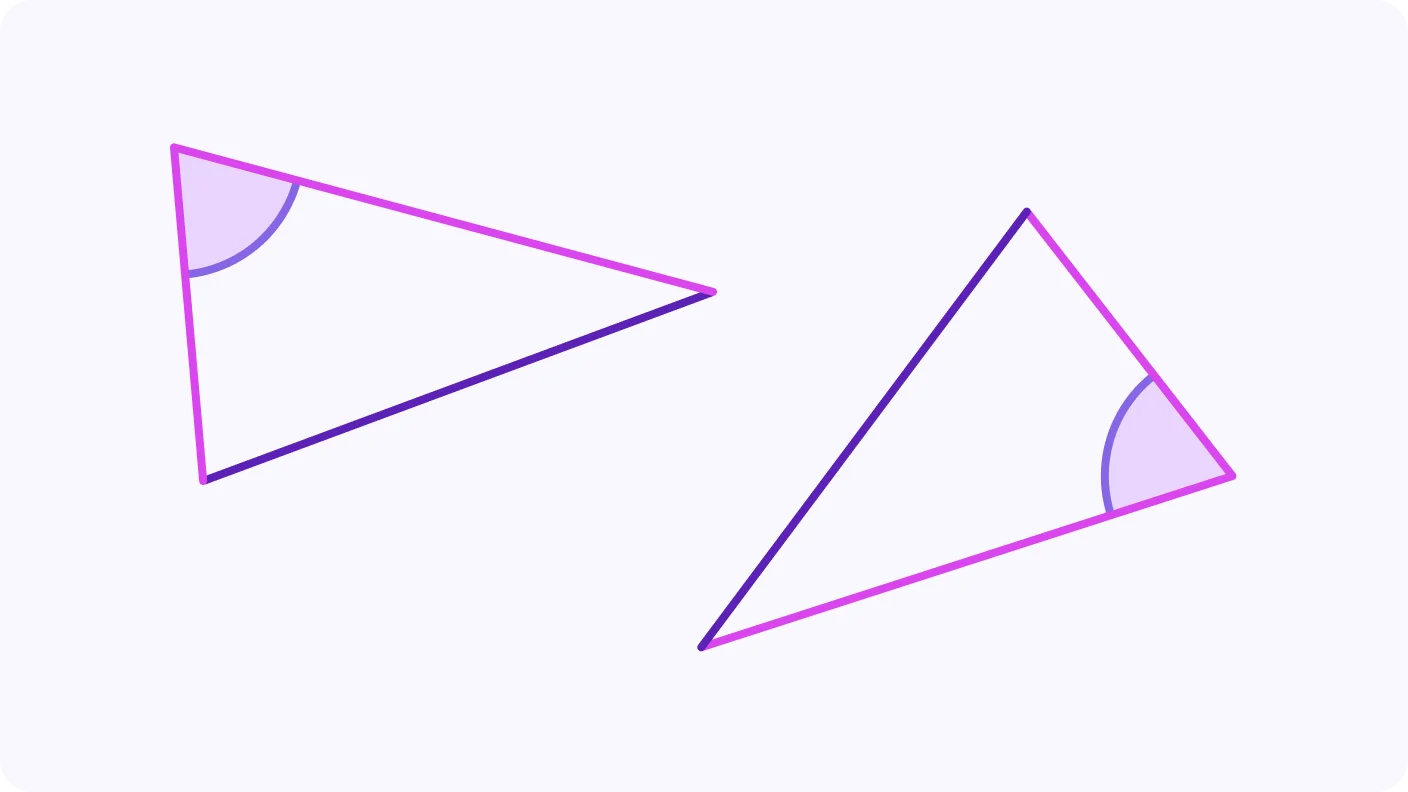
Congruent triangles are the same size and shape, so their corresponding sides and angles are equal. One triangle can be slid, turned, or flipped to fit onto the other. You can prove this using SSS, SAS, ASA, and RHS.
Video Lesson
Watch and learn the basics
🎬 Did this video explain it clearly?
Flashcards
Review key concepts visually
%20Congruent%20Triangles%20Definition.webp)
%20Congruent%20Triangles%20Rules.webp)
%20Congruent%20Triangles%20(Side-Side-Side).webp)
%20Congruent%20Triangles%20(Side-Angle-Side).webp)
%20Congruent%20Triangles%20(Angle-Side-Angle).webp)
%20Congruent%20Triangles%20(RHS).webp)
%20Congruent%20Triangles%20(Common%20Pitfall).webp)
What Are Congruent Triangles?
- Two triangles are congruent if they have the same size and shape.
- This means all corresponding sides and angles are equal.
How Can You Recognise Congruent Triangles?
- Congruent triangles can be moved to overlap perfectly.
- This can be done by translating, reflecting, or rotating.
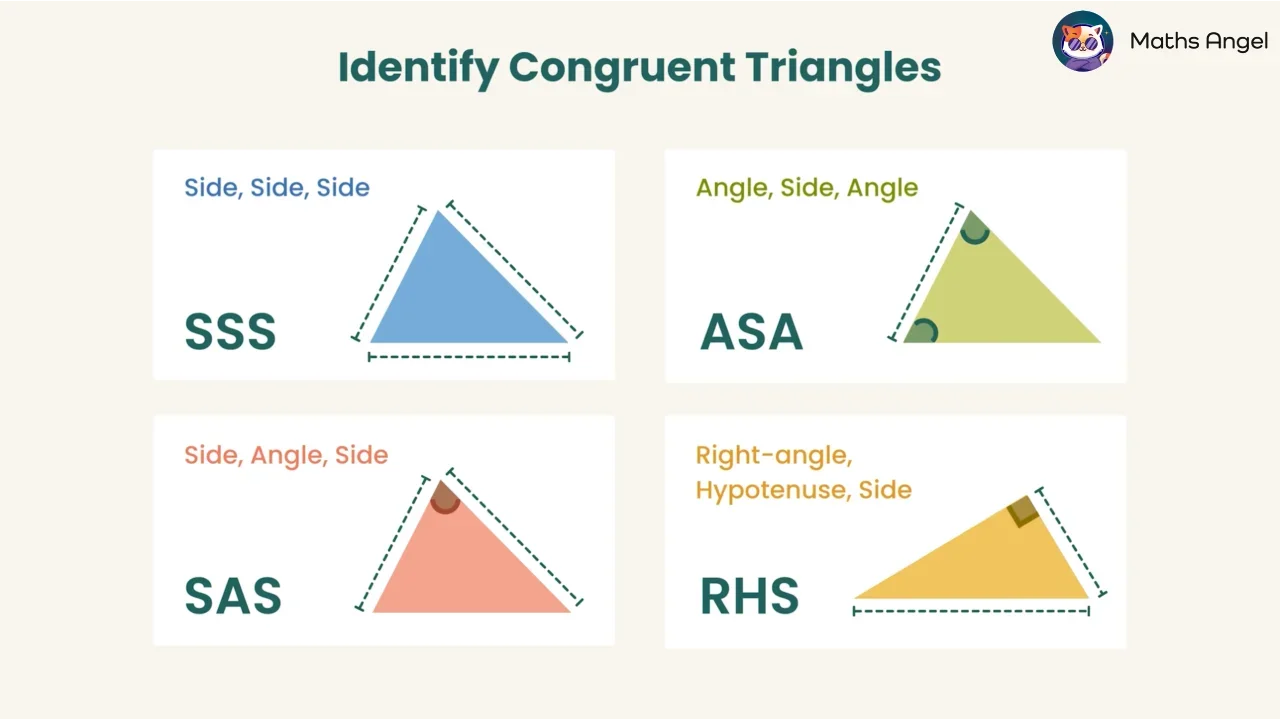
SSS (Side-Side-Side)
- Two triangles are congruent if all three corresponding sides are equal.
- The angles do not need to be given.
SAS (Side-Angle-Side)
- Two triangles are congruent if two corresponding sides and the included angle are equal.
- The angle must be the included angle.
ASA (Angle-Side-Angle)
- Two triangles are congruent if two corresponding angles and the included side are equal.
- The side must be between the two angles.
RHS (Right-Angle-Hypotenuse-Side)
- Applies only to right-angled triangles.
- Triangles are congruent if they have the same hypotenuse and one equal side.
Common Pitfall
- SSA does NOT guarantee congruence.
- Two equal sides and a non-included angle are not enough to prove congruence.
Practice Questions
Test your understanding
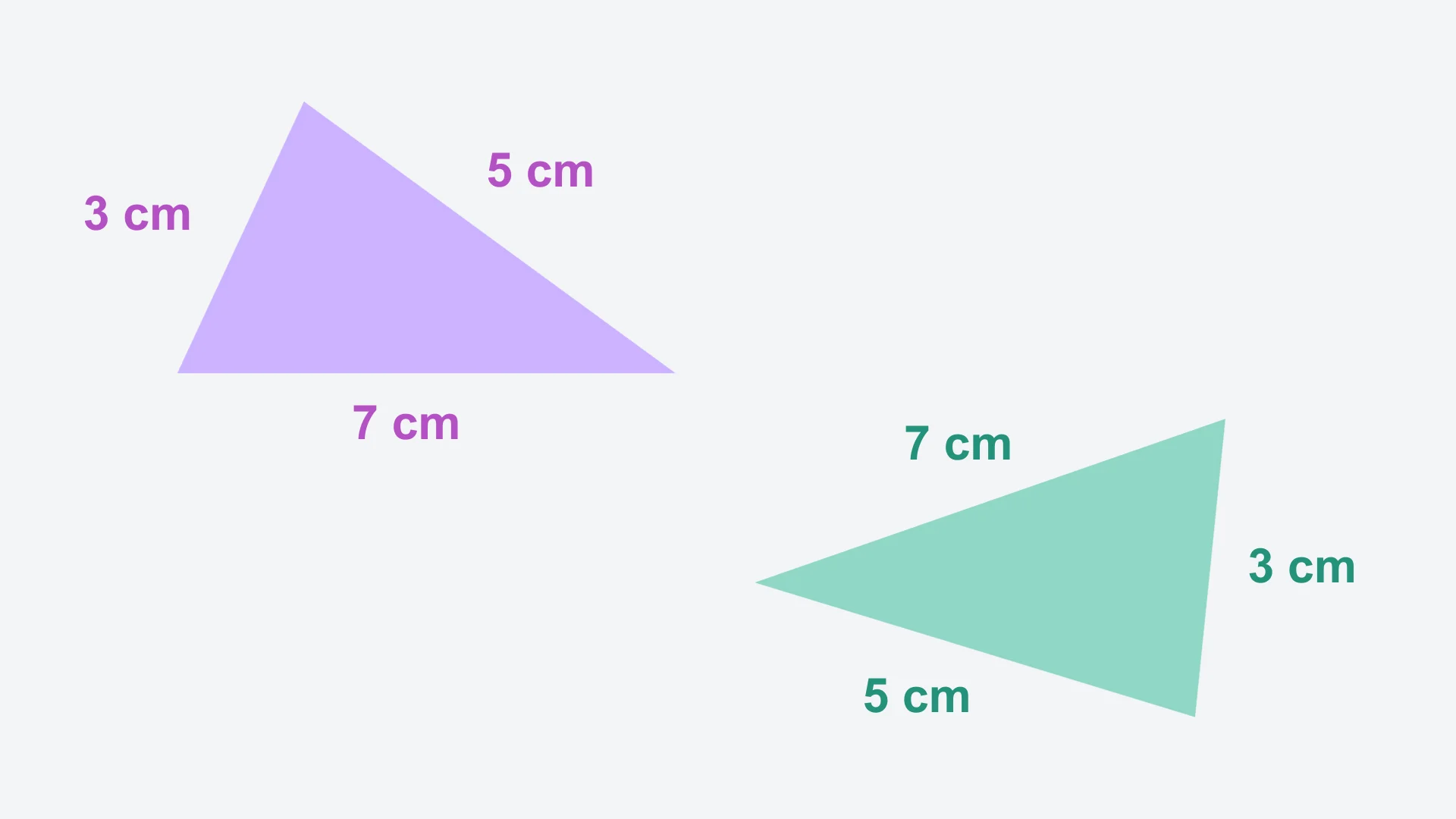
Are these two triangles congruent?
Correct! 🎉 +10 pointsCorrect! 🎉 Worth 10 XPNot quite right
Compare the three pairs of sides: both triangles have sides of , and .
All three pairs of corresponding sides are equal, so the triangles are congruent by the Side-Side-Side (SSS) rule.
The green triangle has been turned round, but rotating or reflecting a shape does not change any of its side lengths, so it is still congruent to the purple one.
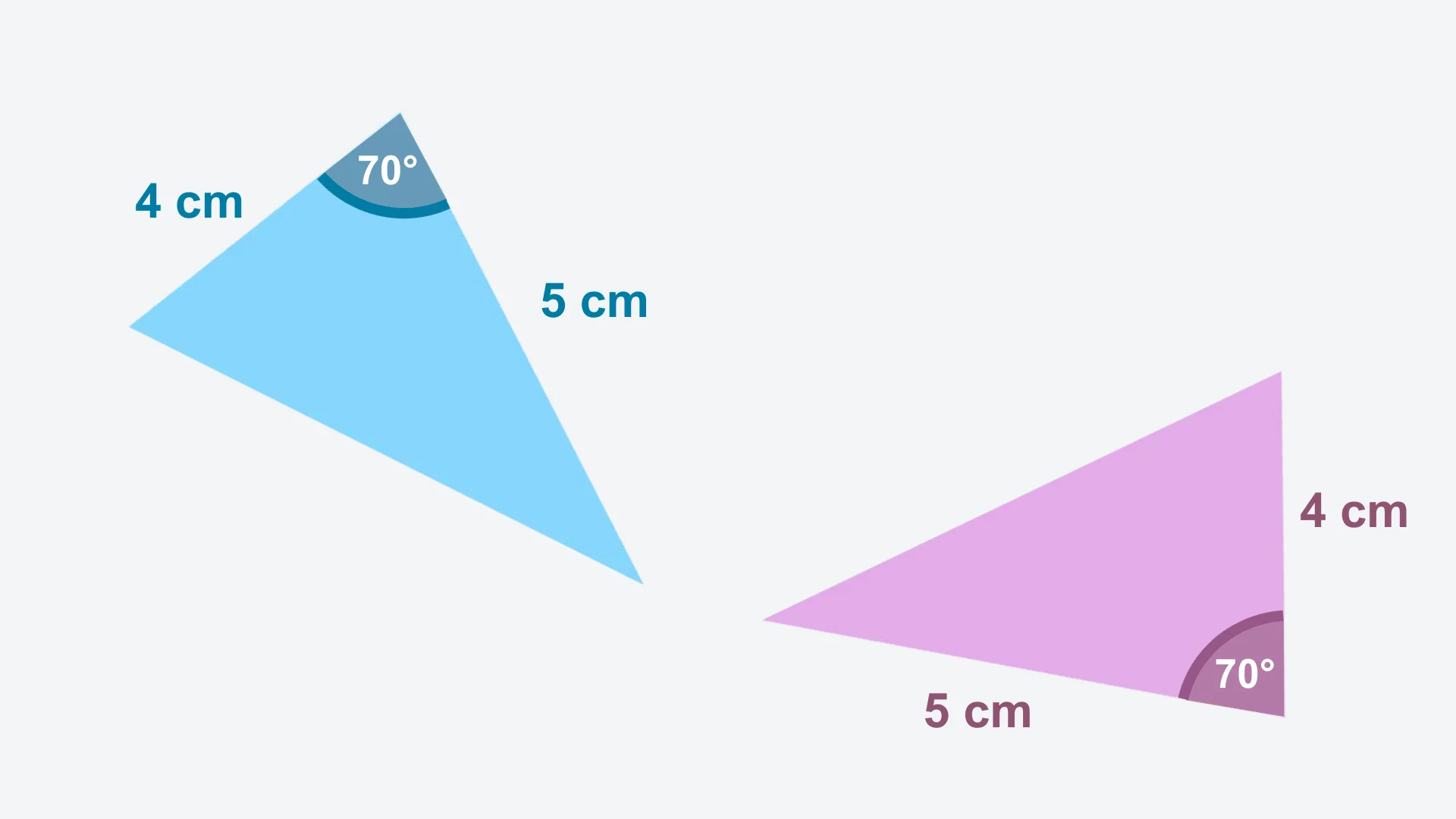
Are these two triangles congruent?
Correct! 🎉 +10 pointsCorrect! 🎉 Worth 10 XPNot quite right
Both triangles have a side and a side with the angle between them, so they match by the Side-Angle-Side (SAS) rule.
The pink triangle is drawn turned round compared with the blue one, but rotating a triangle does not change any of its side lengths or angles, so the two triangles are still congruent.
Two right-angled triangles have the same hypotenuse of and one side of . Are these two triangles congruent?
Correct! 🎉 +20 pointsCorrect! 🎉 Worth 20 XPNot quite right
Both triangles have a right angle, the same hypotenuse and the same side, so the Right angle-Hypotenuse-Side (RHS) rule applies and they are congruent.
You do not need all six measurements. Pythagoras fixes the third side at cm, so these measurements can only make one triangle.
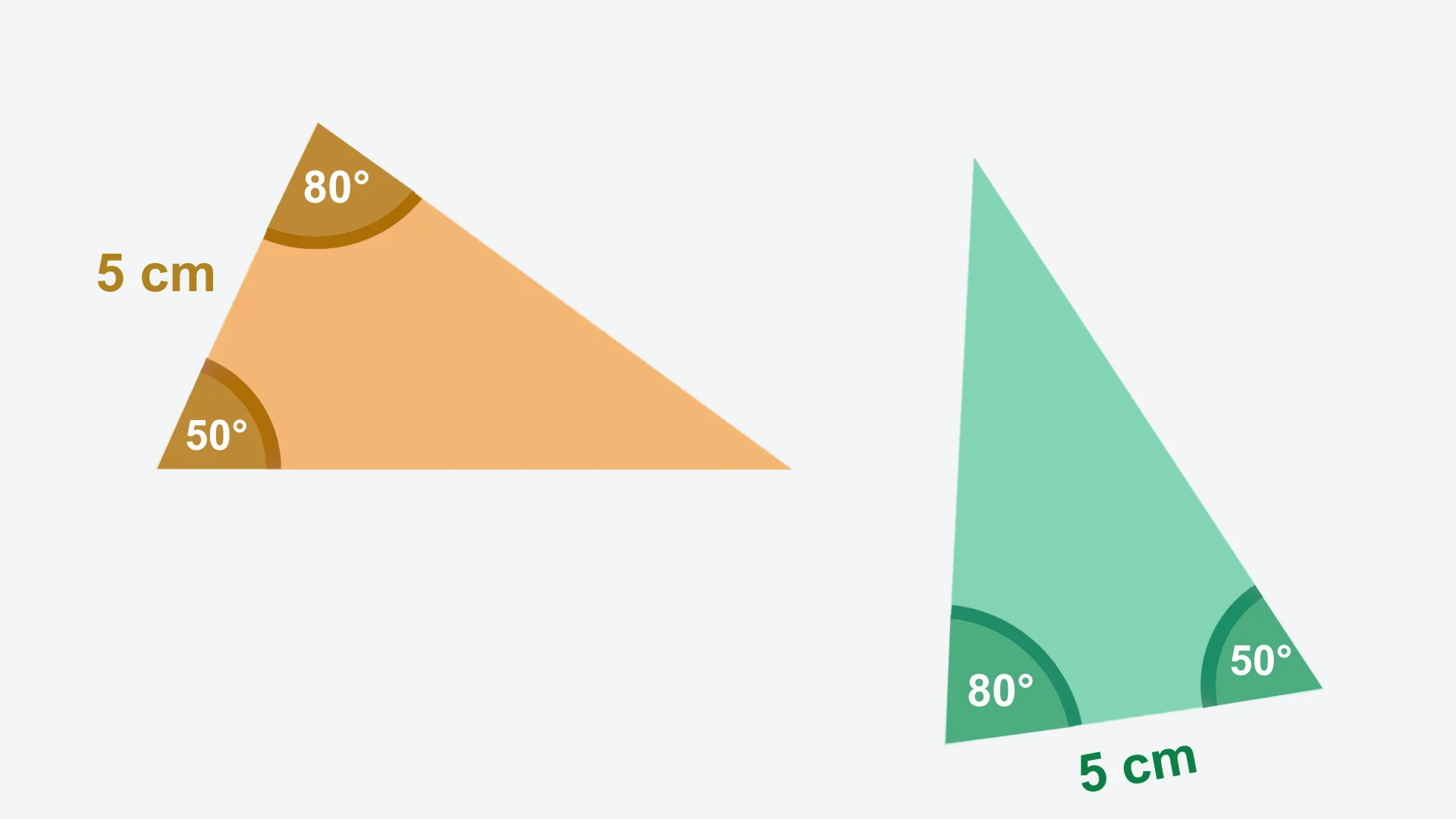
Are these two triangles congruent?
Correct! 🎉 +20 pointsCorrect! 🎉 Worth 20 XPNot quite right
Both triangles have angles of and with the side between those two angles, so they match by the Angle-Side-Angle (ASA) rule.
The green triangle is drawn turned round compared with the orange one, but rotating a triangle leaves every side and angle unchanged, so the two triangles are congruent.
Which condition cannot be used to determine congruent triangles?
Correct! 🎉 +20 pointsCorrect! 🎉 Worth 20 XPNot quite right
AAA is not enough to prove congruence, because three angles fix only the shape of a triangle, not its size. Two triangles can have exactly the same three angles but different side lengths - they are similar, not necessarily congruent.
ASA, SAS and SSS each include at least one side, which fixes the size as well as the shape. SSS still proves congruence when one triangle is a rotation or mirror image of the other, and in SAS the angle used must be the one between the two given sides.
Two triangles each have one side of , another side of . In both triangles, an angle of is opposite the side. Are the triangles congruent?
Correct! 🎉 +30 pointsCorrect! 🎉 Worth 30 XPNot quite right
The angle is opposite the side, not between the two given sides, so this is SSA.
By the sine rule, , which gives or . Both work, because is still less than , so two genuinely different triangles fit the same three measurements. SSA does not guarantee congruence.
Want to see the full working?
Interactive Activity
Explore the 4 rules of triangle congruence: SSS, SAS, ASA, RHS
Loading interactive widget...
Frequently asked questions
The questions students bump into most on this topic
Congruent means exactly the same size and shape. Two shapes are congruent when every corresponding side is the same length and every corresponding angle is the same size, so one can be slid, turned or flipped to fit perfectly on top of the other. Two triangles with sides 3 cm, 4 cm and 5 cm are congruent however they are placed.
Congruent triangles are two triangles with the same three side lengths and the same three angles, so they match exactly even if one is rotated or reflected. You do not need to check all six measurements: four tests, SSS, SAS, ASA and RHS, each use three pieces of information that fix a triangle completely.
SSS: three sides equal. SAS: two sides and the angle between them equal. ASA: two angles and the side between them equal. RHS: in right-angled triangles, the hypotenuse and one other side equal. Each works because only one triangle can be built from that information, so two triangles that share it must be identical.
Match up three facts that fit one of the four rules, then name the rule. Two right-angled triangles each have a hypotenuse of 10 cm and a side of 6 cm: that is the hypotenuse and one side, so they are congruent by RHS. In a GCSE proof, write each matching pair with its reason, then the rule, SSS, SAS, ASA or RHS.
No. With two sides and an angle that is not between them, two different triangles can fit the same information, so congruence is not guaranteed; this is why SAS needs the included angle and ASA the included side. Three angles alone do not work either: triangles with the same angles can be different sizes. The only exception is a right angle, which gives RHS.
Because the right angle lets Pythagoras’ theorem fix the third side. If two right-angled triangles have the same hypotenuse and one other equal side, the remaining side must be equal too, which turns the case into SSS. Without the right angle there is no such link, and two sides with a non-included angle are not enough.
What's next?
Found this one hard? Go one step back first. Feeling confident? Carry on to the next lesson.