Perpendicular Bisectors and Circumcircle
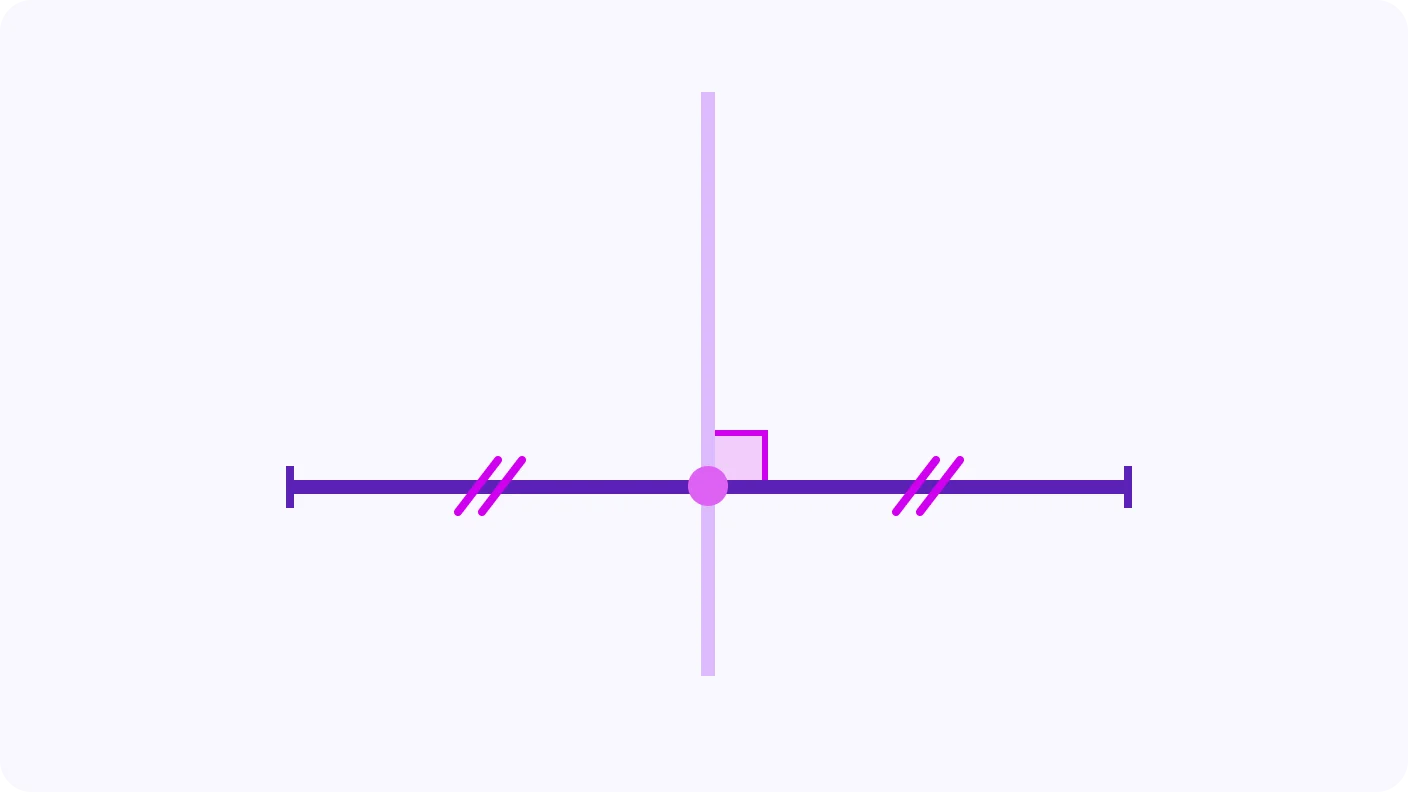
A perpendicular bisector cuts a line segment in half at a right angle (90°). Every point on it is the same distance from both ends. In a triangle, the three bisectors meet at the circumcentre, the centre of its circumcircle.
Video Lesson
Watch and learn the basics
🎬 Did this video explain it clearly?
Flashcards
Review key concepts visually
%20Perpendicular%20Bisector.webp)
%20Drawing%20a%20Perpendicular%20Bisector.webp)
%20Key%20Property%20of%20the%20Perpendicular%20Bisector.webp)
%20Triangle%20Circumcentre.webp)
What Is a Perpendicular Bisector?
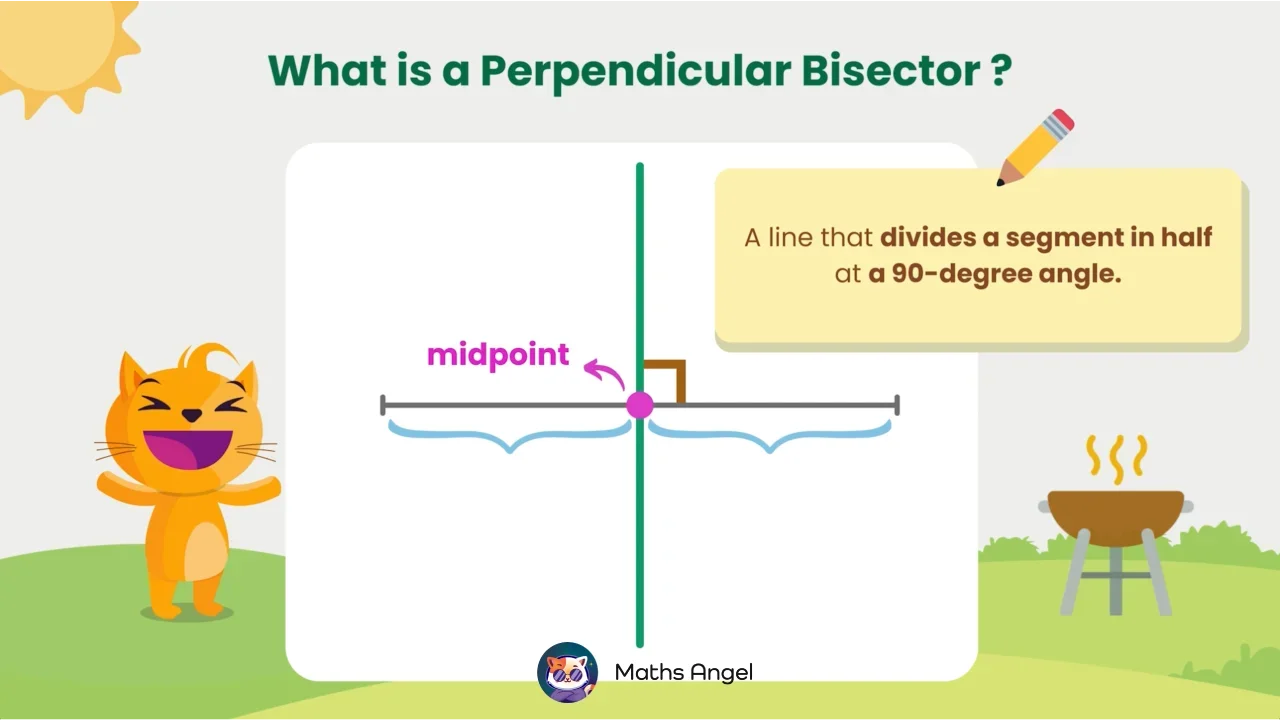
- A perpendicular bisector cuts a line segment in half.
- It meets the segment at a right angle () at the midpoint.
Drawing a Perpendicular Bisector
- With a compass, set the width greater than half the segment.
- Draw arcs above and below from both ends, keeping the same width.
- Draw a straight line through the two points where the arcs cross.
Key Property of a Perpendicular Bisector
- Every point on the perpendicular bisector is the same distance from both ends of the line segment.
- This helps you find points that are exactly in the middle between the two ends.
Perpendicular Bisectors and the Circumcentre
- The circumcentre is where the three perpendicular bisectors of a triangle meet.
- It is equal distance from all three vertices and is the centre of the circumcircle.
Practice Questions
Test your understanding
What is a perpendicular bisector?
Correct! 🎉 +10 pointsCorrect! 🎉 Worth 10 XPNot quite right
A perpendicular bisector does two jobs at once: it passes through the midpoint of the segment, cutting it into two equal parts, and it meets the segment at a right angle.
Drop either condition and it is no longer a perpendicular bisector. Every point on it is the same distance from the two endpoints of the segment.
Which tools do you use to construct the perpendicular bisector of a line segment?
Correct! 🎉 +10 pointsCorrect! 🎉 Worth 10 XPNot quite right
You construct a perpendicular bisector with a pair of compasses and a straight edge (ruler).
Keeping the compasses at one fixed width, more than half the segment, draw arcs from each endpoint; the arcs cross above and below the segment, and the ruler joins those two crossing points. The construction itself guarantees both the right angle and the two equal halves. No measuring with a protractor is needed.
How do you find the circumcentre of a triangle?
Correct! 🎉 +20 pointsCorrect! 🎉 Worth 20 XPNot quite right
The circumcentre is the point that is the same distance from all three vertices, so it must lie on the perpendicular bisector of every side.
Construct the perpendicular bisectors of the sides with compasses and a straight edge. Two of them are enough to fix the point where they cross; the third passes through the same point and acts as a check.
What is the circumcentre of a triangle?
Correct! 🎉 +20 pointsCorrect! 🎉 Worth 20 XPNot quite right
The circumcentre is the point that is the same distance from all three vertices of the triangle.
That distance is the radius of the circumcircle, the circle through all three corners, and the circumcentre is its centre. It is found where the perpendicular bisectors of the sides meet, and it can lie inside, on, or outside the triangle.
What does the circumcircle of a triangle pass through?
Correct! 🎉 +20 pointsCorrect! 🎉 Worth 20 XPNot quite right
The circumcircle is drawn with the circumcentre as its centre and a radius reaching out to a vertex.
Because the circumcentre is the same distance from all three vertices, that circle passes exactly through all three corners of the triangle. The circumcentre is the centre, so it sits inside the circle, not on it; the circle does not pass through the side midpoints, and it does not touch the sides. That is the inscribed circle, a different circle altogether.
You're building a triangular park and want to place a fountain equidistant from all three corners. Which geometric point should you find?
Correct! 🎉 +30 pointsCorrect! 🎉 Worth 30 XPNot quite right
"Equidistant from all three corners" means the same distance from the three vertices, and that point is the circumcentre, where the perpendicular bisectors of the sides meet.
The other centres do different jobs: the incentre is the same distance from the three sides (found with angle bisectors), the centroid is the balance point where the medians meet, and the orthocentre is where the altitudes from the vertices meet. Only the circumcentre gives equal distances to the corners.
Want to see the full working?
Interactive Activity
Perpendicular Bisectors and Circumcircle
Loading interactive widget...
Frequently asked questions
The questions students bump into most on this topic
A perpendicular bisector is a line that crosses a line segment at a right angle, 90°, exactly at its midpoint. The name says both things: perpendicular means at 90°, bisector means it cuts the segment into two equal halves. Every segment has exactly one. In GCSE it is one of the standard constructions and the basis of loci questions.
With a compass: open it to more than half the segment’s length, put the point on one end and draw an arc above and below the segment, then repeat from the other end with the same width. Draw a straight line through the two points where the arcs cross. Without a compass, find the midpoint with a ruler and draw a line through it at 90°.
Every point on it is the same distance from both ends of the segment. So if you and a friend want a barbecue grill exactly as far from each of you, it must sit on the perpendicular bisector of the line between you. A third friend adds a second bisector, and the two fix the one spot that works for all three.
The point where the perpendicular bisectors of a triangle’s three sides meet. Because each bisector is equidistant from two vertices, the meeting point is the same distance from all three. To find it, construct the bisectors of two sides; the third passes through the same point if you have drawn accurately. American sites spell it circumcenter.
The circle that passes through all three vertices of a triangle. Its centre is the circumcentre and its radius, the circumradius, is the distance from the circumcentre to any vertex. To draw it, find the circumcentre, set the compass to that distance and draw the circle. In the barbecue example, it shows where latecomers should sit.
What's next?
Found this one hard? Go one step back first. Feeling confident? Carry on to the next lesson.