Angle Bisectors and Incircle
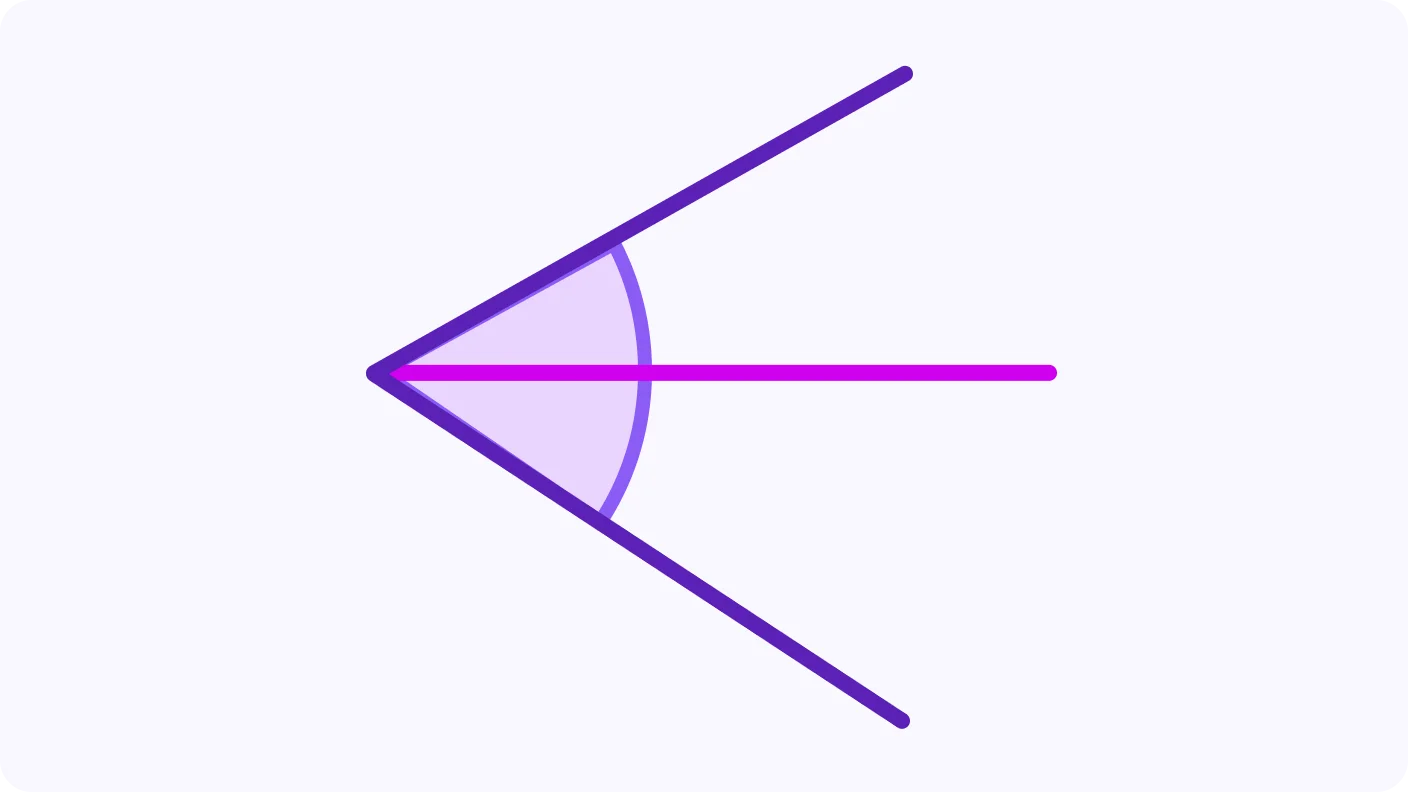
An angle bisector cuts an angle into two equal halves. In a triangle, the three bisectors meet at the incentre. That point is the centre of the incircle: the circle inside the triangle that touches all three sides.
Video Lesson
Watch and learn the basics
🎬 Did this video explain it clearly?
Flashcards
Review key concepts visually
%20Angle%20Bisector.webp)
%20Drawing%20Angle%20Bisectors.webp)
%20Angle%20Bisector%20Property.webp)
%20Triangle%20Incircle.webp)
What Is an Angle Bisector?
- An angle bisector splits an angle into two equal parts.
- Each new angle is exactly half of the original angle.
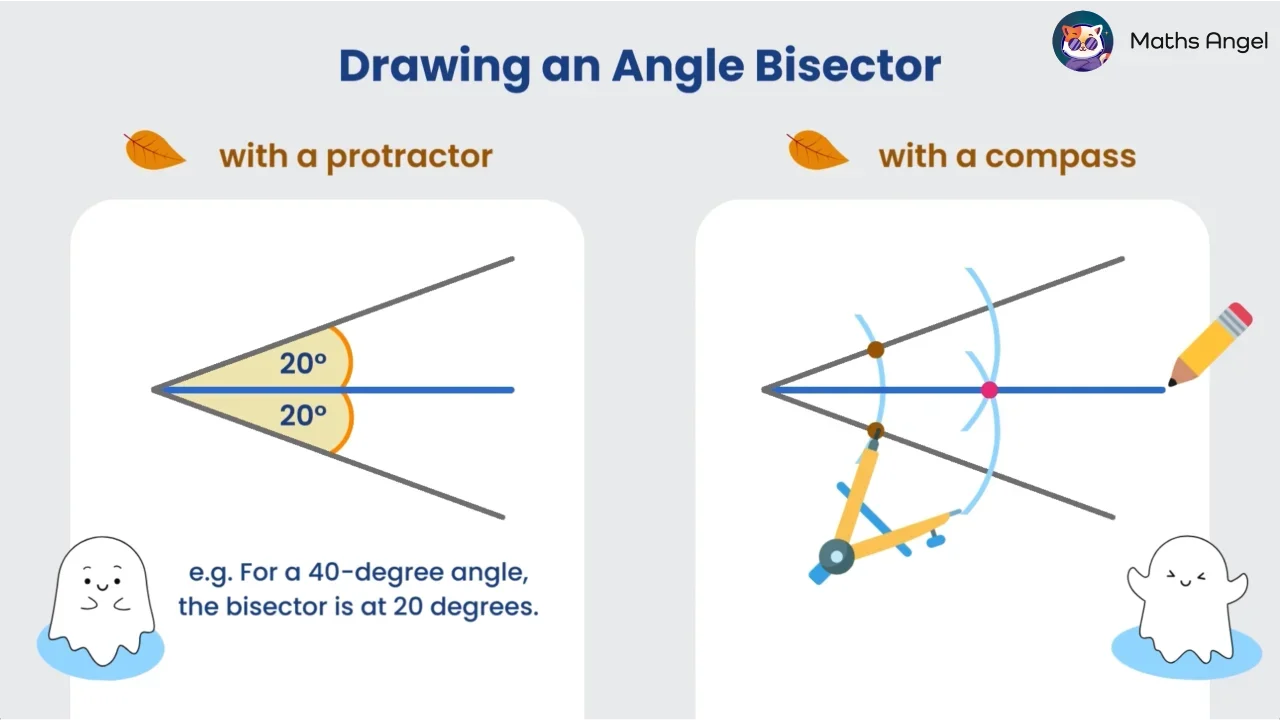
How to Draw an Angle Bisector?
- You can draw an angle bisector using a protractor by halving the angle.
- You can also use a compass to draw the bisector without measuring.
The Key Property of an Angle Bisector
- Any point on an angle bisector is equidistant from both sides of the angle.
- This means the perpendicular distance to each side is the same.
Incentre and Incircle
- The incentre is where the three angle bisectors of a triangle meet.
- The incircle is the largest circle that fits inside the triangle and touches all three sides.
Practice Questions
Test your understanding
What is an angle bisector?
Correct! 🎉 +10 pointsCorrect! 🎉 Worth 10 XPNot quite right
An angle bisector is a line or ray drawn from the vertex of an angle that cuts the angle into two equal parts. 'Bi' means two and 'sect' means cut, so the two parts must be exactly the same size.
It is not the same as a perpendicular bisector, which cuts a line segment into two equal lengths rather than cutting an angle, and it is not a line that halves a whole shape such as a triangle.
Which tool do you use to draw the arcs needed to construct an angle bisector?
Correct! 🎉 +10 pointsCorrect! 🎉 Worth 10 XPNot quite right
An angle bisector is constructed with a pair of compasses: draw an arc from the vertex across both arms, then draw equal arcs from those two crossing points. Where those arcs meet is a point the bisector passes through, and a ruler is only used afterwards to join it to the vertex.
A protractor measures an angle but does not construct anything, and the construction arcs must be left on the page as evidence of the method.
What is the incentre of a triangle?
Correct! 🎉 +20 pointsCorrect! 🎉 Worth 20 XPNot quite right
The incentre is the point where the three angle bisectors of a triangle meet. Because it lies on every angle bisector, it is the same perpendicular distance from all three sides, which is why it is the centre of the incircle.
The other three points are different centres: the perpendicular bisectors of the sides meet at the circumcentre, the medians meet at the centroid, and the altitudes meet at the orthocentre.
What is the inradius of a triangle?
Correct! 🎉 +20 pointsCorrect! 🎉 Worth 20 XPNot quite right
The inradius is the perpendicular distance from the incentre to any side of the triangle. It is the same for all three sides, which is exactly why a circle drawn with that radius touches all three sides.
The distance from the incentre out to a vertex is longer and slanted, the distance right across the incircle is twice the inradius, and the distance from the circumcentre to a vertex is the circumradius, a different circle altogether.
If you want to draw the incircle of a triangle, what do you need to know?
Correct! 🎉 +20 pointsCorrect! 🎉 Worth 20 XPNot quite right
Any circle needs a centre and a radius. For the incircle these are the incentre, found where the three angle bisectors meet, and the inradius, the perpendicular distance from the incentre to any side.
The circumcentre and circumradius belong to the circle through the three vertices, and the centroid and the point where the altitudes meet are different points that do not sit the same distance from all three sides.
To find the largest circle that you can cut out of a triangular piece of paper, what should you do?
Correct! 🎉 +30 pointsCorrect! 🎉 Worth 30 XPNot quite right
The largest circle that fits inside a triangle is its incircle. Draw the angle bisectors of the three angles to find the incentre, then measure the perpendicular distance from the incentre to any side to get the inradius.
The perpendicular bisectors of the sides meet at the circumcentre, which is the centre of the circle through the three vertices - far too big to cut out. The medians meet at the centroid and the altitudes meet at the orthocentre, and neither point is the same distance from all three sides.
Want to see the full working?
Interactive Activity
Explore angle bisector construction and how they form a triangle's incircle
Loading interactive widget...
Frequently asked questions
The questions students bump into most on this topic
An angle bisector is a ray from the vertex that splits an angle into two equal parts: for a 40° angle it passes through the 20° mark. Every angle has exactly one. It is not usually at 90°; that is the perpendicular bisector, which cuts a line, not an angle. If the two halves measure the same, the ray is the bisector.
With a compass: put the point on the vertex and draw an arc across both arms. Keep the same width, put the point on each crossing and draw two more arcs inside the angle. Draw a line from the vertex through the point where those arcs cross. With a protractor, measure the angle and draw the ray at half of it.
Every point on the bisector is the same perpendicular distance from both arms of the angle. That is why the bisectors find the centre of a triangle’s incircle. Real-life example: to cut the largest possible circle from a triangular piece of paper, bisect two angles, measure from the crossing point to a side, and draw the circle with that radius.
The point where the three angle bisectors of a triangle meet, which is the same distance from all three sides. To find it, construct the bisectors of two angles; if you have drawn accurately the third passes through the same point and acts as a check. American sites spell it incenter.
The incircle is the largest circle that fits inside a triangle: it touches all three sides without crossing them. Its centre is the incentre and its radius, the inradius, is the perpendicular distance from the incentre to any side, the same for all three. Every triangle has exactly one. To draw it, find the incentre, measure the inradius and use a compass.
What's next?
Found this one hard? Go one step back first. Feeling confident? Carry on to the next lesson.