Area of Parallelograms and Triangles
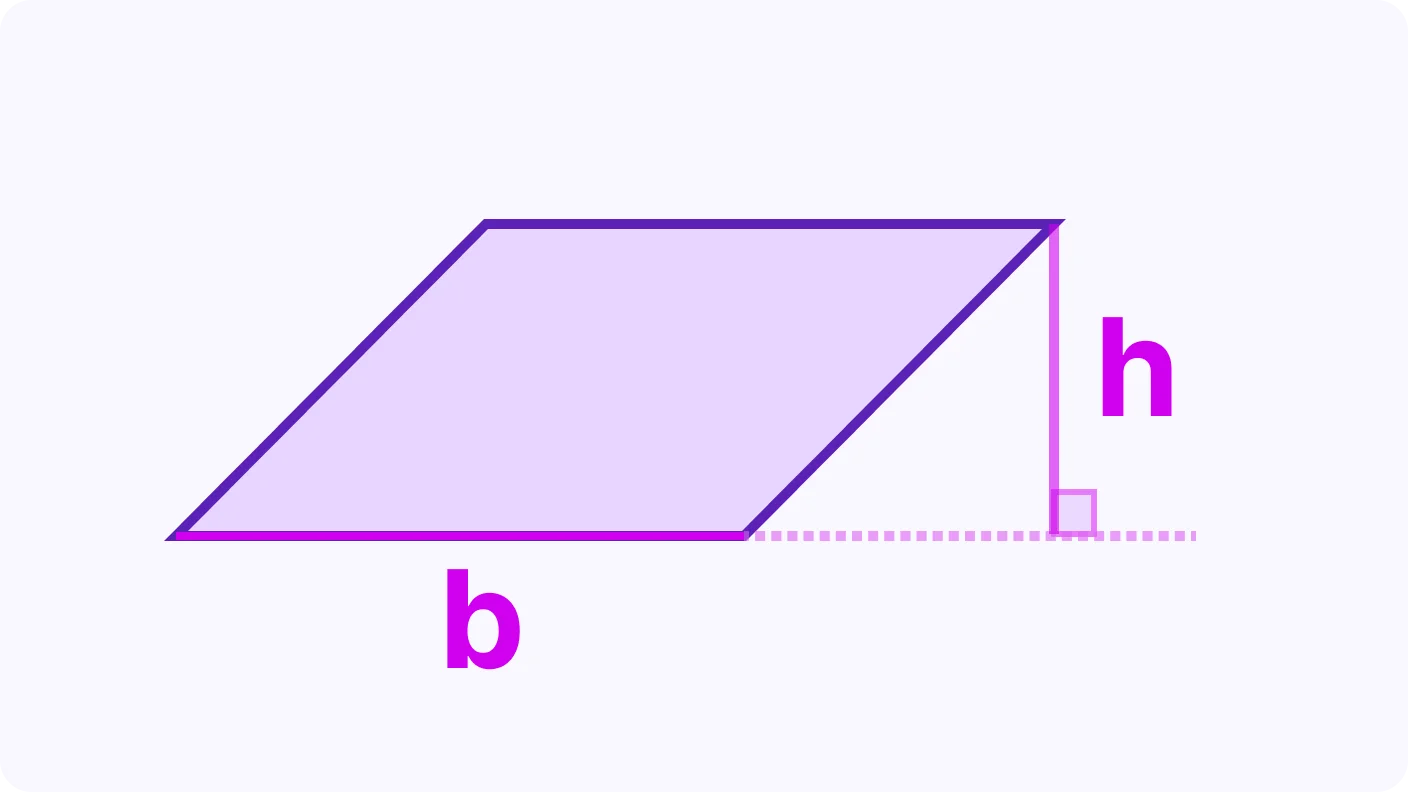
The area of a parallelogram is base × height. The height must be perpendicular to the base, not the slanted side. The area of a triangle is exactly half of this: ½ × base × height.
Video Lesson
Watch and learn the basics
🎬 Did this video explain it clearly?
Flashcards
Review key concepts visually
%20Height%20of%20a%20Parallelogram.webp)
%20Area%20of%20a%20Parallelogram.webp)
%20Height%20of%20a%20Triangle.webp)
%20Area%20of%20a%20Triangle.webp)
Height of a Parallelogram
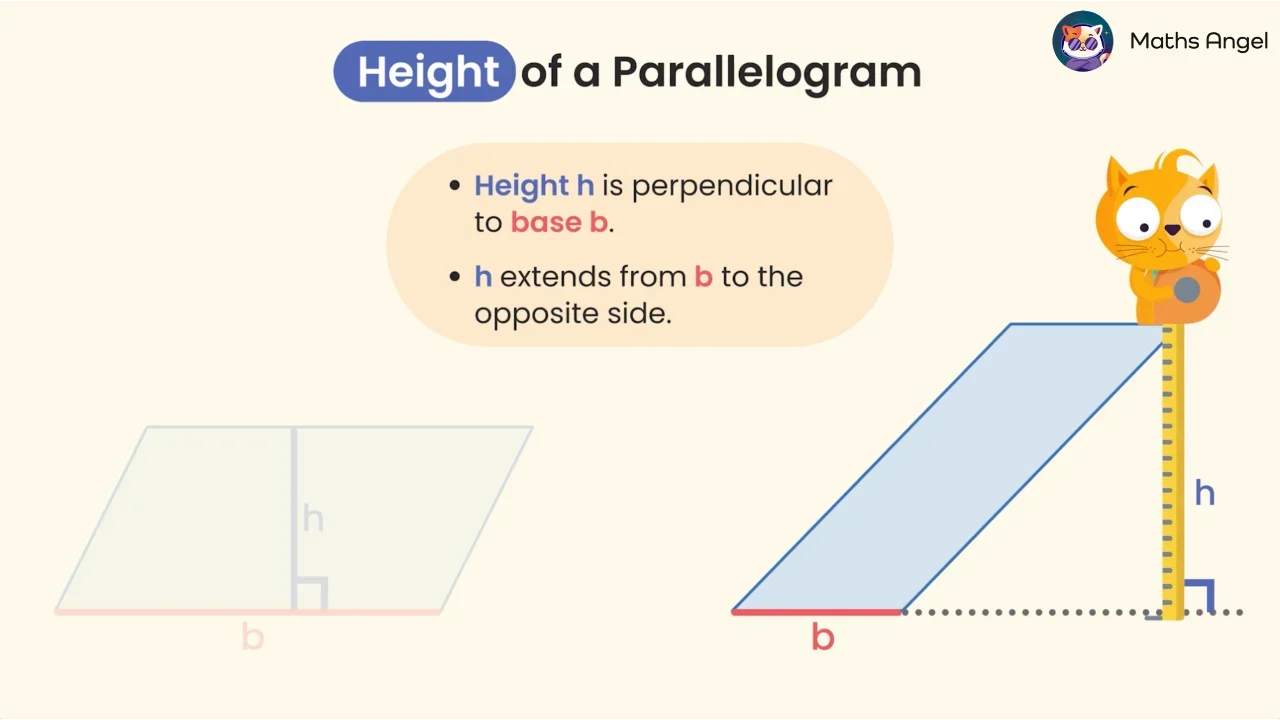
- The height h is perpendicular to the base b.
- The height goes from the base to the opposite side, even if it is outside.
Area of a Parallelogram
- The area of a parallelogram is found using base × height.
- This is written as
Height of a Triangle
- The height h is perpendicular to the base b.
- The height goes from the base to the opposite vertex.
Area of a Triangle
- The area of a triangle is half the area of a parallelogram.
- The formula is .
Practice Questions
Test your understanding
What is the formula for the area of a parallelogram?
Correct! 🎉 +10 pointsCorrect! 🎉 Worth 10 XPNot quite right
The area of a parallelogram is base × perpendicular height.
Cutting the triangle off one end of a parallelogram and sliding it to the other end makes a rectangle with the same base and the same height, so there is no halving. The height must be measured perpendicular to the base, not along the sloping side.
What does the height of a triangle always do?
Correct! 🎉 +10 pointsCorrect! 🎉 Worth 10 XPNot quite right
The height of a triangle is the perpendicular distance from the base to the opposite vertex, so it always meets the base (or the base extended) at a right angle.
It does not have to point straight up the page, and it is usually not one of the sides: any of the three sides can be chosen as the base, and the height is then measured perpendicular to that side.
If the base of a parallelogram is and the height is , what is its area?
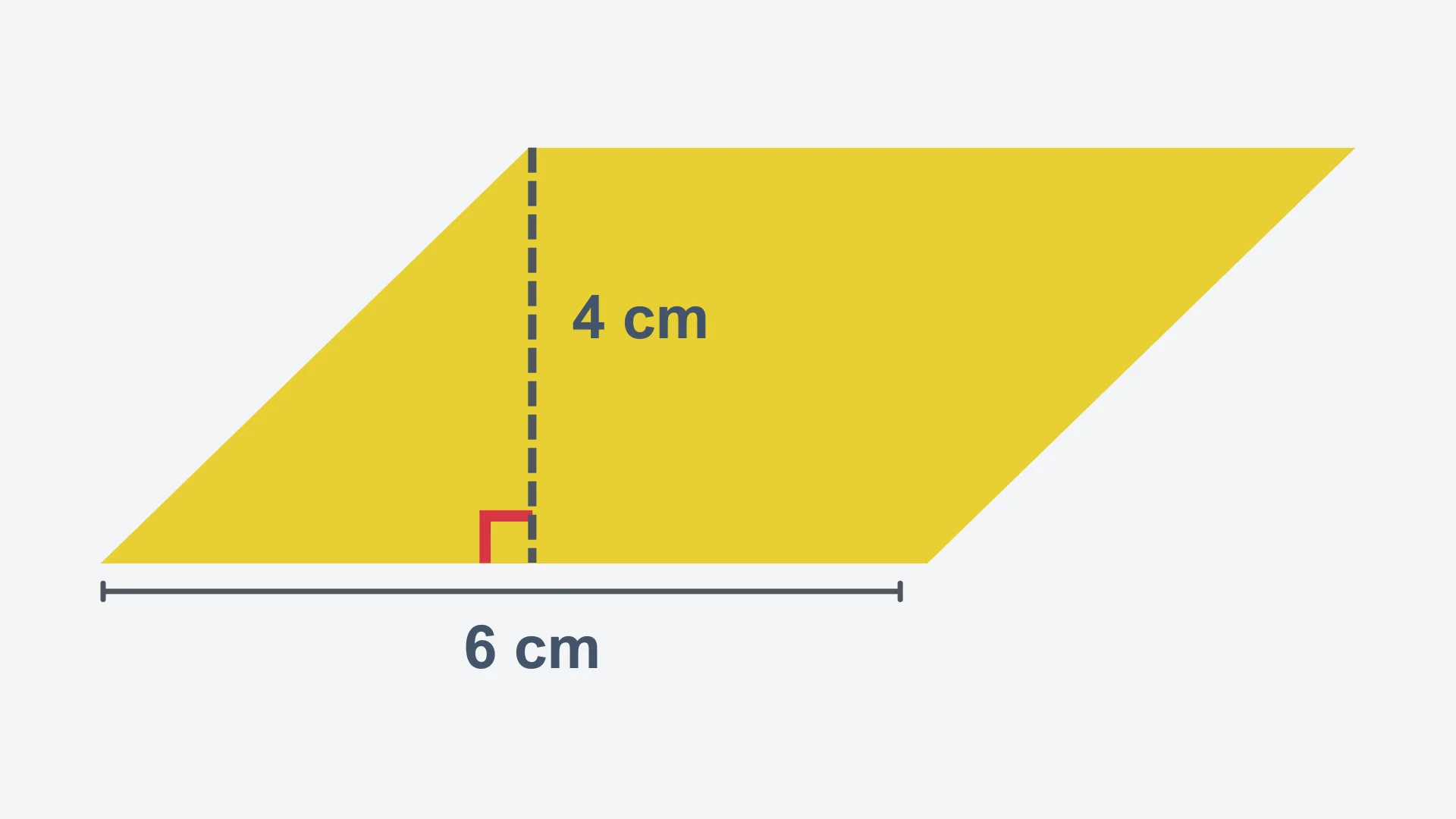
Correct! 🎉 +20 pointsCorrect! 🎉 Worth 20 XPNot quite right
Area of a base × perpendicular height.
The is the dashed line marked with a right angle, so it is the perpendicular height.
.
What is the area of this parallelogram?
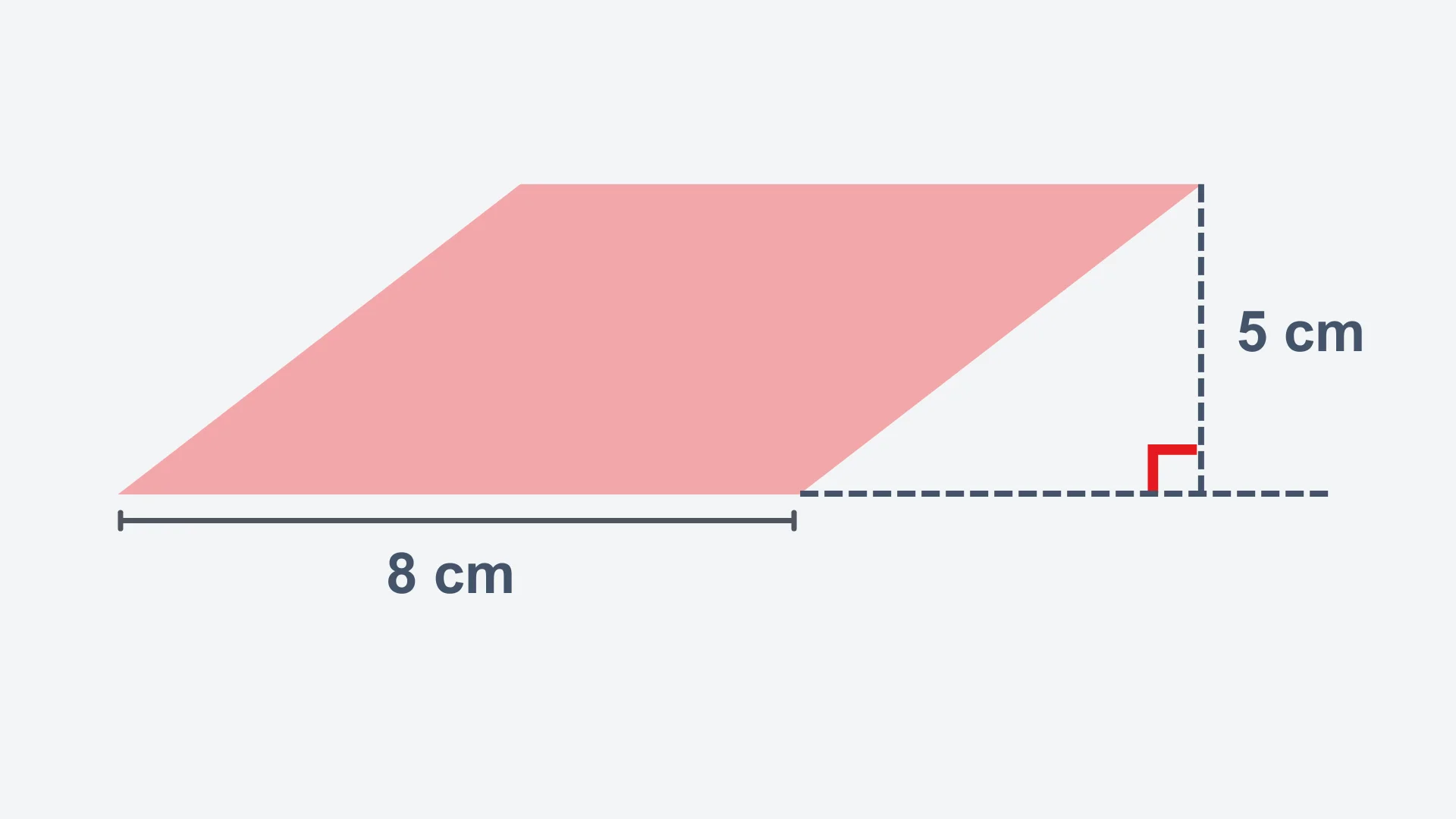
Correct! 🎉 +20 pointsCorrect! 🎉 Worth 20 XPNot quite right
Area of a base × perpendicular height.
Here the base is and the perpendicular height is . The height is drawn outside the shape, against the extended base, but it is still the perpendicular height.
.
What is the area of this triangle?
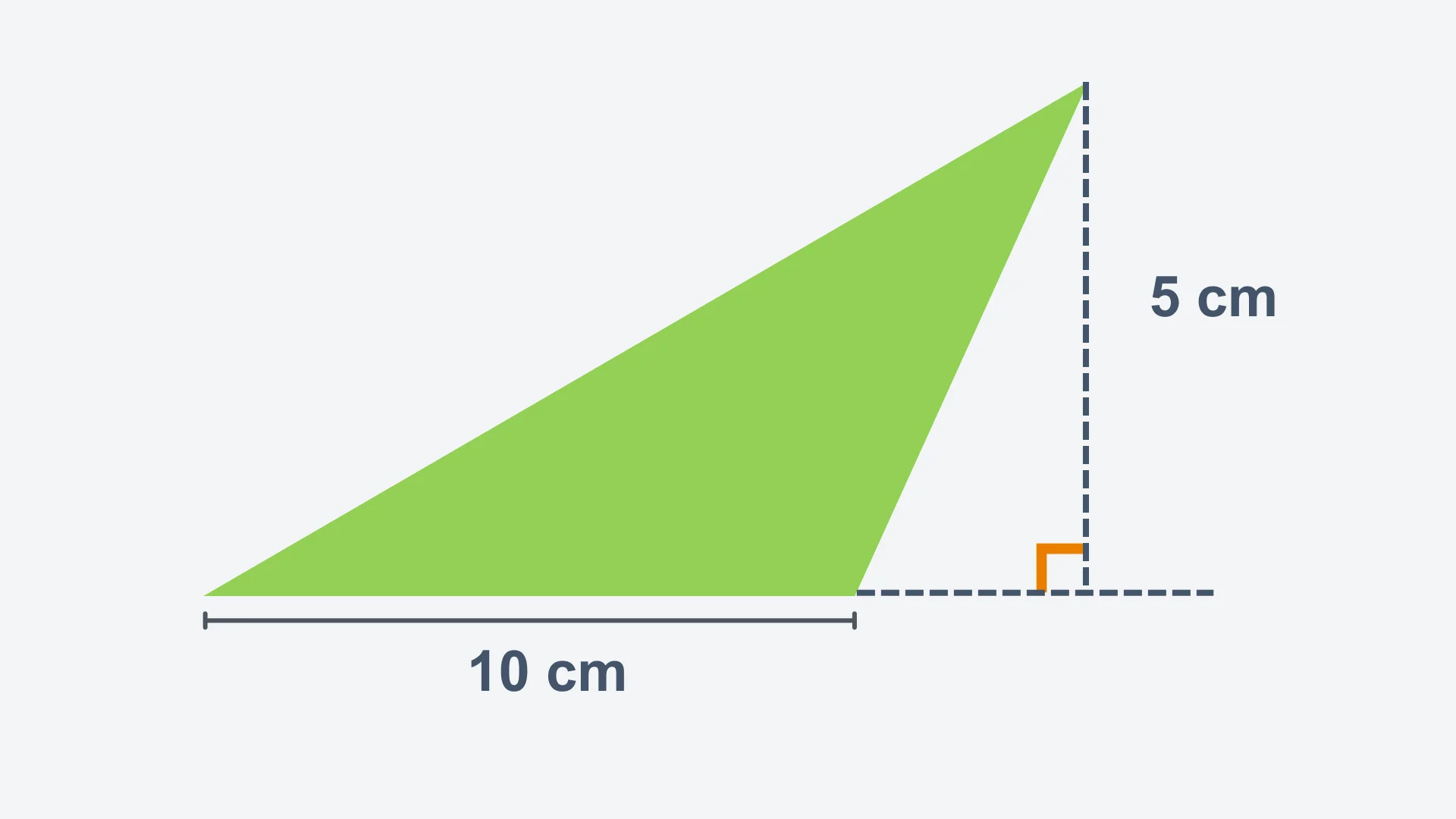
Correct! 🎉 +20 pointsCorrect! 🎉 Worth 20 XPNot quite right
Area of a base × height.
Here the base is and the perpendicular height is . The height is drawn outside the triangle, against the extended base, but it is still the perpendicular height.
.
What is the area of the parallelogram shown in the image?
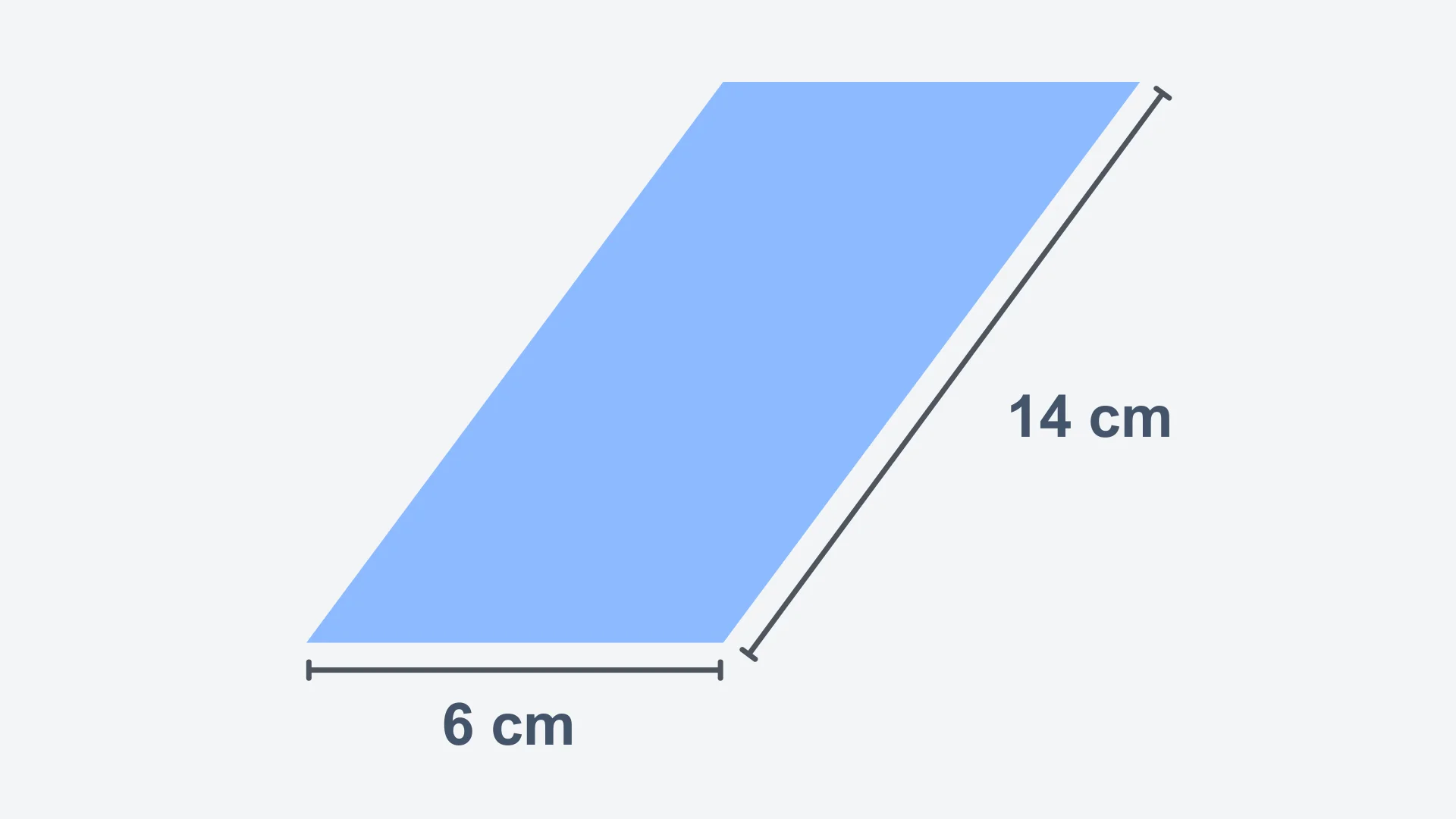
Correct! 🎉 +30 pointsCorrect! 🎉 Worth 30 XPNot quite right
Area of a base × perpendicular height.
The diagram gives the base as and a sloping side as . The side is not the perpendicular height, because it does not meet the base at a right angle, and no perpendicular height is marked.
Without the perpendicular height the area cannot be determined from this diagram.
Want to see the full working?
Interactive Activity
Explore the area of a parallelogram
Loading interactive widget...
Frequently asked questions
The questions students bump into most on this topic
Area = base × height. The base is any side, and the height is the perpendicular distance from that base to the opposite side, measured at right angles, not along the slanted side. A parallelogram with a base of 6 cm and a height of 4 cm has an area of 6 × 4 = 24 cm².
Multiply the base by the perpendicular height. Pick a side as the base, find the height drawn at right angles from it to the opposite side, and multiply: a base of 5 cm with a height of 8 cm gives 5 × 8 = 40 cm². Ignore the length of the slanted side; it is not the height.
Because you can cut a triangle off one end of a parallelogram and slide it to the other end to make a rectangle with the same base and the same height. Nothing is added or lost, so the two shapes have the same area, and the rectangle’s formula, base × height, works for the parallelogram too.
Yes. A parallelogram that leans a long way, or a triangle with an obtuse angle, has its perpendicular height falling outside the shape. Extend the base in a straight line until the perpendicular meets it and measure from there. If no height is given at all, you cannot find the area from the slanted side alone.
Copy any triangle, turn the copy round and fit it against the original: together they make a parallelogram with the same base and height. The parallelogram’s area is base × height, and the triangle is exactly half of it, so the triangle’s area is ½ × base × height. A triangle with base 10 cm and height 5 cm has area 25 cm².
What's next?
Found this one hard? Go one step back first. Feeling confident? Carry on to the next lesson.