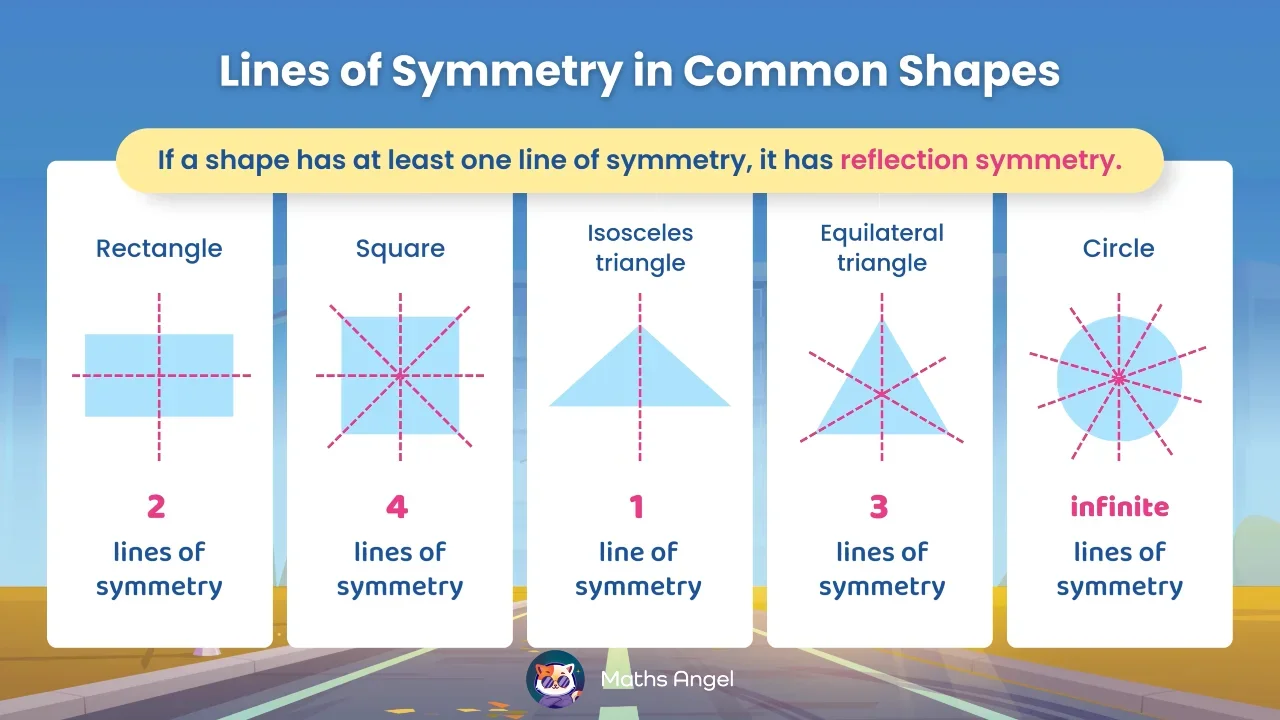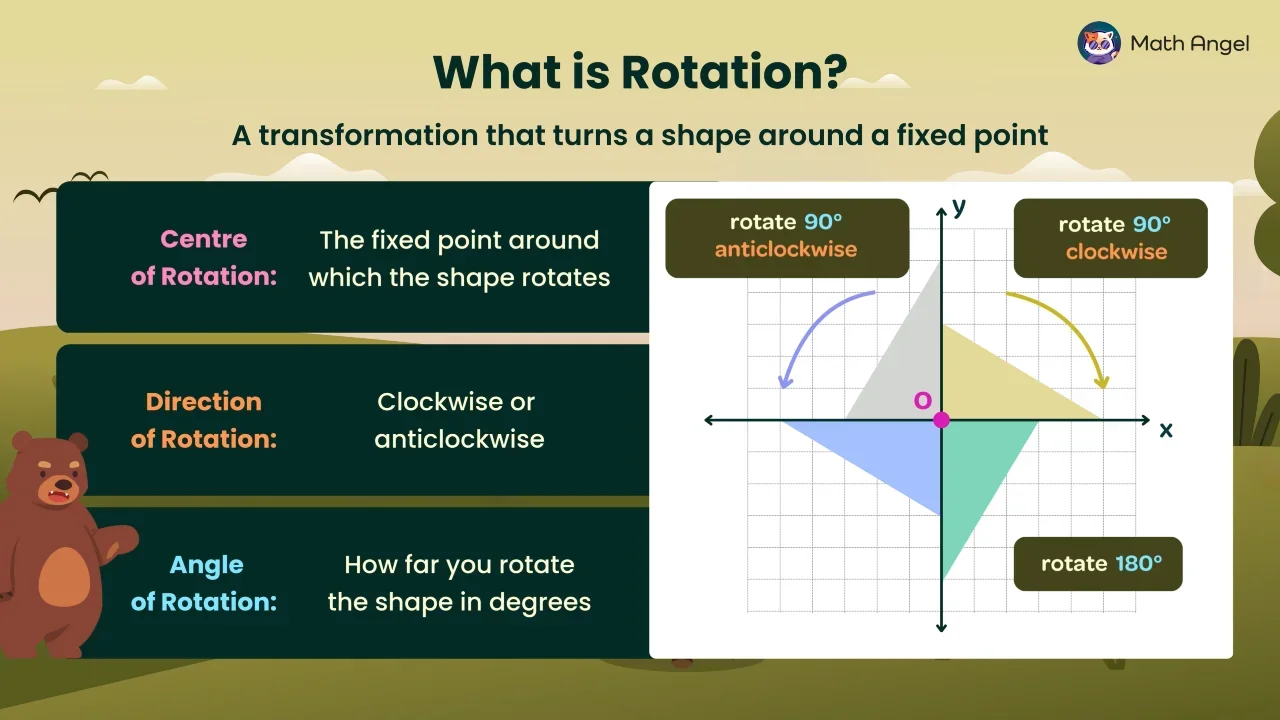
Rotational Symmetry
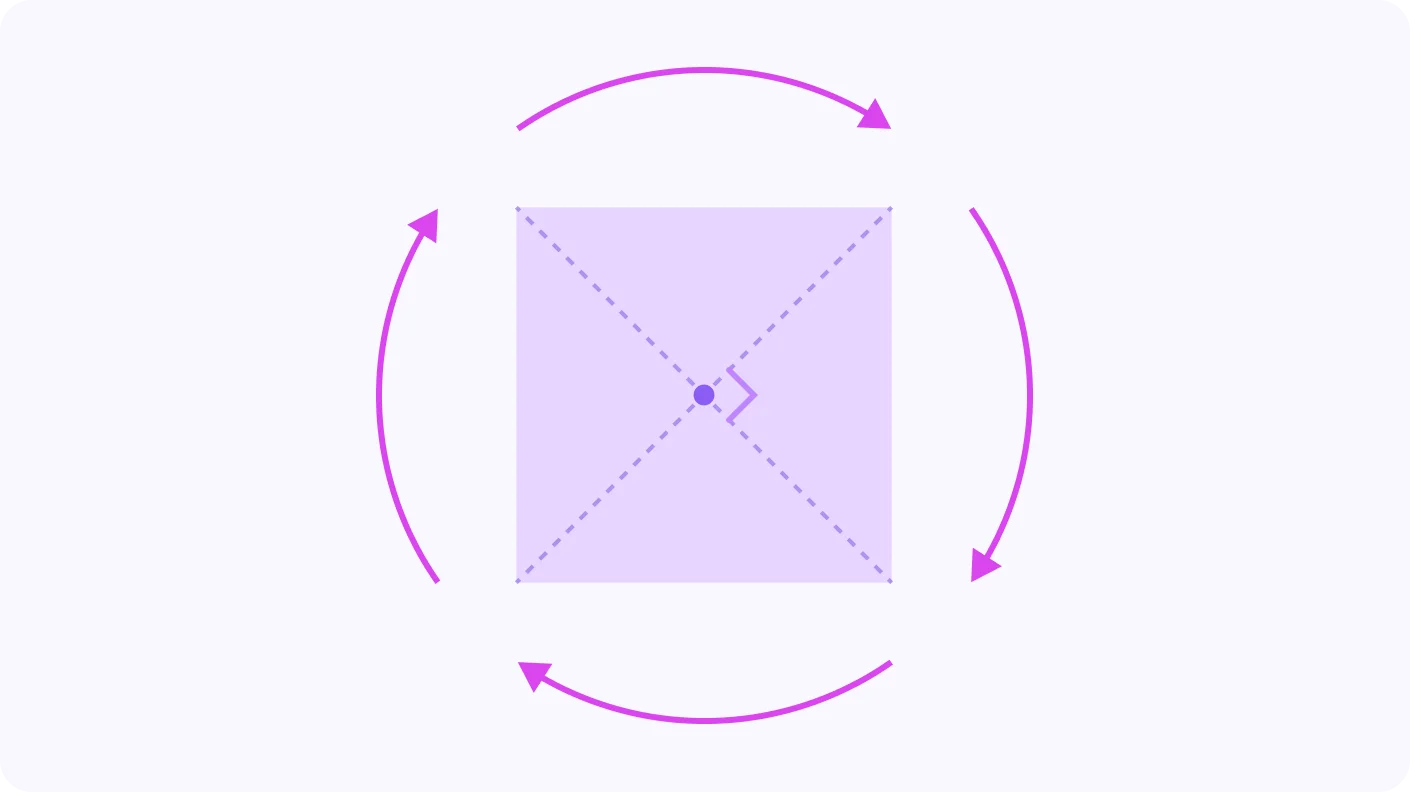
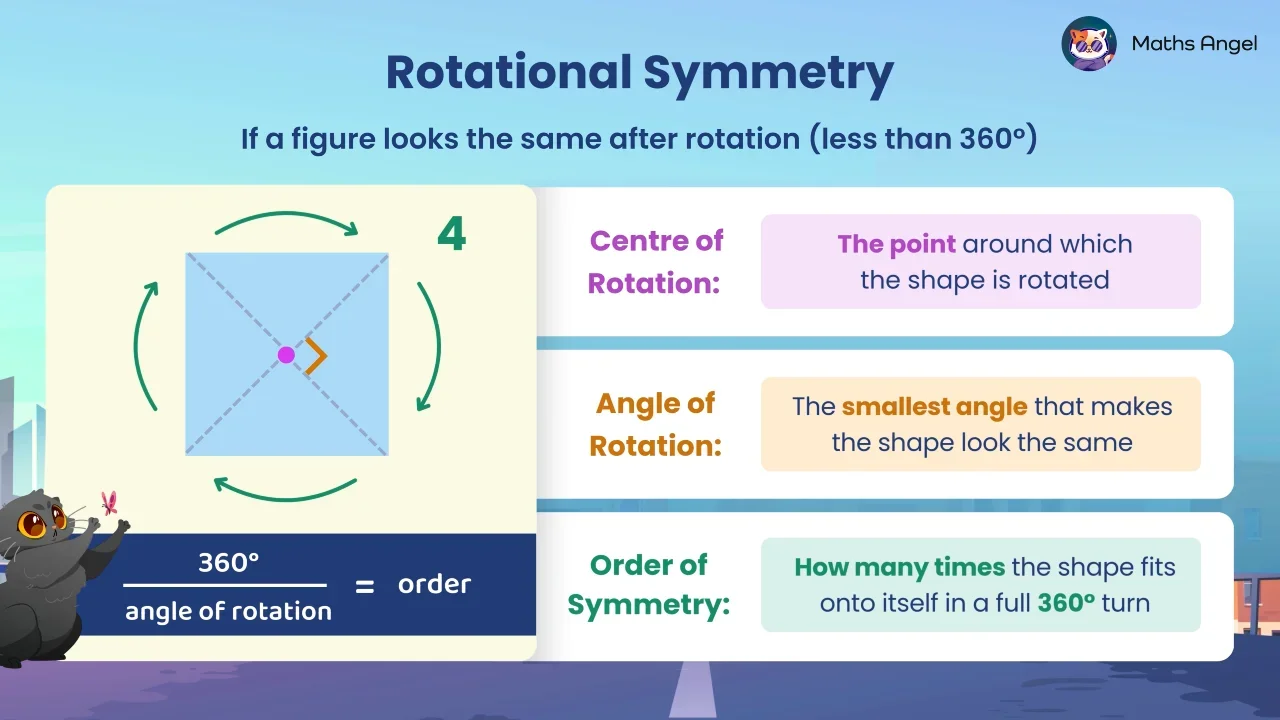
Rotational symmetry means a shape looks the same after a turn of less than 360° about its centre. The order of rotational symmetry counts how many times it matches in one full turn. For example, a square has order 4.
Video Lesson
Watch and learn the basics
🎬 Did this video explain it clearly?
Flashcards
Review key concepts visually
%20Rotational%20Symmetry.webp)
%20Rotational%20Symmetry%20of%20Common%20Shapes.webp)
%20Check%20for%20Rotational%20Symmetry.webp)
What is Rotational Symmetry?
- A shape has rotational symmetry if it looks the same after a turn of less than .
- The shape is rotated about its centre of rotation.
Order and Angle of Rotation
- The order of symmetry is the number of times a shape matches itself in a full turn.
- The angle of rotation = ÷ order (e.g. a rectangle has order 2, so the angle is ).
How to Check for Rotational Symmetry?
- Rotate the shape around its centre and see if it matches its starting position.
- If it matches before , the shape has rotational symmetry.
Practice Questions
Test your understanding
True or False: A non-square rectangle has an angle of rotation of and an order of rotational symmetry of 2.
Correct! 🎉 +10 pointsCorrect! 🎉 Worth 10 XPNot quite right
Turn a rectangle about its centre. After every vertex has moved to the opposite vertex, so the rectangle fits exactly onto its original outline.
In one full turn there are exactly two positions where it matches, at and at , so its order of rotational symmetry is 2, and its angle of rotation is .
The statement is therefore True.
What is the order of rotational symmetry of an equilateral triangle?
Correct! 🎉 +10 pointsCorrect! 🎉 Worth 10 XPNot quite right
Turn the triangle about its centre and count the positions where it fits exactly onto its original outline in one full turn.
It matches at , again at and again at .
That is 3 matching positions, so the order of rotational symmetry is 3 (equivalently ).
A figure first fits onto its own outline again after a turn of . What is its order of rotational symmetry?
Correct! 🎉 +20 pointsCorrect! 🎉 Worth 20 XPNot quite right
The order of rotational symmetry is how many times the figure fits its own outline during one full turn.
If it first matches after , it matches again every : at , and .
So , and the order of rotational symmetry is 3.
A regular octagon has an order of rotational symmetry of 8. What is its angle of rotation?
Correct! 🎉 +20 pointsCorrect! 🎉 Worth 20 XPNot quite right
One full turn is , and the 8 matching positions are spaced equally around that turn.
So the angle of rotation is .
The octagon fits onto its own outline every : at , , and so on up to .
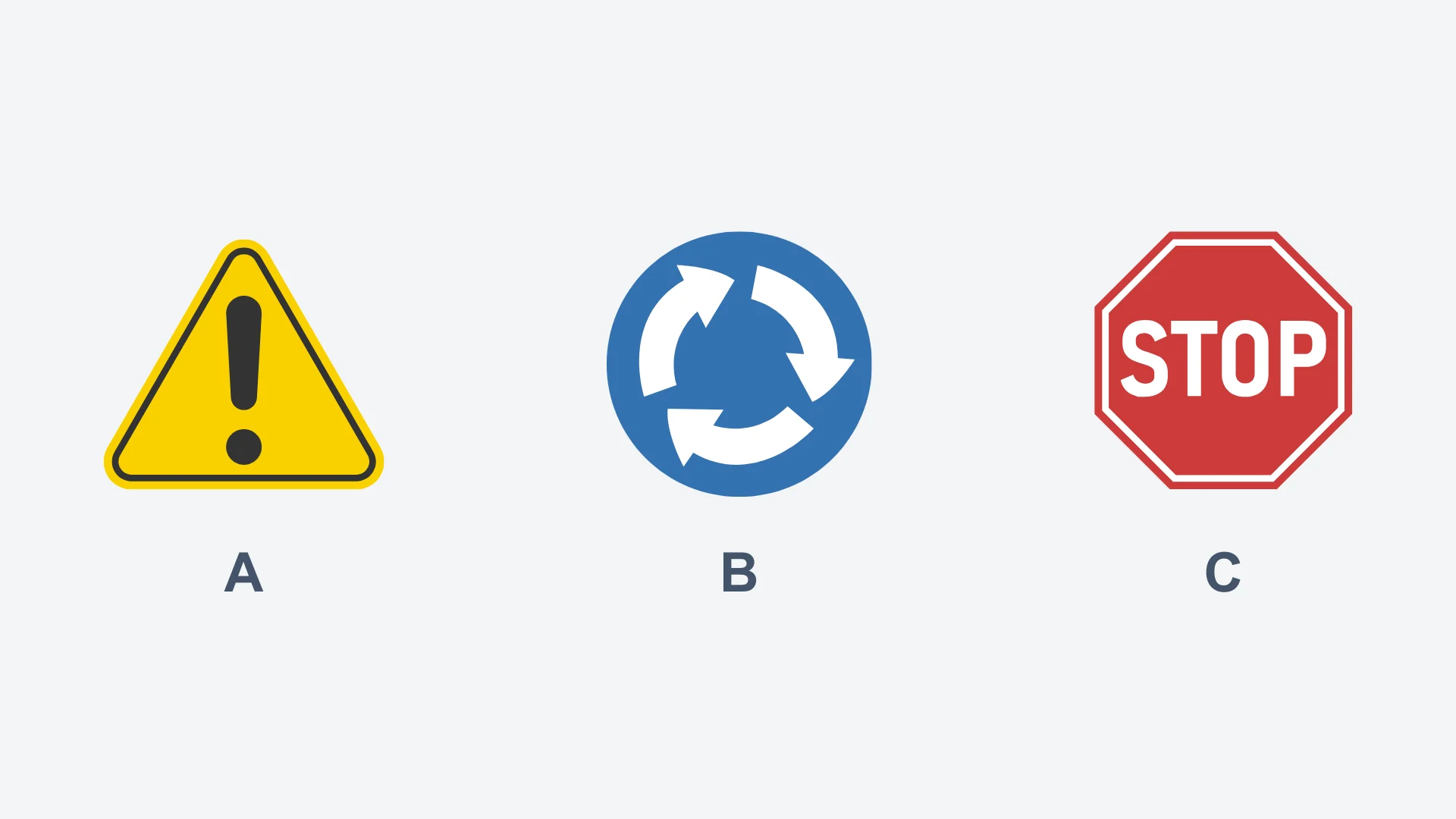
Which of the following signs has rotational symmetry?
Correct! 🎉 +20 pointsCorrect! 🎉 Worth 20 XPNot quite right
Sign B, the blue roundabout sign, has three identical curved arrows spaced equally around the circle. Turning it about its centre leaves it looking exactly the same, so it has rotational symmetry of order 3.
Sign A has a mirror line down the middle, but the exclamation mark means no turn short of a full maps it onto itself.
Sign C is drawn on a regular octagon, but the word STOP inside it does not repeat, so again only a full turn brings it back.
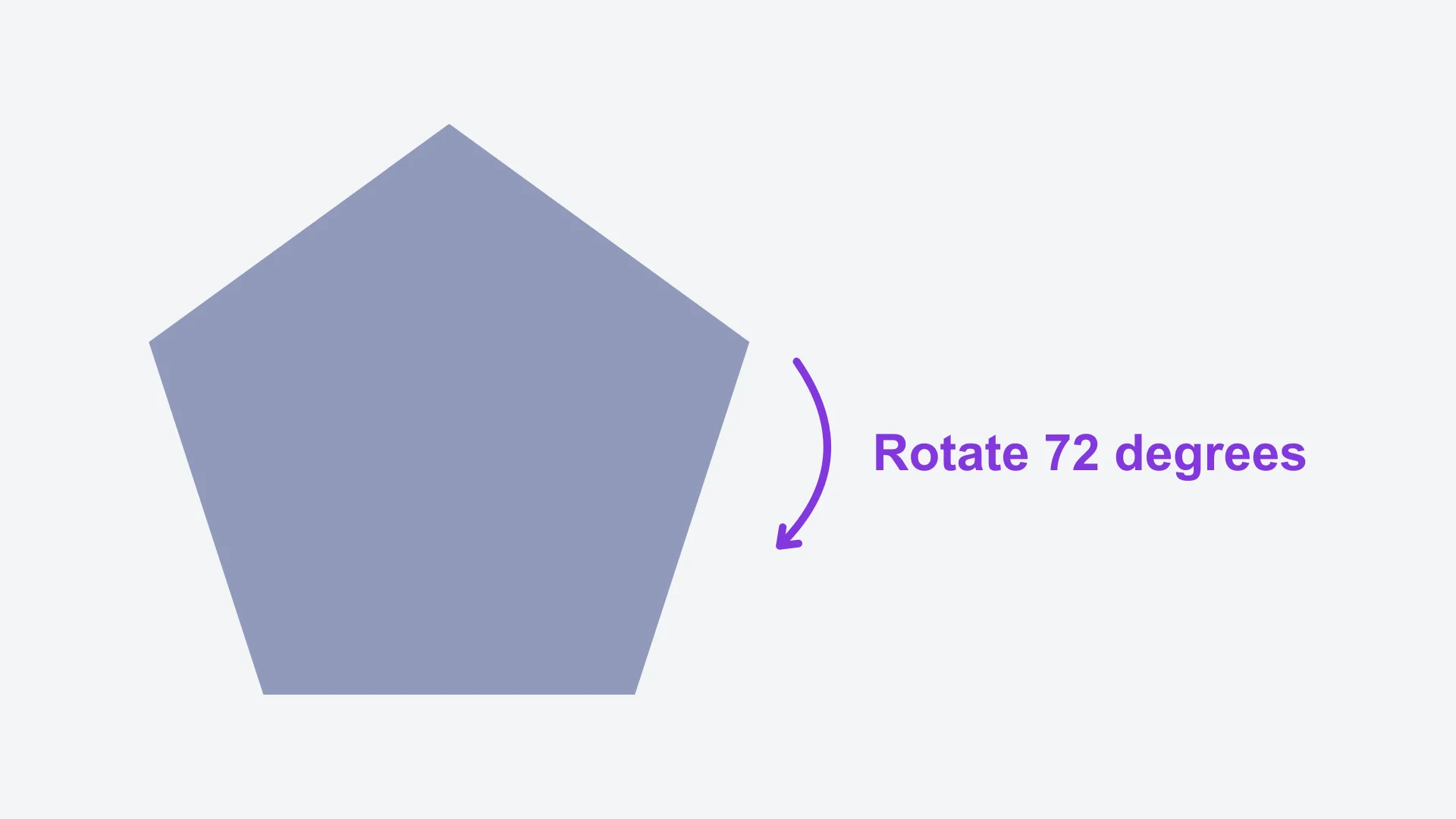
If you rotate a regular pentagon by about its centre, will it look the same?
Correct! 🎉 +30 pointsCorrect! 🎉 Worth 30 XPNot quite right
A regular pentagon has 5 equal sides and 5 equal angles, so it fits onto its own outline 5 times in a full turn: .
A turn of carries each vertex exactly onto the next one, so the pentagon looks identical afterwards.
The answer is Yes.
Want to see the full working?
Interactive Activity
Explore rotational symmetry by spinning shapes
Loading interactive widget...
Frequently asked questions
The questions students bump into most on this topic
A shape has rotational symmetry if it can be turned by less than 360° and still look the same. It turns about its centre of rotation. The order of symmetry is how many times it matches in a full turn, and the angle of rotation is the smallest turn that makes it match: a square matches every 90°, so its order is 4.
The order of rotational symmetry is the number of times a shape fits onto itself during one full 360° turn. There is a simple formula linking it to the angle of rotation: angle = 360° ÷ order, and order = 360° ÷ angle. A regular hexagon has order 6, so its angle of rotation is 360° ÷ 6 = 60°.
Turn the shape about its centre and check whether it matches its starting position before you reach a full turn. If it matches only after 360°, it has no rotational symmetry: a parking sign is one example. A no-entry sign matches after 180°, so it has order 2, and a radioactive symbol matches three times, so it has order 3.
Order 2 means the shape fits onto itself twice in a full turn: once after a half turn of 180° and again at 360°. A rectangle is the classic example, since it looks identical after a 180° rotation. Using the formula, 360° ÷ 2 gives its angle of rotation, 180°. A no-entry sign has order 2 too.
Order 4 means the shape fits onto itself four times in a full turn, so its angle of rotation is 360° ÷ 4 = 90°. A square is the everyday example: turn it a quarter turn and it looks exactly the same, and it matches at 90°, 180°, 270° and 360°.
A regular hexagon has an order of rotational symmetry of 6: it fits onto itself six times during one full turn. Using the formula, 360° ÷ 6 gives an angle of rotation of 60°, the smallest turn that maps the hexagon onto itself. An equilateral triangle, by the same reasoning, has order 3 and an angle of 120°.
What's next?
Found this one hard? Go one step back first. Feeling confident? Carry on to the next lesson.