Plotting and Reflecting Points on the Coordinate Plane
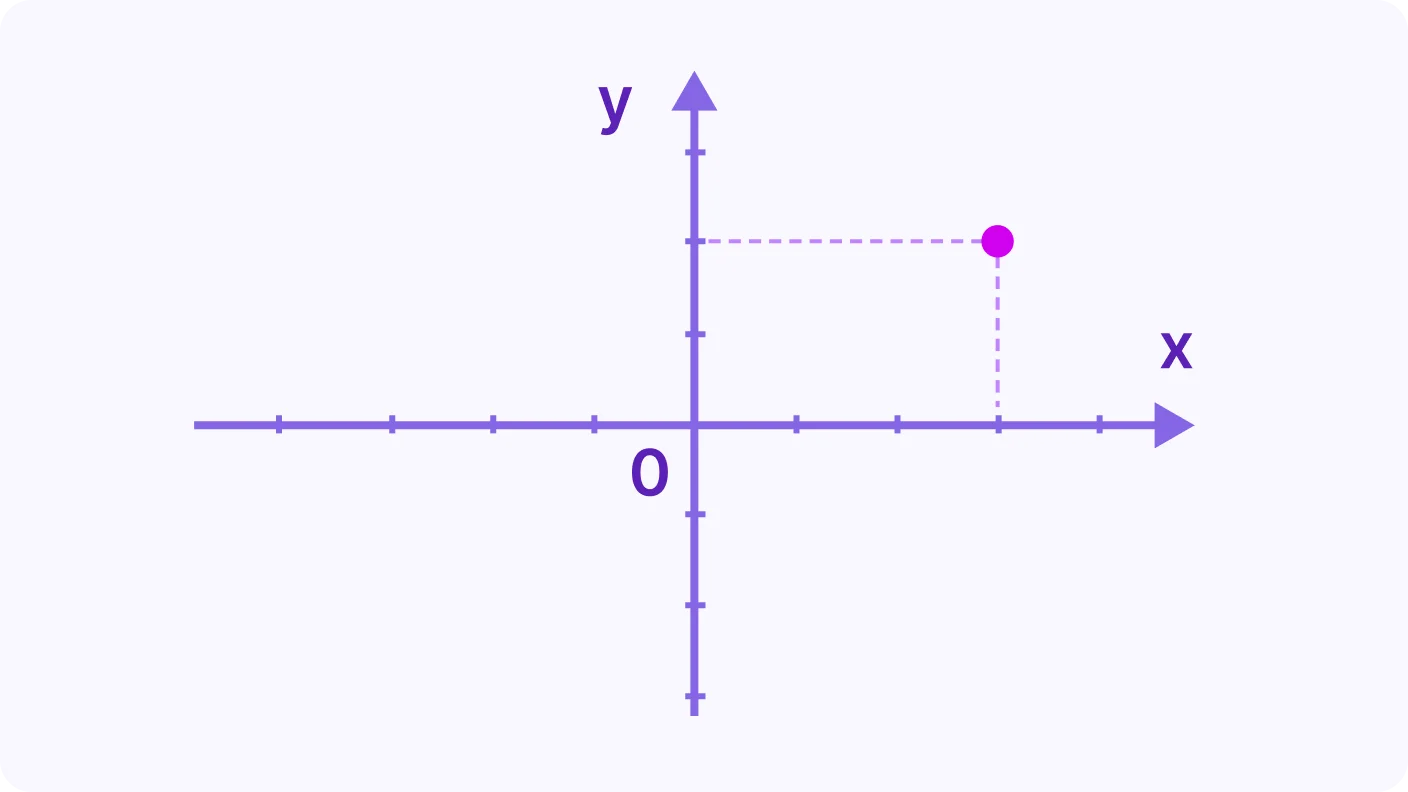
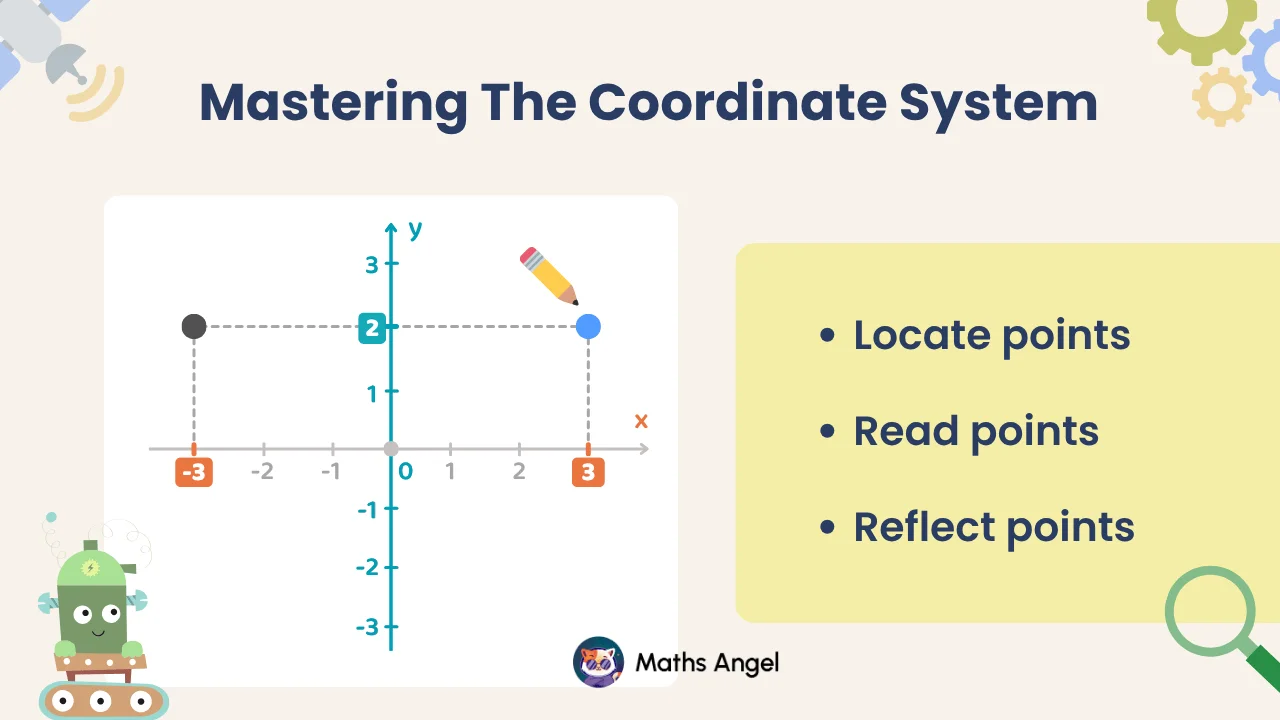
The coordinate plane locates every point with a pair (x, y): x tells you how far left or right, y how far up or down, so (3, 2) is 3 right and 2 up from the origin. Reflecting a point over the x-axis or y-axis changes the sign of one coordinate, while reflecting it in the origin changes the sign of both.
Video Lesson
Watch and learn the basics
🎬 Did this video explain it clearly?
Flashcards
Review key concepts visually
%20Coordinate%20System.webp)
%20Locating%20Points%20on%20Coordinate%20System.webp)
%20Reflecting%20Points%20over%20the%20y-axis.webp)
%20Reflecting%20point%20over%20x-axis.webp)
%20Reflecting%20Point%20over%20the%20origin.webp)
%20Reflecting%20Figure%20over%20y-axis.webp)
The Coordinate System
- The x-axis is horizontal and the y-axis is vertical.
- The point where they meet is called the origin (0,0).
How to Locate a Point on a Grid
- A point is written as (x, y).
- Move along x first, then up or down y.
Reflecting Points over y-axis
- Change the sign of the x-coordinate.
- The y-coordinate stays the same.
Reflecting Points over x-axis
- Change the sign of the y-coordinate.
- The x-coordinate stays the same.
Reflecting in the Origin
- Change the sign of both x and y.
- The point moves to the opposite quadrant.
Reflecting Shapes
- Reflect every vertex using the same rule.
- Then connect the reflected points to form the new shape.
Practice Questions
Test your understanding
What are the coordinates of a point located at 4 units to the left of the origin and 2 units below the origin?
Correct! 🎉 +10 pointsCorrect! 🎉 Worth 10 XPNot quite right
Start at the origin, (0, 0). Moving 4 units to the left makes the x-coordinate −4, and moving 2 units down makes the y-coordinate −2.
Coordinates are always written across first, then up or down, so the point is (−4, −2). Both coordinates are negative, so it sits in the bottom-left quadrant.
Reflect the point (2, −4) in the x-axis. What are the new coordinates?
Correct! 🎉 +10 pointsCorrect! 🎉 Worth 10 XPNot quite right
Reflecting in the x-axis keeps the x-coordinate the same and flips the sign of the y-coordinate.
The point (2, −4) sits 4 units below the x-axis, so its image sits 4 units above it, directly in line at (2, 4). Count the 4 squares from the point up to the axis, then the same 4 squares again beyond it. The mirror line itself is not one of the counted squares.
Reflect the point (−4, 6) over the origin. What are the new coordinates?
Correct! 🎉 +20 pointsCorrect! 🎉 Worth 20 XPNot quite right
Reflecting in the origin is a half turn about (0, 0): the point moves to the opposite side of the origin, the same distance away, so both coordinates change sign.
So (−4, 6) becomes (4, −6).
Reflect the point (2, 3) over the y-axis. What are the new coordinates?
Correct! 🎉 +20 pointsCorrect! 🎉 Worth 20 XPNot quite right
The y-axis is a vertical mirror line. The point (2, 3) is 2 units to the right of it, so its image is 2 units to the left of it, at the same height.
Only the x-coordinate changes sign, so (2, 3) becomes (−2, 3).
A point is reflected over the y-axis, and its new coordinates are (3, −1). What were the original coordinates?
Correct! 🎉 +20 pointsCorrect! 🎉 Worth 20 XPNot quite right
Reflecting in the y-axis changes the sign of the x-coordinate, and reflecting a second time takes you straight back. So to undo the reflection, change the sign of the x-coordinate again.
The image is (3, −1), so the original point was (−3, −1). Check: reflecting (−3, −1) in the y-axis gives (3, −1). ✓
Reflect the point (−5, 4) first over the x-axis, then over the y-axis. What are the final coordinates?
Correct! 🎉 +30 pointsCorrect! 🎉 Worth 30 XPNot quite right
Do the two reflections one at a time.
Reflecting in the x-axis changes the sign of the y-coordinate: (−5, 4) → (−5, −4).
Reflecting that image in the y-axis changes the sign of the x-coordinate: (−5, −4) → (5, −4).
So the final coordinates are (5, −4). (Reflecting in both axes has the same overall effect as a half turn about the origin.)
Want to see the full working?
Interactive Activity
Visualise how points change when reflected across axes
Loading interactive widget...
Frequently asked questions
The questions students bump into most on this topic
A point is written (x, y). Find the x-coordinate on the horizontal x-axis and the y-coordinate on the vertical y-axis, then follow a line from each until they cross: that crossing is the point. For (2, 1), find 2 on the x-axis and 1 on the y-axis. Negative coordinates go left of the origin or below it, so (−3, −1) is 3 left and 1 down.
The origin is the point (0, 0), where the horizontal x-axis and the vertical y-axis cross. Every coordinate is counted from it: positive x-values are to its right and negative ones to its left; positive y-values are above it and negative ones below. Reflecting a point “in the origin” means flipping it to the opposite side of this point.
The x-coordinate comes first, then the y-coordinate, written (x, y). Read the number on the x-axis first and the number on the y-axis second: a point 2 to the left of the origin and 3 up is (−2, 3), and one 1 to the right and 3 down is (1, −3). Swapping the order gives a different point, so (3, 1) is not (1, 3).
Change the sign of one coordinate and keep the other. Reflecting in the y-axis changes the sign of x: (−3, 2) becomes (3, 2), the same height on the other side. Reflecting in the x-axis changes the sign of y: (−3, 2) becomes (−3, −2). UK exam papers say “reflect in the axis”; American sites say “reflect over” or “across”. It is the same move.
Change the sign of both coordinates. (−3, 2) becomes (3, −2): the point moves to the opposite quadrant, the same distance from the origin on the other side. It is the same as reflecting in the x-axis and then in the y-axis, which is why both signs change.
Reflect each vertex with the matching rule, then join the new points in the same order. To reflect a triangle in the y-axis, change the sign of every vertex’s x-coordinate and keep the y-coordinates, plot the three new points and connect them. The reflected shape is the same size and faces the other way.
What's next?
Found this one hard? Go one step back first. Feeling confident? Carry on to the next lesson.