Translating Shapes
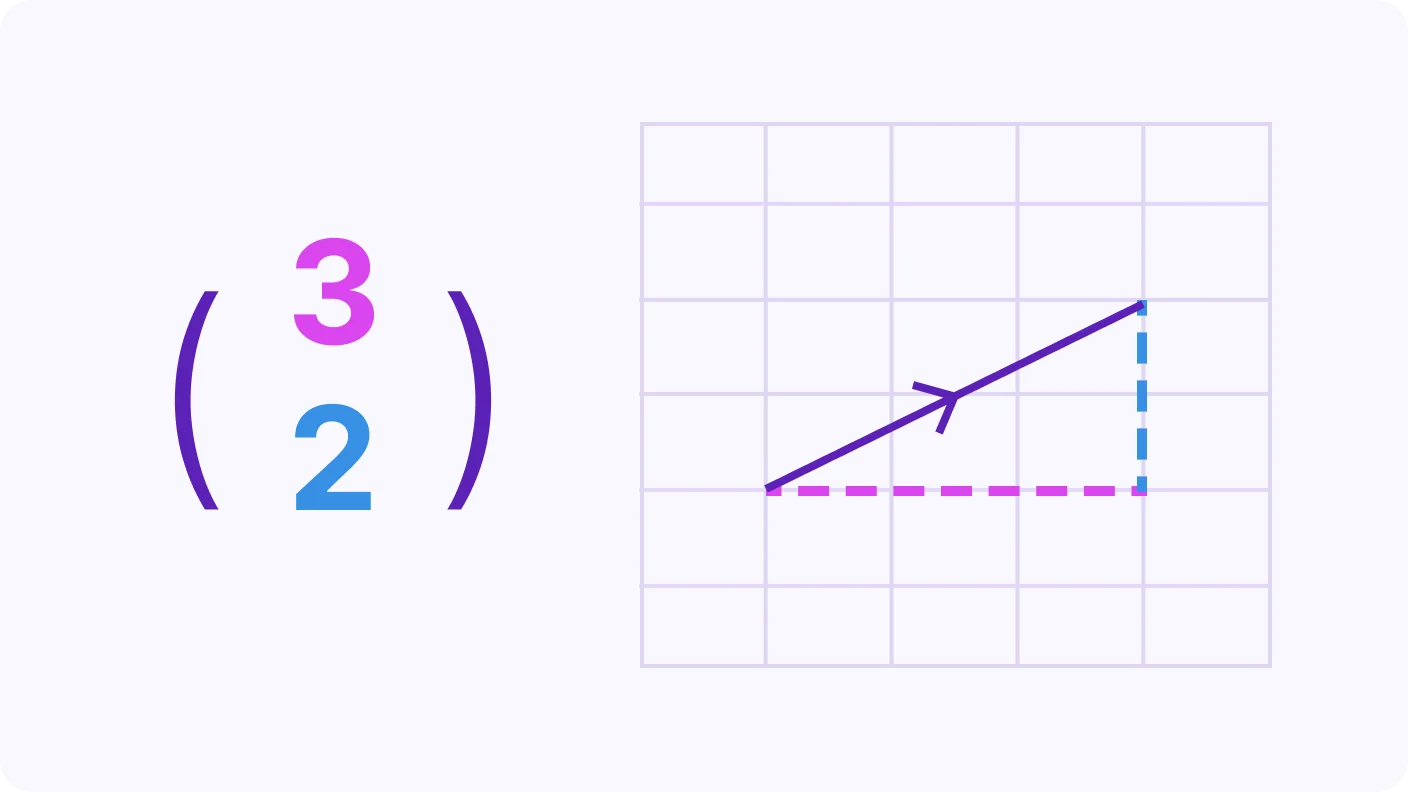
Translating a shape slides it across a grid, keeping its size and orientation the same. All vertices move the same way. A column vector like (3, 2) describes the translation: 3 right, then 2 up.
Video Lesson
Watch and learn the basics
🎬 Did this video explain it clearly?
Flashcards
Review key concepts visually
%20Translation.webp)
%20Column%20vectors.webp)
%20Translating%20with%20a%20column%20vector.webp)
%20Find%20the%20column%20vector%20of%20a%20translation.webp)
Translation: Sliding a Shape
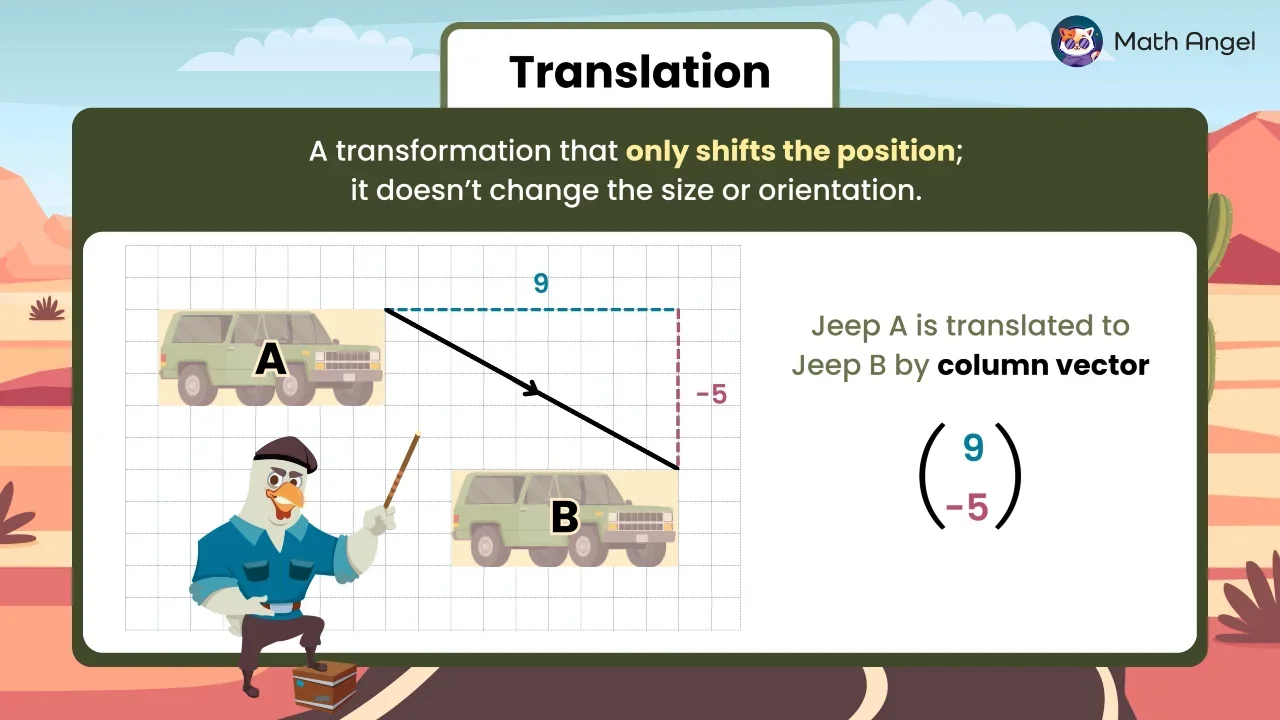
- A translation moves a shape without changing its size or orientation.
- Every point shifts the same distance in the same direction.
Column Vectors
- The top number shows the horizontal movement, where positive is right and negative is left.
- The bottom number shows the vertical movement, where positive is up and negative is down.
Translating 2D Shapes
- You move all vertices using the same column vector, then connect them.
- The shape stays identical, just in a new position.
Finding the Column Vector
- Count how far a point moves left or right first.
- Then count how far it moves up or down.
Practice Questions
Test your understanding
What does column vector mean?
Correct! 🎉 +10 pointsCorrect! 🎉 Worth 10 XPNot quite right
In a column vector the top number is the horizontal movement and the bottom number is the vertical movement.
The top number is : negative means left, so move 4 units to the left.
The bottom number is : positive means up, so move 2 units up.
What does column vector mean?
Correct! 🎉 +10 pointsCorrect! 🎉 Worth 10 XPNot quite right
In a column vector the top number is the horizontal movement and the bottom number is the vertical movement.
The top number is : negative means left, so move 3 units to the left.
The bottom number is : negative means down, so move 6 units down.
Shape A is translated to Shape B by moving 7 units to the right and 3 units down. What is the column vector for this translation?
Correct! 🎉 +20 pointsCorrect! 🎉 Worth 20 XPNot quite right
In a column vector the top number is the horizontal movement (right is positive, left is negative) and the bottom number is the vertical movement (up is positive, down is negative).
Moving 7 units to the right gives a top number of . Moving 3 units down gives a bottom number of .
So the translation is .
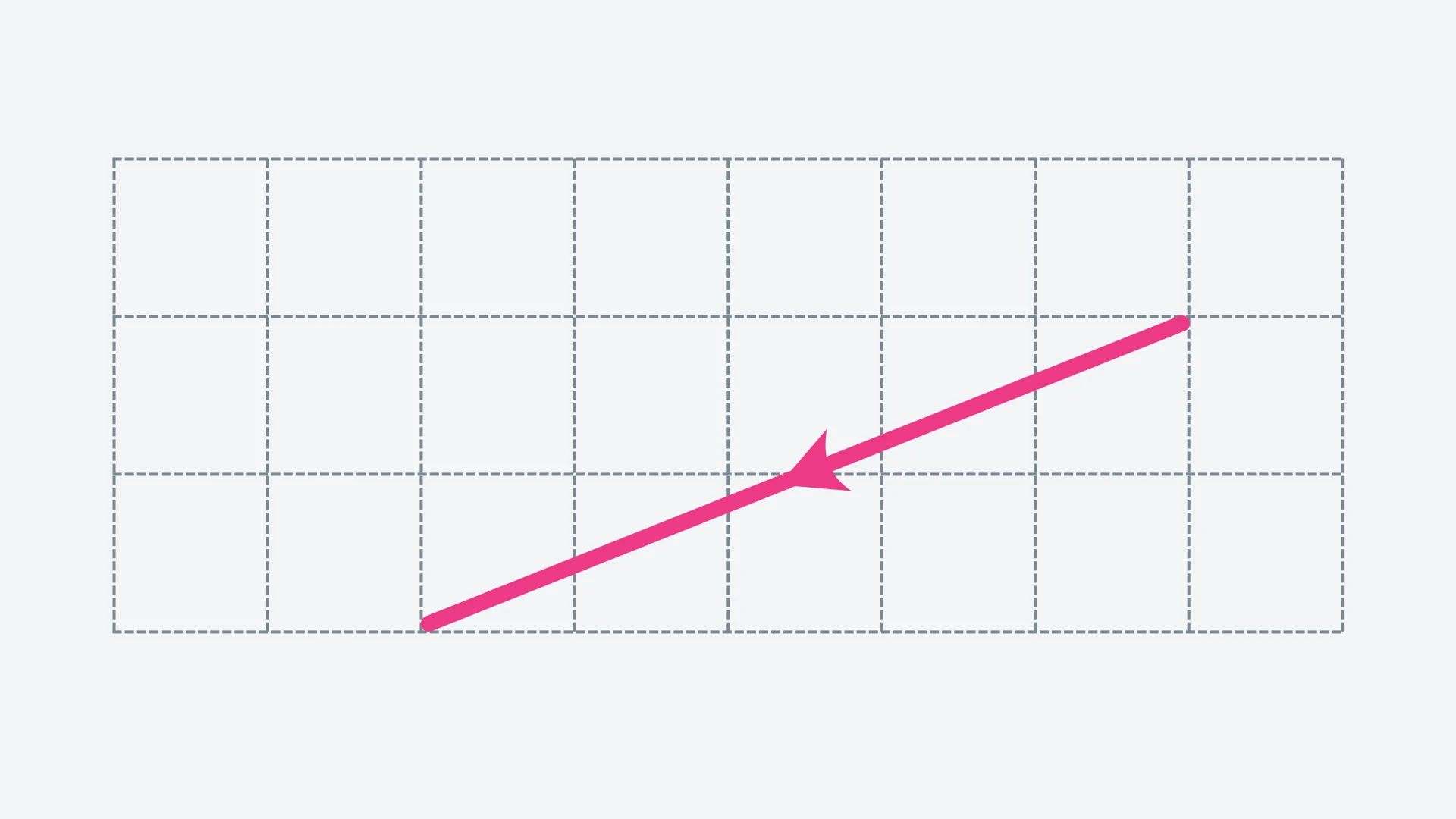
Write down the column vector shown in the diagram.
Correct! 🎉 +20 pointsCorrect! 🎉 Worth 20 XPNot quite right
Start at the tail of the arrow (top right) and follow it to the arrowhead end (bottom left).
First count the horizontal movement: 5 squares to the left, so the top number is .
Then count the vertical movement: 2 squares down, so the bottom number is .
That gives the vector .
A point starts at (2, 5) and is translated using the column vector . What are the new coordinates of the point?
Correct! 🎉 +20 pointsCorrect! 🎉 Worth 20 XPNot quite right
The top number of the vector changes the x-coordinate and the bottom number changes the y-coordinate.
x:
y:
So the point moves to .
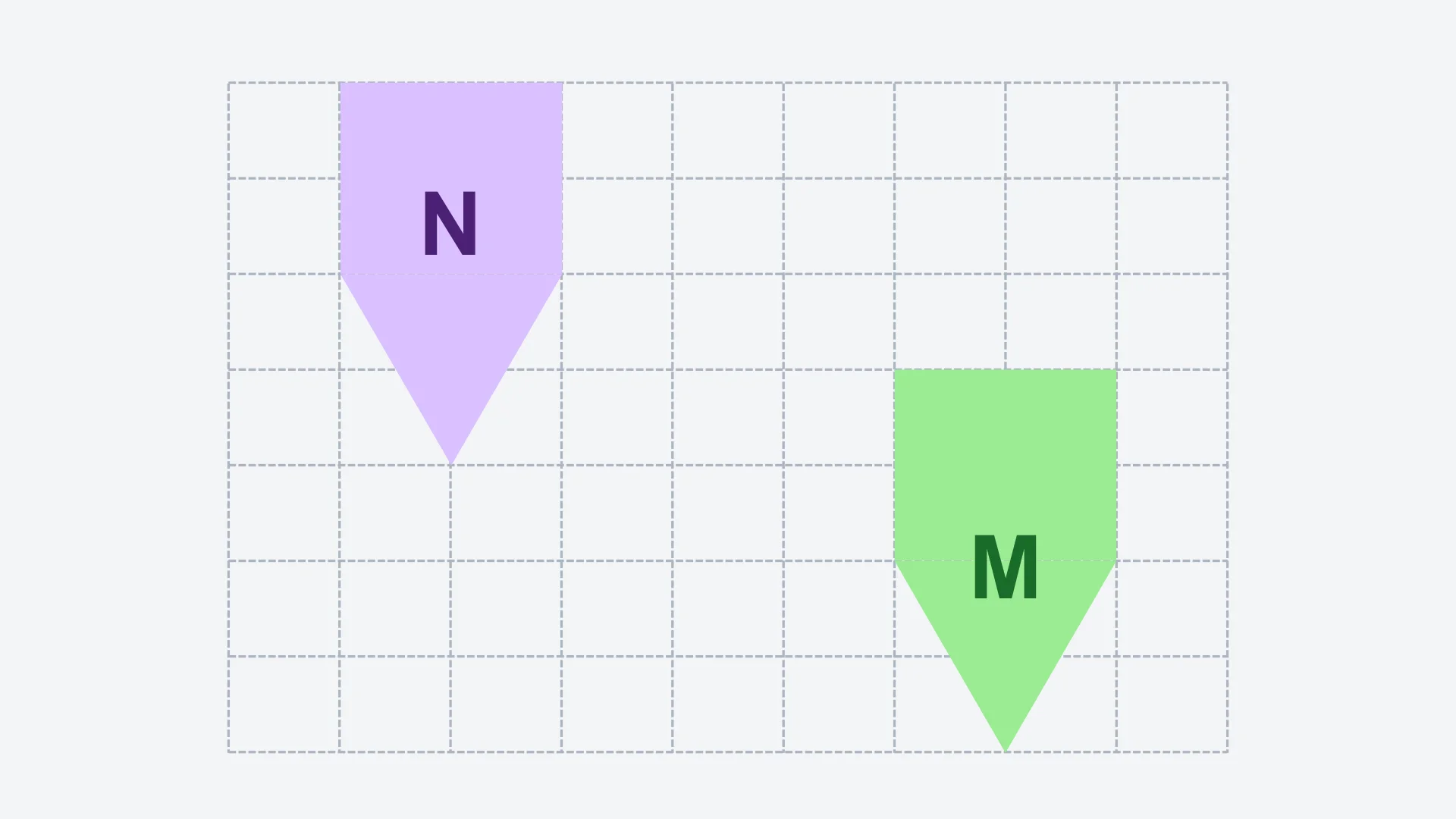
Shape M is translated to Shape N as shown in the diagram. Find the column vector for this translation.
Correct! 🎉 +30 pointsCorrect! 🎉 Worth 30 XPNot quite right
Pick a point on M and find the matching point on N. N is 5 squares to the left of M, so the top number is .
N is also 3 squares above M, so the bottom number is (up is positive).
The translation from M to N is therefore .
Want to see the full working?
Interactive Activity
Translate shapes with column vectors on a grid
Loading interactive widget...
Frequently asked questions
The questions students bump into most on this topic
A translation slides a shape to a new position without turning it, flipping it or changing its size. Every point moves the same distance in the same direction. Jeep A is translated to Jeep B by moving 9 units to the right and 5 units down. In GCSE maths you describe the move with a column vector.
A column vector is two numbers written one above the other that describe a translation. The top number is the horizontal move: positive means right, negative means left. The bottom number is the vertical move: positive means up, negative means down. So top 3, bottom 2 means 3 right and 2 up, and top −6, bottom 1 means 6 left and 1 up.
Move every corner by the vector, then join the new corners in the same order. To translate shape P by top 8, bottom −3, move each corner 8 units to the right and 3 units down, mark the new positions and connect them: that is the image, shape Q. The shape is identical; only its position changes.
Pick one corner of the original shape and the matching corner of the image, then count: left or right first, then up or down, and write the counts as a column vector. From shape M to shape N a corner moves 10 units left and 4 units down, so the translation is top −10, bottom −4. Mind the signs: left and down are negative.
Translation, reflection, rotation and enlargement. A translation slides the shape, described by a column vector; a reflection flips it in a mirror line; a rotation turns it about a centre; an enlargement makes it bigger or smaller by a scale factor. The first three keep the size and shape; only enlargement changes the size. This lesson covers translation.
What's next?
Found this one hard? Go one step back first. Feeling confident? Carry on to the next lesson.