Rotating Shapes
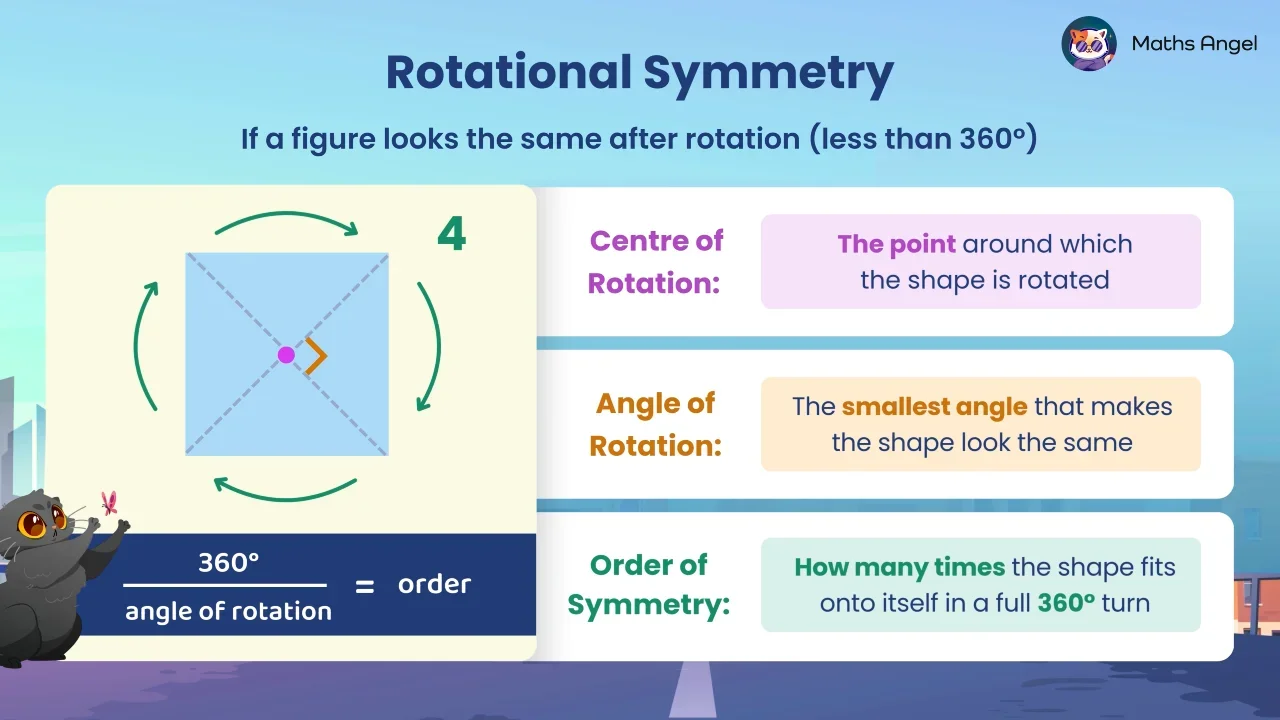
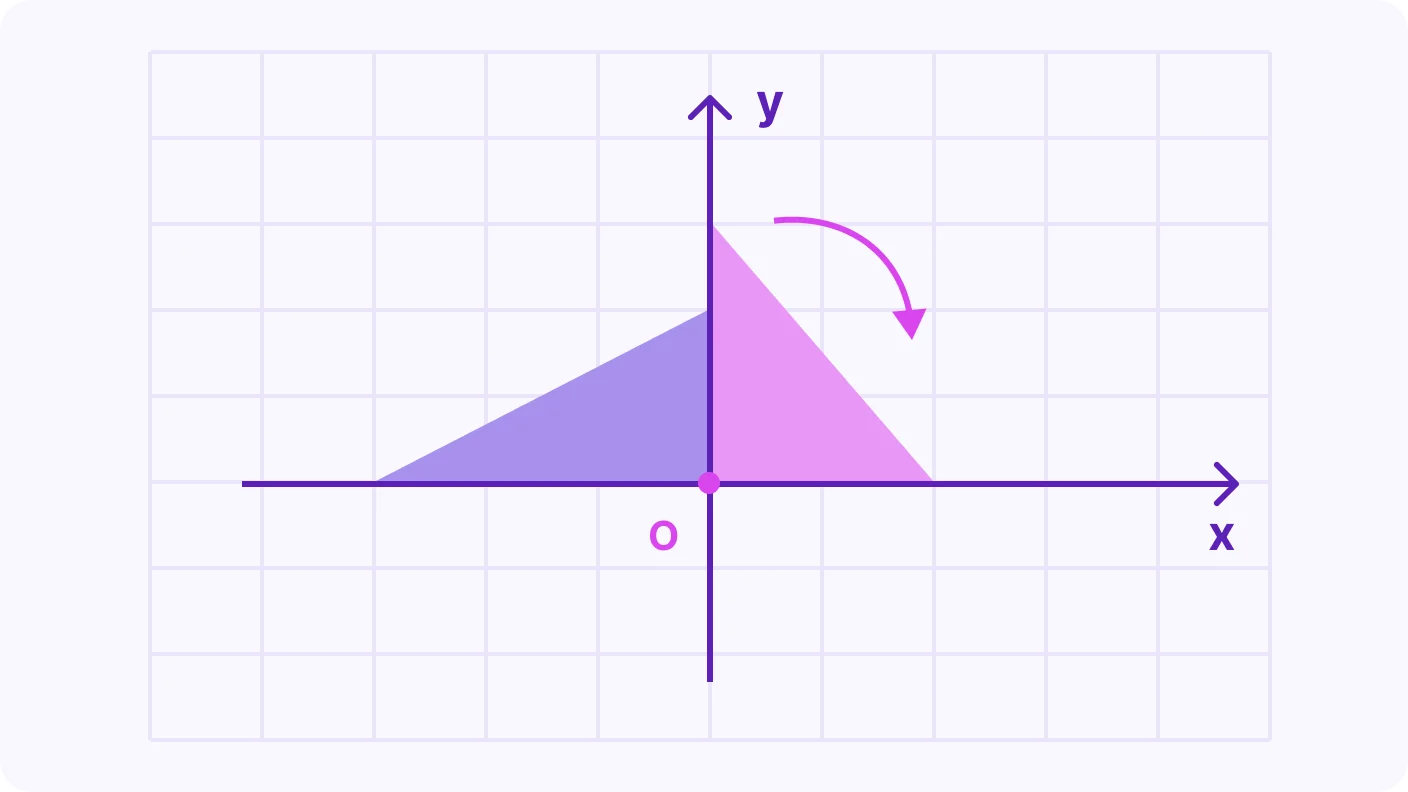
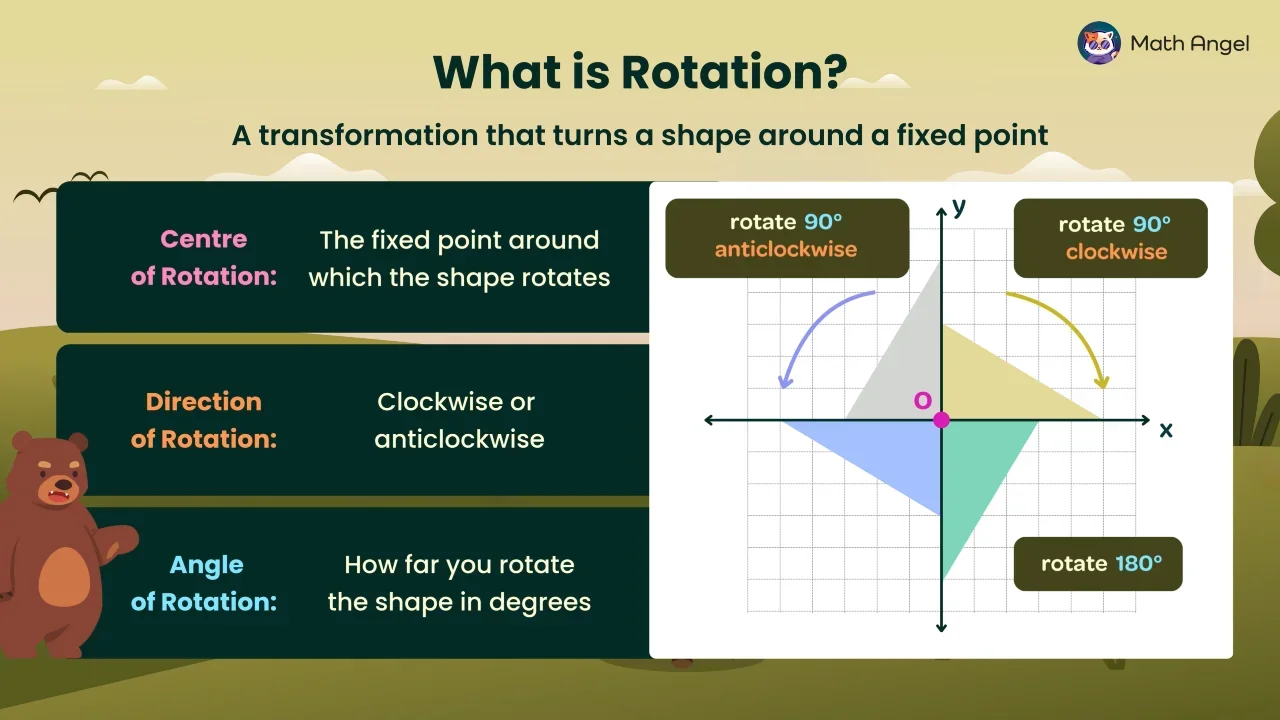
Rotating shapes means turning a shape around a fixed point called the centre of rotation. The shape keeps its size and shape; only its position changes. To describe a rotation, give the angle and direction, like 90° clockwise.
Video Lesson
Watch and learn the basics
🎬 Did this video explain it clearly?
Flashcards
Review key concepts visually
%20What%20is%20Rotation.webp)
%20Rotate%20Shapes%20with%20a%20Tracing%20Paper.webp)
%20Rotate%20Shapes%20by%20Drawing%20Lines.webp)
%20How%20to%20Find%20the%20Centre%20of%20Rotation.webp)
What Is Rotation?
- A rotation turns a shape around a fixed point called the centre.
- The shape keeps the same size and shape, only its position changes.
Rotating Shapes Using Tracing Paper
- Place tracing paper on the shape and mark the centre.
- Turn the paper by the given angle in the correct direction.
Rotating Shapes on a Grid
- Draw a line from the centre of rotation to one vertex.
- Turn the line by the given angle, keeping the same distance from the centre.
- Repeat for all vertices and join the points to form the new shape.
Describing a Rotation
- Draw perpendicular bisectors of matching points to find the centre of rotation.
- Measure the angle at the centre from the original point to the rotated point.
Practice Questions
Test your understanding
What is the fixed point around which a shape rotates called?
Correct! 🎉 +10 pointsCorrect! 🎉 Worth 10 XPNot quite right
The centre of rotation is the fixed point that the shape turns about. It is the only point that does not move: every other point traces a circle around it.
A full description of a rotation needs three things: the centre of rotation, the angle of rotation, and the direction (clockwise or anticlockwise).
What does the angle of rotation describe?
Correct! 🎉 +10 pointsCorrect! 🎉 Worth 10 XPNot quite right
The angle of rotation tells you how far the shape is turned, measured in degrees, for example a quarter turn is and a half turn is .
It does not tell you which way to turn (that is the direction: clockwise or anticlockwise), and it does not tell you what to turn about (that is the centre of rotation). A rotation never changes the size of the shape.
To rotate a shape around a fixed point, does the direction of rotation matter?
Correct! 🎉 +20 pointsCorrect! 🎉 Worth 20 XPNot quite right
A turn is a half turn: every point of the shape moves to the opposite side of the centre, exactly the same distance away.
You land on that same point whether you go clockwise or anticlockwise, so the image is identical either way. The direction does not matter.
Direction only matters for turns that are not whole half turns, such as or .
If you rotate a shape clockwise, then rotate it another clockwise about the same centre, what single rotation is this equivalent to?
Correct! 🎉 +20 pointsCorrect! 🎉 Worth 20 XPNot quite right
Rotations about the same centre simply add up.
, and both turns are clockwise, so the shape ends up where a single clockwise rotation would put it.
(That same position can also be reached by a anticlockwise turn, since .)
What single rotation is equivalent to rotating a shape clockwise?
Correct! 🎉 +20 pointsCorrect! 🎉 Worth 20 XPNot quite right
One full turn is , and a full turn leaves the shape exactly where it started.
So take a full turn off: .
A clockwise rotation is therefore the same as a single rotation (a half turn, which looks the same clockwise or anticlockwise).
Triangle P is rotated onto triangle Q. Find the centre of rotation.
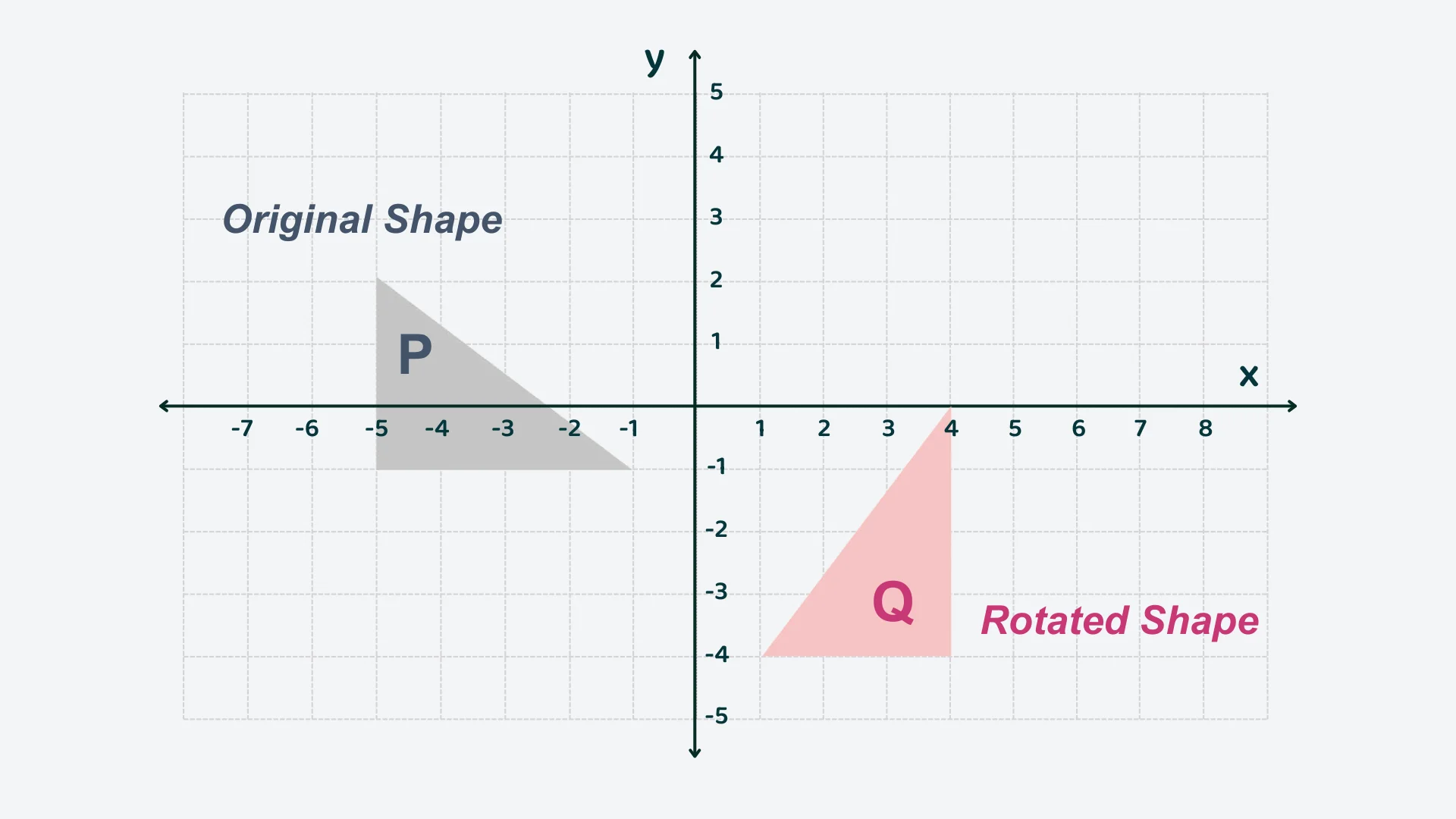
Correct! 🎉 +30 pointsCorrect! 🎉 Worth 30 XPNot quite right
Join a pair of corresponding vertices and draw the perpendicular bisector of that line; repeat for a second pair. The two bisectors cross at the centre of rotation.
Using the right-angle corners and , and the pair and , the bisectors meet at .
Check it: a anticlockwise turn about sends to , so , and , exactly triangle Q. The centre of rotation is .
Want to see the full working?
Interactive Activity
Explore how to rotate a shape on a grid using two different methods
Loading interactive widget...
Frequently asked questions
The questions students bump into most on this topic
A rotation turns a shape around a fixed point, the centre of rotation, without changing its size or shape. To rotate you need an angle, measured in degrees, and a direction, clockwise or anticlockwise: for example, 90° clockwise about the point O. Every point of the shape stays the same distance from the centre as it turns.
The centre of rotation is the fixed point that the shape turns around. It stays still while every other point moves round it in a circle. When you describe a rotation in an exam you must give this point, usually as coordinates such as (2, 3), along with the angle and the direction.
Tracing paper is easiest. To rotate shape P 90° clockwise about O: place the tracing paper over the shape, hold it at O, copy the vertices, turn the paper 90° clockwise, then mark the new positions and join them to give shape Q. Without tracing paper, draw a line from O to each vertex, turn each line 90° and join the new points.
There is no formula; you construct it. Take a point on the original shape and its matching point on the image, join them, and draw the perpendicular bisector of that line. Do the same for a second pair of points. The two bisectors cross at the centre of rotation; in the video’s example it is (2, 3). This needs a ruler and compasses, not tracing paper.
Give three things: the angle, the direction and the centre. Find the centre first with perpendicular bisectors, then join it to a point on the original shape and to the matching point on the image and measure the angle between those lines. The full description reads, for example, “a rotation of 90° anticlockwise about the point (2, 3)”.
No. A turn of 180° clockwise and a turn of 180° anticlockwise give exactly the same image, so you can write either. For any other angle, such as 90°, you must say which way. A rotation of 540° is the same as 180°, because 540° − 360° removes one full turn.
What's next?
Found this one hard? Go one step back first. Feeling confident? Carry on to the next lesson.