Introduction to Enlargement
Enlargement is a transformation that changes a shape's size. You multiply every length by a scale factor, so a factor of 2 turns a 4 cm side into 8 cm. It grows or shrinks from a fixed point called the centre of enlargement.
Video Lesson
Watch and learn the basics
🎬 Did this video explain it clearly?
Flashcards
Review key concepts visually
%20What%20Is%20Enlargement.webp)
%20Key%20Concepts%20in%20Enlargement.webp)
%20How%20to%20Enlarge%20a%20Shape.webp)
%20Finding%20the%20Centre%20of%20Enlargement.webp)
%20Enlargement%20from%20Trapezium%20A%20to%20B.webp)
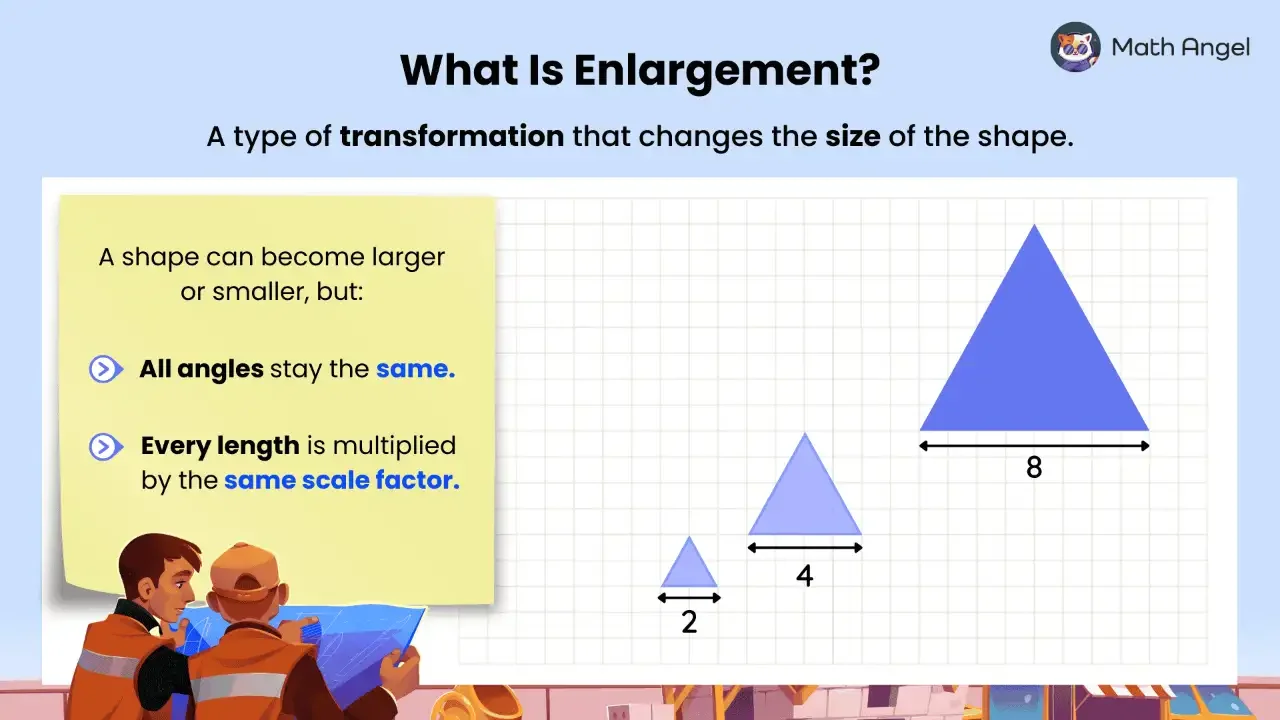
What Is Enlargement?
- Enlargement is a transformation that changes the size of a shape.
- All angles stay the same after an enlargement, but the lengths get bigger or smaller.
Understanding the Scale Factor
- The scale factor is the number you multiply all lengths by.
- If the scale factor is greater than 1, the shape gets bigger, and if it is between 0 and 1, the shape gets smaller.
How to Enlarge a Shape from a Centre
- Draw straight lines from the centre of enlargement to each corner.
- Measure the distance from the centre to a corner, then mark the new point 3 times as far from the centre.
Finding the Centre of Enlargement
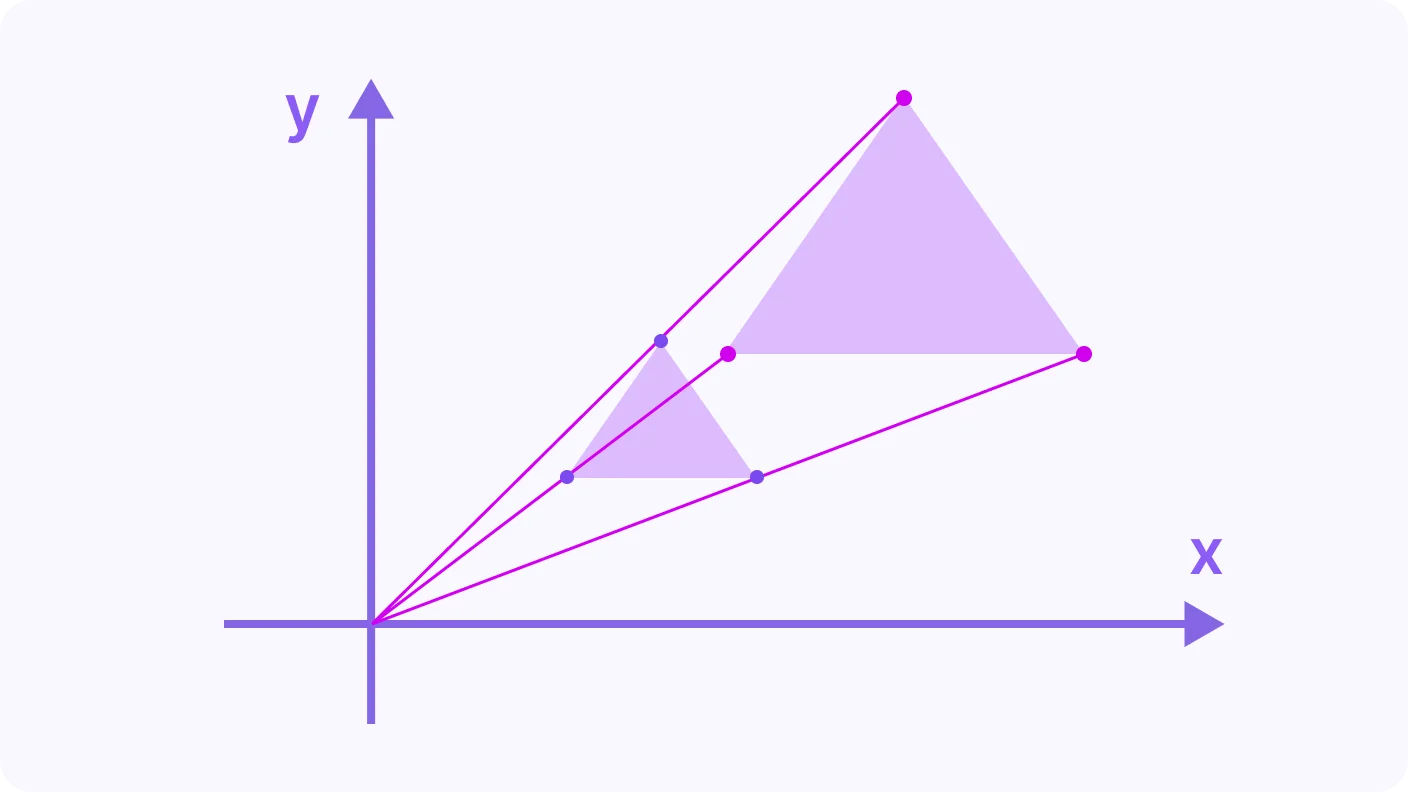
- Join each corner of the original shape to the matching corner of the enlarged shape.
- Extend the lines until they meet at one point, called the centre of enlargement.
Finding the Scale Factor
- The scale factor is found using new length ÷ original length.
- If a side goes from 4 units to 8 units, then , so the scale factor is 2.
- Exam tip: Choose any pair of matching sides. Horizontal or vertical lines on the grid are easiest.
Practice Questions
Test your understanding
A square has sides of length . After an enlargement with scale factor 2, what is the length of each side of the new square?
Correct! 🎉 +10 pointsCorrect! 🎉 Worth 10 XPNot quite right
Enlarging multiplies every length by the scale factor:
So each side of the new square is .
The scale factor is a multiplier: it is not an amount to add on, and you do not divide by it when the shape is getting bigger.
If a shape is enlarged by a scale factor between 0 and 1, what happens to its size?
Correct! 🎉 +10 pointsCorrect! 🎉 Worth 10 XPNot quite right
The word "enlargement" is used for any scaling, even one that shrinks the shape.
A scale factor between 0 and 1 multiplies every length by a number less than 1, so every length gets shorter. For example a scale factor of halves each side.
The image is still the same shape as the original (all the angles are unchanged), just smaller.
The original length of a rectangle is . After enlargement, the length is . What is the scale factor?
Correct! 🎉 +20 pointsCorrect! 🎉 Worth 20 XPNot quite right
scale factor
Check it: ✓
The difference tells you how much longer the rectangle is, not how many times bigger. The scale factor is always a multiplier.
A square has sides of length . It is enlarged by scale factor 3. What is the area of the enlarged square?
Correct! 🎉 +20 pointsCorrect! 🎉 Worth 20 XPNot quite right
First find the new side length: .
Then find the area of the enlarged square: .
You can also go straight from the original area. Lengths scale by 3, so areas scale by : the original area is , and ✓
On a grid, a rectangle has one corner at (3, 2). It is enlarged by scale factor 3 from the origin. Where is the matching corner of the new rectangle?
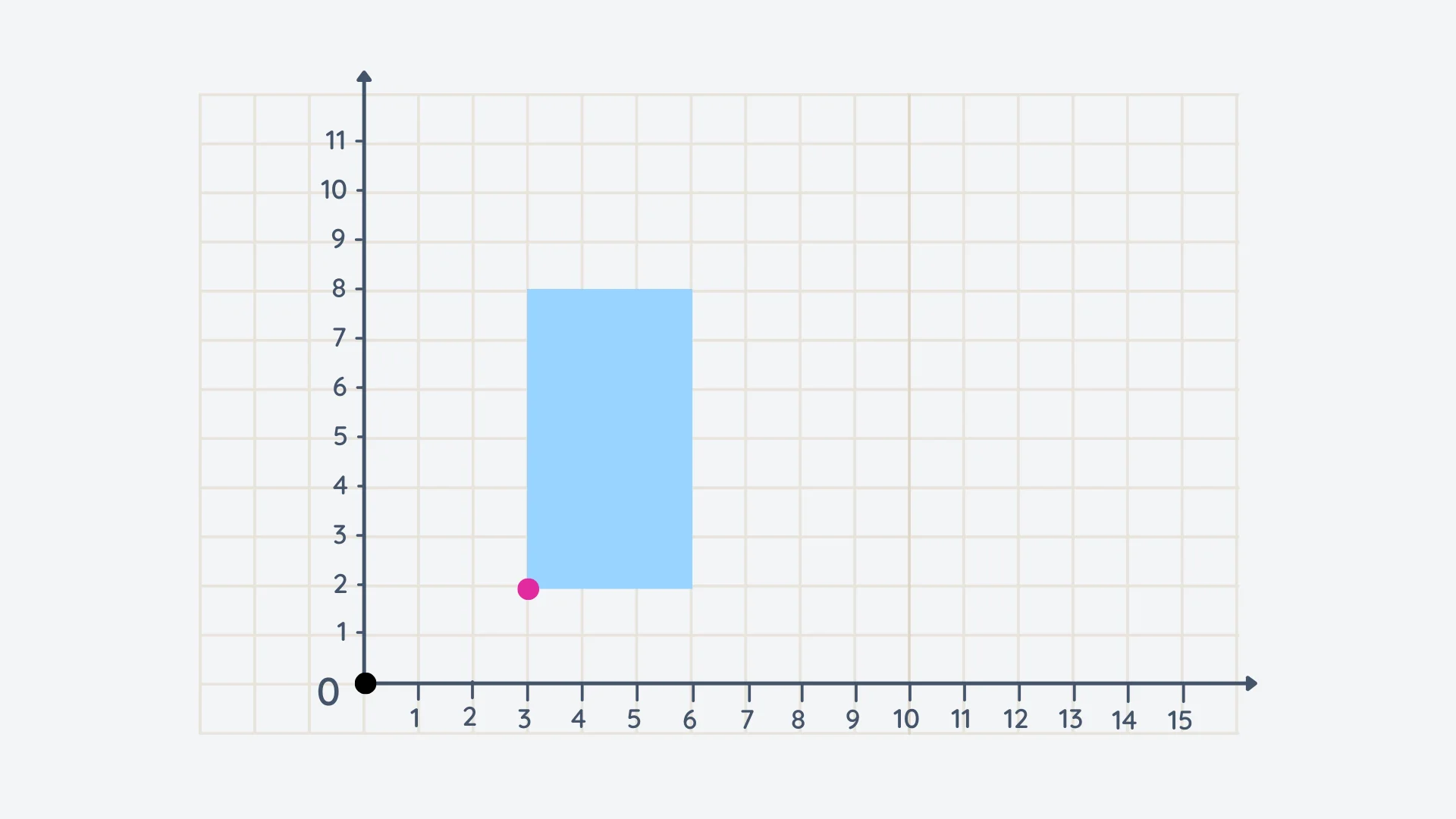
Correct! 🎉 +20 pointsCorrect! 🎉 Worth 20 XPNot quite right
When the centre of enlargement is the origin, multiply both coordinates by the scale factor.
and
So the matching corner is at , written x first, then y.
On a grid, a shape has a vertex at (2, 5). It is enlarged by scale factor 4 from the point (1, 2). Where is the matching vertex after enlargement?
Correct! 🎉 +30 pointsCorrect! 🎉 Worth 30 XPNot quite right
Measure from the centre of enlargement, not from the origin.
From the centre to the vertex you go 1 across and 3 up.
Multiply that step by the scale factor: across and up.
Start again at the centre and take the new step: .
Want to see the full working?
Interactive Activity
Learn how to enlarge a shape by a scale factor from a centre of enlargement
Loading interactive widget...
Frequently asked questions
The questions students bump into most on this topic
An enlargement is a transformation that changes a shape’s size: every length is multiplied by the same scale factor, while every angle stays exactly the same, so the new shape is the same shape, larger or smaller. It is made from a fixed point, the centre of enlargement. American sites call it a dilation.
The scale factor is the number you multiply every length by. A scale factor of 2 doubles each length, so a 4 cm side becomes 8 cm; a scale factor of 3 makes each length three times as long. A scale factor greater than 1 makes the shape bigger; one between 0 and 1 makes it smaller, so ½ turns 4 cm into 2 cm.
Draw a straight line from the centre of enlargement through each corner of the shape. Measure how far each corner is from the centre and mark a new point that many times further along the same line: for a scale factor of 3, three times as far. Join the new points. With the centre at the origin, multiply each coordinate: (3, 2) becomes (9, 6).
Draw a straight line through each corner of the enlarged shape and the matching corner of the original, and extend the lines. They all meet at one point, and that point is the centre of enlargement. Two pairs of corners are enough to find it; a third line through the same point is a check.
Divide a length on the new shape by the matching length on the original: scale factor = new length ÷ original length. Pick any pair of matching sides; horizontal or vertical ones on a grid are easiest to count. If a side goes from 4 units to 8, the scale factor is 8 ÷ 4 = 2; from 8 cm to 20 cm it is 2.5.
Give two things: the scale factor and the centre of enlargement. Find the scale factor by dividing matching lengths, and the centre by extending lines through matching corners. A full GCSE answer reads, for example, “an enlargement, scale factor 2, centre (0, 0)”. Miss either part and you lose the mark.
What's next?
Found this one hard? Go one step back first. Feeling confident? Carry on to the next lesson.