Sine Rule
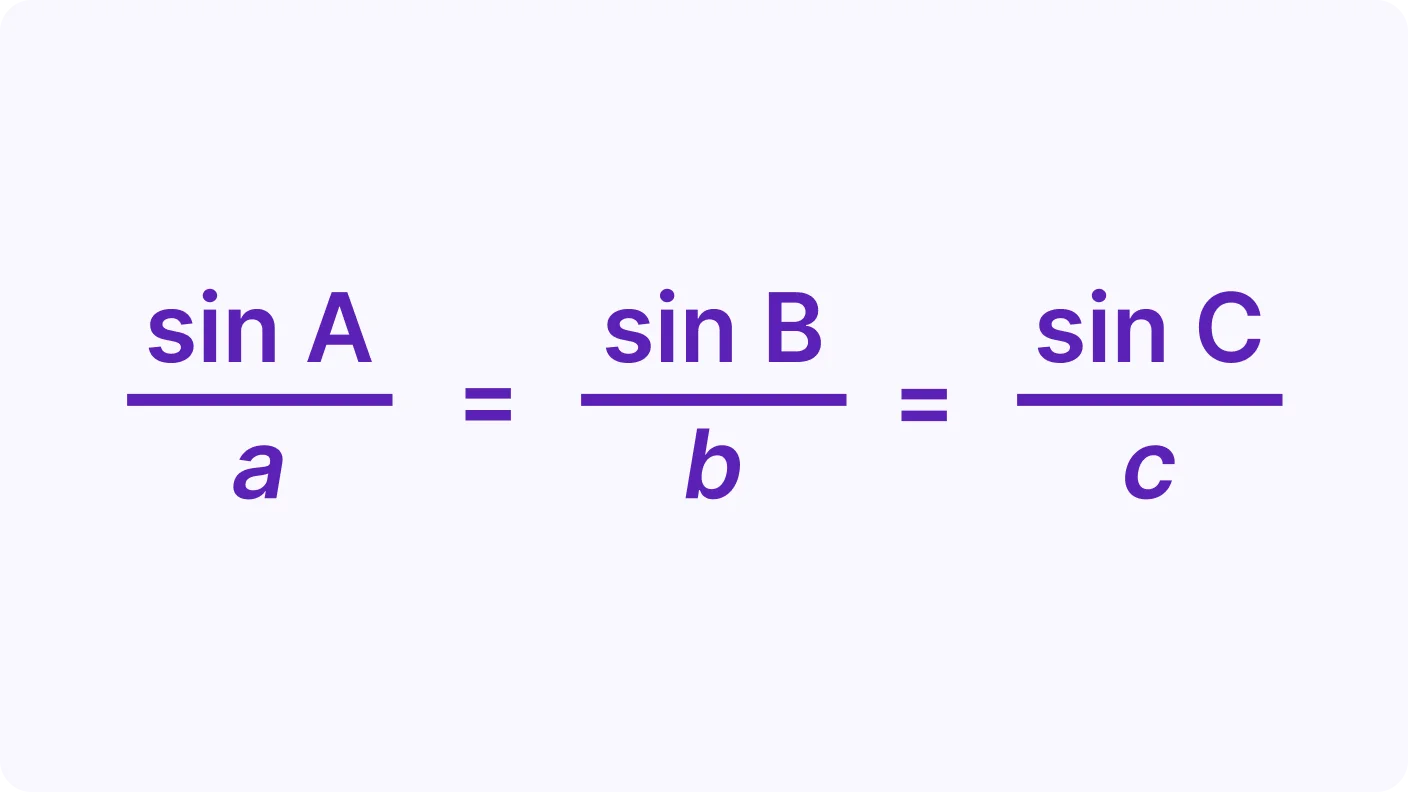
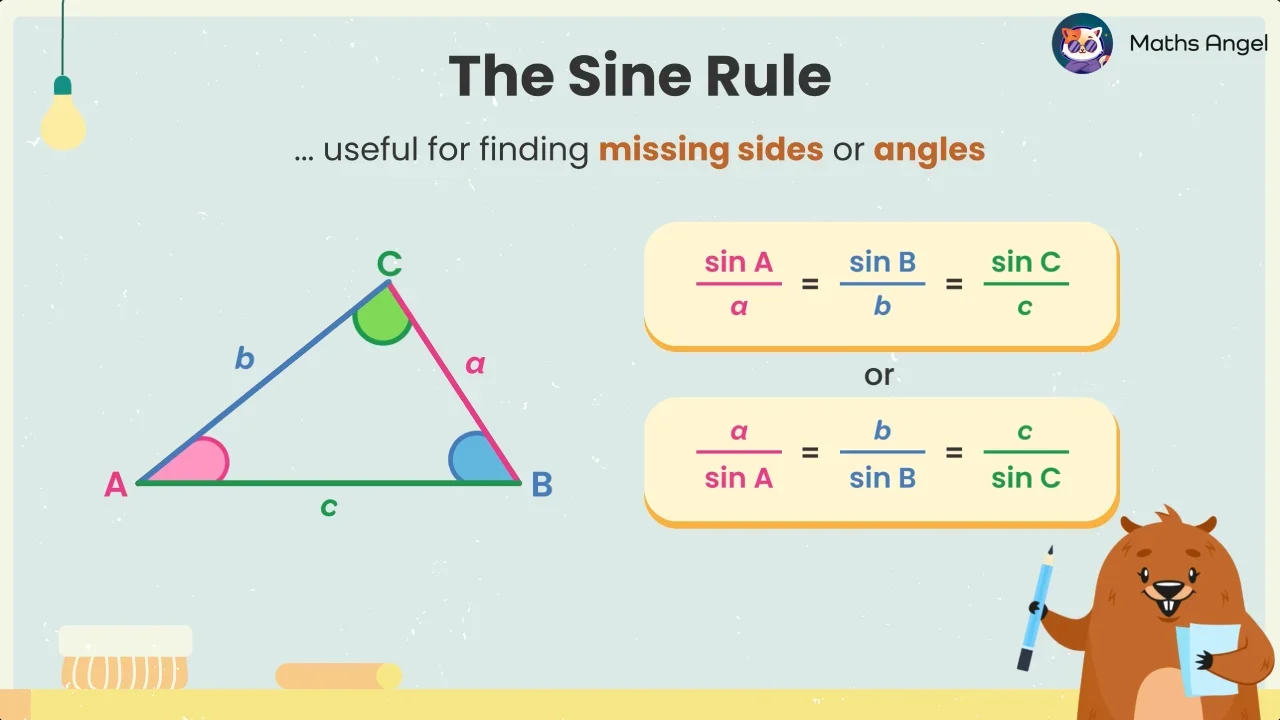
The sine rule formula is a/sin A = b/sin B = c/sin C. It finds a missing side or angle in a non-right-angled triangle, linking each side to its opposite angle. You just need one angle and its opposite side as a matching pair.
Video Lesson
Watch and learn the basics
🎬 Did this video explain it clearly?
Flashcards
Review key concepts visually
%20Sine%20Rule.webp)
%20Applying%20the%20Sine%20Rule%20to%20find%20Missing%20Sides.webp)
%20Applying%20the%20Sine%20Rule%20to%20find%20Missing%20Angles.webp)
What Is the Sine Rule?
- The Sine Rule is used to find missing sides or angles in a non-right-angled triangle.
- The formula is .
Using the Sine Rule to Find a Side
- You must know one angle and its opposite side as a matching pair.
- Use this known pair to calculate the missing side opposite another known angle.
Using the Sine Rule to Find an Angle
- You must know one side and its opposite angle as a matching pair.
- Then apply to find the angle.
Practice Questions
Test your understanding
What information is required to apply the Sine Rule?
Correct! 🎉 +10 pointsCorrect! 🎉 Worth 10 XPNot quite right
The Sine Rule pairs each side with the angle opposite it: .
To use it you need at least one complete pair, an angle together with the side opposite that angle, plus one more piece of information (a second angle, or a second side) to find the unknown.
Without a complete opposite pair, none of the fractions can be worked out, and you need the Cosine Rule instead.
In the Sine Rule formula , what do the letters a, b, and c represent?
Correct! 🎉 +10 pointsCorrect! 🎉 Worth 10 XPNot quite right
In the Sine Rule the capital letters , and are the angles of the triangle, and the lower-case letters , and are the sides opposite those angles.
So side is opposite angle , side is opposite angle and side is opposite angle .
It is that opposite pairing that makes the three fractions equal; pairing a side with the angle next to it breaks the rule.
In a triangle, angle A and side a . If angle B , what is the length of side b?
Give your answer to 1 decimal place.
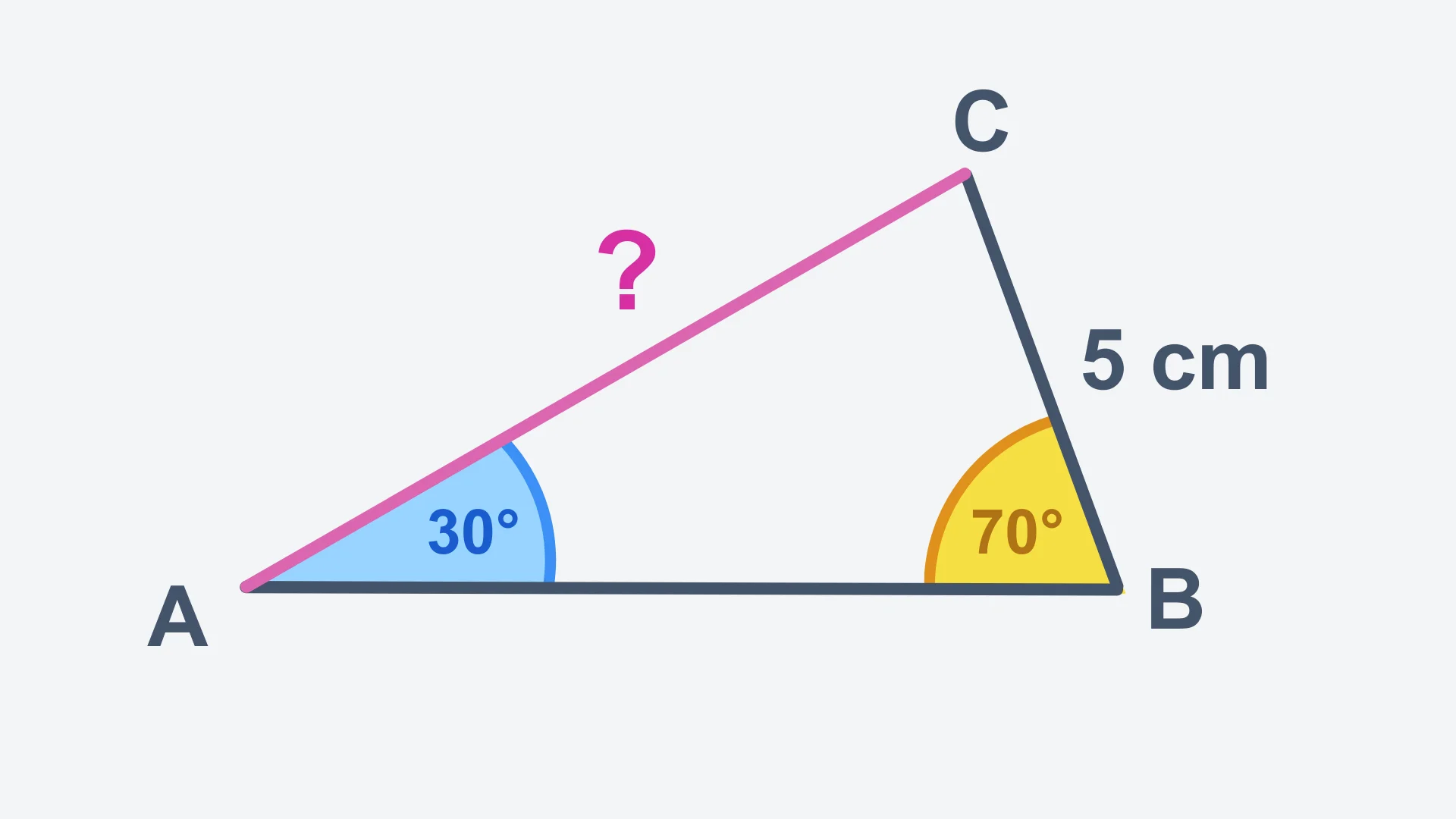
Correct! 🎉 +20 pointsCorrect! 🎉 Worth 20 XPNot quite right
The sine rule pairs each side with the angle opposite it: .
Here cm is opposite , and is opposite , so .
Since and , .
So (1 d.p.). It makes sense that , because the larger angle () sits opposite the longer side.
In a triangle, angle A and side a . If angle B , what is the length of side b?
Give your answer to 1 decimal place.
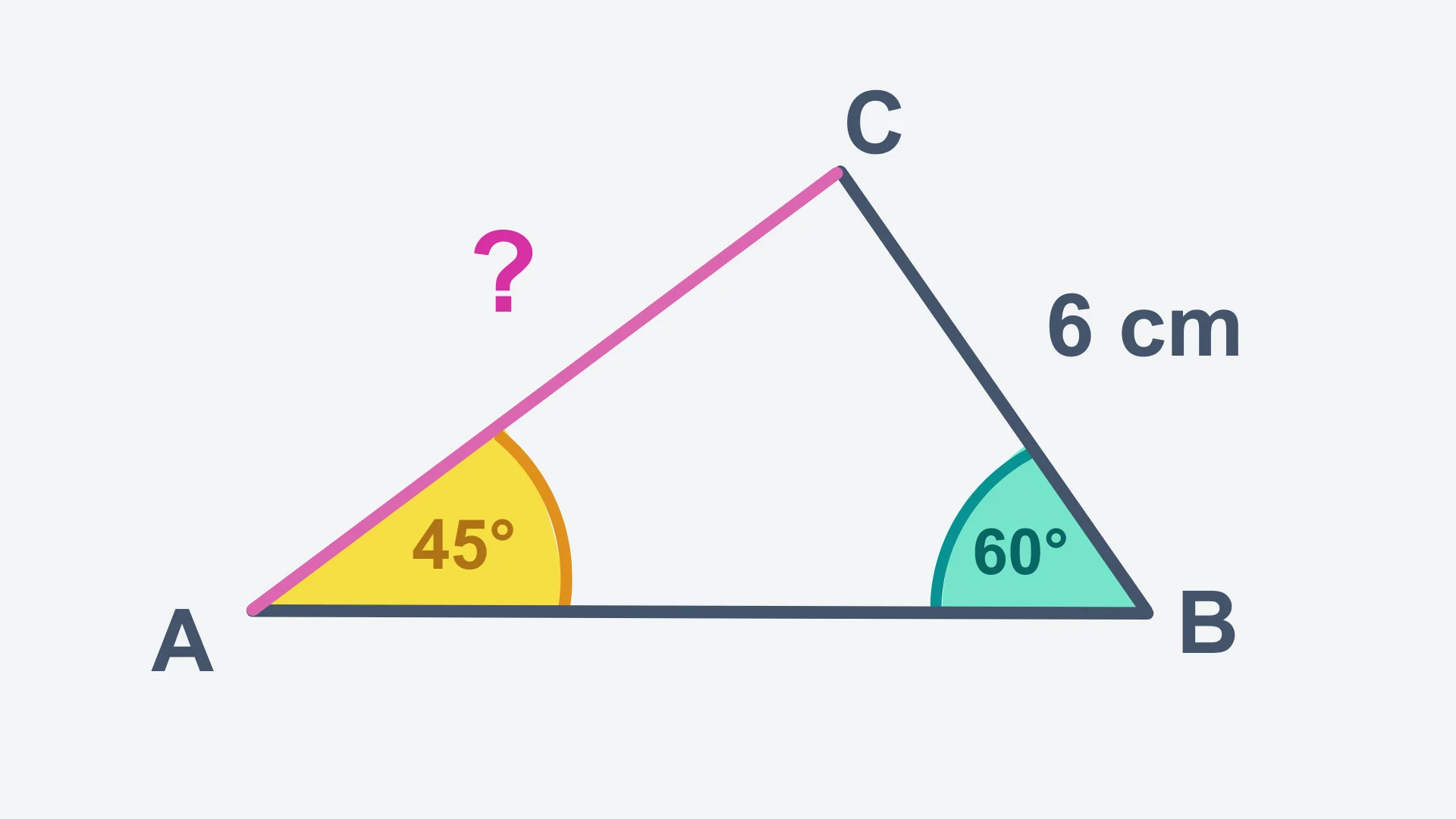
Correct! 🎉 +20 pointsCorrect! 🎉 Worth 20 XPNot quite right
The sine rule pairs each side with the angle opposite it: .
Here cm is opposite , and is opposite , so .
Since and , .
So (1 d.p.). It makes sense that , because the larger angle () sits opposite the longer side.
In a triangle, angle A and side a . If angle B , what is the length of side b?
Give your answer to 1 decimal place.
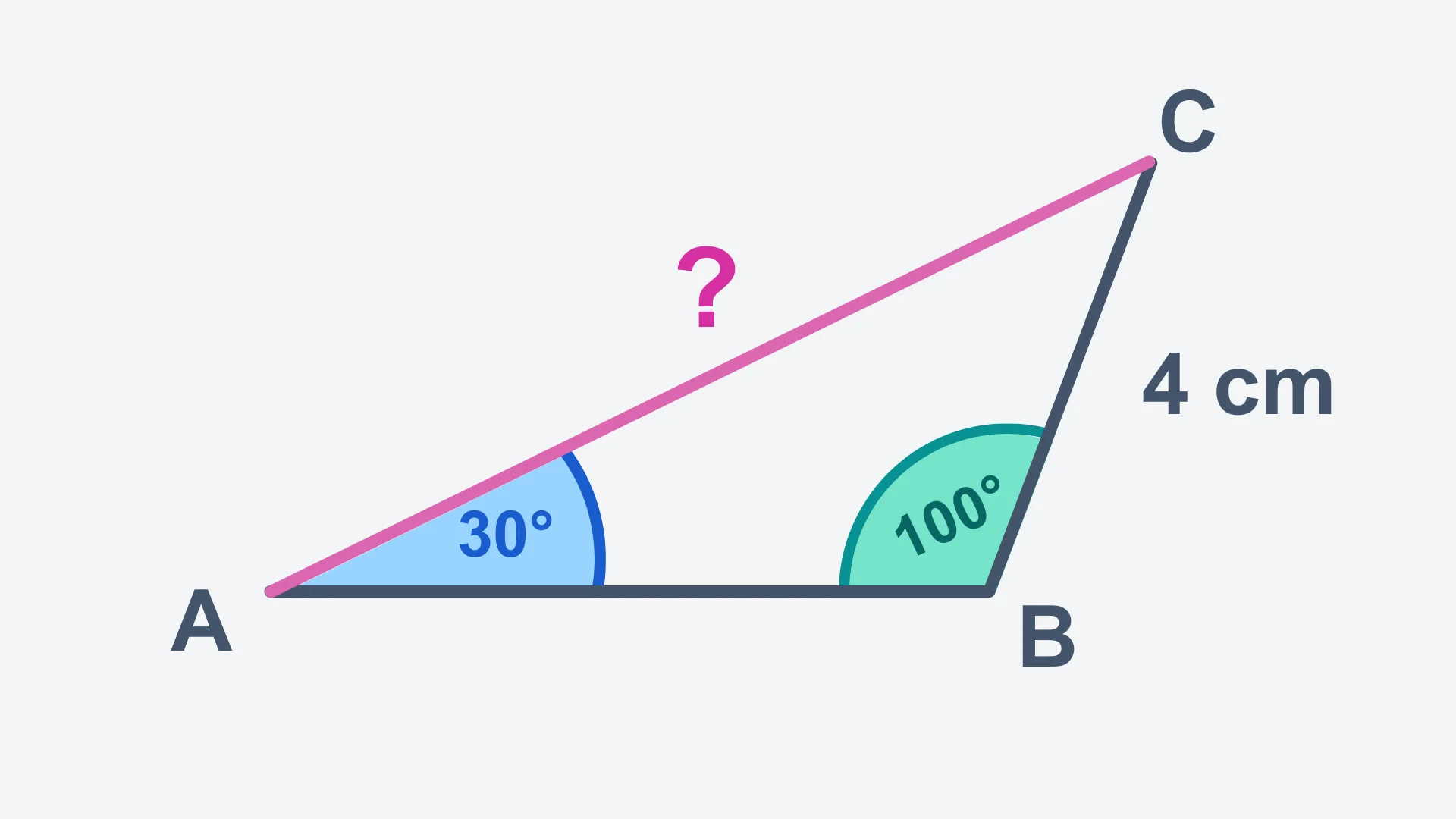
Correct! 🎉 +20 pointsCorrect! 🎉 Worth 20 XPNot quite right
The sine rule pairs each side with the angle opposite it: .
Here cm is opposite , and is opposite , so .
An obtuse angle still has a positive sine: . With , .
So (1 d.p.). Side is the longest side, as it faces the largest angle.
In a triangle, side a , side b and angle B . Find angle A.
Give your answer to 1 decimal place.
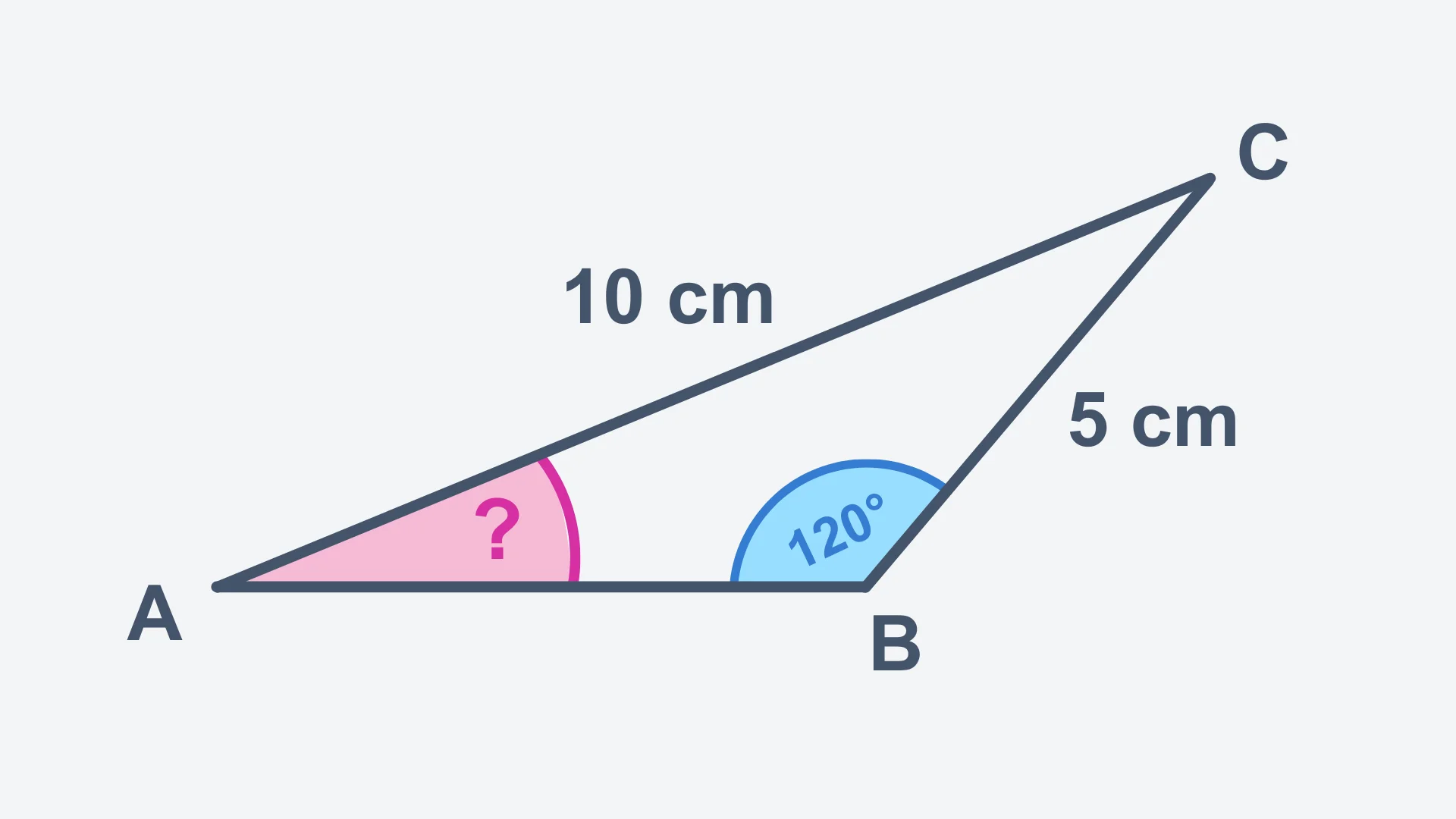
Correct! 🎉 +30 pointsCorrect! 🎉 Worth 30 XPNot quite right
Use the sine rule in the form that puts the unknown on top: , so .
Substituting, . Since , .
Then , so (1 d.p.).
The calculator's second solution, , is impossible here: angle is already , so the other two angles must total only .
Want to see the full working?
Interactive Activity
Drag Point B to generate new practice problems
Loading interactive widget...
Frequently asked questions
The questions students bump into most on this topic
In any triangle, each side divided by the sine of its opposite angle gives the same value: a ÷ sin A = b ÷ sin B = c ÷ sin C. Written the other way up, sin A ÷ a = sin B ÷ b, it finds an angle. It links two sides with their two opposite angles, which is the GCSE Higher use; American books call it the law of sines.
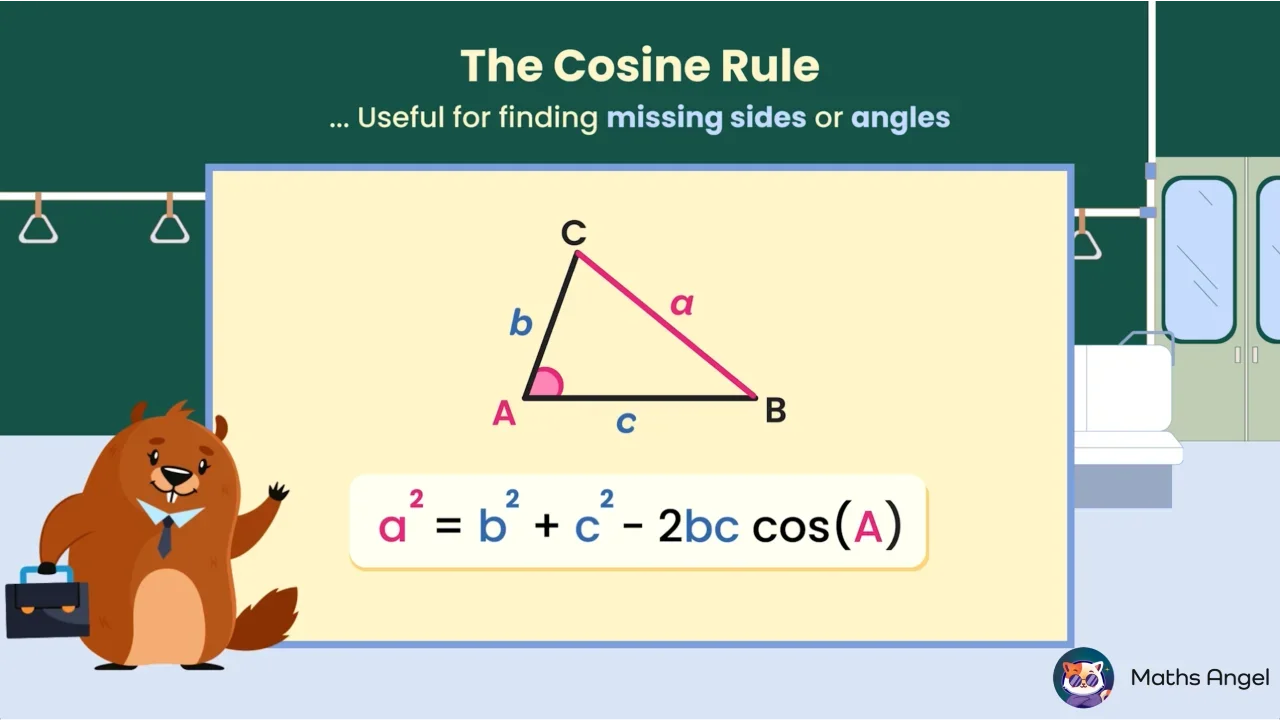
In a triangle that is not right-angled, whenever you know a matching pair: one angle and the side directly opposite it. With that pair plus one more angle you can find a side, and with that pair plus one more side you can find an angle. If you have two sides and the angle between them instead, use the cosine rule.
Write the known pair on one side and the wanted side with its angle on the other, then cross-multiply. A 30° angle sits opposite a 4 cm side, and you want the side opposite 70°: x ÷ sin 70° = 4 ÷ sin 30°. With sin 30° = 0.5 and sin 70° ≈ 0.94, x = 4 × 0.94 ÷ 0.5 ≈ 7.5 cm.
Use the flipped form with the sines on top. A 135° angle sits opposite a 10 cm side, and you want the angle opposite a 5 cm side: sin θ ÷ 5 = sin 135° ÷ 10. With sin 135° ≈ 0.71, sin θ = 0.71 × 5 ÷ 10 ≈ 0.355, and the inverse sine gives θ ≈ 20.8°.
Because every side keeps the same ratio with the sine of its opposite angle, the equation stays true whichever is on top. Put the sides on top to find a side and the sines on top to find an angle, so the unknown is in the numerator. You do not need to label every side and angle; just spot one angle-side pair.
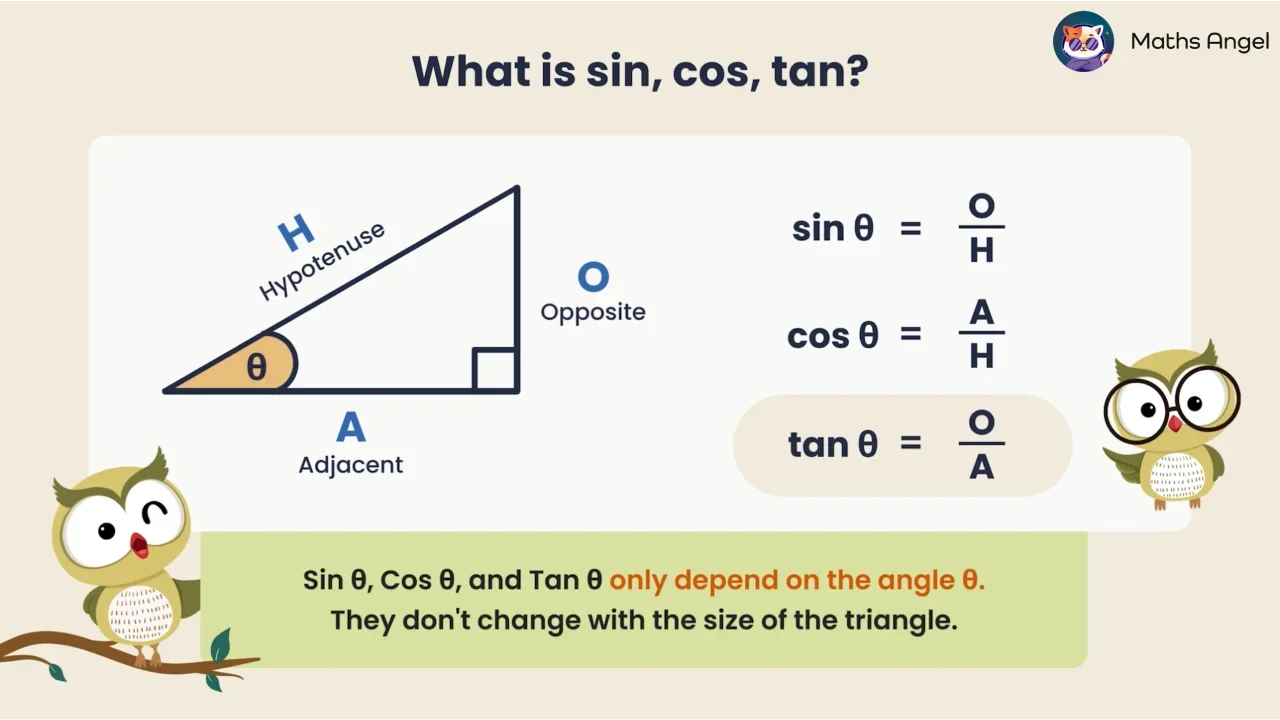
Yes, it works in every triangle, but in a right-angled one it is the long way round. With the 90° angle opposite the hypotenuse, sin 90° = 1, and the sine rule turns into sin θ = opposite ÷ hypotenuse, which is SOHCAHTOA. So use the sine rule for triangles without a right angle and the basic ratios when there is one.
What's next?
Found this one hard? Go one step back first. Feeling confident? Carry on to the next lesson.