Line of Symmetry and Reflection Symmetry
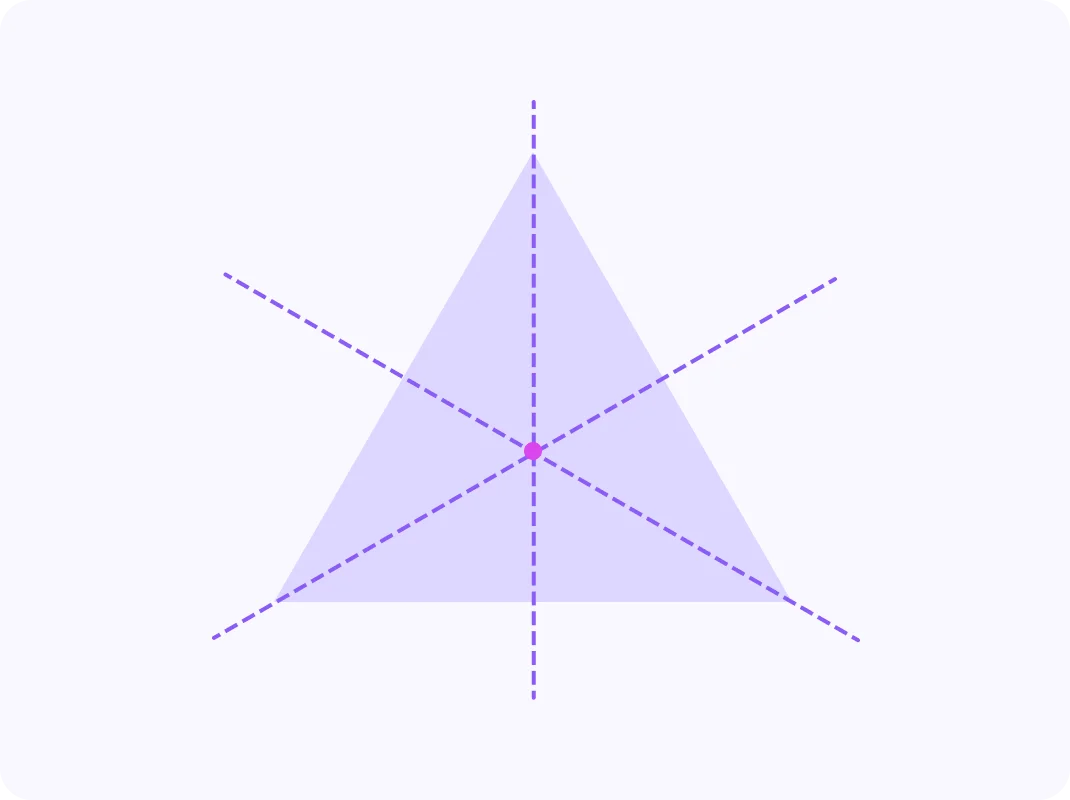
A line of symmetry splits a shape into two identical halves. If you fold the shape along this line, both sides match exactly. A shape has reflection symmetry if it has at least one line of symmetry.
Video Lesson
Watch and learn the basics
🎬 Did this video explain it clearly?
Flashcards
Review key concepts visually
%20What%20is%20Line%20of%20Symmetry.webp)
%20Line%20of%20Symmetry%20in%20Common%20Shapes.webp)
%20Check%20for%20Reflection%20Symmetry.webp)
%20Key%20Feature%20of%20Line%20of%20Symmetry.webp)
%20Complete%20a%20Shape%20Given%20Line%20of%20Symmetry.webp)
What is a Line of Symmetry?
- A line of symmetry divides a shape into two matching, mirror-image halves.
- If you fold the shape along the line, both sides match exactly.
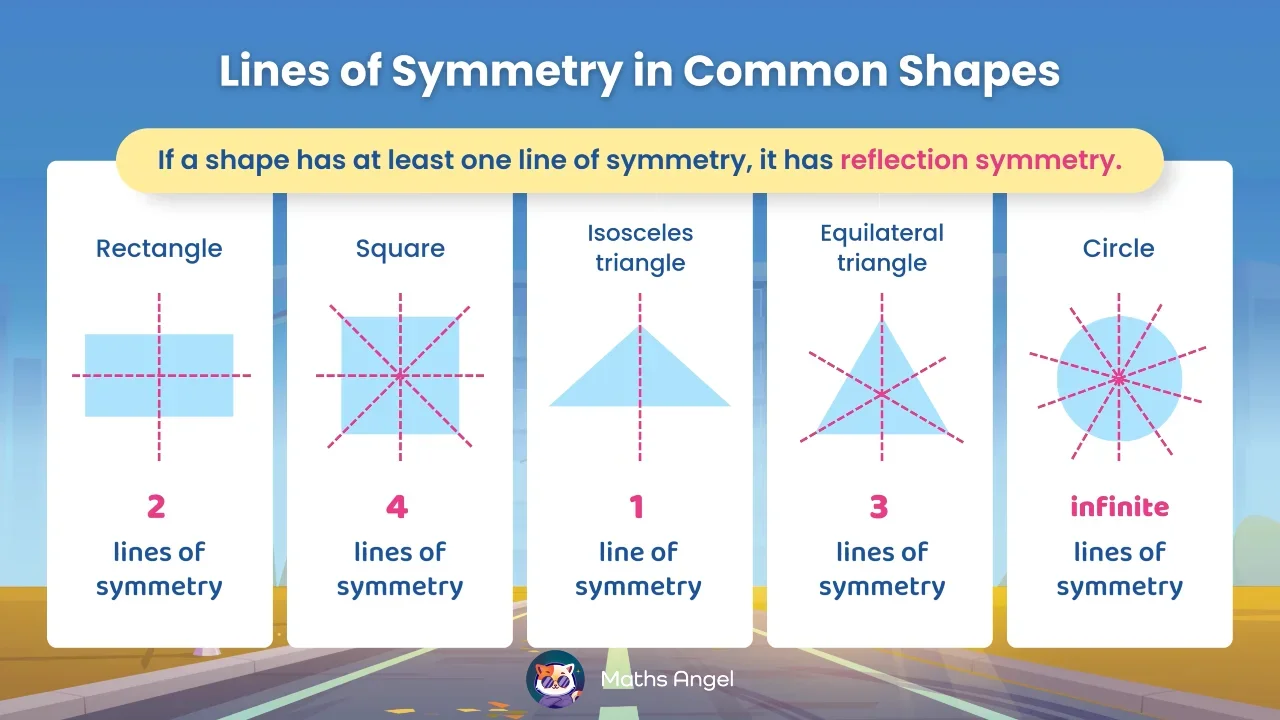
Lines of Symmetry in Common Shapes
- The number of lines depends on how many ways a shape can fold exactly in half.
- Squares have 4, rectangles have 2, and circles have infinitely many lines.
How to Check for Reflection Symmetry?
- Try folding the shape along a line and see if both sides match exactly.
- If you can find at least one line of symmetry, the shape has reflection symmetry.
Key Features of a Line of Symmetry
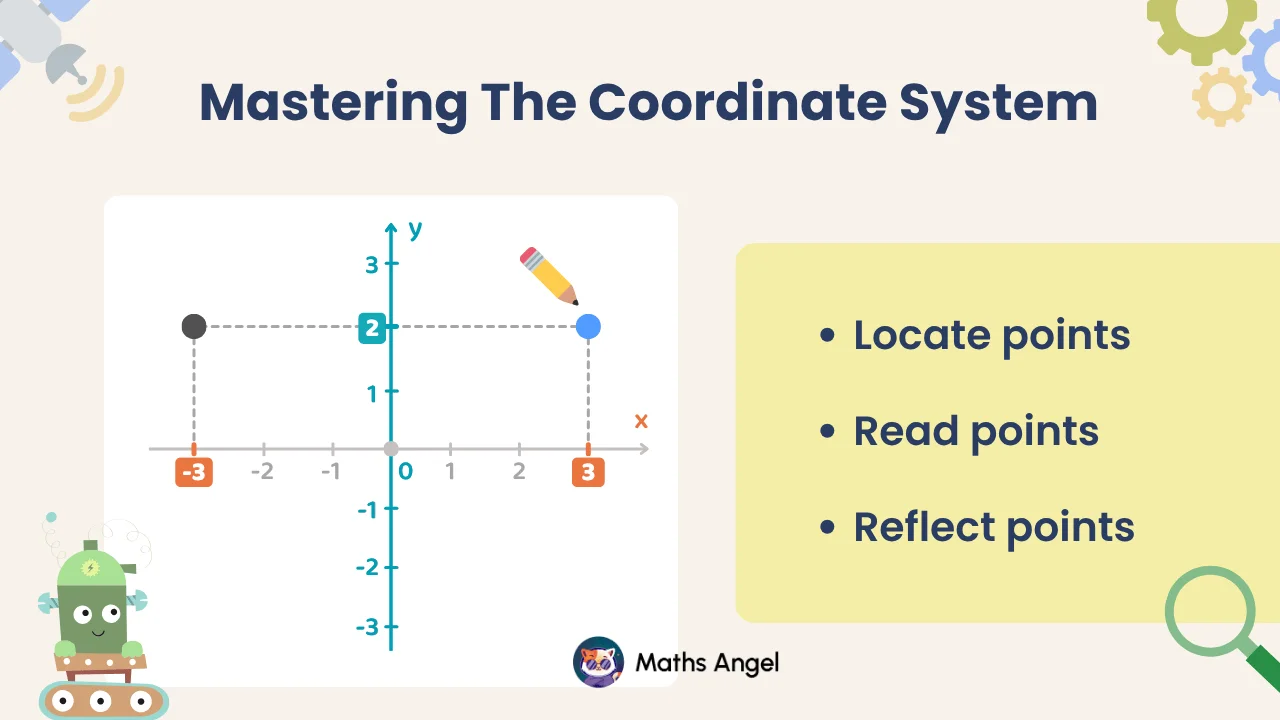
- Every point on one side has a mirror point on the other side.
- Mirror points are the same distance from the line of symmetry.
Completing a Shape Given Line of Symmetry
- Measure the distance from a point to the line of symmetry.
- Plot the mirror point the same distance on the other side.
- Connect the points to complete the shape.
Practice Questions
Test your understanding
How many lines of symmetry does a square have?
Correct! 🎉 +10 pointsCorrect! 🎉 Worth 10 XPNot quite right
A square has 4 lines of symmetry: the two diagonals, plus the two lines through the midpoints of opposite sides.
A line only counts if folding along it makes the two halves land exactly on top of each other. Cutting the square into two pieces of equal area is not enough: plenty of other lines through the centre do that, but only 4 of them are mirror lines.
Which shape has infinitely many lines of symmetry?
Correct! 🎉 +10 pointsCorrect! 🎉 Worth 10 XPNot quite right
A circle has infinitely many lines of symmetry: every diameter, at any angle, is a mirror line that folds one half exactly onto the other.
The other shapes have only a few. A square has 4 lines of symmetry, a rectangle has 2, and an oval has 2: one through its longest width and one through its shortest.
True or False: An isosceles triangle has three lines of symmetry.
Correct! 🎉 +20 pointsCorrect! 🎉 Worth 20 XPNot quite right
False. An isosceles triangle has exactly one line of symmetry: the line through the apex and the midpoint of the unequal side.
It is the equilateral triangle, with all three sides equal, that has three lines of symmetry.
If point P is away from the line of symmetry, where will its mirror point P' be?
Correct! 🎉 +20 pointsCorrect! 🎉 Worth 20 XPNot quite right
A reflection keeps the image exactly the same distance from the mirror line as the object, but on the other side of it.
So P' sits from the line, on the opposite side, on the line through P that is perpendicular to the mirror line. The total gap from P to P' is .
Does this shape have reflection symmetry?

Correct! 🎉 +20 pointsCorrect! 🎉 Worth 20 XPNot quite right
Yes. The shape is a kite: it has two pairs of adjacent equal sides.
Its line of symmetry is the diagonal from the top-left vertex to the bottom-right vertex. Folding along this diagonal maps each half exactly onto the other. The mirror line is slanted, not upright or flat, which is why it is easy to miss.
How many lines of symmetry does a regular pentagon have?

Correct! 🎉 +30 pointsCorrect! 🎉 Worth 30 XPNot quite right
A regular pentagon has 5 lines of symmetry. Each one runs from a vertex to the midpoint of the opposite side.
In general, a regular polygon with n sides has exactly n lines of symmetry, so 5 for a pentagon, not 10 and not infinitely many.
Want to see the full working?
Interactive Activity
Fold shapes to test for symmetry
Loading interactive widget...
Frequently asked questions
The questions students bump into most on this topic
A line of symmetry is an imaginary line that divides a shape into two identical halves, like a mirror: fold the shape along it and the two halves match exactly. A shape with at least one line of symmetry has reflection symmetry. A rectangle has 2 lines, a square 4 and a circle infinitely many, because every line through its centre works.
A square has four lines of symmetry: two diagonals from corner to corner, and two lines through the middle of each pair of opposite sides. Fold along any of the four and the halves match exactly. That is two more than a rectangle, whose diagonals do not work.
A rectangle has two lines of symmetry: one vertical line down the middle and one horizontal line across the middle. Its diagonals are not lines of symmetry, because folding along a diagonal does not make the halves match. With two lines, a rectangle has reflection symmetry.
It depends on the triangle. An isosceles triangle has one line of symmetry, through the top corner and the middle of the base. An equilateral triangle has three, one through each corner. A scalene triangle, with three different sides, has none, because no fold makes the halves match.
A regular pentagon has five lines of symmetry, each running from one corner to the middle of the opposite side. A pentagon whose sides are not all equal has fewer, and may have none. To check any shape, test each possible fold and count the ones where the halves match exactly.
Fold a paper shape in half: if the two halves sit on top of each other, the fold is a line of symmetry. Try a few folds on a square and count how many work. To finish a half-drawn shape, measure each corner’s distance from the line and mark the same distance on the other side.
What's next?
Found this one hard? Go one step back first. Feeling confident? Carry on to the next lesson.