Cavalieri's Principle
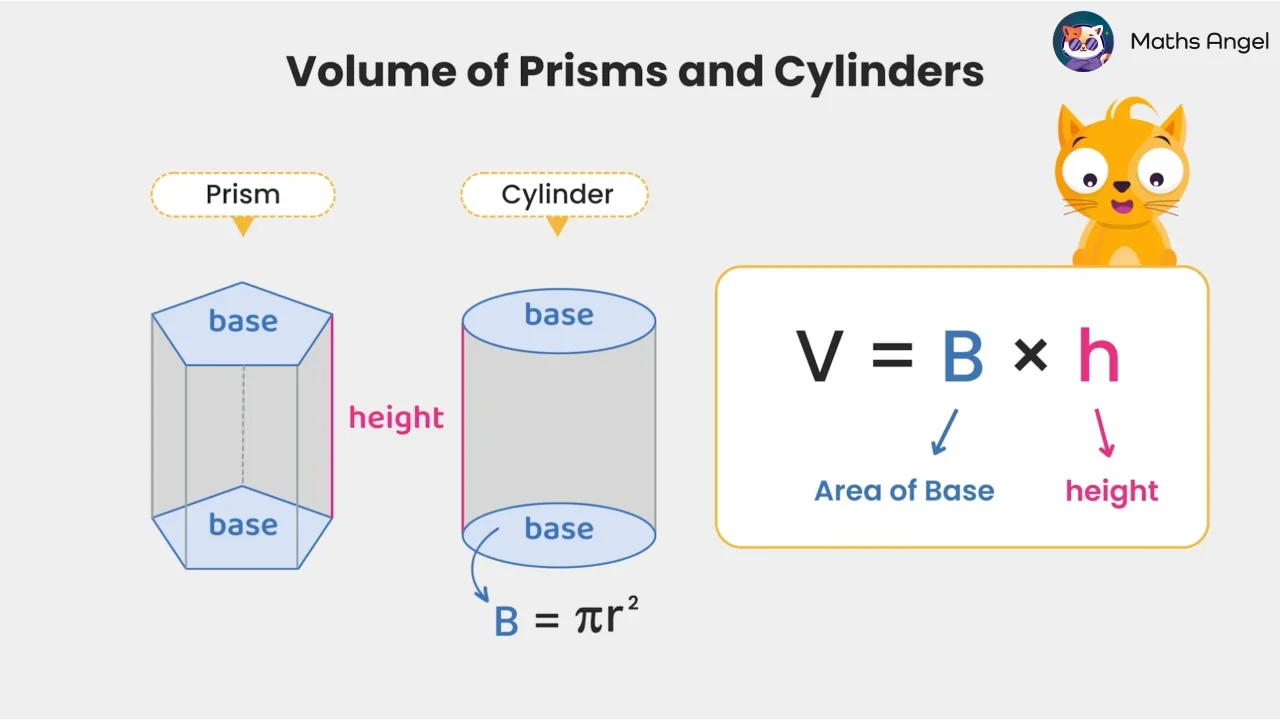
Cavalieri's Principle says two solids have equal volume if they share the same height and cross-sectional area at every level. Slanting a stack of slices keeps its volume. So you can find each volume with V = base area × height.
Video Lesson
Watch and learn the basics
🎬 Did this video explain it clearly?
Flashcards
Review key concepts visually
%20An%20Example%20of%20Cavalieri%27s%20Principle.webp)
%20What%20is%20Cavalieri%27s%20Principle.webp)
%20Calculating%20Volume%20of%20Inclined%20Solids%20Using%20Cavalieri%27s%20Principle.webp)
%20Check%20Whether%20Two%203D%20Shapes%20Have%20Same%20Volume%20With%20Cavalieri%27s%20Principle.webp)
Cavalieri’s Principle in Real Life
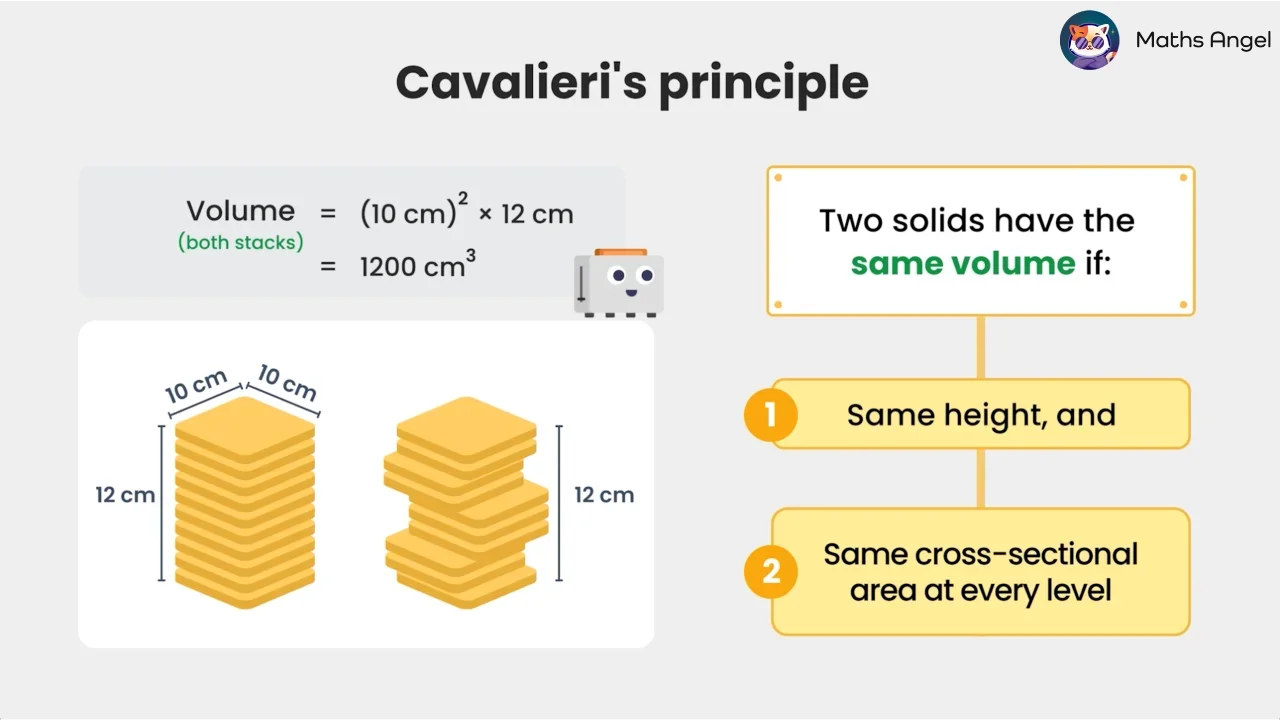
- Imagine two stacks made from the same number of slices.
- If each slice has the same area, the stacks have the same volume.
- Rearranging the slices does not change the volume of the stack.
What Is Cavalieri’s Principle?
- Two solids can look different but still have the same volume.
- They must have the same height.
- They must have the same cross-sectional area at every level.
Use Cavalieri’s Principle to Find Volume
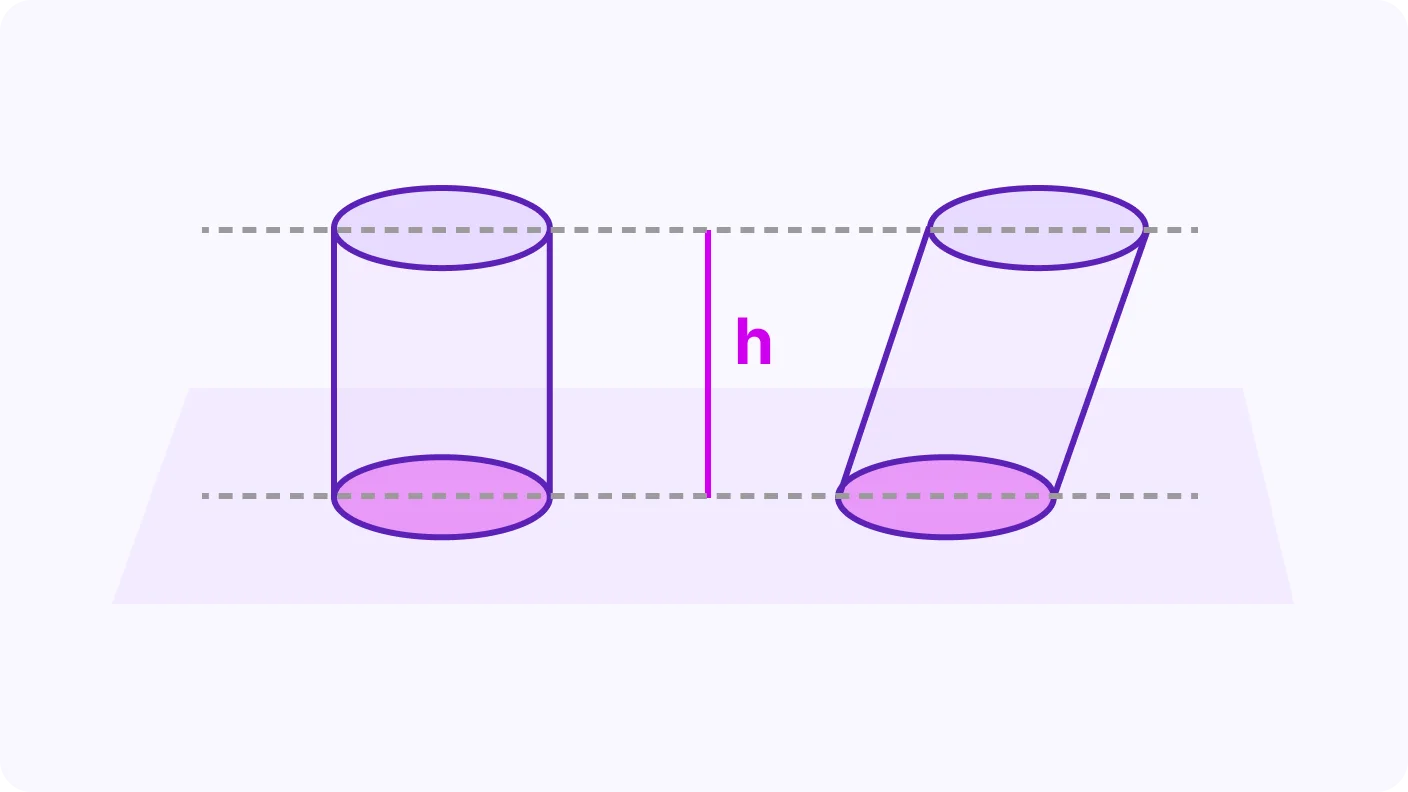
- At each height, a tilted prism has the same cross-sectional area as an upright prism with the same base area.
- So by Cavalieri’s principle they have the same volume, and you can use V = base area × height.
Checking Equal Volume Using Cavalieri’s Principle
- Compare the height and the cross-sectional area at matching levels.
- If they match all the way up, the solids have equal volume.
Practice Questions
Test your understanding
If two solids have the same height and identical cross-sectional areas at the same height, what can we conclude about their volumes?
Correct! 🎉 +10 pointsCorrect! 🎉 Worth 10 XPNot quite right
This is Cavalieri's principle: if two solids stand between the same pair of parallel planes and every cross-section taken at the same level has the same area, then the two solids have the same volume.
Think of a straight stack of coins and the same stack pushed sideways into a lean. Every cross-section is still a coin of the same area, so the volume is unchanged, even though the outline looks different and the surface area is not the same.
A cylinder has a height of and a cross-sectional area of . A rectangular prism has the same height of and a cross-sectional area of . Do they have the same volume?
Correct! 🎉 +10 pointsCorrect! 🎉 Worth 10 XPNot quite right
Each solid has the same cross-section all the way up, so its volume is cross-sectional area height.
Cylinder: . Rectangular prism: .
This is Cavalieri's principle: two solids with the same height whose cross-sections have equal areas at every level have equal volumes, whatever shape those cross-sections are. So yes, both solids have a volume of .
Two solids have the same cross-sectional area of at every height. The first solid has a height of , and the second solid has a height of . Do they have the same volume?
Correct! 🎉 +20 pointsCorrect! 🎉 Worth 20 XPNot quite right
Each solid has a constant cross-section, so volume = cross-sectional area height.
First solid: . Second solid: .
Since , the volumes are not the same. Cavalieri's principle needs both conditions to hold: matching cross-sectional areas at every level and the same height. Here the heights differ, so the principle does not apply and the taller solid has the greater volume.
Two solids have a height of . One has a square cross-section with an area of , and the other has a circular cross-section with the same area of . What can you conclude about their volumes?
Correct! 🎉 +20 pointsCorrect! 🎉 Worth 20 XPNot quite right
Volume = cross-sectional area height, so each solid has a volume of .
By Cavalieri's principle, two solids of the same height whose cross-sections have equal areas at every level have equal volumes. It makes no difference that one cross-section is a square and the other a circle: only the area of each cross-section matters, not its shape. So both volumes are .
Two solids have the same height of . The first solid has a cross-sectional area of at every height, and the second solid has a cross-sectional area of at every height. Do they have the same volume?
Correct! 🎉 +20 pointsCorrect! 🎉 Worth 20 XPNot quite right
Each solid has a constant cross-section, so volume = cross-sectional area height.
First solid: . Second solid: .
Since , they do not have the same volume. Cavalieri's principle only guarantees equal volumes when the cross-sectional areas match at every height. Here they differ, so the solid with the larger cross-section has the larger volume.
A stack of toast has a height of , and its cross-sectional area is at each level. Another stack has the same height but a cross-sectional area of at each level. Using Cavalieri's principle, what can we conclude about the volumes of these two stacks?
Correct! 🎉 +30 pointsCorrect! 🎉 Worth 30 XPNot quite right
Both stacks are tall and each has a constant cross-section, so volume = cross-sectional area height.
First stack: . Second stack: .
With the heights equal, Cavalieri's principle tells us the volumes can only be equal if the cross-sectional areas are equal too. They are not, so the stack with the larger cross-section has the larger volume: the stack, by .
Want to see the full working?
Interactive Activity
Tilt a prism to see how Cavalieri's Principle keeps the volume the same regardless of slant
Loading interactive widget...
Frequently asked questions
The questions students bump into most on this topic
Stack ten slices of toast, then push the stack sideways so it leans. It looks different, but it is still the same ten slices, so its volume has not changed. Cavalieri’s principle says that two solids have the same volume if they have the same height and the same cross-sectional area at every level. Those are the two conditions.
Because a solid’s volume is the sum of all its thin layers. If two solids are the same height and every layer has the same area in both, they are made of the same layers, just arranged differently, so the totals are equal. Leaning the toast stack moves the slices without changing any of them.
Whenever a solid leans or looks awkward but matches an upright solid in height and in cross-section at every level. Then you find the easy one’s volume, base area × height, and it is the answer for both. The leaning toast stack, 12 cm tall with the same slice area as the upright one, has the same 1,200 cm³.
Yes. A cylinder and a square-based prism that are both 9 cm tall with a cross-sectional area of 10 cm² at every level hold exactly the same volume, even though one is round and the other has corners. Only the height and the areas matter, not the shape of the slices.
What's next?
Found this one hard? Go one step back first. Feeling confident? Carry on to the next lesson.