Volume and Surface Area of Pyramids, Cones, Spheres
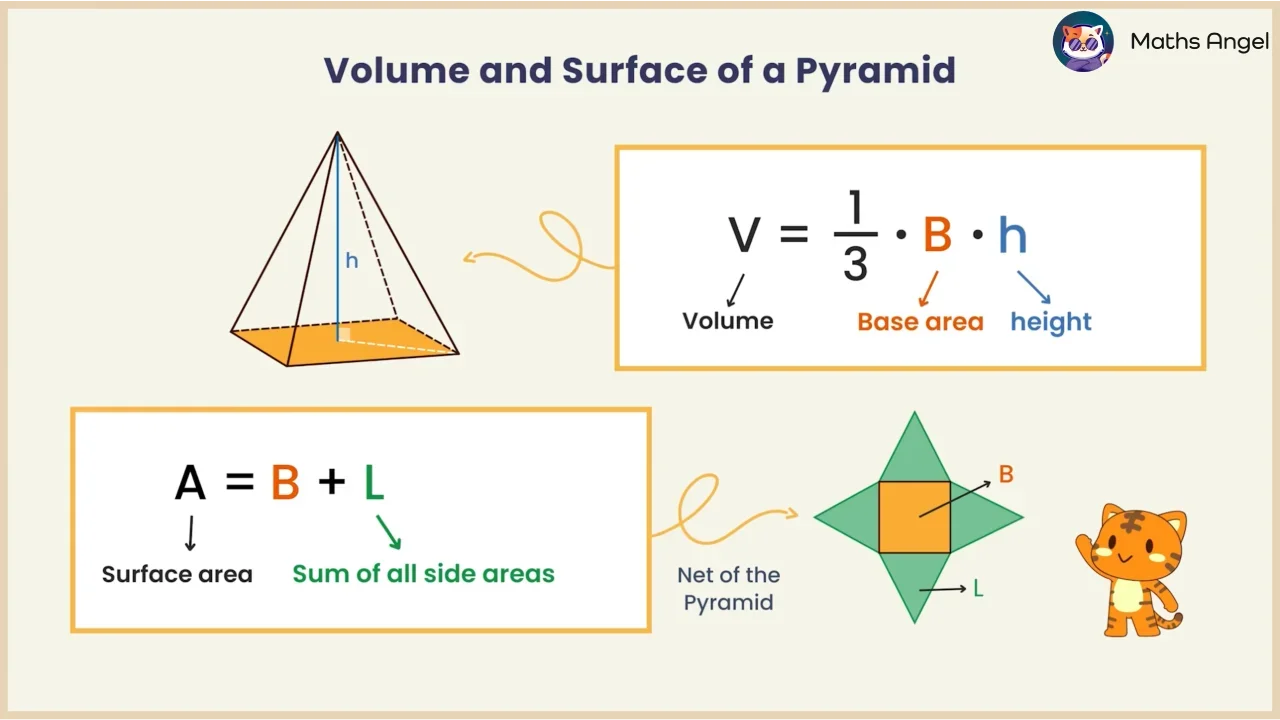
The volume of a pyramid is V = ⅓ × base area × height, the same formula a cone uses. A base of 30 cm² and height 10 cm gives 100 cm³. Its surface area is A = B + L, the base area plus all its triangular faces.
Video Lesson
Watch and learn the basics
🎬 Did this video explain it clearly?
Flashcards
Review key concepts visually
%20What%20is%20a%20Pyramid.webp)
%20Volume%20and%20Surface%20Area%20of%20Pyramids.webp)
%20Volume%20and%20Surface%20Area%20of%20Pyramids%20Example.webp)
%20Volume%20and%20Surface%20Area%20of%20Cones.webp)
%20Volume%20and%20Surface%20Area%20of%20Cones%20Example.webp)
%20Volume%20and%20Surface%20Area%20of%20Spheres.webp)
What Is a Pyramid?
- A pyramid is a 3D shape with a polygon base and triangular faces meeting at a single point.
- The base can be a triangle, square, or any other polygon.
Volume and Surface Area of a Pyramid
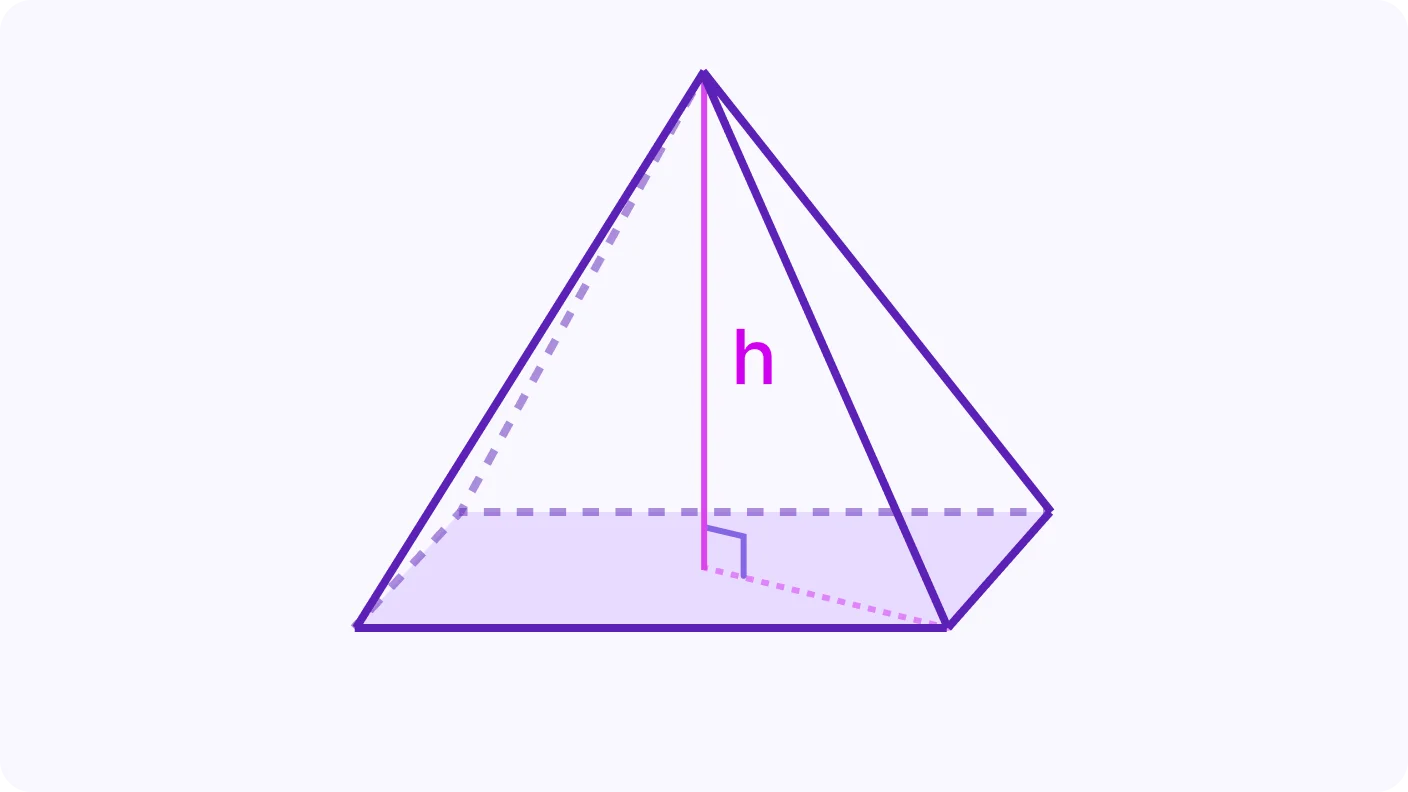
- The volume of a pyramid is , where B is the base area and h is the perpendicular height.
- The surface area is , where L is the total area of all triangular faces.
Example: Pyramid Volume and Surface Area
- With a square base of side and height , V .
- Adding the base and four identical triangular faces gives a surface area of .
Volume and Surface Area of a Cone
- The volume of a cone is , where r is the radius and h is the perpendicular height.
- The surface area is , where s is the slant height.
Example: Cone Volume and Surface Area
- If cm and cm, then .
- Using cm gives a surface area of .
Volume and Surface Area of a Sphere
- The volume of a sphere is , so the radius is cubed.
- The surface area is , so the radius is squared.
- Exam tip: Volume uses cubed units and area uses squared units.
Practice Questions
Test your understanding
What is the formula for the volume of a pyramid?
Correct! 🎉 +10 pointsCorrect! 🎉 Worth 10 XPNot quite right
The volume of a pyramid is , where B is the area of the base (whatever shape the base is) and h is the perpendicular height from the base up to the apex.
A pyramid fills exactly one third of the prism that has the same base and the same height, which is where the comes from.
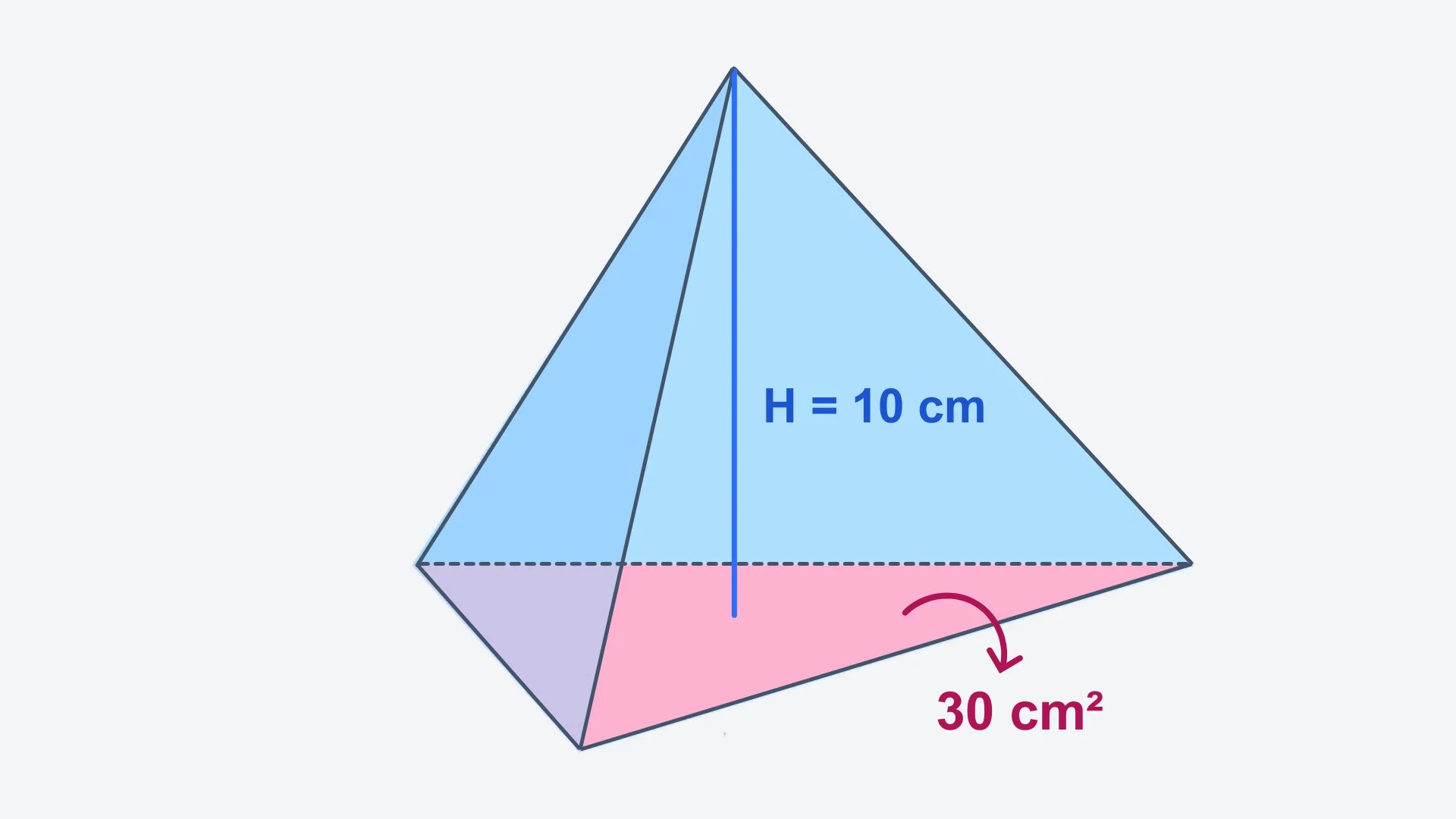
A pyramid has a triangular base with an area of and a height of . What is its volume?
Correct! 🎉 +10 pointsCorrect! 🎉 Worth 10 XPNot quite right
The volume of a pyramid is , where B is the base area and h is the perpendicular height.
Substituting: .
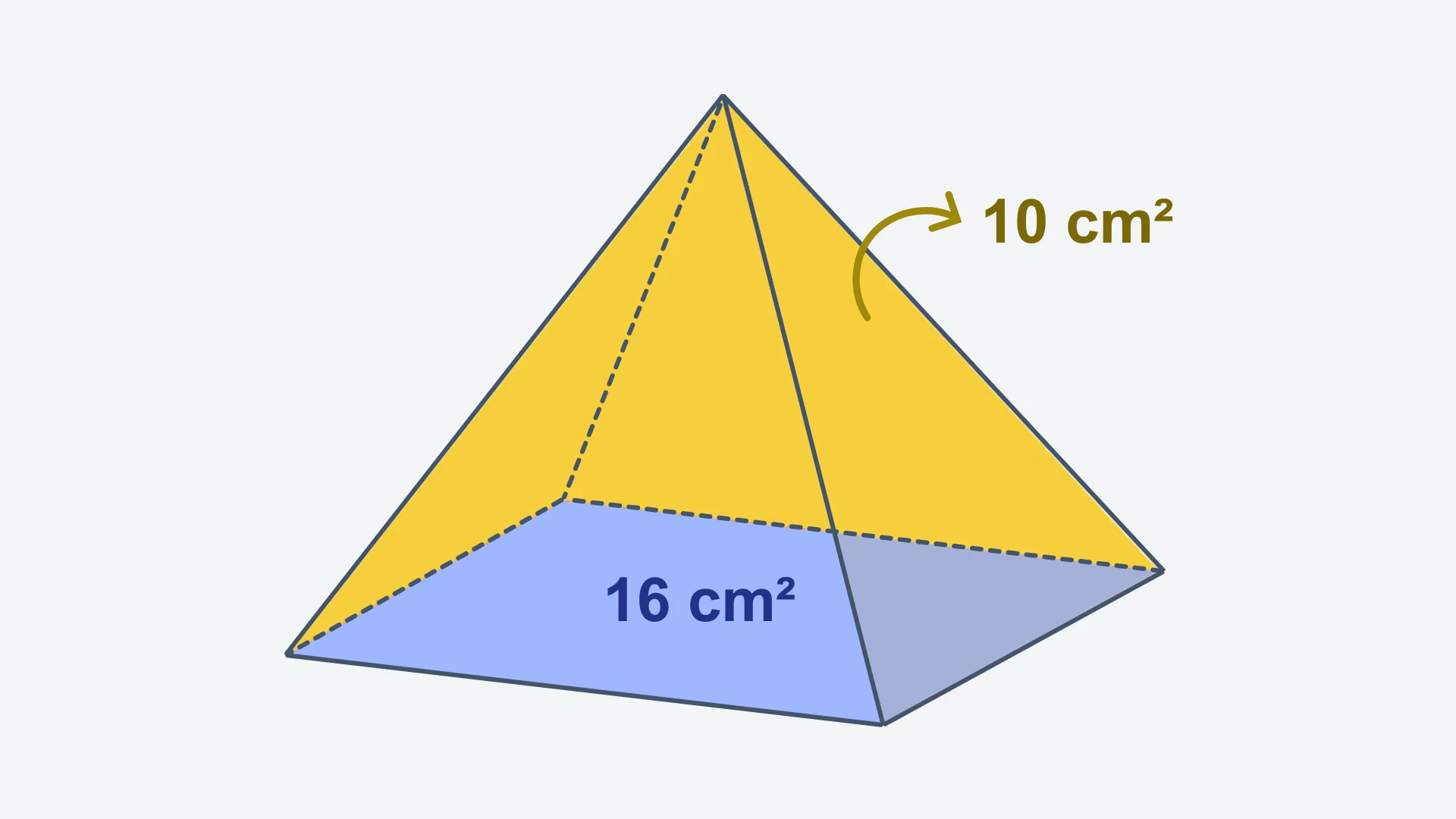
What is the surface area of a square pyramid with a base area of and four identical triangular faces with an area of each?
Correct! 🎉 +20 pointsCorrect! 🎉 Worth 20 XPNot quite right
The surface area is the square base plus all four triangular faces, including the two you cannot see in the drawing.
. A pyramid has only one base, so the is counted once.
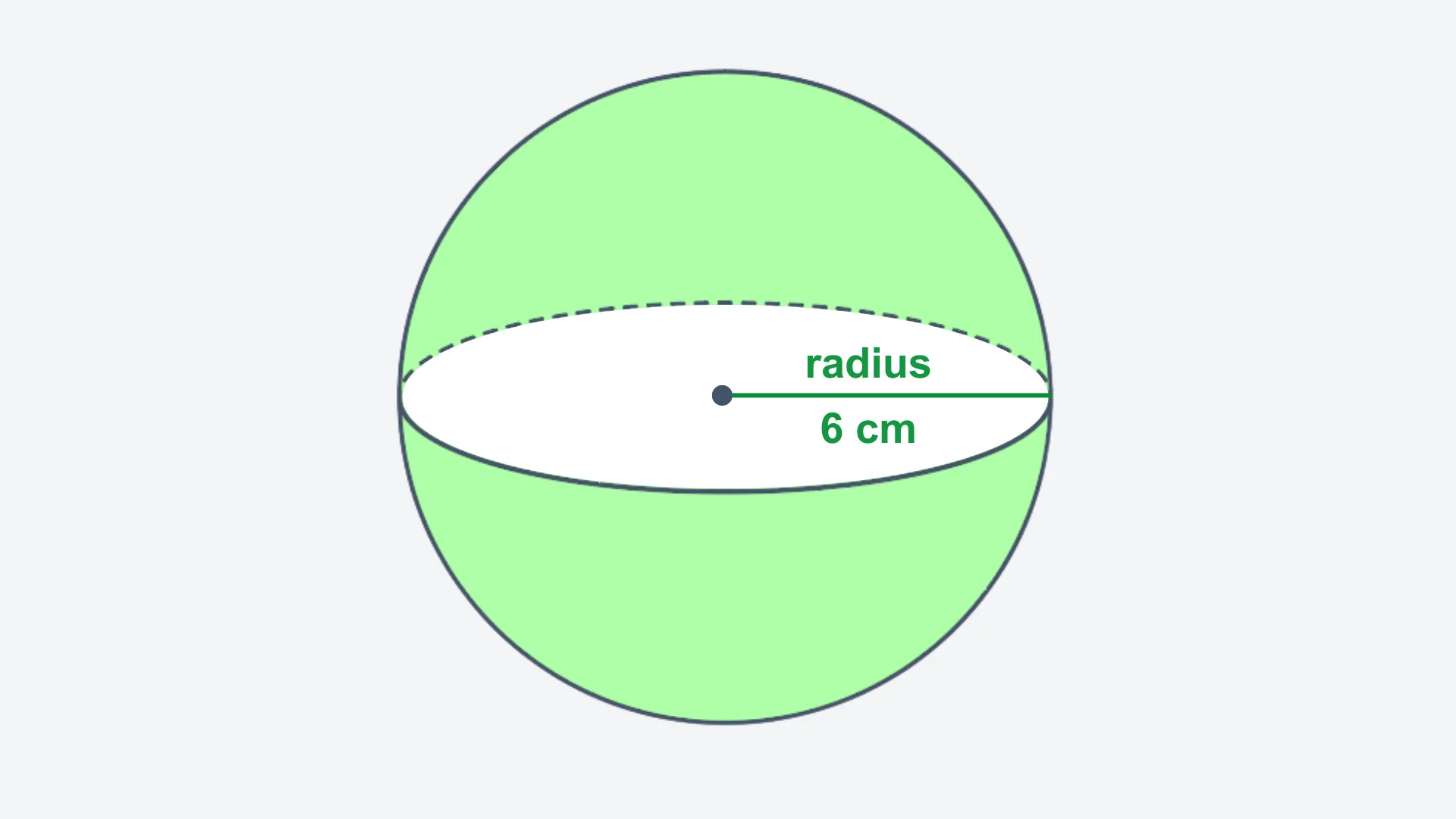
A sphere has a radius of . What is its surface area?
Correct! 🎉 +20 pointsCorrect! 🎉 Worth 20 XPNot quite right
The surface area of a sphere is . Square the radius first: .
(about ).
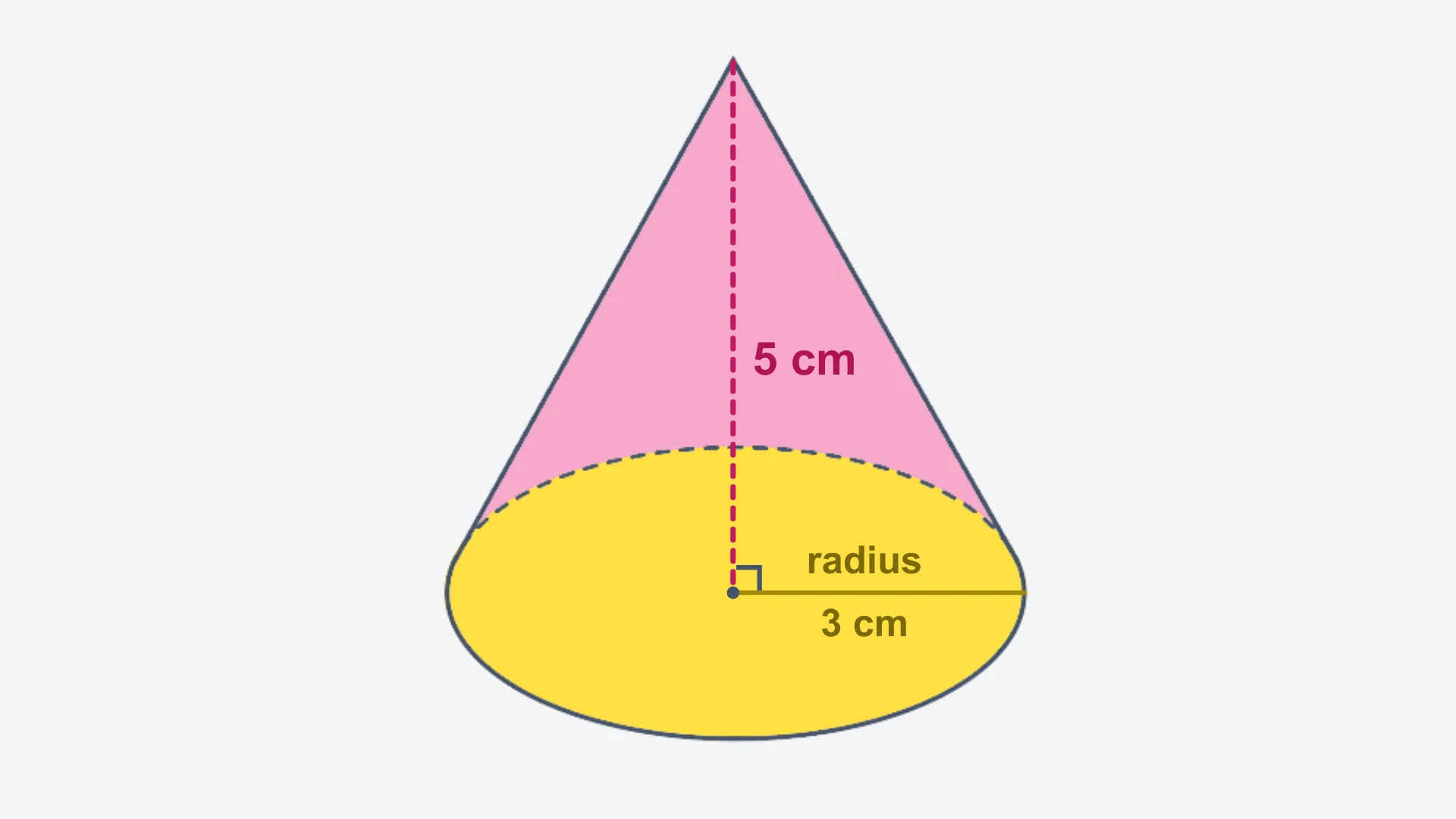
What is the volume of a cone with a radius of and a height of ?
Correct! 🎉 +20 pointsCorrect! 🎉 Worth 20 XPNot quite right
The volume of a cone is . Square the radius first: .
(about ).
A cone has a slant height of and a radius of . What is its surface area?
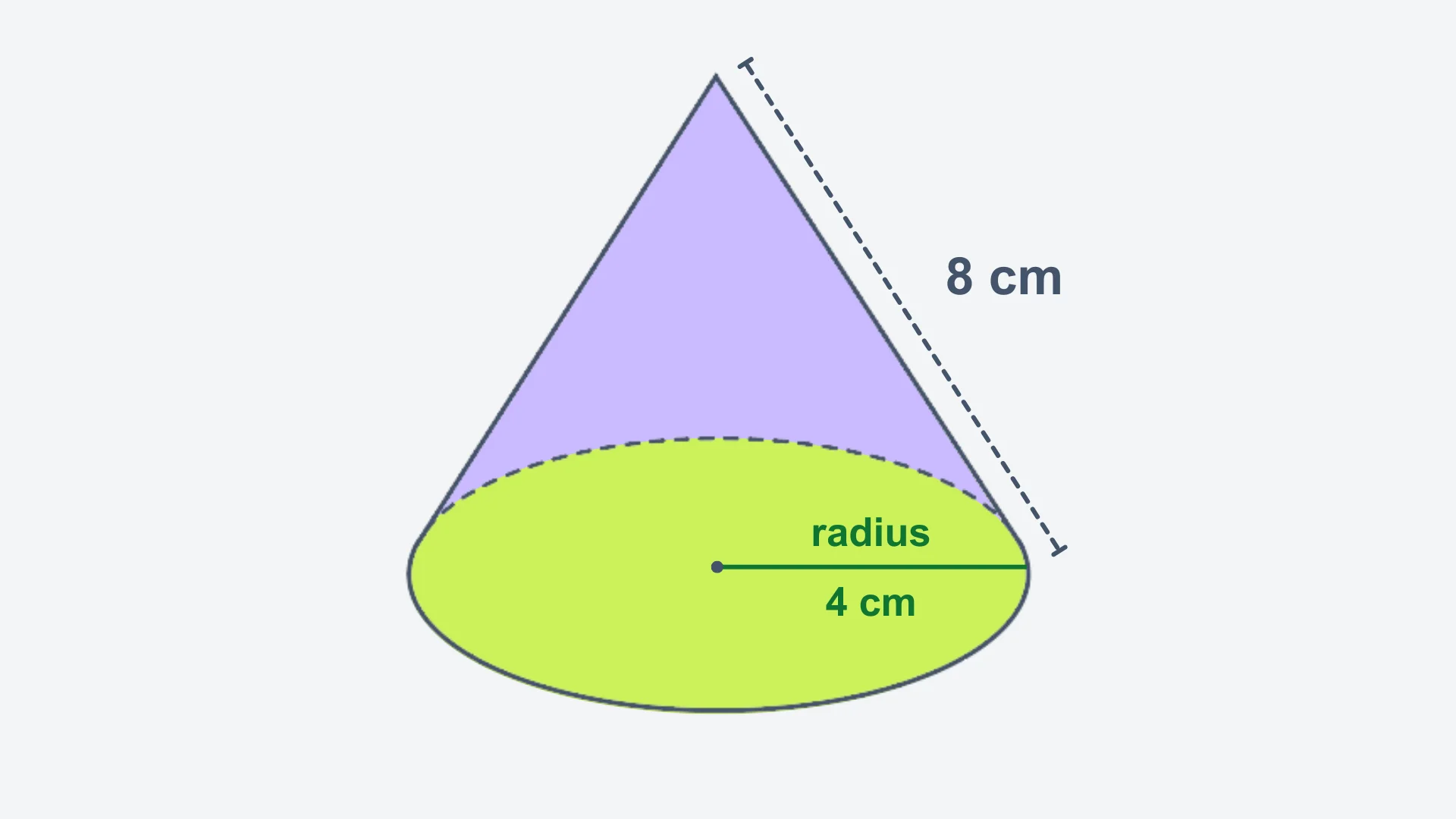
Correct! 🎉 +30 pointsCorrect! 🎉 Worth 30 XPNot quite right
The surface area of a cone is the base circle plus the curved surface: , where l is the slant height.
Base: . Curved surface: . Total: (about ).
Want to see the full working?
Interactive Activity
Explore how dimensions affect volume and surface area
Loading interactive widget...
Frequently asked questions
The questions students bump into most on this topic
Volume = ⅓ × base area × perpendicular height, whatever shape the base is. A square pyramid with a 10 cm side and a height of 12 cm has a base area of 100 cm², so V = ⅓ × 100 × 12 = 400 cm³. A pyramid on a triangular base of 30 cm² with a height of 10 cm has V = ⅓ × 30 × 10 = 100 cm³. Use the height, not the slant edge.
A cone is a pyramid with a circular base, so it uses the same formula: V = ⅓ × base area × height, with the base area πr². For a cone with radius 3 cm and height 5 cm, V = ⅓ × π × 9 × 5 = 15π cm³. The third is there for the same reason as in a pyramid: a pointed solid holds a third of the prism on the same base.
Add the base to all the triangular faces. For the square pyramid with a 10 cm side, the base is 100 cm². Each face is a triangle with base 10 cm and height 13 cm, the slant height, so its area is ½ × 10 × 13 = 65 cm²; four faces make 260 cm². The surface area is 100 + 260 = 360 cm².
Add the circular base, πr², to the curved surface, πrs, where s is the slant height: A = πr² + πrs. For a cone with r = 3 cm and s = 6 cm, A = 9π + 18π = 27π cm². The curved part unfolds into a sector of a circle, which is where πrs comes from.
Volume = 4/3 × π × r³ and surface area = 4 × π × r². For a sphere with radius 3 cm, V = 4/3 × π × 27 = 36π cm³ and A = 4 × π × 9 = 36π cm². The common slip is swapping the powers: cubed for volume, squared for area. A sphere of radius 6 cm has surface area 4 × π × 36 = 144π cm².
The perpendicular height goes straight from the apex down to the base at a right angle; the slant height runs along a sloping face from the base edge to the apex. Use the height for volume and the slant height for surface area: the square pyramid has height 12 cm but slant height 13 cm. If only one is given, Pythagoras links them.
What's next?
Found this one hard? Go one step back first. Feeling confident? Carry on to the next lesson.