Pythagoras' Theorem
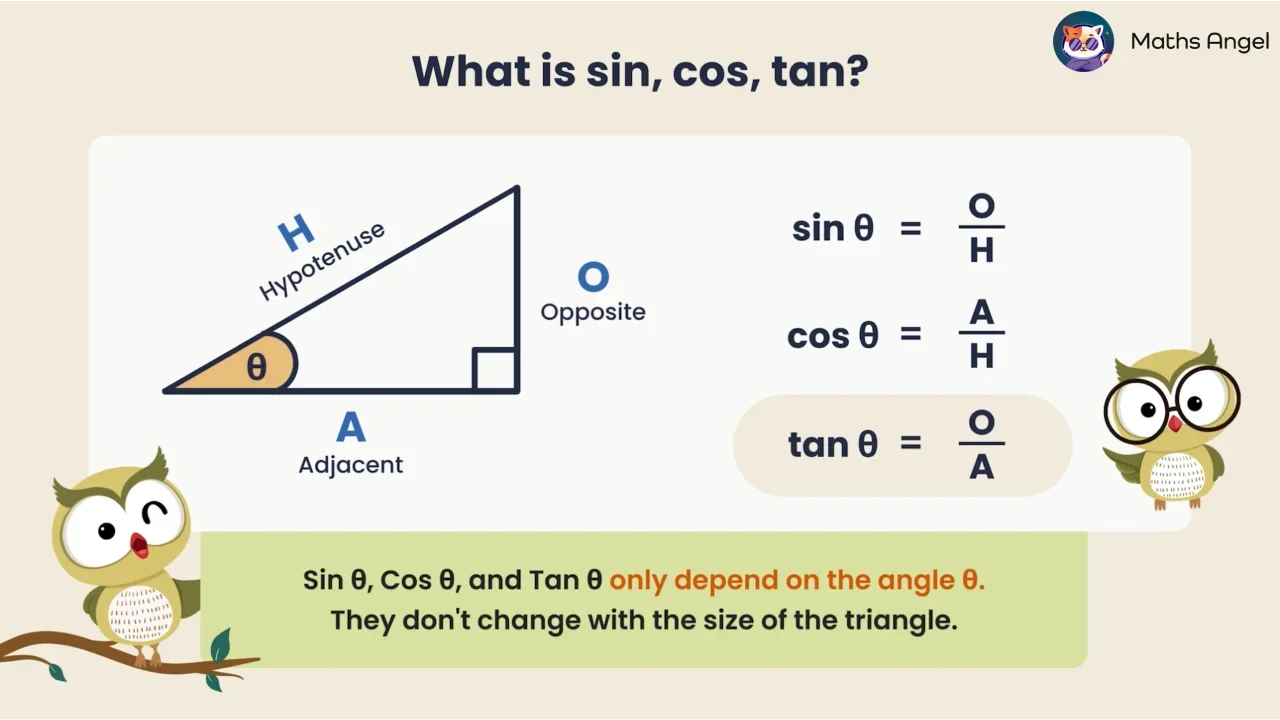
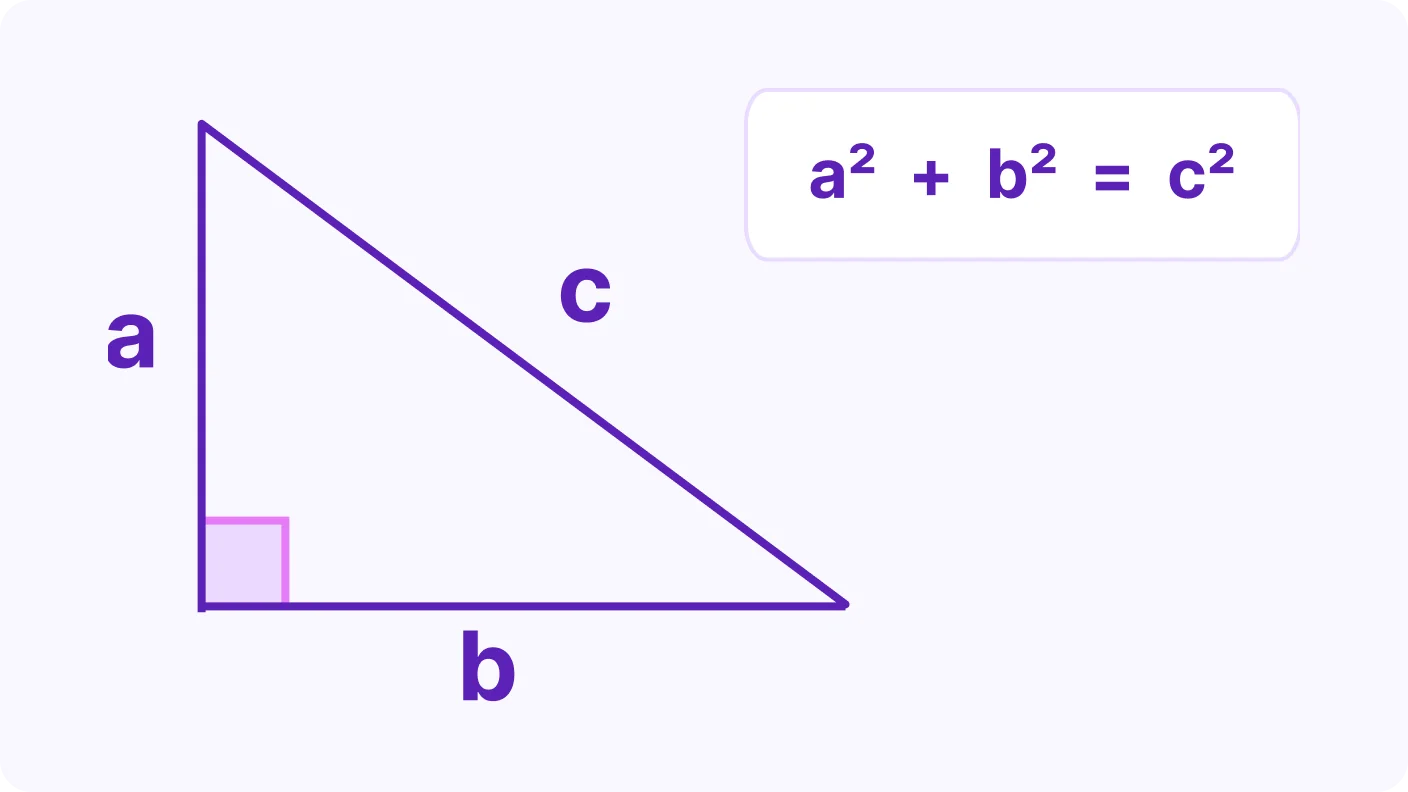
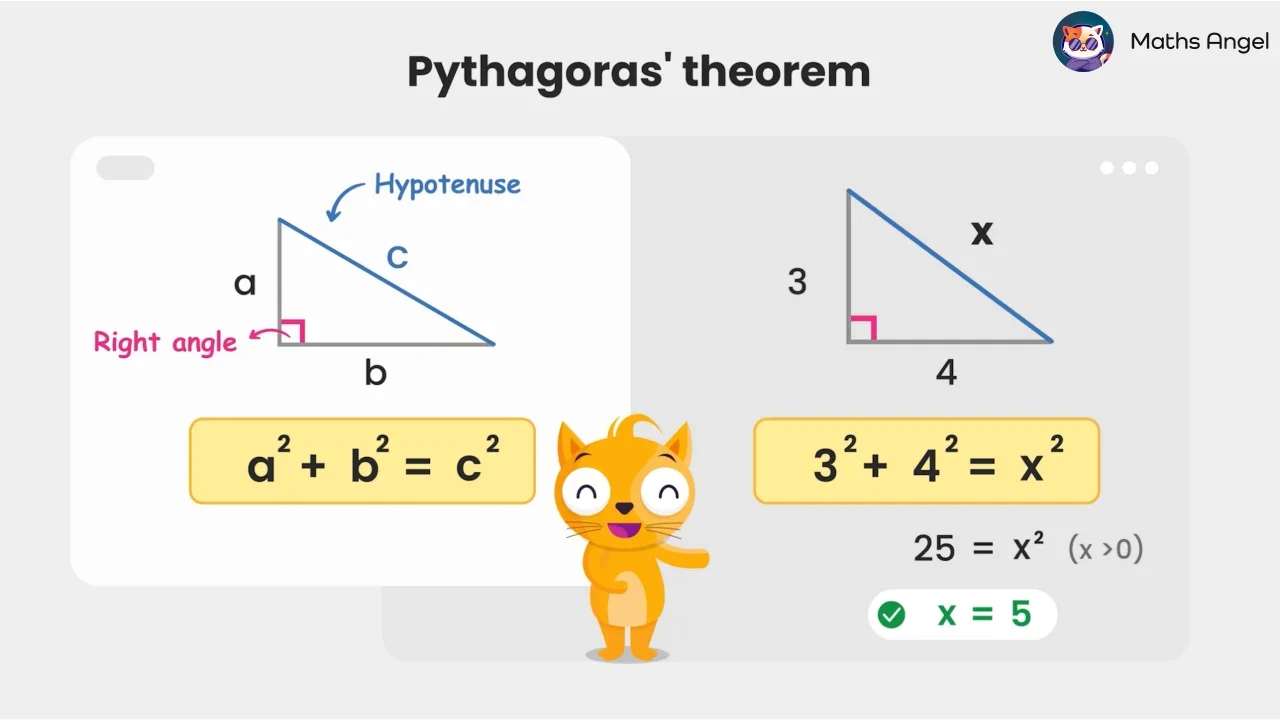
Pythagoras' theorem says that in a right-angled triangle, a² + b² = c². The two shorter sides squared add up to the longest side squared, so 3² + 4² = 5². That longest side, c, is the hypotenuse, opposite the right angle.
Video Lesson
Watch and learn the basics
🎬 Did this video explain it clearly?
Flashcards
Review key concepts visually
%20Pythagoras%20Theorem.webp)
%20Pythagoras%20Theorem%2C%20missing%20side%20triangle.webp)
%20Pythagoras%20Theorem%2C%20distance%20two%20points.webp)
%20Pythagoras%20Theorem%2C%20room%20diagonale%20cuboid.webp)
Pythagoras' Theorem
- Only works in a right-angled triangle
- The square of the hypotenuse equals the sum of the squares of the other two sides:
Finding a Missing Side in a Triangle
- Identify the hypotenuse first (the side opposite the right angle)
- Substitute the known lengths into , then solve
Finding the Distance Between Two Points
- Draw a right-angled triangle using horizontal and vertical distances
- Use Pythagoras to find the diagonal distance:
Using Pythagoras in 3D Shapes
- Break the problem into two right-angled triangles
- Apply Pythagoras twice to find the longest diagonal
Practice Questions
Test your understanding
What is the length of the hypotenuse in a right-angled triangle with sides 3 and 4?
Correct! 🎉 +10 pointsCorrect! 🎉 Worth 10 XPNot quite right
The hypotenuse is the side opposite the right angle, so we use Pythagoras' theorem with and .
Calling the hypotenuse x: , so and .
The final step is to square root, because is not the length itself: .
What is the length of the hypotenuse in a right-angled triangle with sides 6 and 8?
Correct! 🎉 +10 pointsCorrect! 🎉 Worth 10 XPNot quite right
The hypotenuse is the side opposite the right angle, so we use Pythagoras' theorem with and .
Calling the hypotenuse x: , so and .
Square rooting both sides gives the length itself: .
What is the length of the hypotenuse in a right-angled triangle with sides 9 and 12?
Correct! 🎉 +20 pointsCorrect! 🎉 Worth 20 XPNot quite right
The hypotenuse is the side opposite the right angle, so we use Pythagoras' theorem with and .
Calling the hypotenuse x: , so and .
Square rooting both sides gives the length itself: .
In a right-angled triangle, the sides are 12, 16 and 20. Which side is the hypotenuse?
Correct! 🎉 +20 pointsCorrect! 🎉 Worth 20 XPNot quite right
The hypotenuse is the side opposite the right angle, and it is always the longest side of a right-angled triangle. Here the longest side is , so is the hypotenuse.
You can check this with Pythagoras' theorem: , and , so the two shorter sides are and .
In a right-angled triangle, the hypotenuse is 13, and one of the shorter sides is 12. What is the length of the other shorter side?
Correct! 🎉 +20 pointsCorrect! 🎉 Worth 20 XPNot quite right
With , the hypotenuse and one shorter side is . Because the missing side is a shorter side, we subtract rather than add.
Calling the missing side x: , so and .
Square rooting gives .
What is the distance between the points (2, 2) and (8, 10) on a coordinate plane?
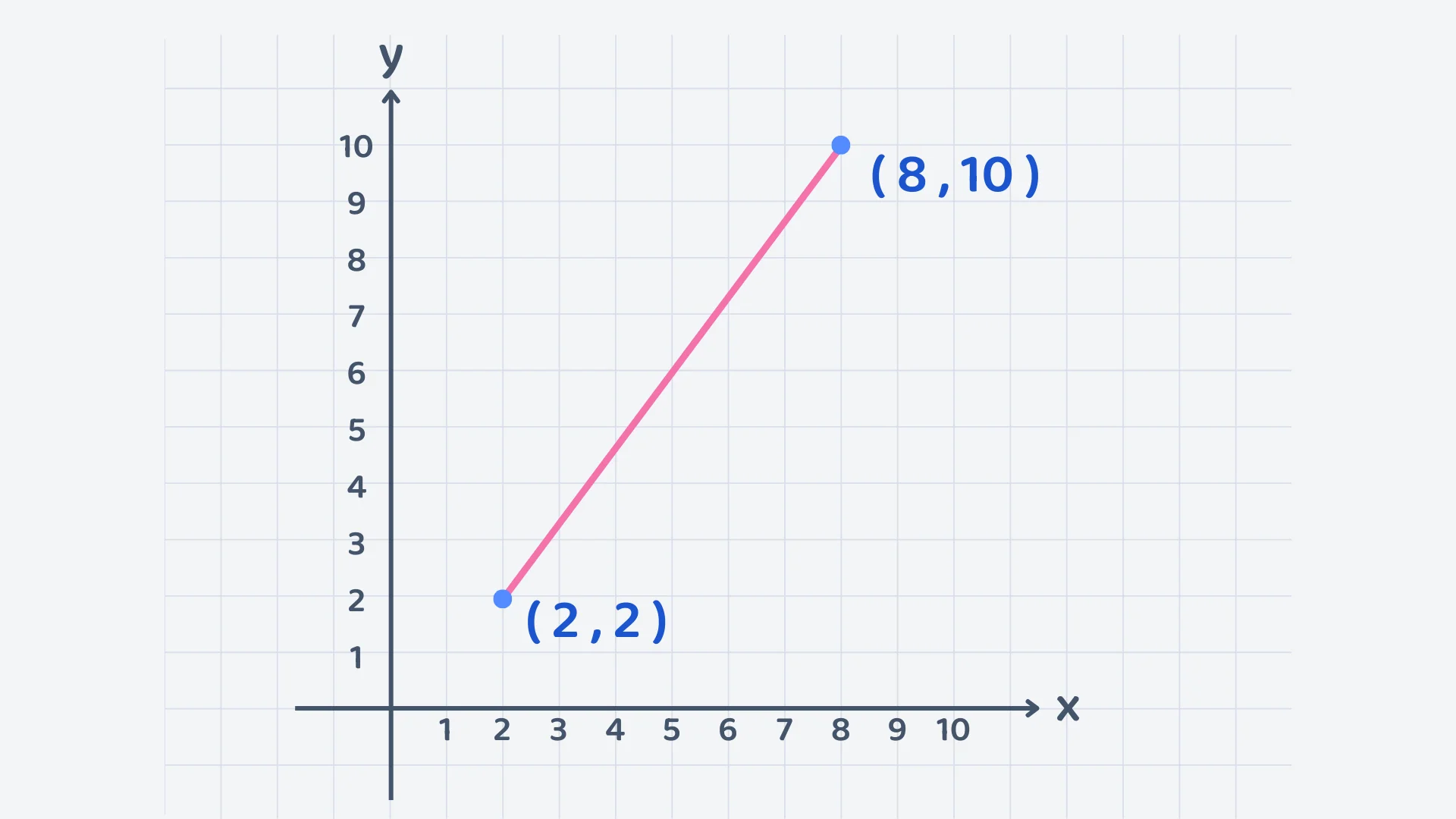
Correct! 🎉 +30 pointsCorrect! 🎉 Worth 30 XPNot quite right
Draw a right-angled triangle with the line joining the points as its hypotenuse. The horizontal side is and the vertical side is .
Calling the distance x: , so and .
Square rooting gives . The slanted distance is longer than either the horizontal or the vertical gap, but shorter than the two added together.
Want to see the full working?
Interactive Activity
Explore the Pythagoras Theorem
Loading interactive widget...
Frequently asked questions
The questions students bump into most on this topic
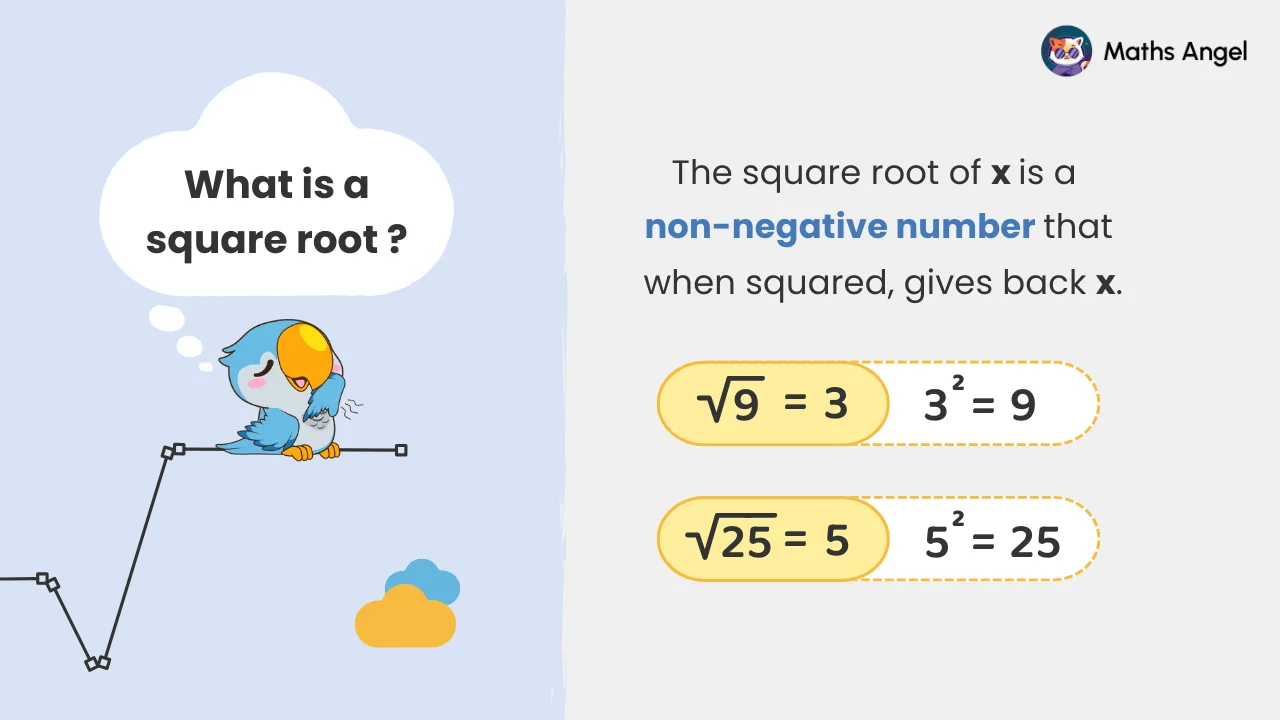
In a right-angled triangle, the square of the longest side equals the squares of the other two sides added together: a² + b² = c². The longest side, c, is the hypotenuse, opposite the right angle. With sides 3 and 4, 9 + 16 = 25, so the hypotenuse is 5. That one rule is all GCSE asks; American books call it the Pythagorean theorem.
Find the hypotenuse, write a² + b² = c², put in the two sides you know and solve. For a missing hypotenuse with sides 3 and 4: x² = 9 + 16 = 25, so x = 5. For a missing shorter side with hypotenuse 13 and side 5: x² = 169 − 25 = 144, so x = 12. Take the positive square root, because a length cannot be negative.
No, only right-angled triangles. Check for the 90° angle first; the hypotenuse is the side opposite it and is always the longest side. For a triangle with no right angle you need trigonometry, the sine and cosine rules, which are separate lessons. Pythagoras is about sides only, not angles.
Draw a right-angled triangle between them, using the horizontal and vertical gaps as the two shorter sides; the distance is the hypotenuse. From (2, 2) to (8, 10) the gaps are 6 across and 8 up, so x² = 36 + 64 = 100 and the distance is 10. Subtract the coordinates to get the gaps.
Yes, by using it twice. For the long diagonal of a cuboid, first find the diagonal across the base from the length and width, then use that diagonal and the height as the two shorter sides of a second right-angled triangle. For a 4 by 2 by 3 cuboid: d² = 16 + 4 = 20, then x² = 20 + 9 = 29, so x = √29.
Pythagoras was a Greek mathematician and philosopher who lived around 570 to 495 BC. The rule carries his name because his school was credited with proving it, although builders in Babylon and Egypt used 3, 4, 5 triangles to make right angles a thousand years earlier. Today it is used for distances, navigation, construction and the diagonals inside 3D shapes.
What's next?
Found this one hard? Go one step back first. Feeling confident? Carry on to the next lesson.