Cosine Rule
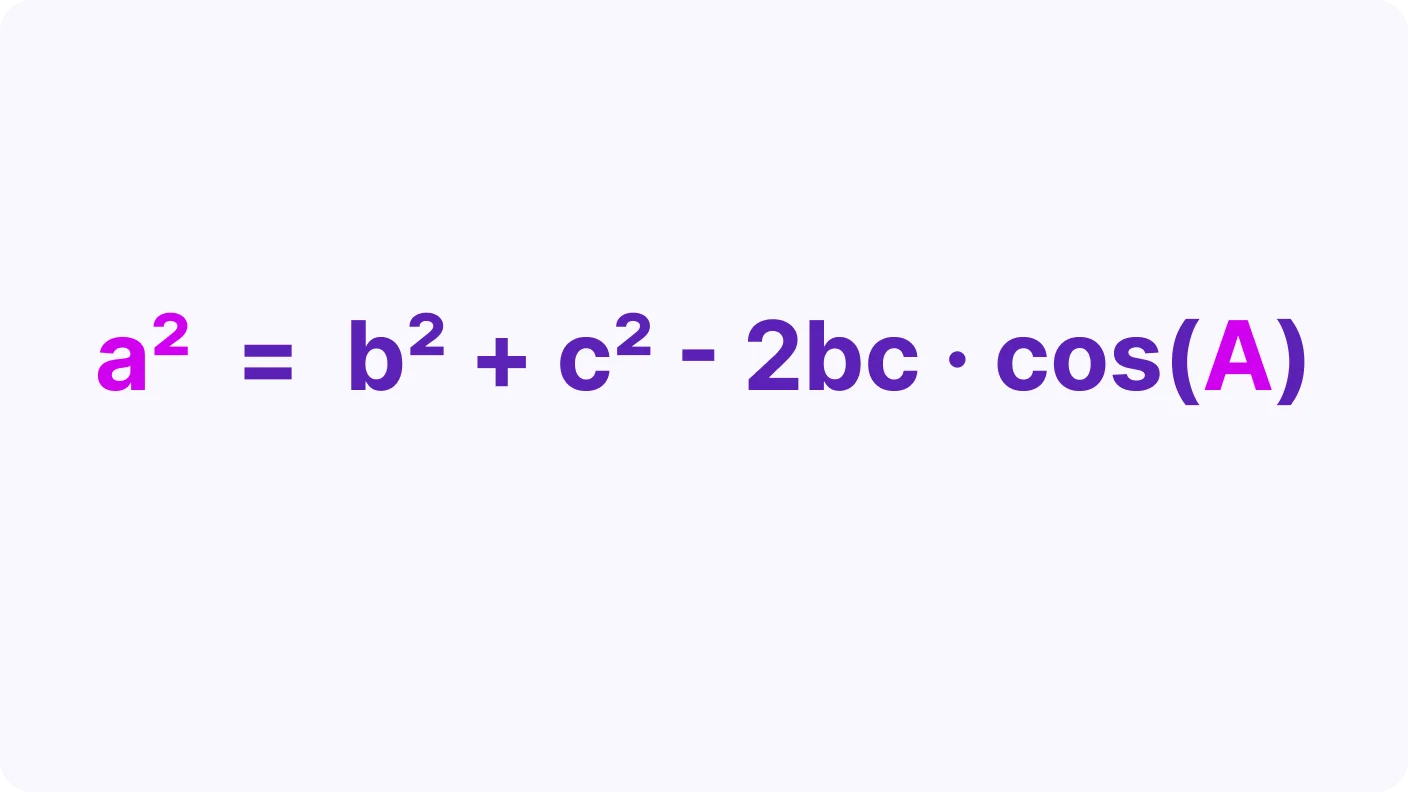
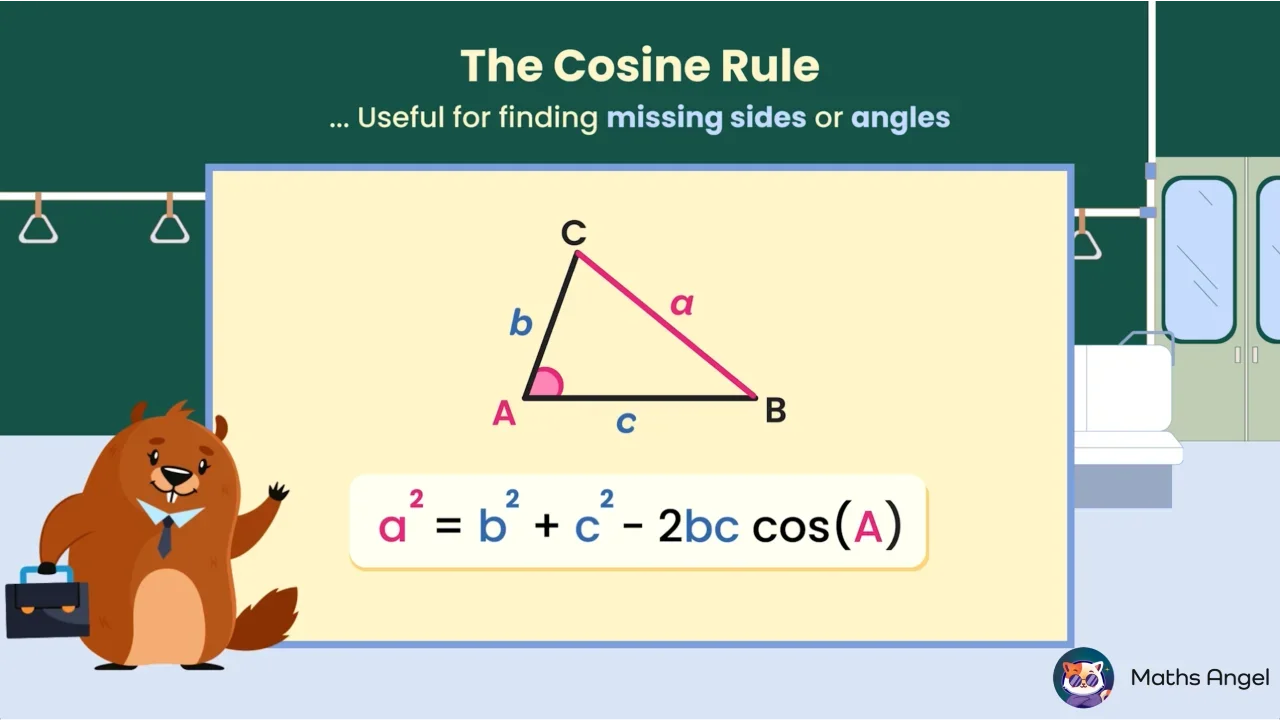
The cosine rule finds a missing side or angle. If you know two sides and the angle between them, or all three sides, use a² = b² + c² − 2bc cos A. Use it in non-right-angled triangles; right-angled ones use Pythagoras.
Video Lesson
Watch and learn the basics
🎬 Did this video explain it clearly?
Flashcards
Review key concepts visually
%20What%20is%20the%20Cosine%20Rule.webp)
%20How%20to%20Apply%20the%20Cosine%20Rule%20to%20Find%20Sides%20in%20Triangles.webp)
%20The%20Cosine%20Rule%20Formula.webp)
%20Applying%20the%20Cosine%20Rule%20to%20Find%20Angles%20in%20Triangles.webp)
The Cosine Rule
- The cosine rule is used to find a missing side or angle in any triangle.
- It is used when the triangle is not right-angled (otherwise use Pythagoras’ theorem).
Example: The Cosine Rule for Finding a Side
- If you know two sides and the angle between them, you can find the third side.
- The rule is , where a is the unknown side and A is the angle between b and c.
Rearranging the Cosine Rule to Find an Angle
- If you know all three sides, you can find a missing angle.
- Rearrange to . Once you find , you can find angle A.
Example: Finding an Angle Using the Cosine Rule
- Substitute the three side lengths into the rearranged formula.
- Once you find , you can find angle F.
- Use on your calculator to find the angle in degrees.
Practice Questions
Test your understanding
Which of the following is the correct Cosine Rule formula?
Correct! 🎉 +10 pointsCorrect! 🎉 Worth 10 XPNot quite right
The Cosine Rule is , where and are the two sides that enclose angle , and is the side opposite .
Two things must be right. The sign in front of is a minus, not a plus. And the subtraction applies only to that whole term: you work out first and then subtract it, rather than working out and multiplying that by .
The sine rule, , is a different formula and cannot be used when you know two sides and the angle between them.
What does the Cosine Rule help you find in a triangle?
Correct! 🎉 +10 pointsCorrect! 🎉 Worth 10 XPNot quite right
The Cosine Rule links all three sides to one angle: .
Use it to find a missing side when you know two sides and the angle between them (the included angle), and to find a missing angle when you know all three sides.
If instead you know two angles and a side, the Sine Rule is the tool to reach for. The Cosine Rule does not give area or perimeter directly.
In a triangle, sides a and b meet at an angle of . What is the exact length of the third side?
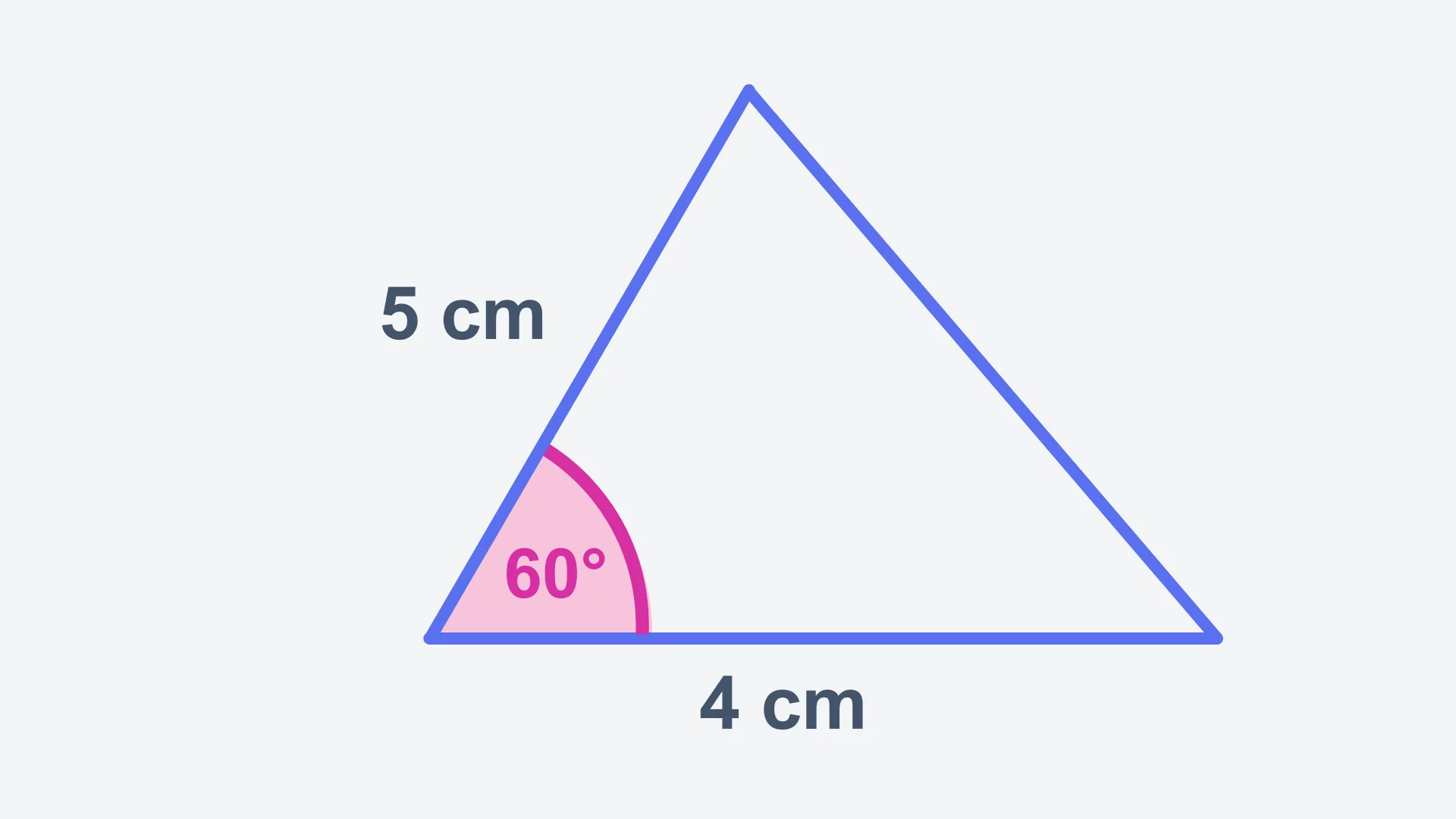
Correct! 🎉 +20 pointsCorrect! 🎉 Worth 20 XPNot quite right
The angle sits between the two known sides, so use the Cosine Rule with , and .
Since : .
Only the term is multiplied by the cosine, and the final step is to square root: .
In a triangle, sides a , b , and the angle between them is . What is the exact length of the third side?
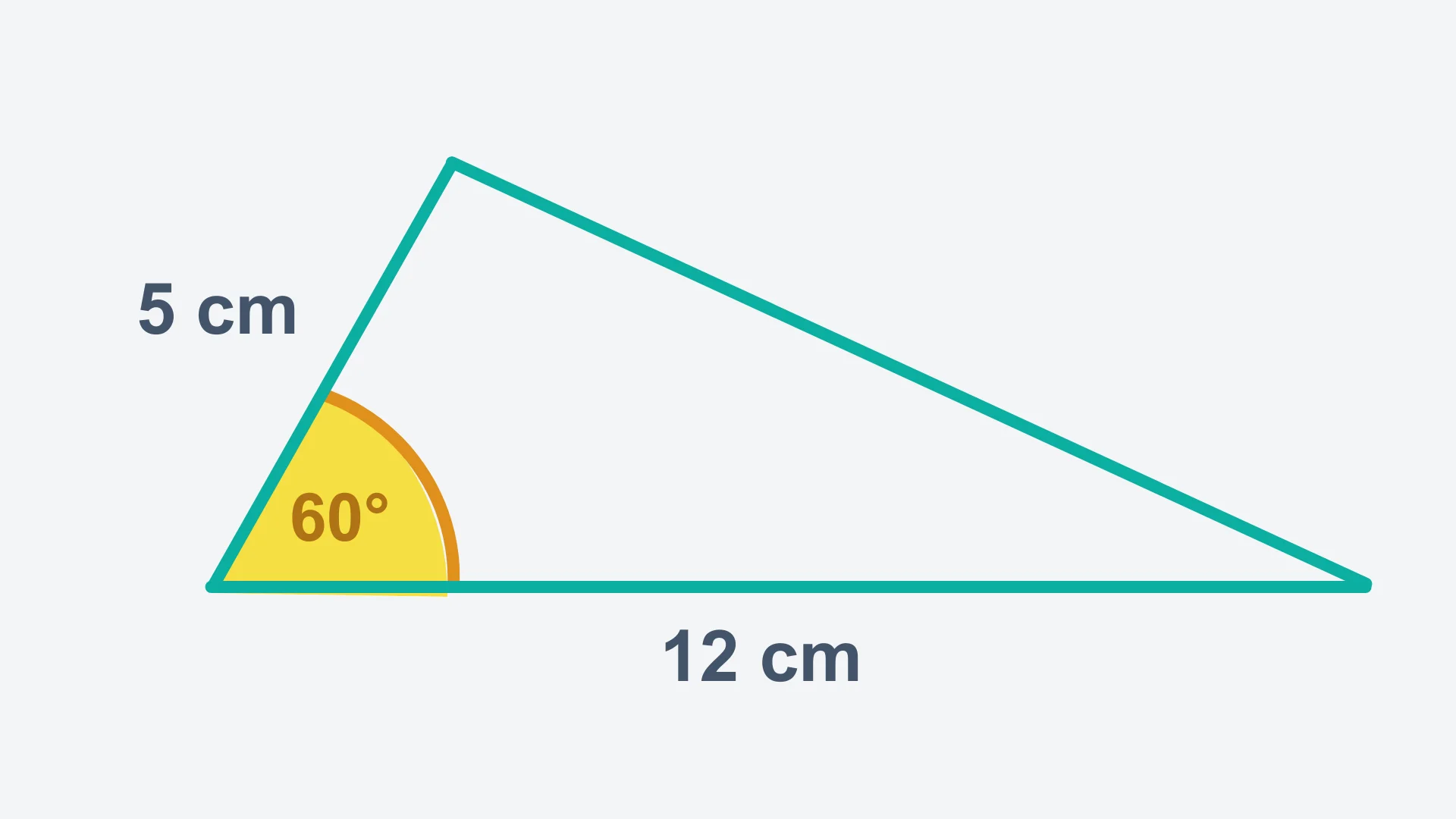
Correct! 🎉 +20 pointsCorrect! 🎉 Worth 20 XPNot quite right
The angle is the included angle, so use with , and .
Since : .
Square root at the end: . It is not . That would only be right if the angle were .
In a triangle, sides a , b , and the angle between them is . What is the length of the third side?
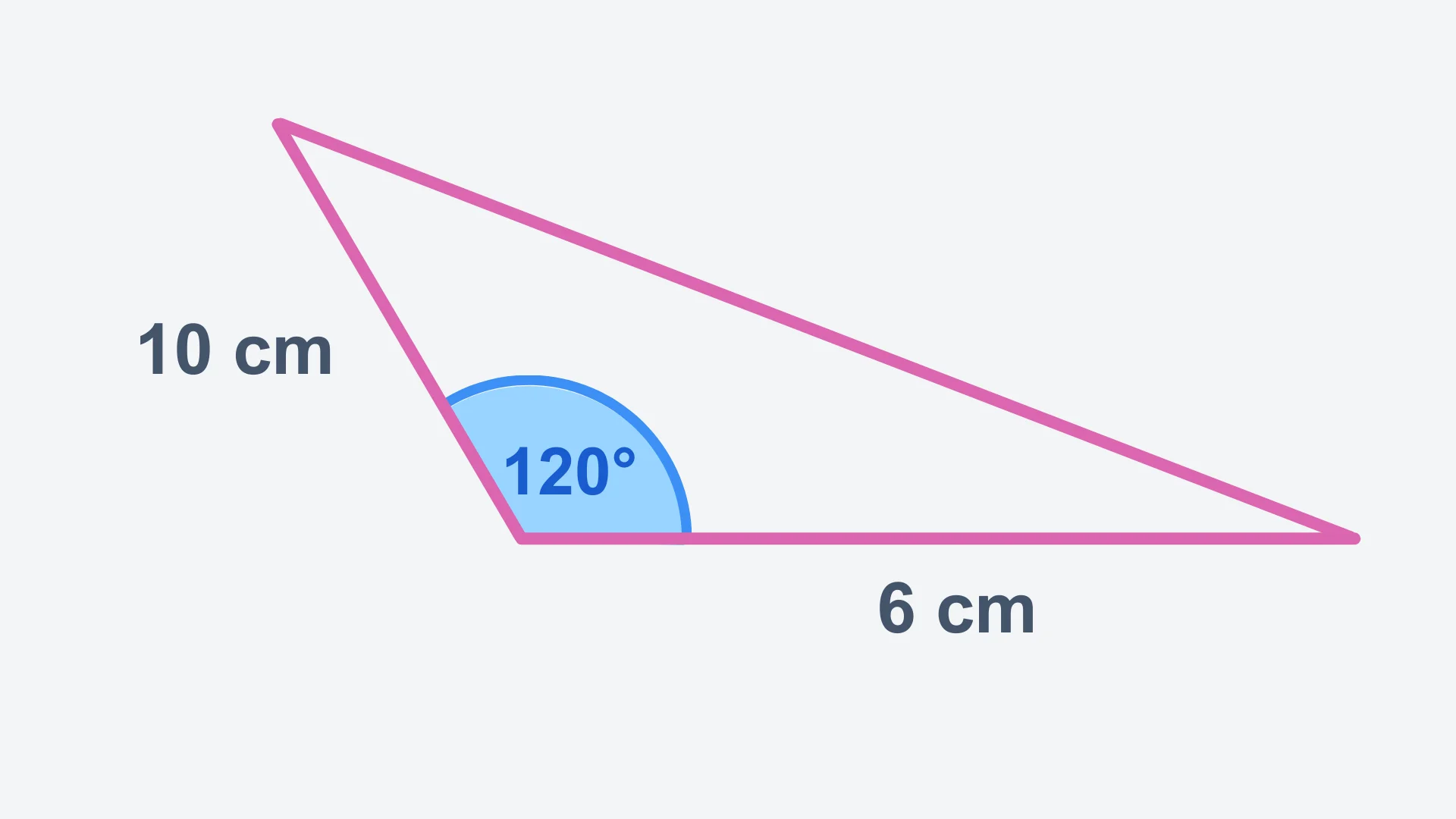
Correct! 🎉 +20 pointsCorrect! 🎉 Worth 20 XPNot quite right
Use with , and .
The angle is obtuse, so its cosine is negative: . Subtracting a negative adds on:
So . Sensibly, the side opposite the obtuse angle is longer than both and .
In a triangle, sides a , b , and c . Find the angle between sides a and b.
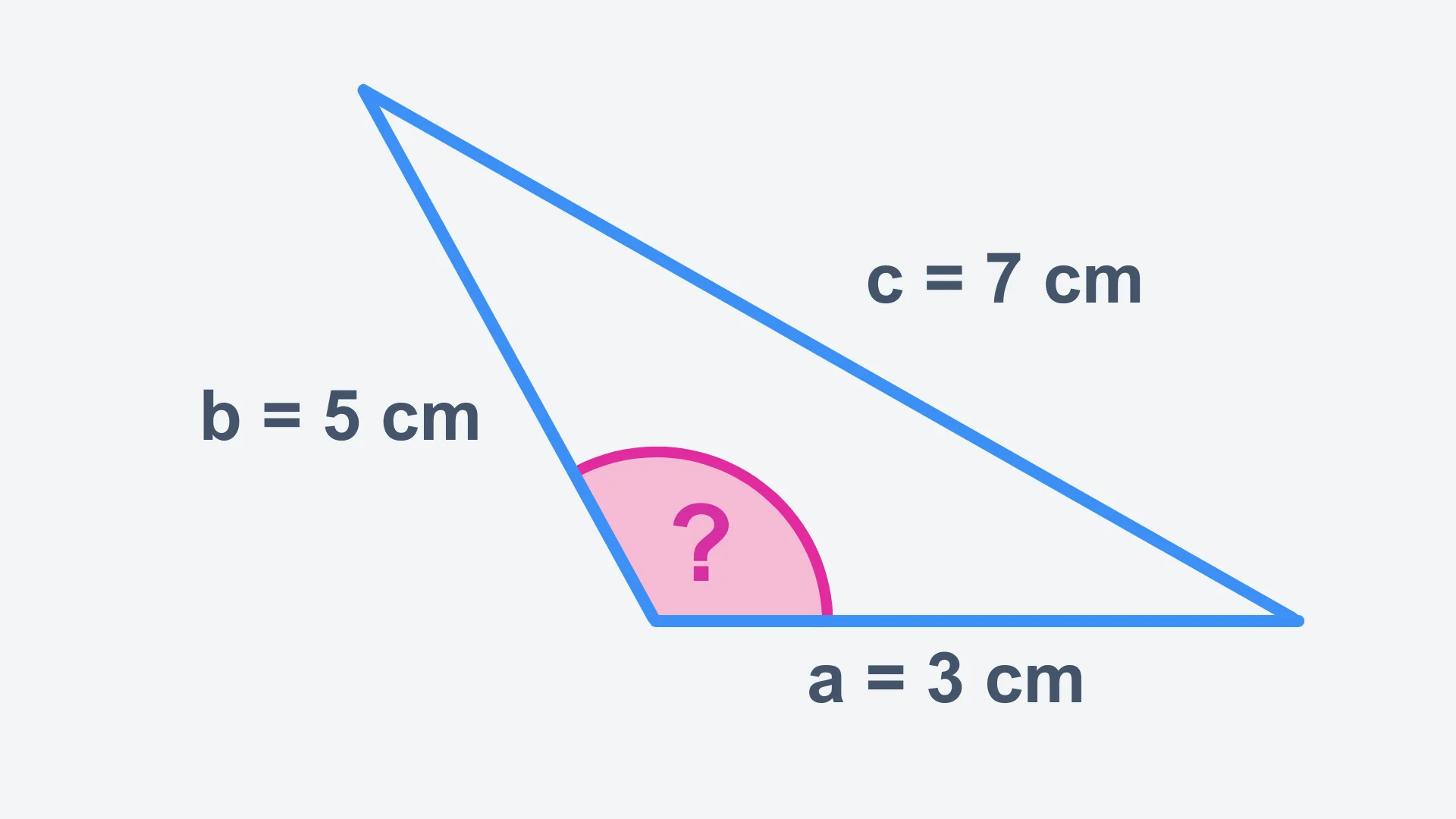
Correct! 🎉 +30 pointsCorrect! 🎉 Worth 30 XPNot quite right
The angle between a and b is the angle C, opposite the side . Rearranging the Cosine Rule gives
A negative cosine means the angle is obtuse, so . Keep the minus sign: dropping it gives the acute angle instead.
Want to see the full working?
Interactive Activity
Practice using the Cosine Rule to find a missing side or angle of a non-right-angled triangle
Loading interactive widget...
Frequently asked questions
The questions students bump into most on this topic
The cosine rule links three sides of any triangle and one angle: a² = b² + c² − 2bc cos A, where A is the angle between sides b and c and a is the side opposite it. It is Pythagoras with a correction term for triangles that are not right-angled. GCSE Higher uses it in both directions; American books call it the law of cosines.
In two situations. When you know two sides and the angle between them, the rule gives the third side. When you know all three sides, the rearranged rule gives any angle. If the triangle is right-angled, use Pythagoras or SOHCAHTOA instead, and if you know an angle with its opposite side, the sine rule is quicker.
Look at what you know. If you have an angle and the side opposite it, use the sine rule. If you have two sides and the angle between them, or all three sides, use the cosine rule. A quick test: the sine rule needs a matching pair, the cosine rule needs the angle to sit between the sides. Many questions use one rule, then the other.
Square the two known sides, add them, subtract 2 × the two sides × cos of the angle between them, then square root. For sides 4 and 5 with a 60° angle between them: x² = 16 + 25 − 2 × 4 × 5 × cos 60°, and cos 60° = 0.5, so x² = 41 − 20 = 21 and x = √21 ≈ 4.6. Take the positive root, because a length cannot be negative.
Rearrange to cos A = (b² + c² − a²) ÷ 2bc, where a is the side opposite the angle you want. No labelling is needed: add the squares of the two sides next to the angle, subtract the square of the side opposite, and divide by twice the product of the two neighbours. For sides 2, 4 and 3: cos F = 11/16, and the inverse cosine gives about 47°.
Yes. When the angle is 90°, cos 90° is 0, the correction term disappears and the rule becomes a² = b² + c², which is Pythagoras’ theorem. So Pythagoras is the special case and the cosine rule the general one. Whether the rule is printed on your GCSE formula sheet has varied by year and board, so check the current rules; it is safer to learn it.
What's next?
Found this one hard? Go one step back first. Feeling confident? Carry on to the next lesson.