Area of a Trapezium
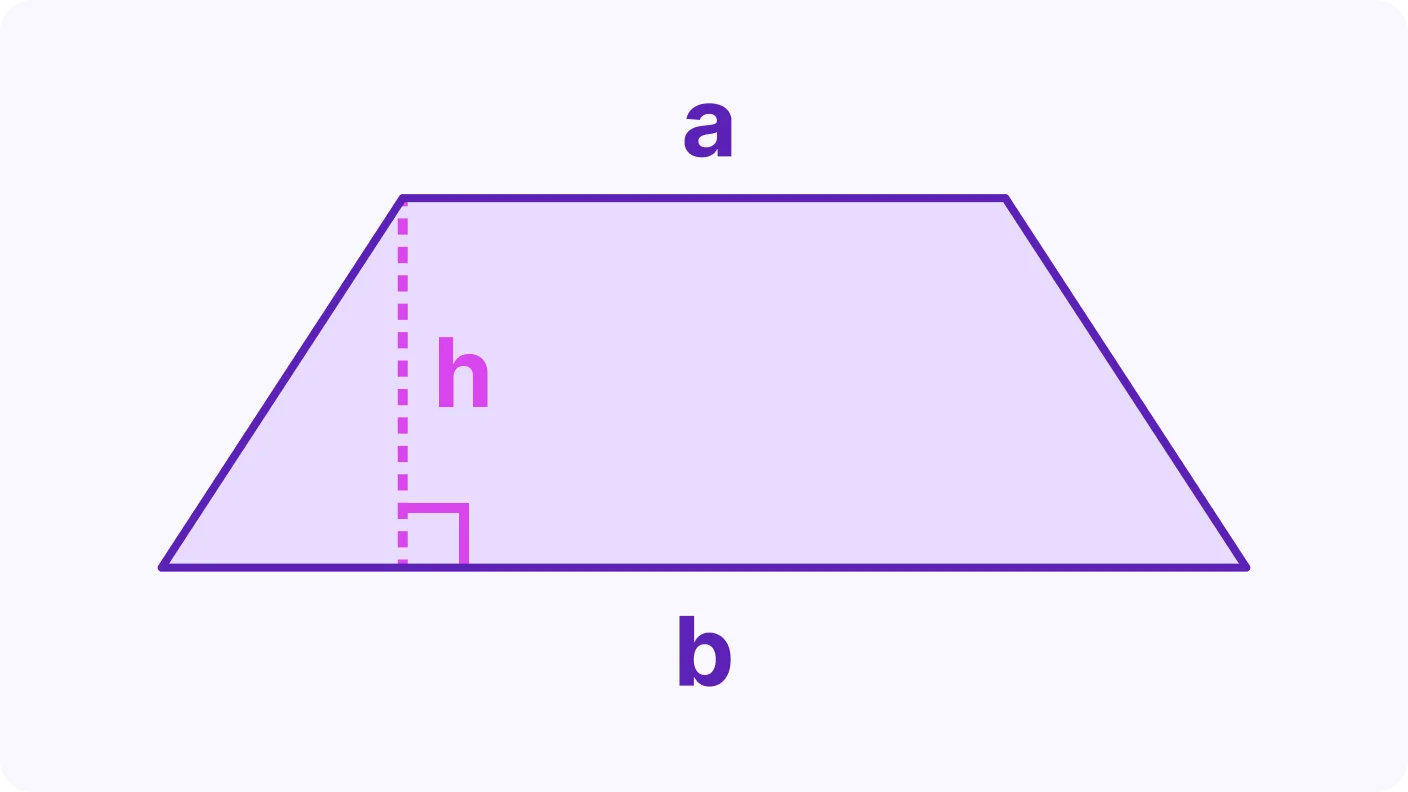
The trapezium area formula is (a + b) ÷ 2 × h, where a and b are the parallel sides and h is the perpendicular height, not the slanted side. With bases 8 cm and 12 cm and height 6 cm: (8 + 12) ÷ 2 × 6 = 10 × 6 = 60 cm².
Video Lesson
Watch and learn the basics
🎬 Did this video explain it clearly?
Flashcards
Review key concepts visually
%20What%20is%20a%20Trapezium.webp)
%20Area%20of%20a%20Trapezium.webp)
%20Area%20of%20a%20Right-Angled%20Trapezium.webp)
%20Area%20of%20an%20Isosceles%20Trapezium.webp)
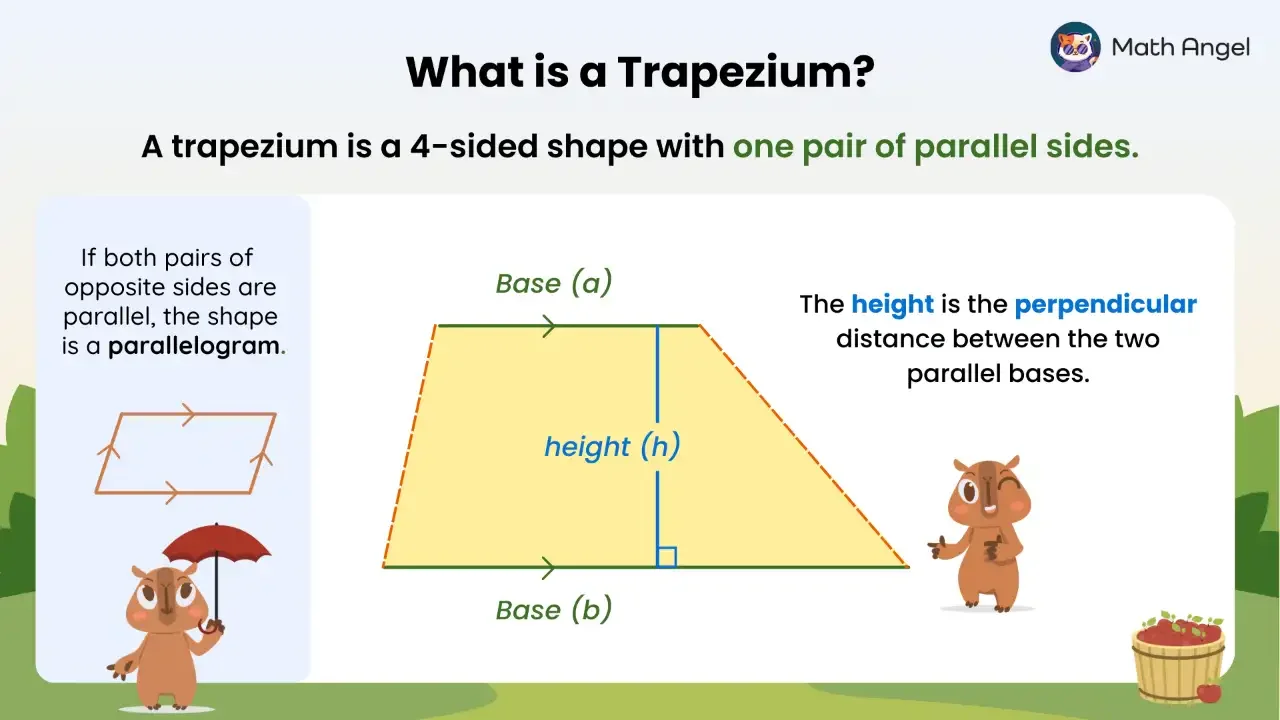
What is a Trapezium?
- A trapezium is a four-sided shape with only one pair of parallel sides.
- The height is the perpendicular distance between the parallel sides.
Area of a Trapezium
- The area of a trapezium is given by: Area
- Here, a and b are the lengths of the parallel sides.
Area of a Right-Angled Trapezium
- A right-angled trapezium has two right angles, so the height is easy to identify.
- Use the same formula and take the perpendicular side as the height.
Finding the Height of a Trapezium
- Use the same formula: Area
- Substitute the known values and solve for the height.
Practice Questions
Test your understanding
Which of the following is always true for a trapezium?
Correct! 🎉 +10 pointsCorrect! 🎉 Worth 10 XPNot quite right
A trapezium is a quadrilateral with one pair of parallel sides. That is the only property guaranteed by the name.
Everything else varies from trapezium to trapezium: the angles need not be right angles, the diagonals are only equal in the special isosceles case, and a second pair of parallel sides would make the shape a parallelogram.
What is the height of a trapezium?
Correct! 🎉 +10 pointsCorrect! 🎉 Worth 10 XPNot quite right
The height of a trapezium is the perpendicular distance between the two parallel sides, measured at right angles to them.
The height stays perpendicular to the parallel sides no matter how the trapezium is turned on the page.
Calculate the area of a trapezium with parallel sides and , and height .
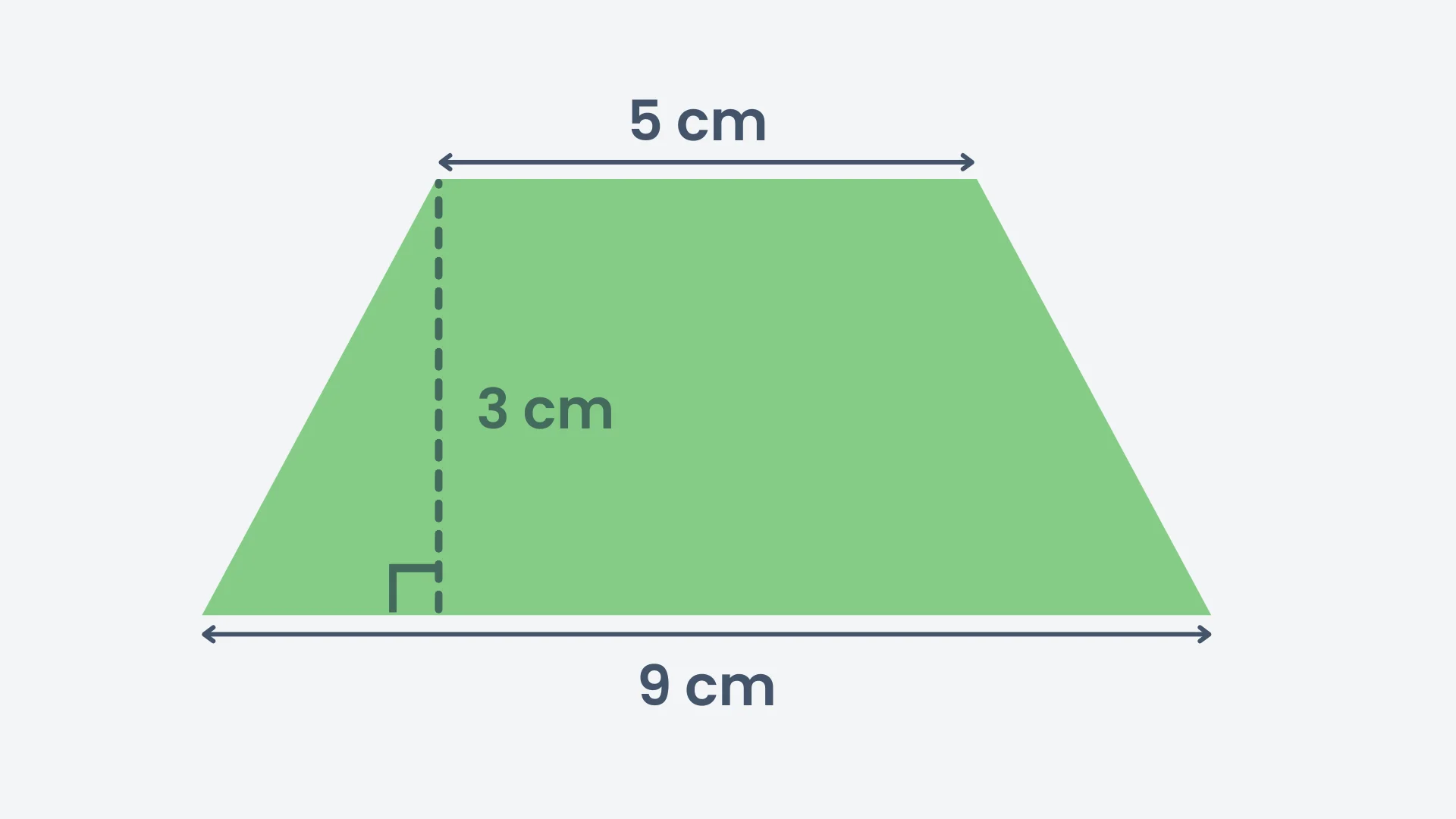
Correct! 🎉 +20 pointsCorrect! 🎉 Worth 20 XPNot quite right
Use Area with , and .
First average the parallel sides: .
Then multiply by the height: .
The area is cm². The brackets matter: the two parallel sides must be added and halved before multiplying by the height.
In a right-angled trapezium the parallel sides are and , and the area is . What is the height?
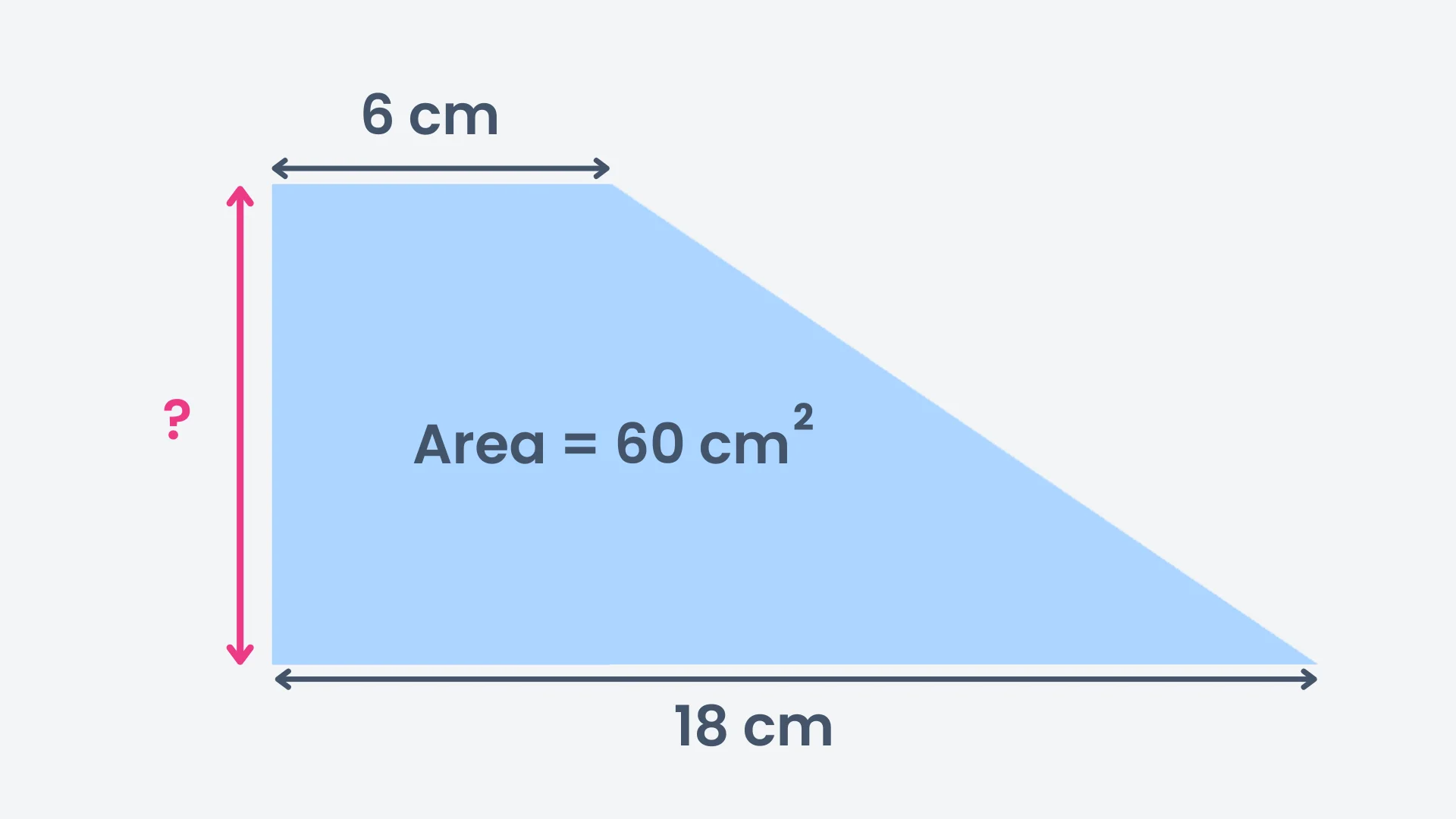
Correct! 🎉 +20 pointsCorrect! 🎉 Worth 20 XPNot quite right
Use Area .
Average the parallel sides: .
So , which gives .
The height is cm.
An isosceles trapezium has parallel sides of and . If its area is , what is the height?
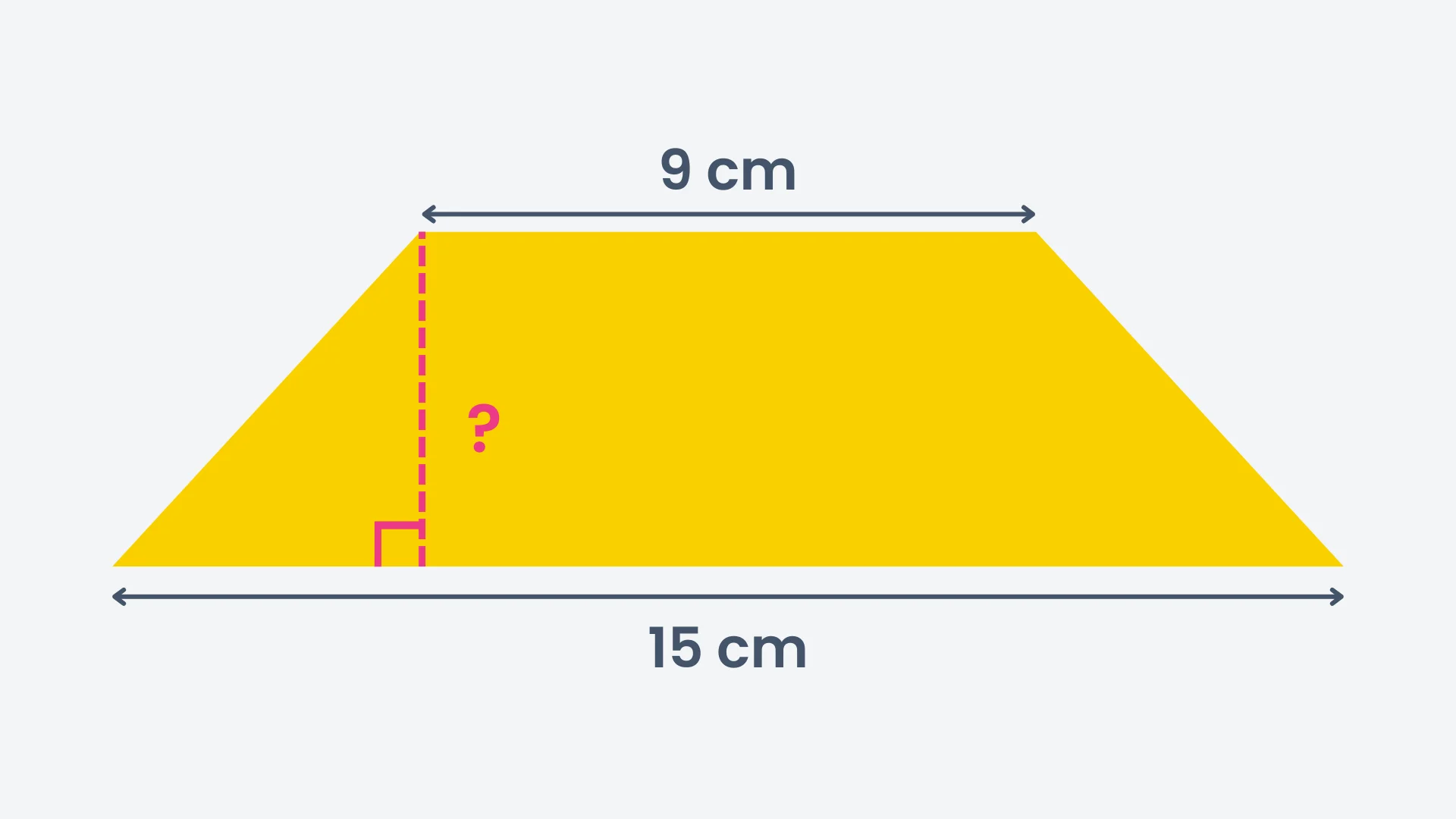
Correct! 🎉 +20 pointsCorrect! 🎉 Worth 20 XPNot quite right
Use Area .
Average the parallel sides: .
So , which gives .
The height is cm.
Find the area of the isosceles trapezium shown, where the bottom base is , the top base is , and the height is .
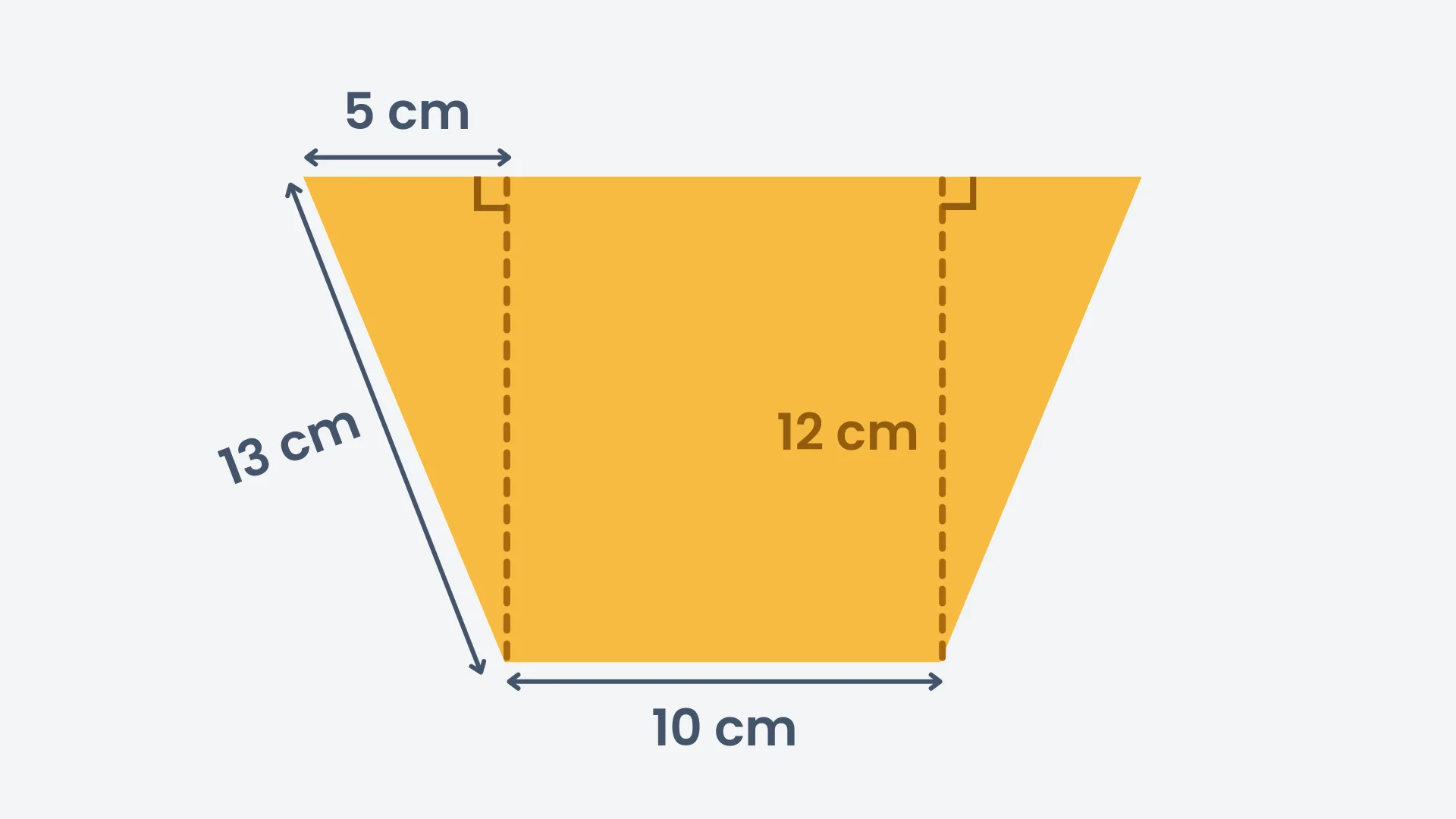
Correct! 🎉 +30 pointsCorrect! 🎉 Worth 30 XPNot quite right
The parallel sides are cm and cm, and the perpendicular height is cm. The cm slant side is not needed.
Area .
The area is cm².
Want to see the full working?
Interactive Activity
Explore the area of a trapezium
Loading interactive widget...
Frequently asked questions
The questions students bump into most on this topic
A trapezium is a four-sided shape with one pair of parallel sides, called the bases. The other two sides are not parallel; if they were, the shape would be a parallelogram. The height is the perpendicular distance between the bases. A right-angled trapezium has two right angles, and an isosceles trapezium has two equal non-parallel sides.
The area of a trapezium is (a + b) ÷ 2 × h, where a and b are the parallel sides and h is the perpendicular height. Add the parallel sides, divide by 2, then multiply by the height. With bases 8 cm and 12 cm and height 6 cm: (8 + 12) ÷ 2 × 6 = 60 cm².
Add the two parallel sides, divide by 2, then multiply by the perpendicular height. For a right-angled trapezium with parallel sides 6 cm and 9 cm and height 4 cm: (6 + 9) ÷ 2 = 7.5, and 7.5 × 4 = 30 cm². In GCSE questions, use the perpendicular height between the parallel sides, never a slanted side.
A trapezium has four sides, making it a quadrilateral. Two of these sides are parallel and are called the bases. The other two sides are not parallel. Every trapezium shares this four-sided structure, whether it is right-angled, isosceles, or a general trapezium.
The four angles in a trapezium add up to 360°, like every four-sided shape. Each non-parallel side sits between the two parallel bases, so the two angles along that side add up to 180°. For example, if one of them is 110°, the angle at the other end of that side is 70°.
In the UK, a trapezium is a four-sided shape with one pair of parallel sides. In American English that shape is called a trapezoid, and “trapezium” means a four-sided shape with no parallel sides. The names swap, but the area formula does not: (a + b) ÷ 2 × h works for both.
What's next?
Found this one hard? Go one step back first. Feeling confident? Carry on to the next lesson.