Surface Area of Solids
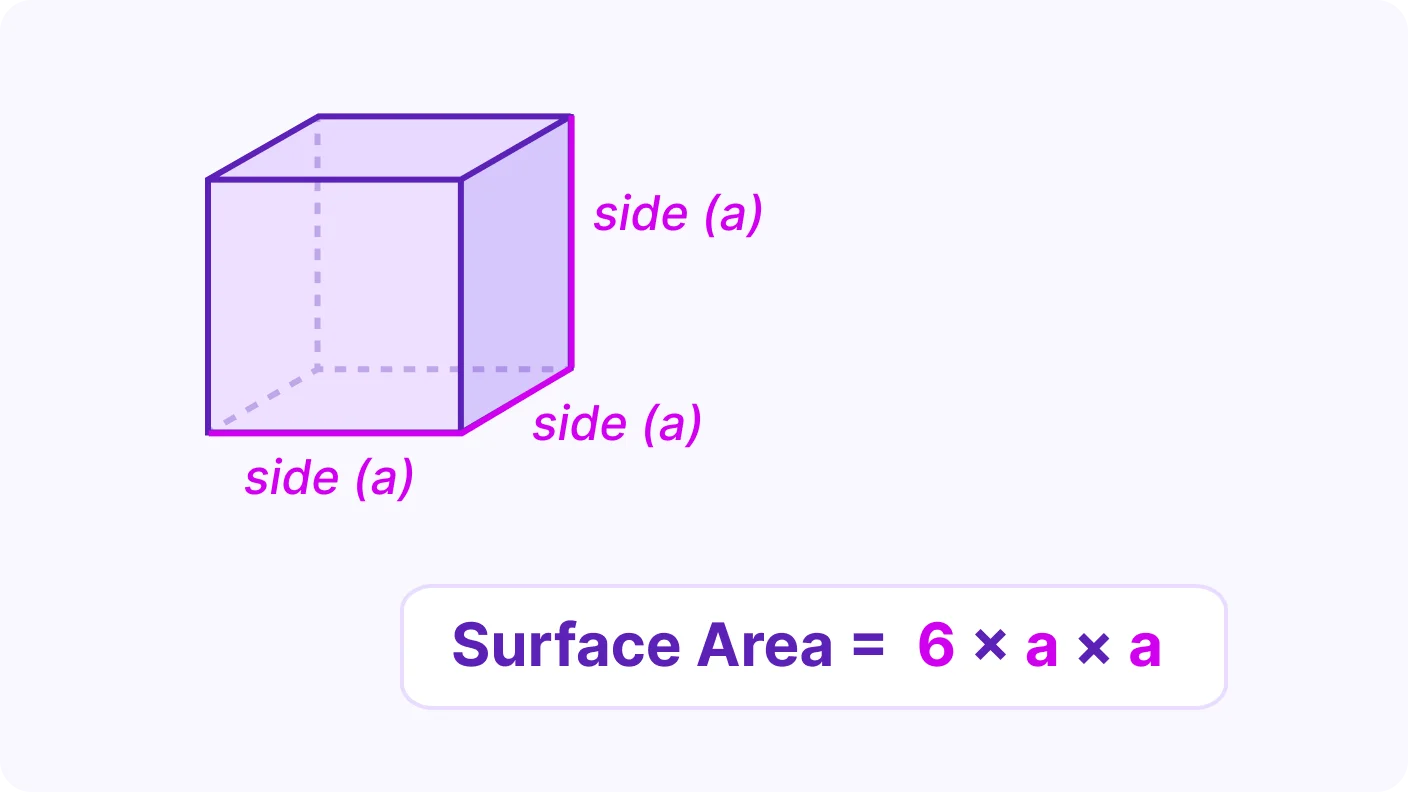
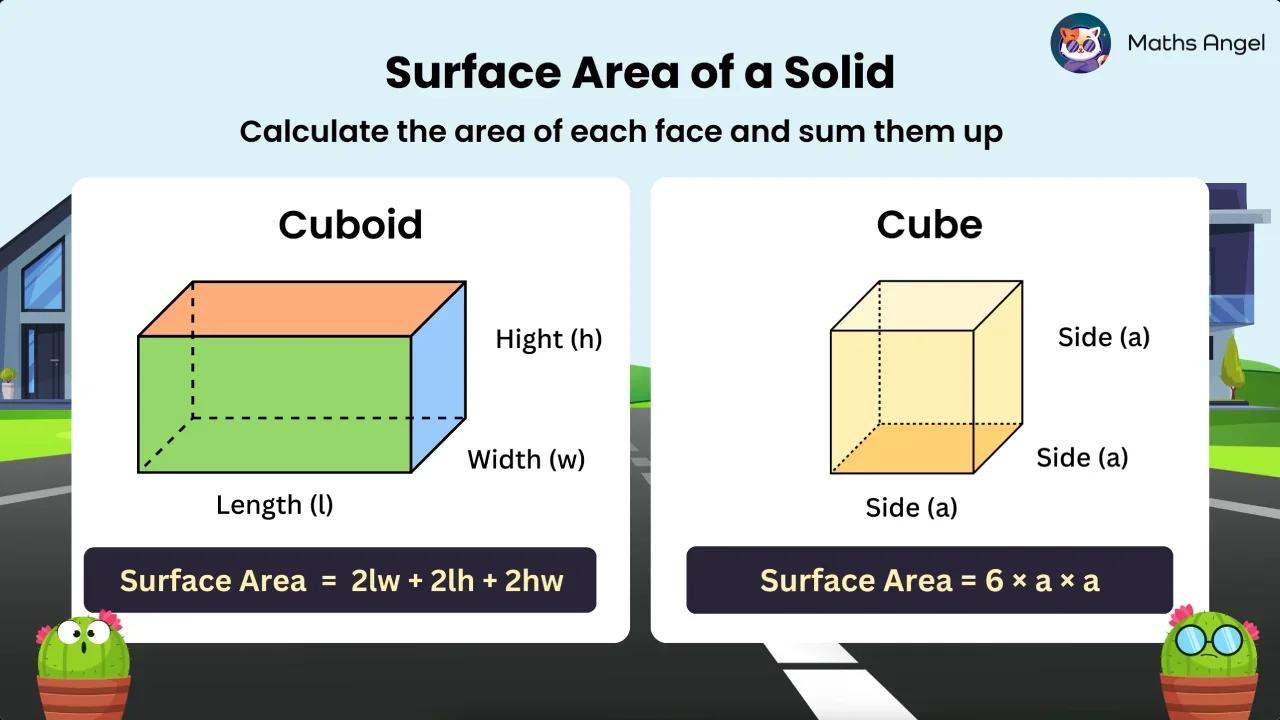
The surface area of a cuboid is 2lw + 2lh + 2hw and the surface area of a cube is 6 × a × a. Surface area is the total area of all the faces of a 3D shape: 3 matching pairs for a cuboid, 6 identical squares for a cube.
Video Lesson
Watch and learn the basics
🎬 Did this video explain it clearly?
Flashcards
Review key concepts visually
%20Surface%20Area%20of%20Solids.webp)
%20Surface%20Area%20of%20Cuboids%20and%20Cubes.webp)
%20Calculating%20Surface%20Area%20of%20a%20Cuboid.webp)
%20Calculating%20the%20surface%20area%20of%20a%20Prism.webp)
What is Surface Area?
- Surface area is the total area of all the faces of a solid.
- To find it, calculate the area of each face and add them together.
Surface Area of Cubes and Cuboids
- A cuboid has 6 faces, arranged in 3 identical pairs.
- A cube has 6 identical square faces.
Calculating the Surface Area of a Cuboid
- A cuboid has 3 pairs of identical faces: top and bottom, front and back, and left and right.
- Find the area of one face in each pair, multiply each by 2, then add them together.
Calculating the Surface Area of a Prism
- A prism has two identical ends and several rectangular side faces.
- Find the area of every face, then add them all together to get the surface area.
Practice Questions
Test your understanding
What is the surface area of a cube with a side length of ?
Correct! 🎉 +10 pointsCorrect! 🎉 Worth 10 XPNot quite right
A cube has 6 identical square faces, so surface area = .
Each face has area .
Surface area = .
Take care not to give the volume instead: that would be , a different quantity in different units.
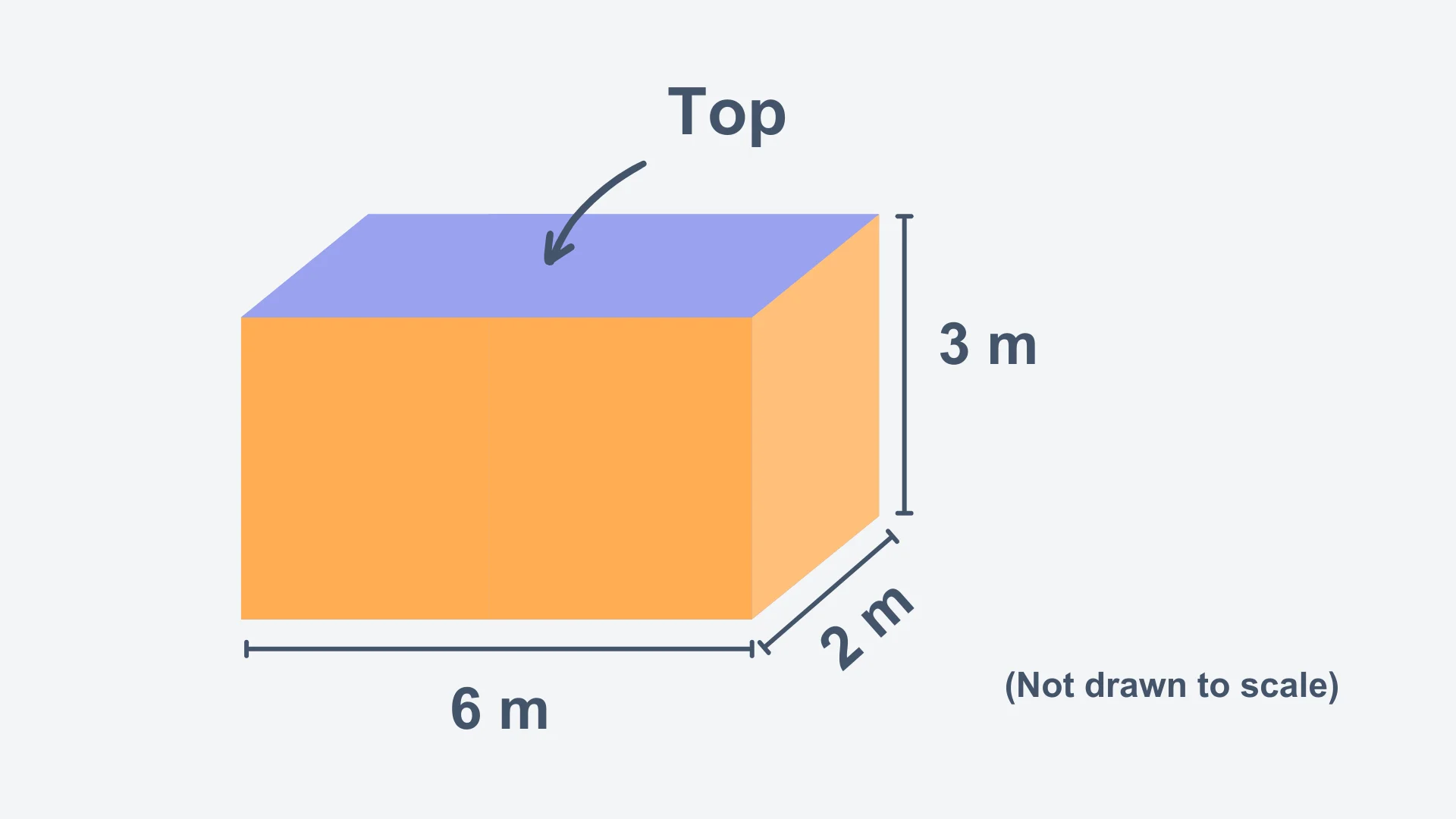
What is the area of the cuboid's top face?
Correct! 🎉 +10 pointsCorrect! 🎉 Worth 10 XPNot quite right
The top face is a rectangle. Its two edges are the length, , and the depth, . The edge is the height of the cuboid and is not part of the top face.
Area = length × width = .
Area is measured in square metres (m²) because two lengths have been multiplied together.
A cube has a surface area of . What is the length of one side?
Correct! 🎉 +20 pointsCorrect! 🎉 Worth 20 XPNot quite right
A cube has 6 identical square faces, so its surface area is , where is the length of one side.
Set up the equation: , so .
Now take the square root: . Check: .
A cuboid has a length of , a width of , and a height of . What is its total surface area?
Correct! 🎉 +20 pointsCorrect! 🎉 Worth 20 XPNot quite right
A cuboid has three pairs of identical rectangular faces, so the total surface area is .
Here: .
Remember to double: the three faces you picture facing you are matched by three identical hidden faces behind them.
A cuboid has a length of , a width of , and a height of . What is its total surface area?
Correct! 🎉 +20 pointsCorrect! 🎉 Worth 20 XPNot quite right
A cuboid has three pairs of identical rectangular faces, so the total surface area is .
Here: .
The doubling matters: every face you can see has an identical partner on the opposite side.
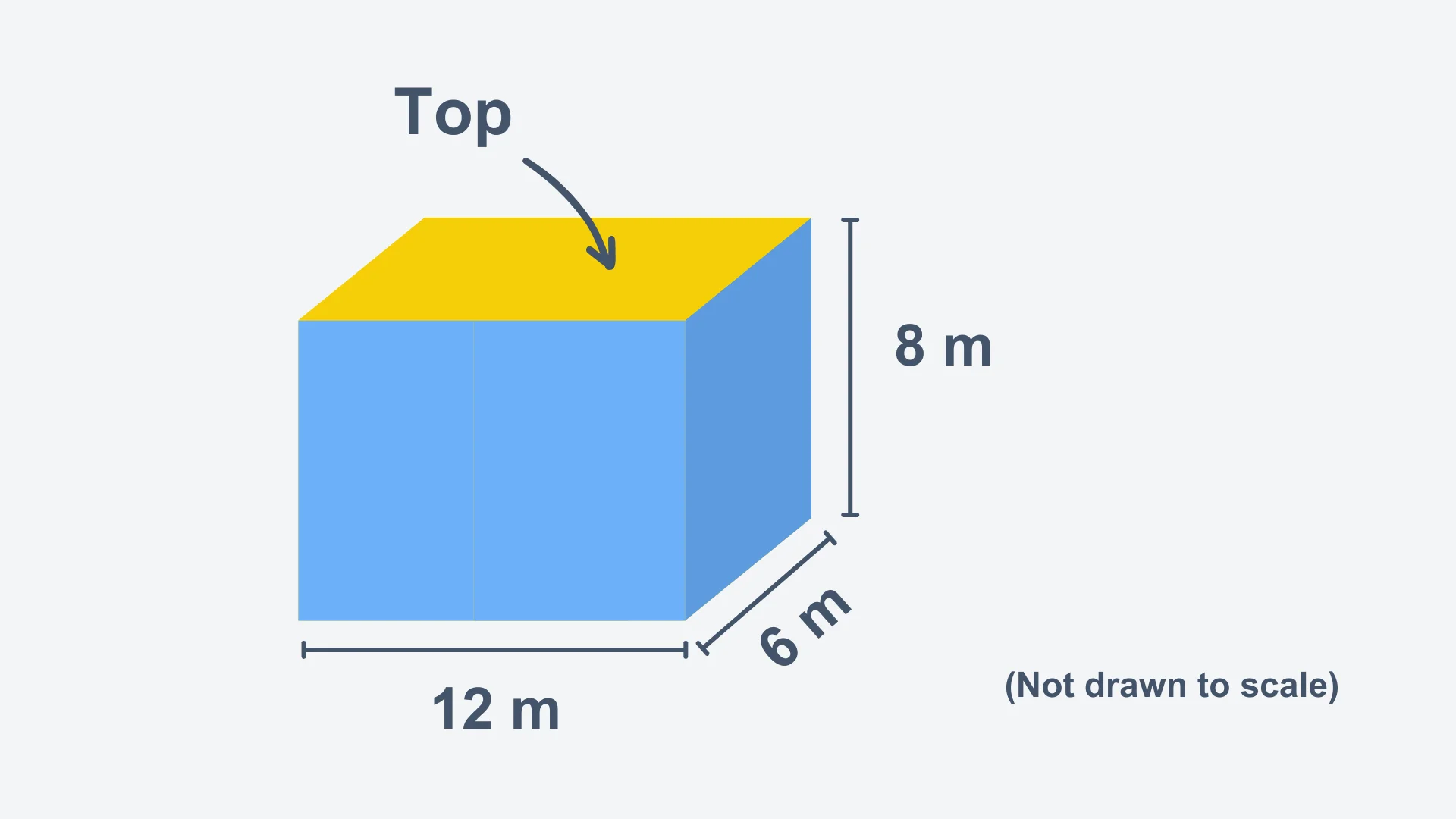
Consider the cuboid below. Excluding its top face, what is its surface area?
Correct! 🎉 +30 pointsCorrect! 🎉 Worth 30 XPNot quite right
First find the total surface area: .
The top face is a by rectangle, so its area is .
Excluding the top face: . Note that the base is still included: only the top is left out.
Want to see the full working?
Interactive Activity
Click on the faces to calculate surface area
Loading interactive widget...
Frequently asked questions
The questions students bump into most on this topic
Surface area is the total area of all the faces of a 3D shape, measured in square units such as cm². To find it, work out the area of each face and add them together. A cuboid has 6 faces in 3 matching pairs, a cube has 6 identical square faces, and a triangular prism has 2 triangles and 3 rectangles.
Work out the area of every face, then add the areas together. Count the faces first so none is missed: a cuboid has 6 and a triangular prism has 5. For a cuboid the total is 2 × length × width + 2 × length × height + 2 × width × height; for a cube it is 6 × side × side. Give the answer in square units.
A cuboid has 6 faces in 3 identical pairs. Find the area of one face in each pair, double it, then add the three results. For a cuboid 10 cm by 5 cm by 8 cm: 2 × 10 × 5 + 2 × 10 × 8 + 2 × 8 × 5 = 100 + 160 + 80 = 340 cm². In the US a cuboid is called a rectangular prism.
The surface area of a cube is 6 × side × side, because a cube has six identical square faces and each face has area side × side. For a cube with 4 cm edges, one face is 4 × 4 = 16 cm², so the surface area is 6 × 16 = 96 cm². A 5 cm cube has 6 × 25 = 150 cm².
A triangular prism has five faces: two identical triangles and three rectangles. Work out each triangle as half × base × height and each rectangle as length × width, then add all five. In the lesson’s example the triangles are 6 cm² each and the rectangles are 28, 35 and 21 cm², so the surface area is 6 + 6 + 28 + 35 + 21 = 96 cm².
What's next?
Found this one hard? Go one step back first. Feeling confident? Carry on to the next lesson.