Solids and Units of Volume
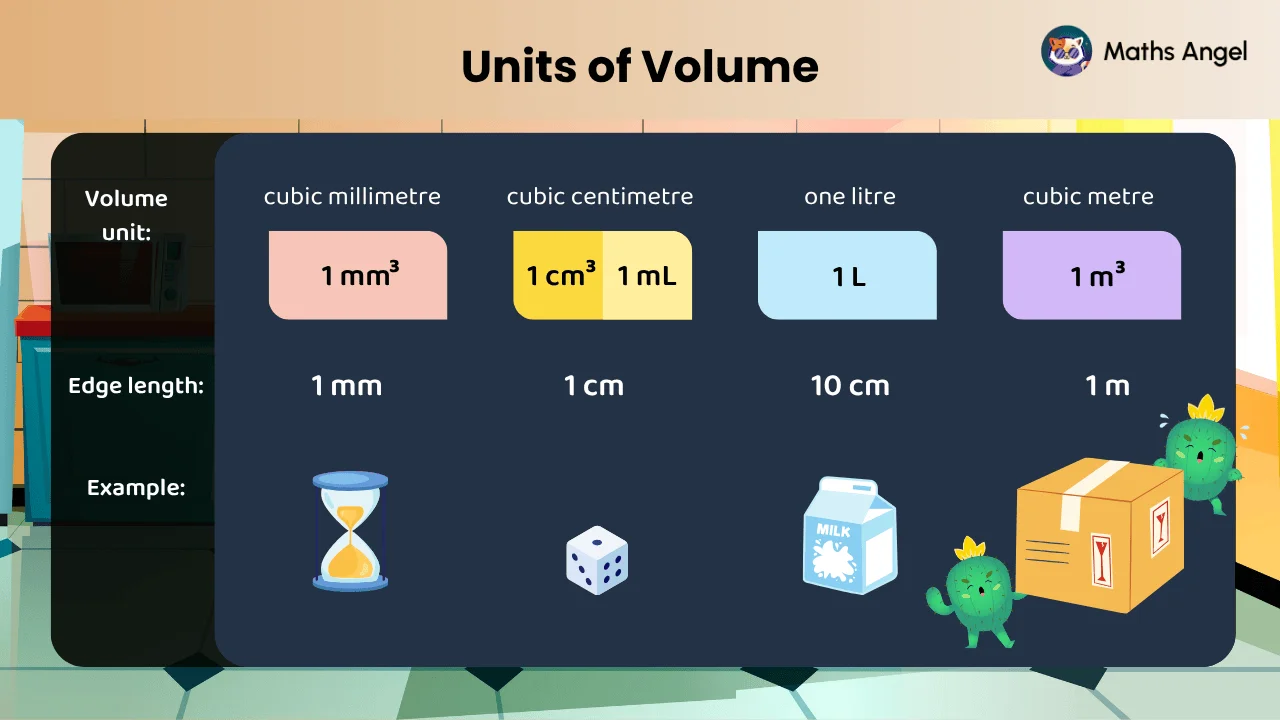
Units of volume are the cubic units used to measure the space inside a solid, such as mm³, cm³ and ml. One cm³ is a cube 1 cm on each side, like a dice. To reach a smaller unit, multiply by 1000, so 1 cm³ = 1000 mm³.
Video Lesson
Watch and learn the basics
🎬 Did this video explain it clearly?
Flashcards
Review key concepts visually
%20Solids.webp)
%20Cuboid%20and%20Cubes.webp)
%20Volume.webp)
%20Units%20of%20Volume.webp)
%20Converting%20between%20Units%20of%20Volume.webp)
What are Solids?
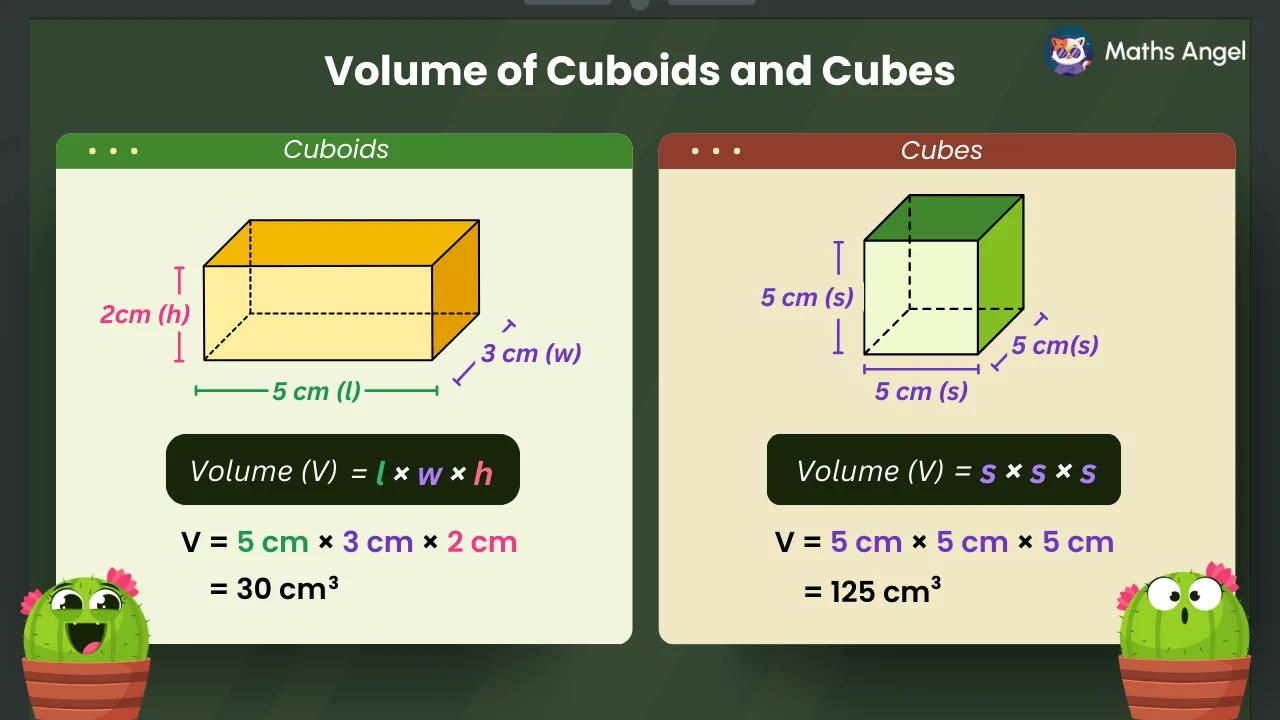
- Solids are 3D shapes with length, width, and height.
- Solids take up space. Cubes and cuboids are common solids.
Parts of Cubes and Cuboids
- Faces are flat surfaces, edges are where faces meet, and vertices are corners.
- A cuboid has 6 faces, 12 edges, and 8 vertices.
What Does Volume Mean?
- Volume is the amount of space a solid occupies.
- If a solid is made from 27 cubes of size , its volume is .
Units of Volume
- Volume is measured using cubic units such as mm³, cm³, and m³.
- is the volume of a cube × × , about the size of a dice.
Converting Between Units of Volume
- When converting to a smaller unit, multiply by 1000 (e.g. .
- When converting to a larger unit, divide by 1000 (e.g. .
Practice Questions
Test your understanding
How many faces does a cube have?
Correct! 🎉 +10 pointsCorrect! 🎉 Worth 10 XPNot quite right
A cube is made from 6 identical square faces: the top, the bottom and the four sides.
It is easy to mix faces up with the other features of a cube: a cube also has 12 edges (the lines where two faces meet) and 8 vertices (the corners). Only the flat surfaces count as faces.
What is the approximate volume of a dice with edges?
Correct! 🎉 +10 pointsCorrect! 🎉 Worth 10 XPNot quite right
Volume of a cube = length × width × height. Each edge is , so the volume is .
A cube is the standard unit of volume, which is why a dice this size is a useful thing to picture when estimating other volumes. A whole litre, by contrast, is 1000 of them.
Convert 2.5 litres to millilitres.
Correct! 🎉 +20 pointsCorrect! 🎉 Worth 20 XPNot quite right
There are 1000 millilitres in 1 litre, and millilitres are the smaller unit, so the number must get bigger: multiply by 1000.
So 2.5 .
How many cubic millimetres are in 1 cubic centimetre?
Correct! 🎉 +20 pointsCorrect! 🎉 Worth 20 XPNot quite right
A cubic centimetre is a cube measuring along every edge, and .
So the same cube measures by by : .
Therefore . The conversion factor is cubed (10³), not used once (10) or squared (10²).
A small yoghurt has a volume of . How many cubic centimetres is this?
Correct! 🎉 +20 pointsCorrect! 🎉 Worth 20 XPNot quite right
1 millilitre is defined as exactly 1 cubic centimetre, so there is nothing to multiply or divide: the number stays the same and only the unit changes.
(It also helps to remember 1 .)
How many cubic millimetres are in a litre?
Correct! 🎉 +30 pointsCorrect! 🎉 Worth 30 XPNot quite right
Work in two steps.
1 .
.
So 1 litre = mm³ (one million cubic millimetres).
Want to see the full working?
Interactive Activity
Practice converting units of volume
Loading interactive widget...
Frequently asked questions
The questions students bump into most on this topic
A solid is a three-dimensional shape with length, width and height, so unlike a flat shape it has thickness. Solids have faces, which are the flat surfaces, edges, where two faces meet, and vertices, the corners where three or more edges meet. Cubes and cuboids are the most common solids in school maths.
Volume is the amount of space a solid takes up. You can measure it with unit cubes, where a unit cube has every edge 1 unit long: a cubic centimetre is a cube with 1 cm edges, about the size of a small dice. If a solid can be filled with 27 of those cubes, its volume is 27 cm³.
Volume is measured in cubic units. A cubic millimetre (mm³) is a cube with 1 mm edges, about a grain of sand; a cubic centimetre (cm³) is about a small dice; a litre is a cube with 10 cm edges, used for milk and water; a cubic metre (m³) is a cube with 1 m edges, used for containers. One cm³ equals one millilitre.
Yes. One cubic centimetre is exactly one millilitre, the unit printed on yoghurts and drinks, so 150 ml is 150 cm³ and no calculation is needed to swap between them. A small yoghurt is about 100 to 200 ml, which is 100 to 200 dice-sized cubes.
Neighbouring units of volume are 1,000 apart, so multiply by 1,000 to move to a smaller unit and divide by 1,000 to move to a larger one. To change 5 cm³ into cubic millimetres, multiply: 5 × 1,000 = 5,000 mm³. To change 2,000 ml into litres, divide: 2,000 ÷ 1,000 = 2 litres.
Divide by 1,000, because 1 litre is 1,000 millilitres and the litre is the larger unit. So 2,000 ml ÷ 1,000 = 2 litres. To go back from litres to millilitres, multiply by 1,000 instead: 2.5 litres is 2,500 ml.
What's next?
Found this one hard? Go one step back first. Feeling confident? Carry on to the next lesson.