Calculating Money
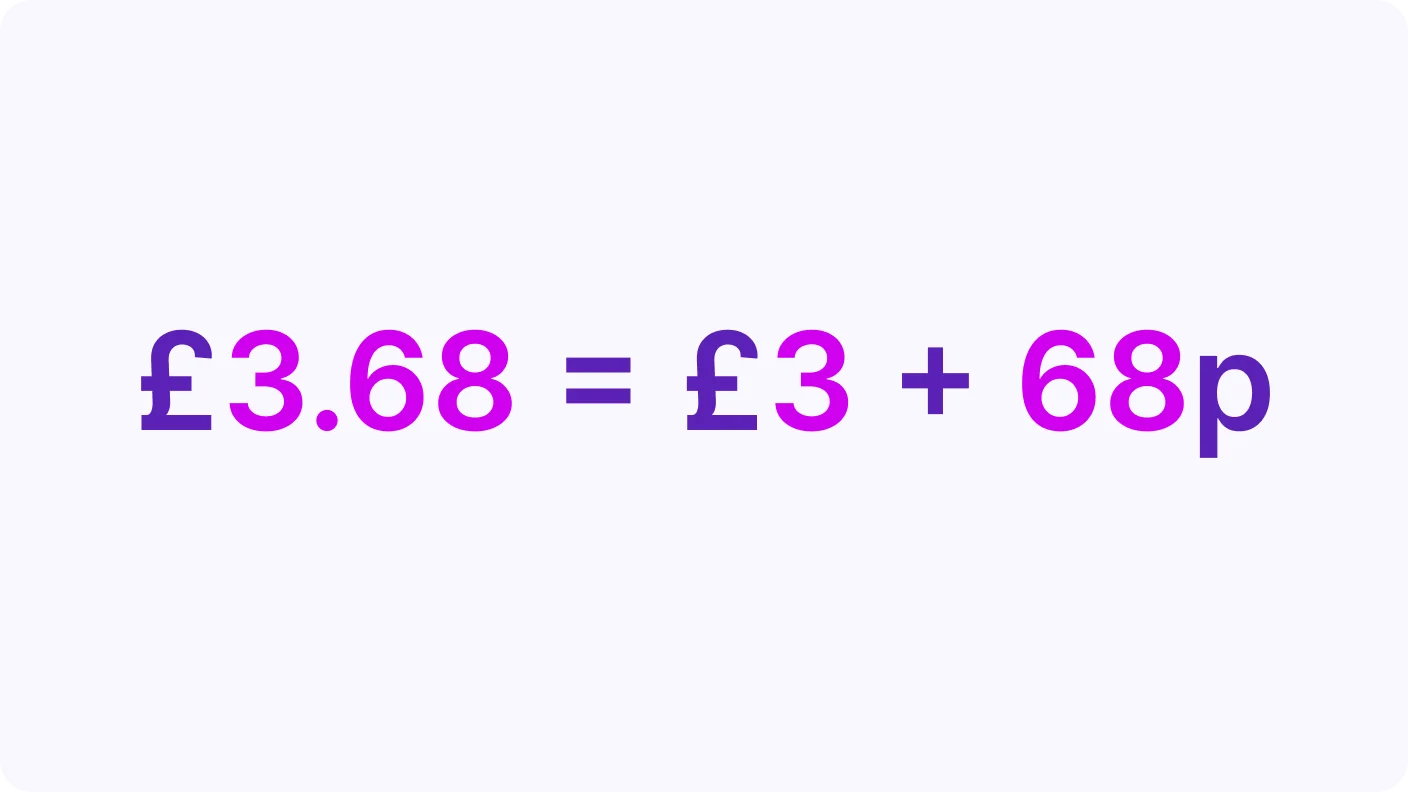
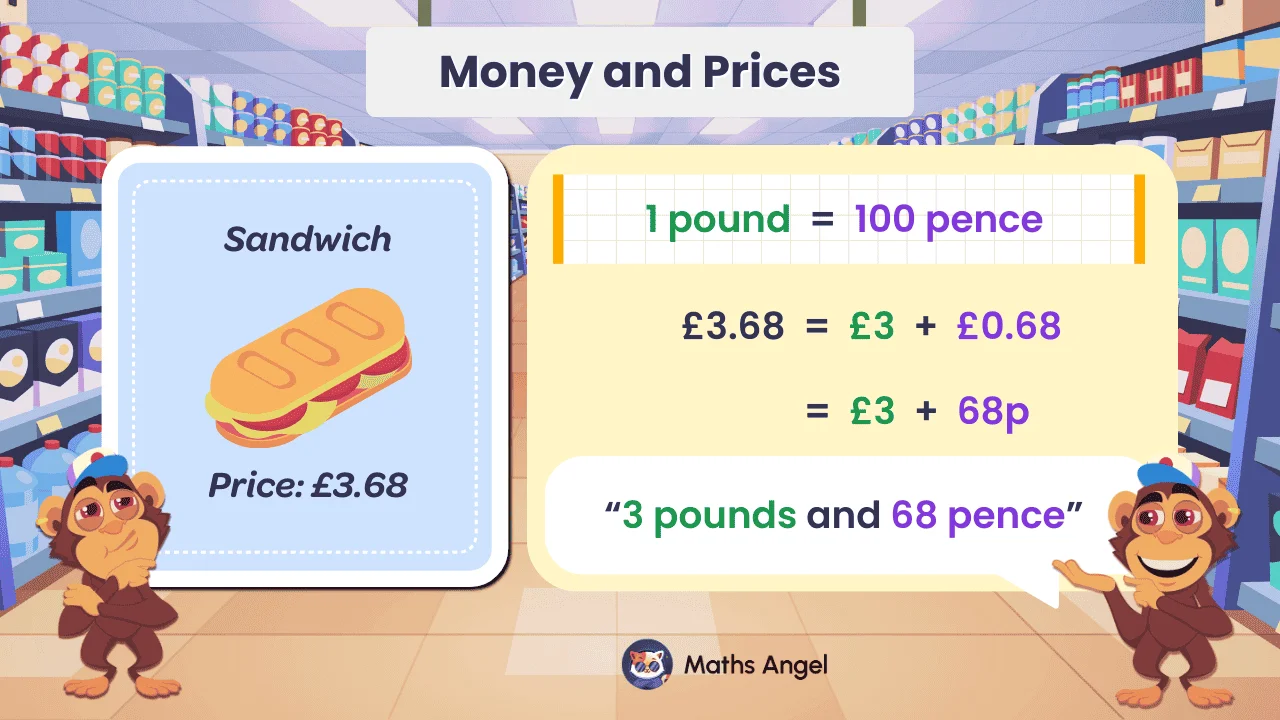
Calculating money means splitting each price into pounds and pence, since £1 = 100p, so £3.68 = £3 + 68p. This lets you add, subtract, multiply, and divide any prices, converting extra pence back into pounds.
Video Lesson
Watch and learn the basics
🎬 Did this video explain it clearly?
Flashcards
Review key concepts visually
%20Money%20and%20Prices.webp)
%20Adding%20Prices.webp)
%20Subtracting%20Prices.webp)
%20Multiplying%20a%20Price.webp)
%20Dividing%20a%20Price.webp)
Understanding Money and Prices
- Money is measured using pounds (£) and pence (p).
- £, for example £.
How to Add Prices?
- Add pounds and pence separately, then combine the total.
- If the pence total is 100 or more, convert to pounds (e.g. £1.49).
How to Subtract Prices?
- Subtract pounds and pence separately.
- If there is not enough pence to subtract, exchange £1 for 100p first.
How to Multiply a Price?
- Multiply the pounds and pence separately, then add them together.
- Convert extra pence into pounds at the end if needed.
How to Divide a Price?
- Convert the full amount into pence first (e.g. £.
- Divide, then convert back to pounds and pence (e.g. £3.20).
Practice Questions
Test your understanding
If a coffee costs £2.50, what is the equivalent amount in pence?
Correct! 🎉 +10 pointsCorrect! 🎉 Worth 10 XPNot quite right
There are 100 pence in £1, so to change pounds into pence you multiply by 100.
, so £ pence.
A useful check: £2 is 200p and 50p is half a pound, and .
If you have £10 and spend £6.75, how much money is left?
Correct! 🎉 +10 pointsCorrect! 🎉 Worth 10 XPNot quite right
Spending means the amount goes down, so subtract: £10.00 − £6.75.
Setting it out in columns, write £10 as 10.00 so the decimal points line up. Exchanging gives .
A quick check: £6.75 + £ £10.00, so £3.25 is left.
You buy 2 items costing £2.35 each. What is the total cost?
Correct! 🎉 +20 pointsCorrect! 🎉 Worth 20 XPNot quite right
Two items at the same price means 2 × £2.35.
Double the pounds: 2 × £ £4. Double the pence: .
Total: £ £4.70.
You buy a sandwich for £3.45 and a drink for £1.55. What is the total cost?
Correct! 🎉 +20 pointsCorrect! 🎉 Worth 20 XPNot quite right
Add the two amounts with the decimal points lined up: £3.45 + £1.55.
The pence make , which is £1, so write 00 in the pence and carry £1 into the pounds.
Pounds: £3 + £1 + £1 (carried) = £5.
Total: £5.00.
A book costs £12.75. You pay with a £20 note. How much change should you receive?
Correct! 🎉 +20 pointsCorrect! 🎉 Worth 20 XPNot quite right
Change = £20.00 − £12.75.
Count up from the price: £ £13.00, then £13.00 + £ £20.00.
So the change is £ £7.25.
You have £15 and buy 4 notebooks at £2.25 each. How much money do you have left?
Correct! 🎉 +30 pointsCorrect! 🎉 Worth 30 XPNot quite right
First find the cost of the notebooks: 4 × £2.25.
4 × £ £8 and £1, so 4 notebooks cost £9.00.
Then take that off what you started with: £15.00 − £ £6.00.
Want to see the full working?
Interactive Activity
Set the amounts on the right to start calculating
Loading interactive widget...
Frequently asked questions
The questions students bump into most on this topic
There are 100 pence in one pound, so £1 = 100p and every 100p can be swapped for £1. The decimal point on a price splits pounds from pence: £3.68 means 3 pounds and 68 pence. When pence add up to 100 or more, move the extra pounds across: 117p is £1 and 17p.
Split each amount into pounds and pence, work them out separately, then put them back together. To add £3.68 and £1.49: the pounds give £3 + £1 = £4, the pence give 68p + 49p = 117p, and 117p is £1 and 17p, so the total is £5.17. The same split works for subtracting, multiplying and dividing.
Subtract the price from £10. If the price has pence and £10 does not, swap £1 for 100p first, so £10 becomes £9 and 100p. Then subtract pounds and pence separately: £9 − £5 = £4 and 100p − 17p = 83p. The change from £10 for a £5.17 lunch is £4.83.
Multiply the pounds and the pence separately, then add them, converting any extra pence into pounds. For 8 chocolate bars at £1.20 each: 8 × £1 = £8 and 8 × 20p = 160p, which is £1.60, so the total is £9.60. Check the pence at the end: if they reach 100 or more, move the pounds across.
Either divide the pounds and the pence separately, or turn the whole amount into pence first. To share £9.60 between 3 people: £9 ÷ 3 = £3 and 60p ÷ 3 = 20p, so £3.20 each. Or 960p ÷ 3 = 320p, which is £3.20. Both ways give the same answer, so use whichever is easier.
What's next?
Found this one hard? Go one step back first. Feeling confident? Carry on to the next lesson.