Converting and Calculating Units of Length
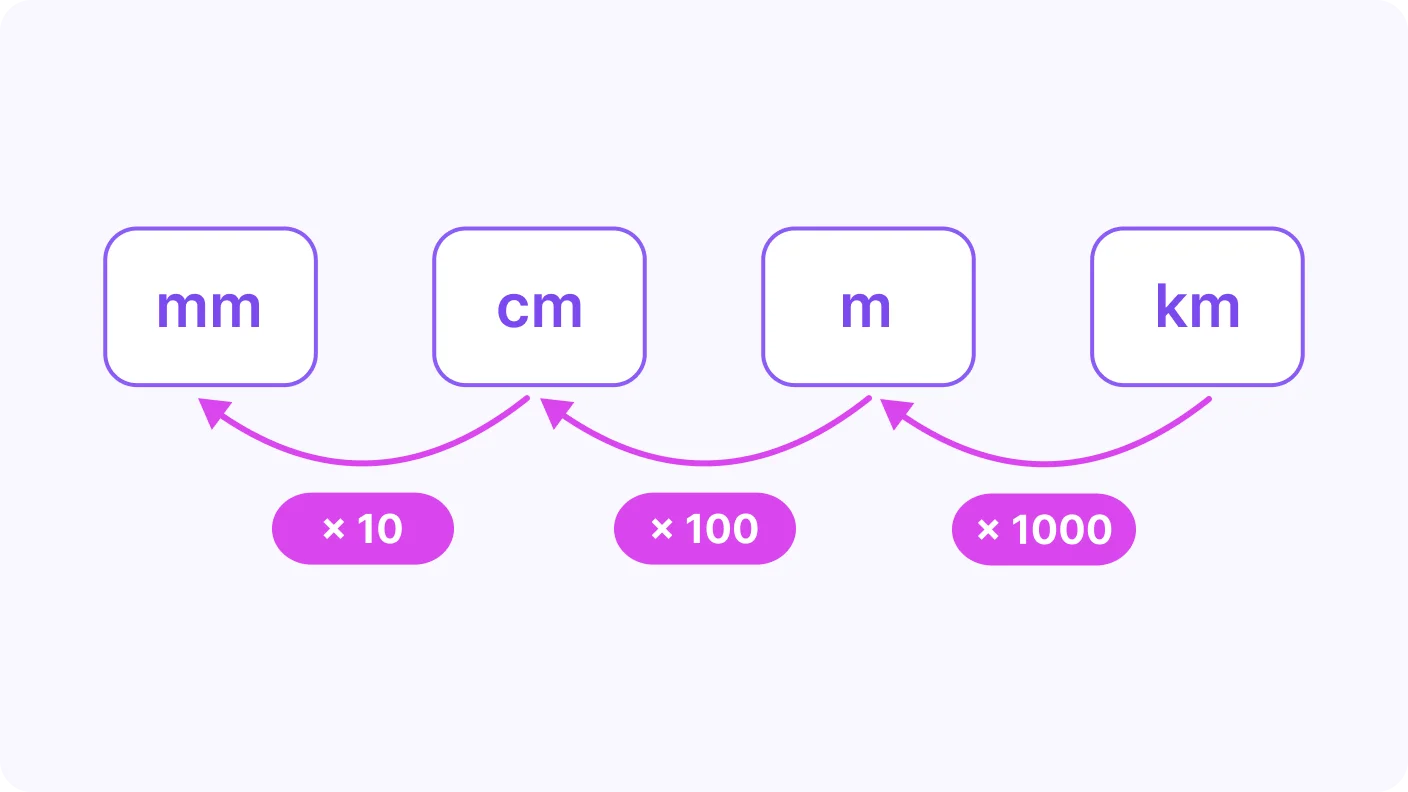
Units of length measure distance using mm, cm, m, and km. To convert, multiply for a smaller unit or divide for a larger one, so 47 m = 4700 cm. To add or subtract lengths, first convert them to the same unit.
Video Lesson
Watch and learn the basics
🎬 Did this video explain it clearly?
Flashcards
Review key concepts visually
%20Converting%20Units%20of%20Length.webp)
%20Converting%20Units%20of%20Length%20Example.webp)
%20Calculating%20Units%20of%20Length.webp)
What are Metric Units of Length?
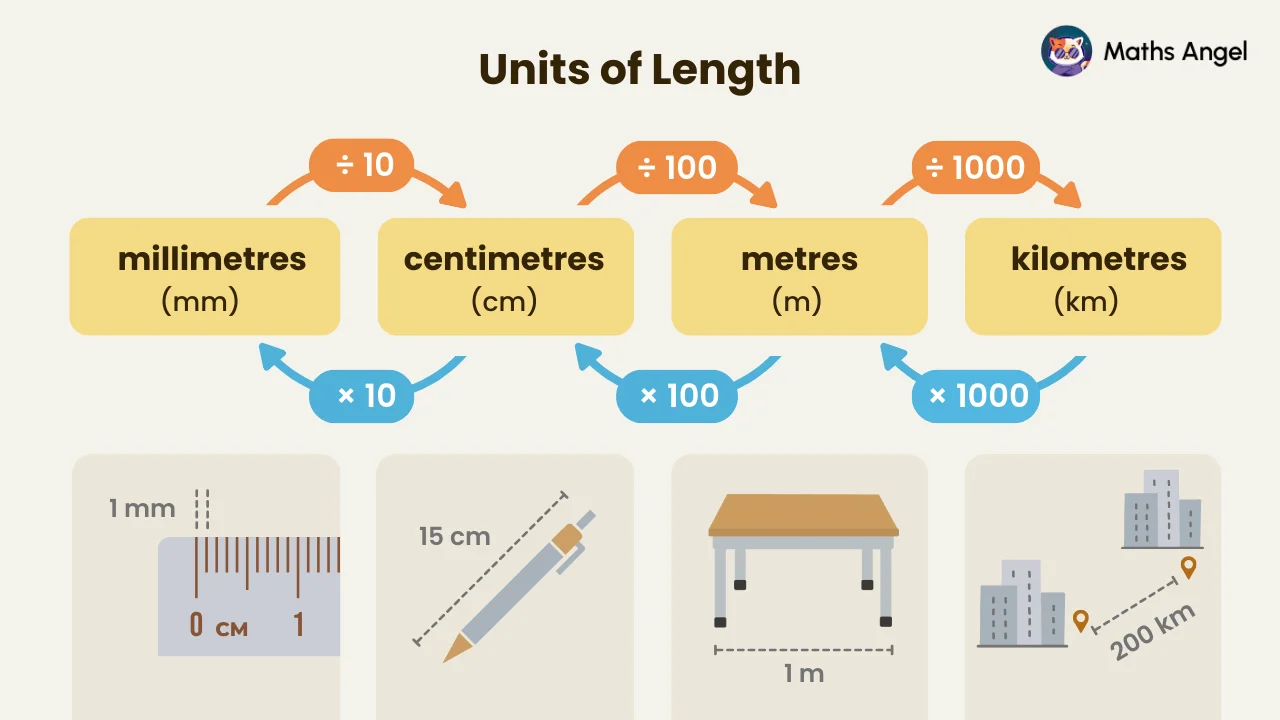
- Length is measured in millimetres (mm), centimetres (cm), metres (m), and kilometres (km)
- The conversion rates you have to know: , , and
How to Convert Units of Length?
- Converting to a smaller unit means multiplying; converting to a larger unit means dividing.
- For example, (multiply by 100) and (divide by 1000).
How to Calculate with Different Units?
- Before adding or subtracting, convert all values to the same unit.
- Choose one unit (e.g. all cm or all m) and do not mix units.
Practice Questions
Test your understanding
Convert 2 metres to centimetres.
Correct! 🎉 +10 pointsCorrect! 🎉 Worth 10 XPNot quite right
1 metre equals 100 centimetres, and centimetres are the smaller unit, so multiply: .
So . Converting to a smaller unit always gives a bigger number, which is a quick check that multiplying (not dividing) was the right move.
Convert 3.6 kilometres to metres.
Correct! 🎉 +10 pointsCorrect! 🎉 Worth 10 XPNot quite right
1 kilometre equals 1000 metres, and metres are the smaller unit, so multiply: .
So . Multiplying by 1000 moves the digits three places (); it is not the same as ignoring the decimal point and writing three zeros after 36.
Which is longer: 2500 millimetres or 2.5 metres?
Correct! 🎉 +20 pointsCorrect! 🎉 Worth 20 XPNot quite right
There are 1000 millimetres in 1 metre, so .
That makes 2.5 metres exactly 2500 millimetres, so neither is longer: they are equal.
Subtract from 5.5 metres. What is the result?
Correct! 🎉 +20 pointsCorrect! 🎉 Worth 20 XPNot quite right
Change both lengths to the same unit first. There are 100 centimetres in 1 metre, so metres.
Now subtract with the decimal points lined up: metres.
Add 2.5 metres and 150 centimetres. What is the total length?
Correct! 🎉 +20 pointsCorrect! 🎉 Worth 20 XPNot quite right
Change both lengths to the same unit first. There are 100 centimetres in 1 metre, so metres.
Now add with the decimal points lined up: metres. The tenths make 10, so remember to carry 1 into the units column.
Convert 0.085 kilometres to centimetres.
Correct! 🎉 +30 pointsCorrect! 🎉 Worth 30 XPNot quite right
Do it in two steps. Kilometres to metres: metres. Then metres to centimetres: centimetres.
In one step, , and cm.
Want to see the full working?
Interactive Activity
Visualise length units and convert between them
Loading interactive widget...
Frequently asked questions
The questions students bump into most on this topic
The metric units of length are the millimetre (mm), centimetre (cm), metre (m) and kilometre (km), from smallest to largest. A pen is about 15 cm long, a classroom desk about 1 m, and kilometres measure distances between towns. The links to remember: 10 mm = 1 cm, 100 cm = 1 m and 1,000 m = 1 km.
Recall how the two units relate, then multiply or divide. Converting to a smaller unit means multiplying: 47 m × 100 = 4,700 cm. Converting to a larger unit means dividing: 5,020 m ÷ 1,000 = 5.02 km. The factors are 10 between mm and cm, 100 between cm and m, and 1,000 between m and km.
There are 100 centimetres in a metre. To change metres into centimetres, multiply by 100: 47 m is 47 × 100 = 4,700 cm. To go back from centimetres to metres, divide by 100: 175 cm is 1.75 m. A millimetre is smaller still, with 10 mm in every centimetre.
Kilo means a thousand, so 1 km = 1,000 m. To change kilometres into metres, multiply by 1,000: 2 km = 2,000 m, and 5 km is 5,000 m, not 500. To change metres into kilometres, divide by 1,000: 5,020 m = 5.02 km. Multiply when going to the smaller unit and divide when going to the larger one.
Change both lengths to the same unit first, then add. To add 1.75 m and 40 cm, change 40 cm to 0.4 m and add to get 2.15 m. To subtract 40 cm from 1.75 m, you could instead change 1.75 m to 175 cm: 175 − 40 = 135 cm, which is 1.35 m. Use whichever unit is easier; never add mixed units.
What's next?
Found this one hard? Go one step back first. Feeling confident? Carry on to the next lesson.