Multiplying Fractions
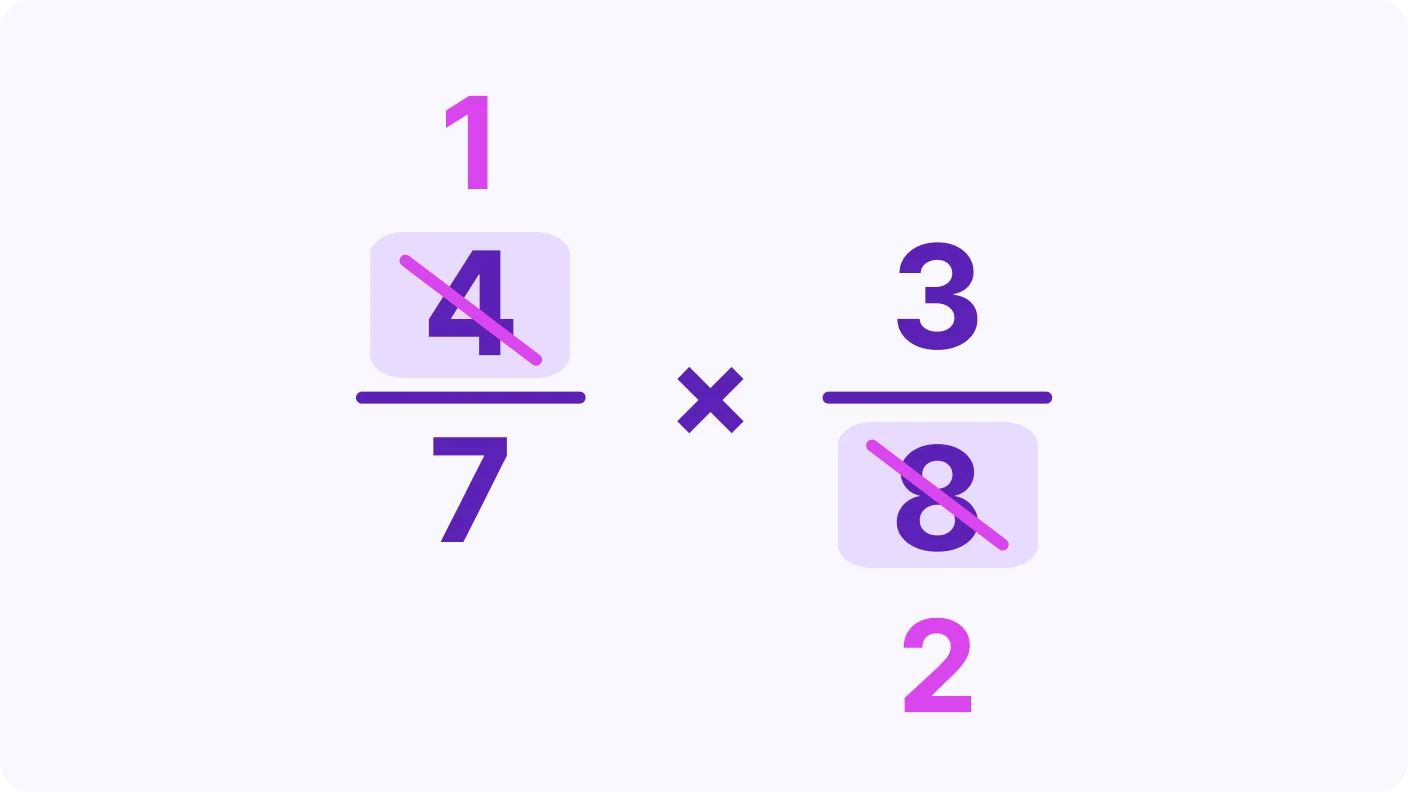
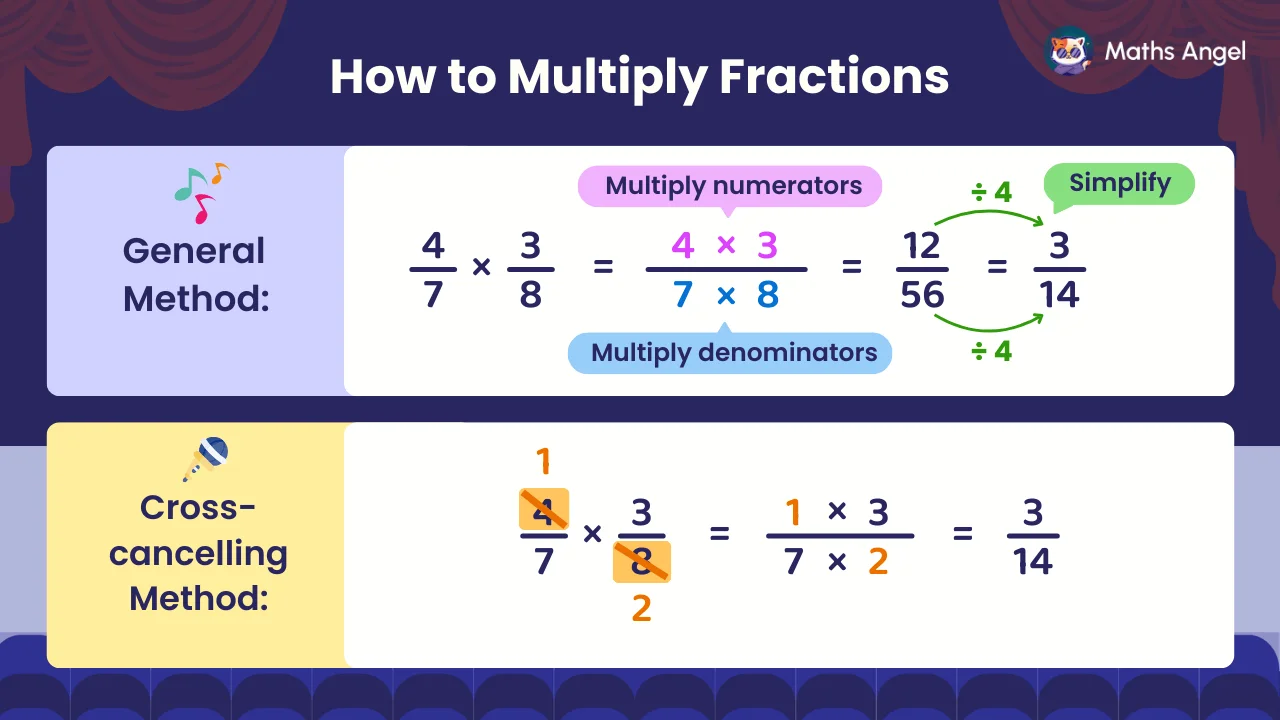
Multiplying fractions means multiplying the numerators, then the denominators. Then simplify if you can. Cross-cancelling divides a top and bottom by a common factor first to keep numbers smaller.
Video Lesson
Watch and learn the basics
🎬 Did this video explain it clearly?
Flashcards
Review key concepts visually
%20Multiplying%20Fractions%20and%20Cross-Cancelling.webp)
%20Practising%20Cross-Cancelling.webp)
%20Fraction%20times%20Number.webp)
%20Multiplying%20Mixed%20Fractions.webp)
How Do We Multiply Fractions?
- Multiply the numerators together and multiply the denominators together.
- Then simplify the fraction, if possible.
What Is Cross-Cancelling When Multiplying Fractions?
- You can simplify first by cross-cancelling a numerator with a denominator.
- Cross-cancelling makes the numbers smaller and easier to multiply.
How Do We Multiply a Fraction by a Whole Number?
- Write the whole number as a fraction over 1.
- Then multiply as you would with two fractions.
How Do We Multiply Mixed Numbers?
- Convert mixed numbers into improper fractions first.
- Then multiply and simplify the final answer.
Practice Questions
Test your understanding
What is ?
Correct! 🎉 +10 pointsCorrect! 🎉 Worth 10 XPNot quite right
Multiply the numerators: . Multiply the denominators: .
So . The numbers 6 and 35 share no common factor, so this is already in its simplest form.
Notice the answer is smaller than both fractions: multiplying by a fraction less than 1 always makes a value smaller.
What is of 15?
Correct! 🎉 +10 pointsCorrect! 🎉 Worth 10 XPNot quite right
"Of" means multiply, so work out .
Find one fifth first: . Then multiply by the numerator: .
Using fractions throughout: write 15 as , cross-cancel the 5 with the 15 to leave 1 and 3, then over , giving 21. Since is bigger than 1, the answer is larger than 15.
What is ? Give your answer in its simplest form.
Correct! 🎉 +20 pointsCorrect! 🎉 Worth 20 XPNot quite right
Simplify each fraction first: (divide top and bottom by 5) and (divide top and bottom by 5).
Multiply the numerators: . Multiply the denominators: . So the answer is .
If you multiply without simplifying first you get , which cancels down to the same answer, .
What is ? Give your answer in its simplest form.
Correct! 🎉 +20 pointsCorrect! 🎉 Worth 20 XPNot quite right
Simplify each fraction first: 16 and 24 both divide by 8, giving ; 18 and 27 both divide by 9, giving .
Now multiply: for the numerator and for the denominator, giving .
Multiplying without simplifying first gives , which cancels down to the same answer, .
What is using the cross-cancelling method? Give your answer in its simplest form.
Correct! 🎉 +20 pointsCorrect! 🎉 Worth 20 XPNot quite right
Cross-cancel diagonally. The 25 and the 50 both divide by 25, becoming 1 and 2. The 40 and the 32 both divide by 8, becoming 5 and 4.
The calculation is now . Multiply: and , giving , which simplifies to .
Multiplying without cancelling gives , which cancels down to the same answer, .
What is using the cross-cancelling method?
Correct! 🎉 +30 pointsCorrect! 🎉 Worth 30 XPNot quite right
First change the mixed number into an improper fraction: .
Now cross-cancel: the 9 and the 3 both divide by 3, becoming 3 and 1. The calculation is .
Multiply: and , giving (which is ). Without cancelling you get , the same value.
Want to see the full working?
Interactive Activity
Master cross-cancellation across different formats
Loading interactive widget...
Frequently asked questions
The questions students bump into most on this topic
Multiply the numerators together, then multiply the denominators together, and simplify if you can: 3/5 × 2/7 = 6/35. Unlike adding, you do not need a common denominator; the denominators can be different. Because the numbers grow quickly, it is easier to cancel common factors before you multiply, which is called cross-cancelling.
Cross-cancelling means dividing a numerator and a denominator by their highest common factor before you multiply, so the numbers stay small and the answer comes out simplified. For 11/24 × 36/55: 11 and 55 share 11, giving 1 and 5; 24 and 36 share 12, giving 2 and 3. Then 1 × 3 over 2 × 5 is 3/10.
Write the whole number over 1, then multiply as usual, cross-cancelling first if you can. A piano has 88 keys and 13/22 of them are black: 88/1 × 13/22. Cancel 88 and 22 by 22 to get 4 and 1, then multiply: 4 × 13 = 52 black keys. The method is exactly the same as for two fractions.
Change each mixed number into an improper fraction first, then multiply. A mixed number is a whole number plus a fraction, not a whole number times a fraction, so multiplying the parts separately gives the wrong answer. For 2 1/3 × 9/4: 2 1/3 = 7/3, cancel 9 and 3 to get 3 and 1, and 7 × 3 over 1 × 4 is 21/4, or 5 1/4.
Check every time. If you multiplied straight across, the answer often still has a common factor to cancel: 15/35 × 5/10 gives 75/350 that way, which simplifies to 3/14. If you cross-cancelled first, the answer is usually already in its simplest form, but it costs nothing to look.
What's next?
Found this one hard? Go one step back first. Feeling confident? Carry on to the next lesson.