Dividing Fractions
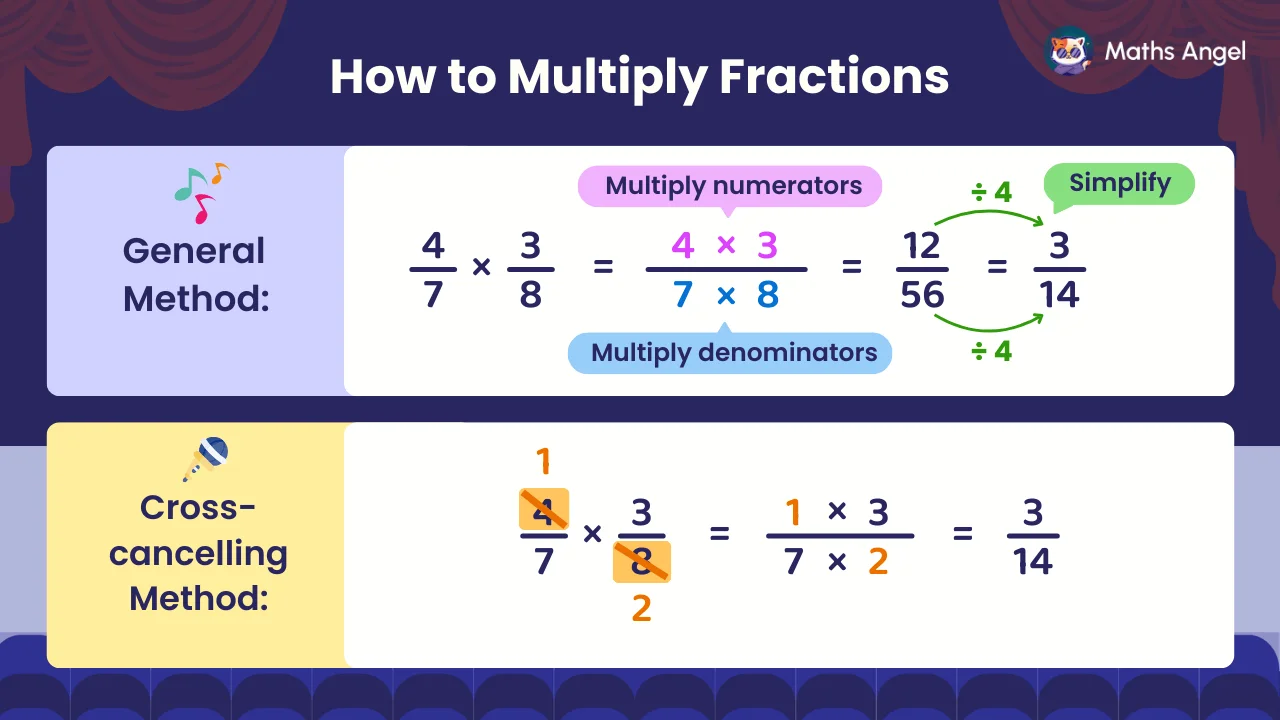
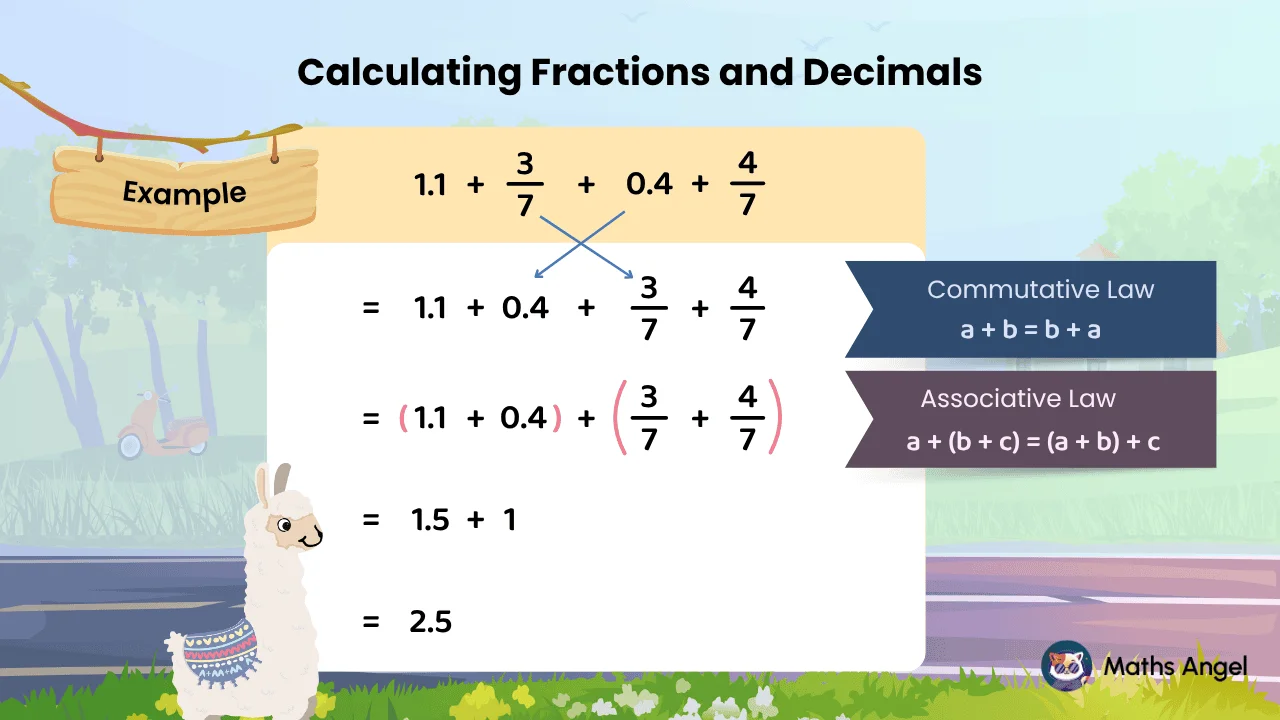
Dividing fractions means keep the first, flip the second to its reciprocal, then multiply. The same rule handles a whole number (write it over 1) and a mixed number (make it improper).
Video Lesson
Watch and learn the basics
🎬 Did this video explain it clearly?
Flashcards
Review key concepts visually
%20Division%20with%20Fractions.webp)
%20Dividing%20Fractions%20by%20a%20Whole%20Number.webp)
%20Handling%20Mixed%20Fractions.webp)
How to Divide a Fraction?
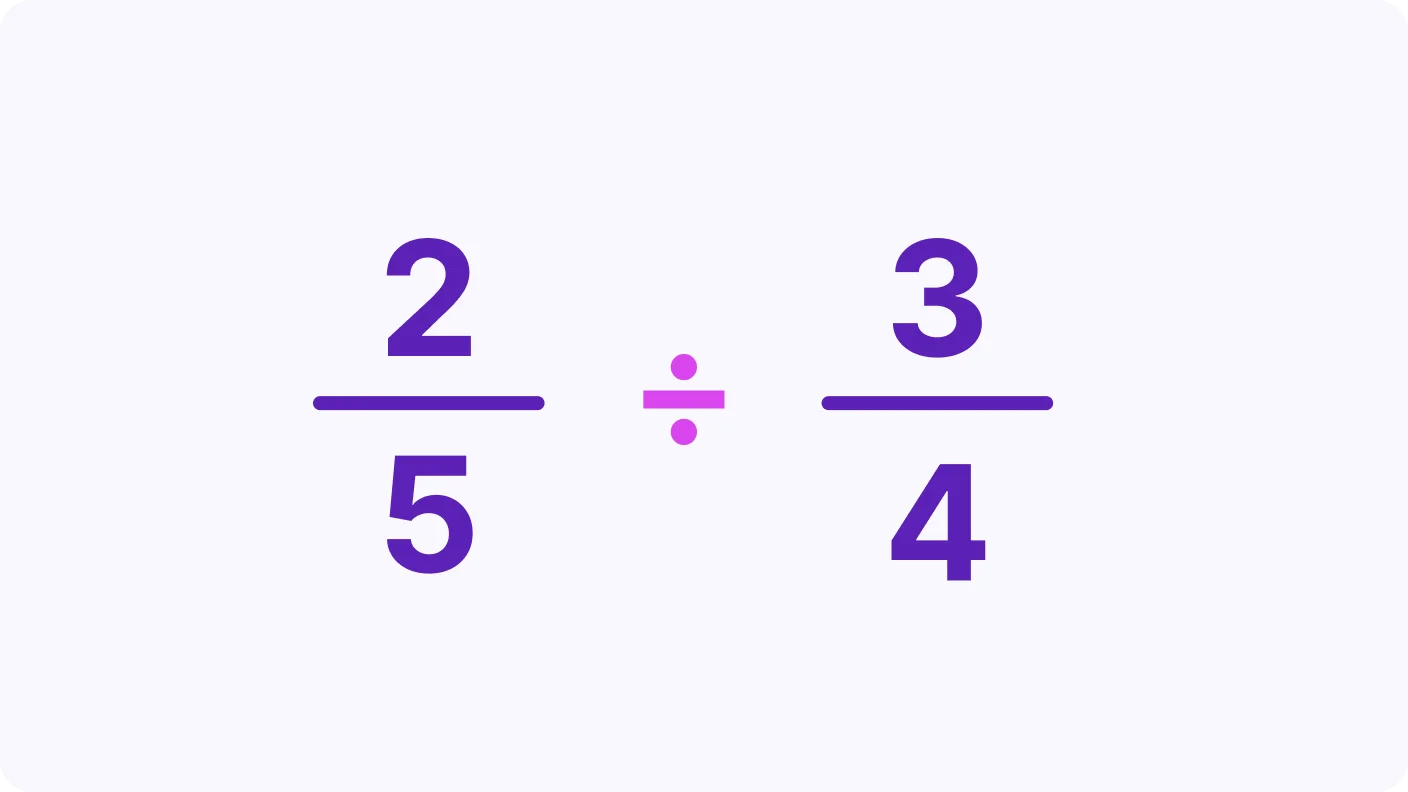
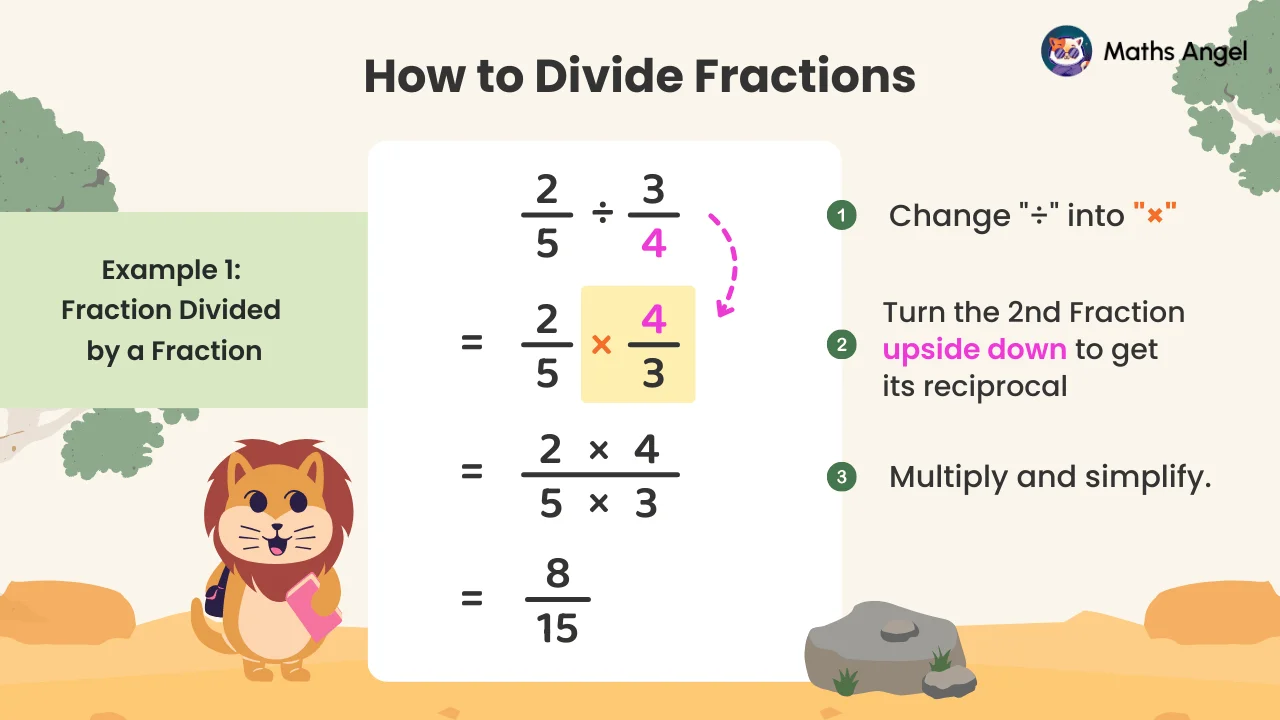
- Change the division sign into multiplication.
- Turn the second fraction upside down to get the reciprocal.
- Multiply the fractions and simplify to get the final answer.
How to Divide a Fraction by a Whole Number?
- Write the whole number as a fraction over 1.
- Flip it to its reciprocal, then multiply.
How to Handle Mixed Numbers in Division?
- First convert mixed numbers into improper fractions.
- To do so, multiply the whole number by the denominator, then add the numerator.
- Finally, use the same rule to divide: flip, multiply, and simplify.
Practice Questions
Test your understanding
What is ?
Correct! 🎉 +10 pointsCorrect! 🎉 Worth 10 XPNot quite right
To divide by a fraction, keep the first fraction, flip the second (the divisor) and multiply.
Multiplying gives (you can also cancel the 2s first).
So the answer is .
What is ?
Correct! 🎉 +10 pointsCorrect! 🎉 Worth 10 XPNot quite right
To divide by a fraction, keep the first fraction, flip the divisor and multiply.
The highest common factor of 20 and 8 is 4, so .
So the answer is (you can also cancel the 4 with the 8 before multiplying).
What is ?
Correct! 🎉 +20 pointsCorrect! 🎉 Worth 20 XPNot quite right
Write the whole number as a fraction: .
To divide by a fraction, keep the first fraction, flip the divisor and multiply.
So the answer is (which is ). It is bigger than 3 because is less than 1.
What is ?
Correct! 🎉 +20 pointsCorrect! 🎉 Worth 20 XPNot quite right
To divide by a fraction, keep the first fraction, flip the divisor and multiply.
Multiplying gives .
9 and 8 share no factor other than 1, so is already in its simplest form.
What is ?
Correct! 🎉 +20 pointsCorrect! 🎉 Worth 20 XPNot quite right
To divide by a fraction, keep the first fraction, flip the divisor and multiply.
The highest common factor of 35 and 20 is 5, so (you can also cancel the 5 with the 10 before multiplying).
What is ? Give your answer as a fraction in its simplest form.
Correct! 🎉 +30 pointsCorrect! 🎉 Worth 30 XPNot quite right
First change the mixed number into an improper fraction: .
Now keep the first fraction, flip the divisor and multiply:
The highest common factor of 42 and 20 is 2, so (which is ).
Want to see the full working?
Interactive Activity
How to divide fractions step-by-step
Loading interactive widget...
Frequently asked questions
The questions students bump into most on this topic
Three steps. First, change the division sign to a multiplication sign. Second, flip the second fraction upside down to get its reciprocal, so 3/4 becomes 4/3. Third, multiply the fractions and simplify. Cancel early if you can: a numerator and a denominator that share a factor can both be divided by it before you multiply.
Write the whole number as a fraction over 1, then divide as usual: flip it and multiply. So 3/4 ÷ 2 = 3/4 × 1/2 = 3/8. Simplify as early as you can: in 9/10 ÷ 6, the reciprocal of 6 is 1/6, and 9 and 6 share a factor of 3, so cancel to 3 and 2 and get 3/20.
Swap the numerator and the denominator, so the fraction turns upside down: the reciprocal of 3/4 is 4/3. For a whole number, write it over 1 first, so the reciprocal of 6 is 1/6. Dividing by a fraction is the same as multiplying by its reciprocal, which is why the second fraction gets flipped.
Change each mixed number into an improper fraction first: multiply the whole number by the denominator and add the numerator, so 2 2/5 becomes 12/5. Then divide as normal. 12/5 ÷ 2/5 is 12/5 × 5/2; cancel the 2s and the 5s to get 6. Never divide only the fraction parts: 2/5 ÷ 2/5 = 1 would give the wrong answer of 2.
Dividing asks how many times one amount fits into another. Dividing by 1/2 asks how many halves fit, and two halves fit into every whole, so dividing by 1/2 is the same as multiplying by 2. The same is true for any fraction: dividing by 2/5 is the same as multiplying by 5/2. Flipping the second fraction turns the division into a multiplication you can do.
What's next?
Found this one hard? Go one step back first. Feeling confident? Carry on to the next lesson.