Decimals and Fractions
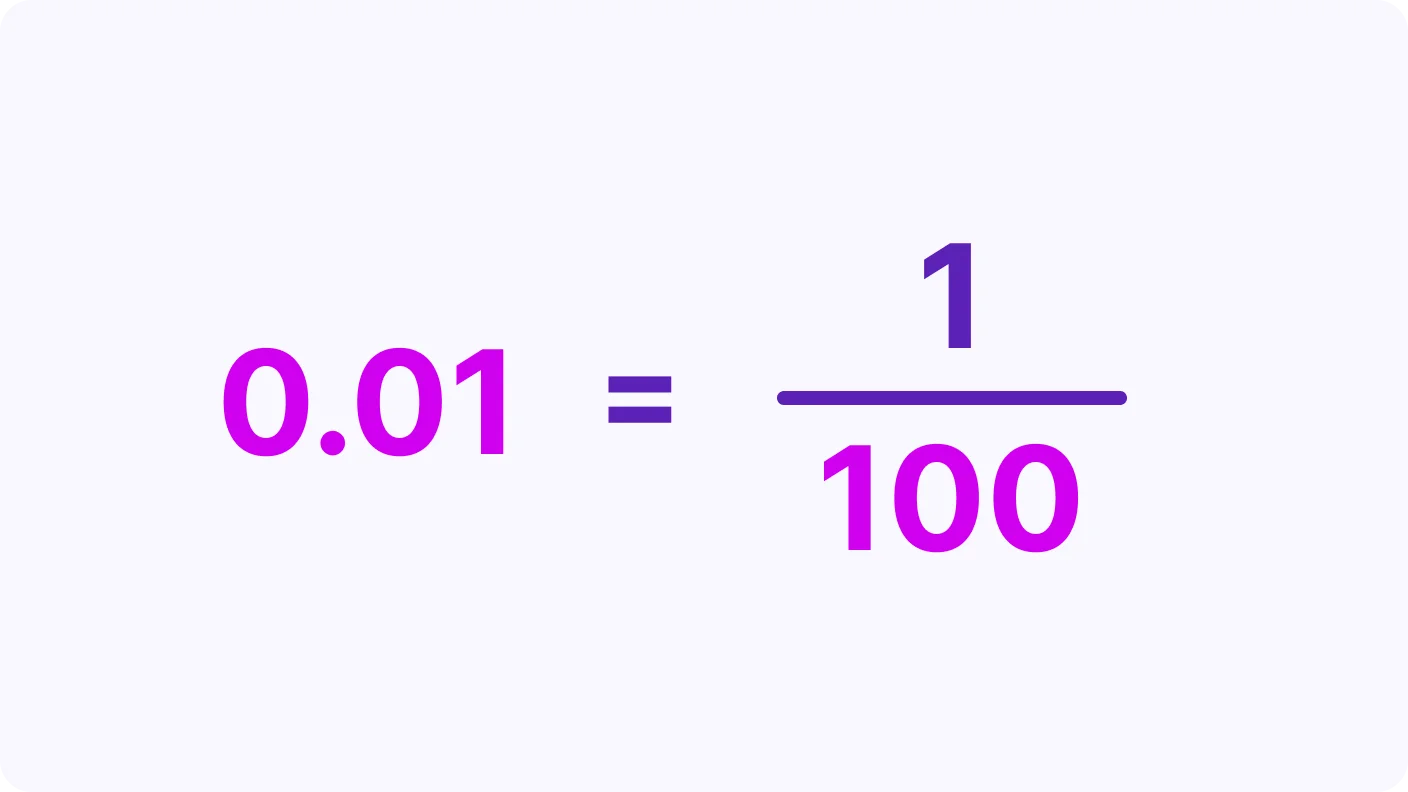
Decimals and fractions are two ways to show the same value. To convert a decimal to a fraction, count the decimal places to set the denominator 10, 100 or 1000, then simplify if you can. So 0.01 = 1/100.
Video Lesson
Watch and learn the basics
🎬 Did this video explain it clearly?
Flashcards
Review key concepts visually
%20Decimal%20and%20Decimal%20Point.webp)
%20Converting%20Decimals%20to%20Fractions.webp)
%20Converting%20Decimals%20greater%20than%201%20to%20Fractions.webp)
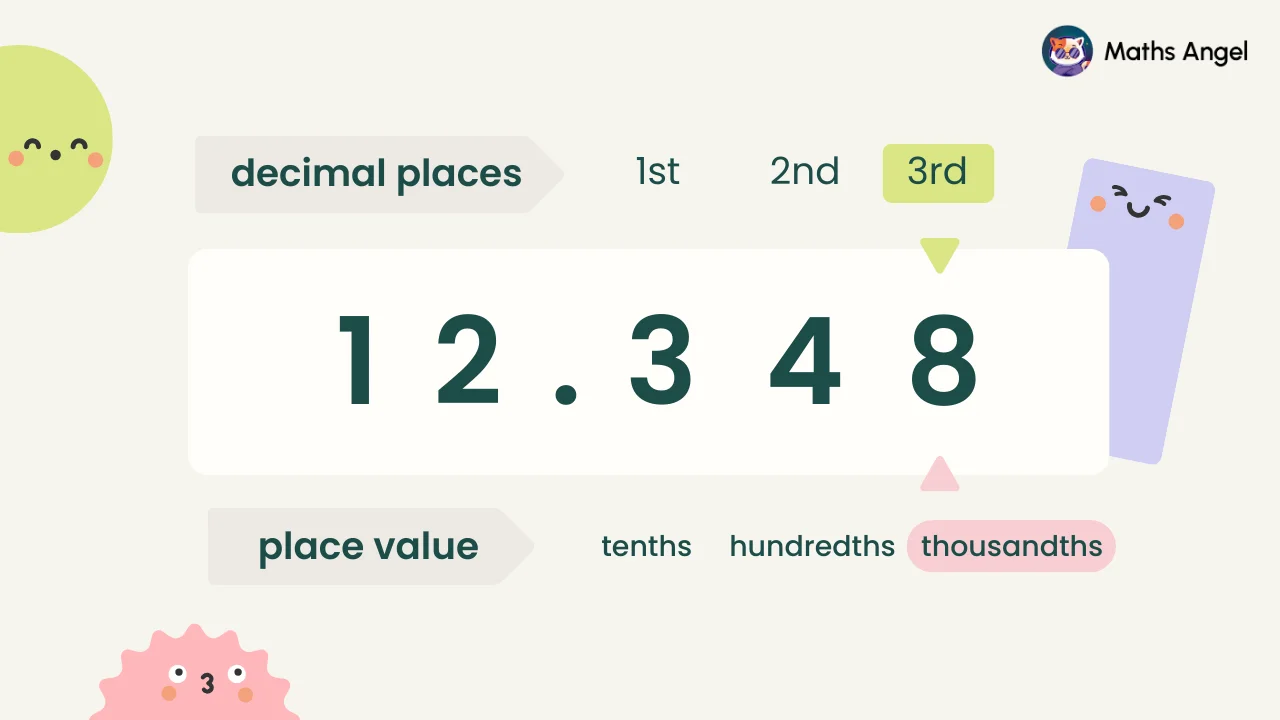
The Decimal Place Value
- The decimal point separates the whole number and the fractional part.
- Each place to the right of the decimal point is 10 times smaller: tenths, hundredths, thousandths.
Converting Decimals (Less Than 1) to Fractions
- Write the decimal as a fraction over 10, 100, or 1000.
- Simplify the fraction if possible. For example, .
Converting Decimals (Greater Than 1) to Fractions
- Split the number into a whole number and a decimal part.
- Convert the decimal part to a fraction, then combine with the whole number.
- For example,
Practice Questions
Test your understanding
What is 0.01 as a fraction in its simplest form?
Correct! 🎉 +10 pointsCorrect! 🎉 Worth 10 XPNot quite right
In 0.01 the digit 1 sits in the hundredths column, so 0.01 means 1 hundredth.
As a fraction that is , which is already in its simplest form.
What is 0.4 as a fraction in its simplest form?
Correct! 🎉 +10 pointsCorrect! 🎉 Worth 10 XPNot quite right
0.4 has one decimal place, so it means 4 tenths: .
Dividing the numerator and the denominator by 2 gives , which is the simplest form.
Convert 0.45 to a fraction in its simplest form.
Correct! 🎉 +20 pointsCorrect! 🎉 Worth 20 XPNot quite right
0.45 means 45 hundredths, so .
The highest common factor of 45 and 100 is 5, so divide both the numerator and the denominator by 5: and .
So . Checking: .
Which fraction is equal to 0.28 in its simplest form?
Correct! 🎉 +20 pointsCorrect! 🎉 Worth 20 XPNot quite right
0.28 means 28 hundredths, so .
The highest common factor of 28 and 100 is 4, so divide both parts by 4: and .
So . Checking: .
Convert 0.22 to a fraction in its simplest form.
Correct! 🎉 +20 pointsCorrect! 🎉 Worth 20 XPNot quite right
0.22 means 22 hundredths, so .
The highest common factor of 22 and 100 is 2, so divide both parts by 2: and .
So . Checking: .
Convert 0.375 to a fraction in its simplest form.
Correct! 🎉 +30 pointsCorrect! 🎉 Worth 30 XPNot quite right
0.375 means 375 thousandths, so .
The highest common factor of 375 and 1000 is 125, so divide both parts by 125: and .
So . Checking: .
Want to see the full working?
Interactive Activity
Practice converting decimals to fractions
Loading interactive widget...
Frequently asked questions
The questions students bump into most on this topic
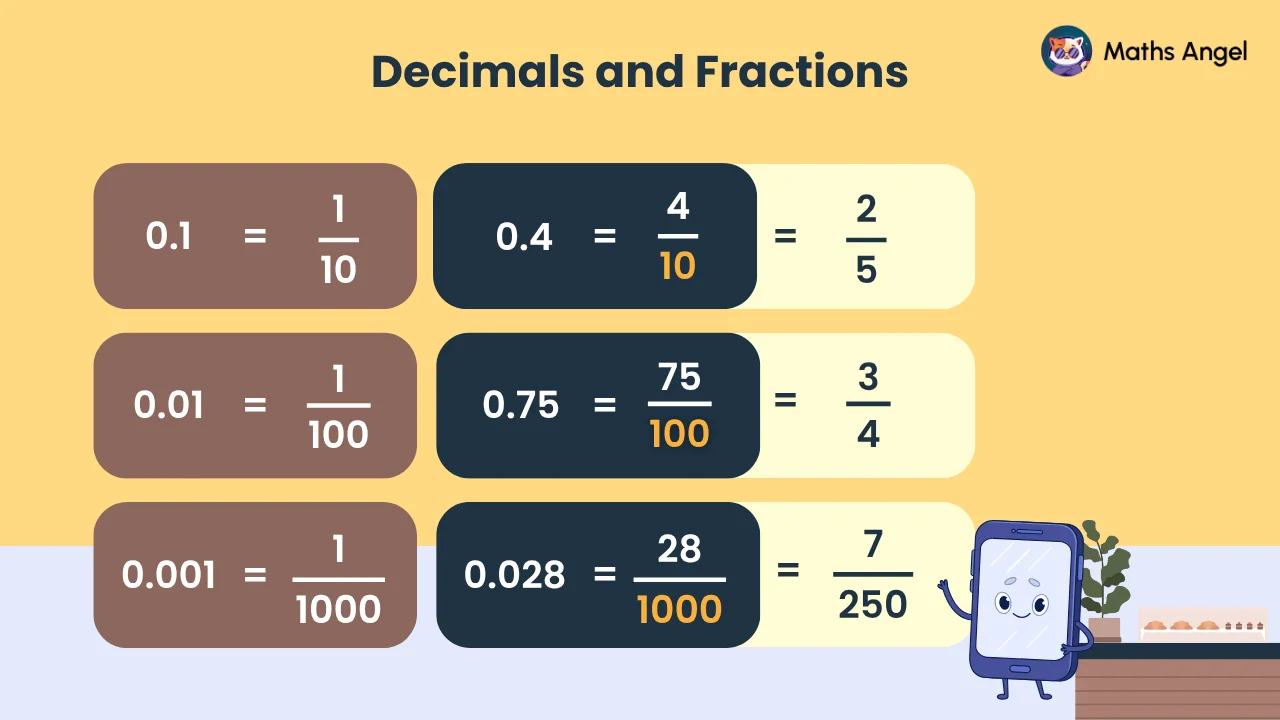
Both show parts of a whole; they are two ways of writing the same value. A decimal uses a decimal point with tenths, hundredths and thousandths places, so 0.1 is one tenth, 0.01 one hundredth and 0.001 one thousandth. A fraction writes the same part as a numerator over a denominator: 0.1 = 1/10 and 0.01 = 1/100.
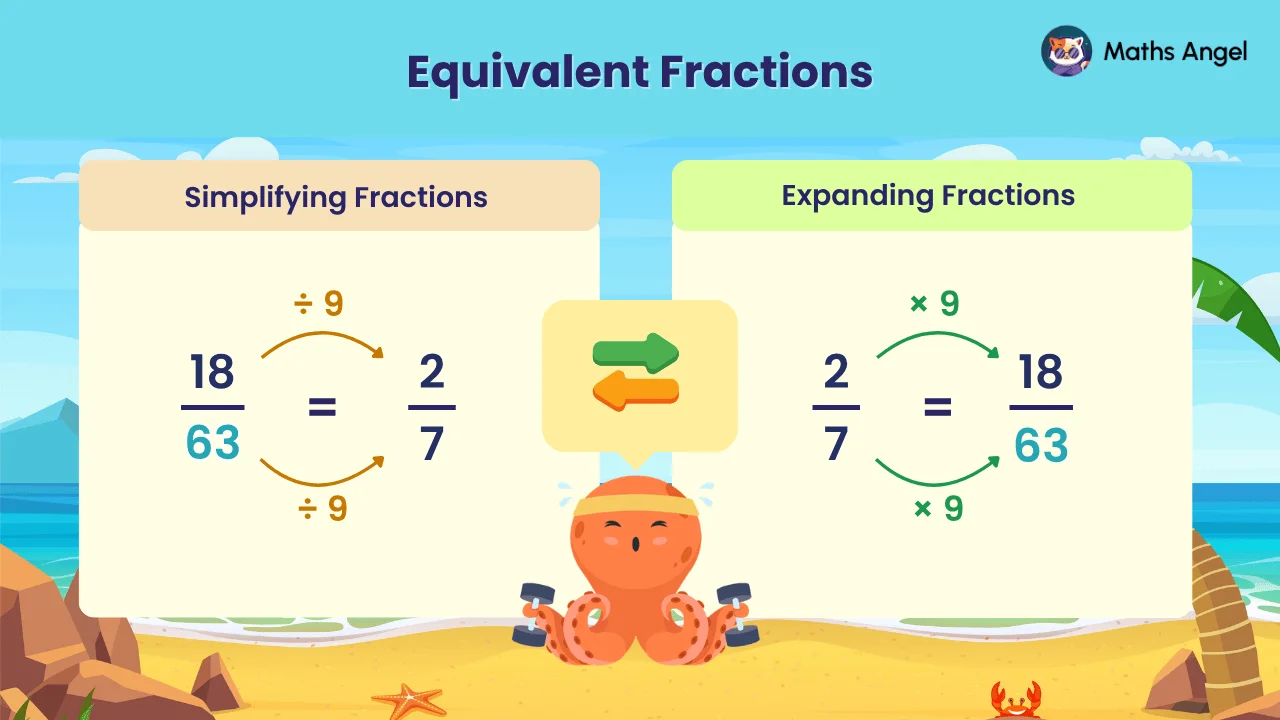
Count the digits after the decimal point: one place means the denominator is 10, two means 100, three means 1,000. Write the digits without the point on top, then simplify. So 0.4 = 4/10 = 2/5, and 0.028 = 28/1,000 = 7/250. The box question 0.35 works the same way: 35/100 = 7/20.
0.75 is three quarters. It has two decimal places, so write 75 over 100, then divide the top and bottom by 25 to get 3/4. Three quarters means three out of four equal parts, which is why 0.75 of £1 is 75p.
Split the number into its whole part and its decimal part, convert only the decimal part, then put them back together. 1.75 is 1 + 0.75, and 0.75 is 3/4, so 1.75 = 1 3/4, a mixed number. Converting the whole thing as 175/100 also works, but simplifying it is harder.
Use money. £1 is the whole; 10p is one tenth of it, which can be written as 1/10 or as 0.1; 1p is one hundredth, 1/100 or 0.01. Then look at prices: £0.75 is 75p, which is three quarters of a pound, so 0.75 and 3/4 are the same amount.
What's next?
Found this one hard? Go one step back first. Feeling confident? Carry on to the next lesson.