Comparing and Rounding Decimals
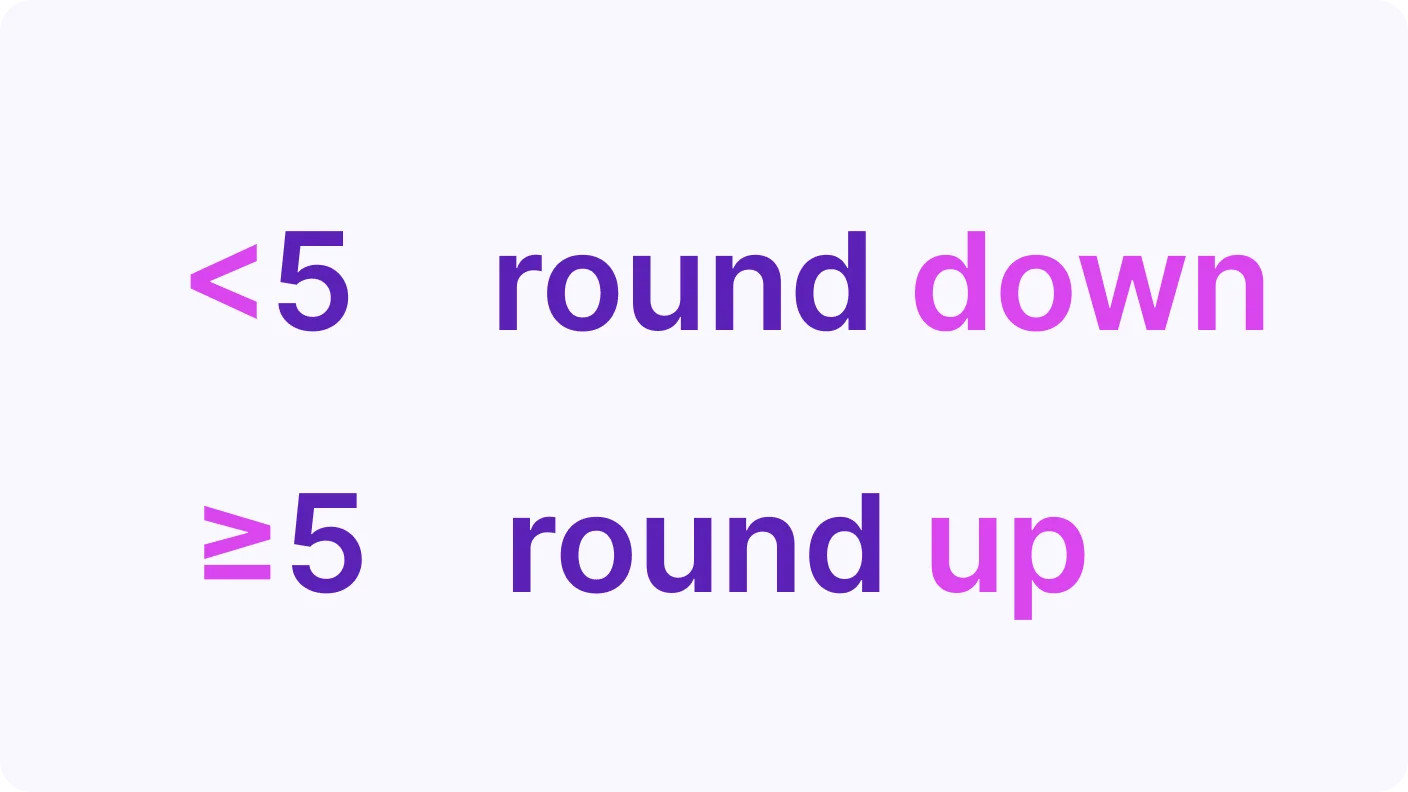
Rounding decimals keeps a set number of decimal places. Look at the next digit. If it is 5 or more, round up. If it is less, round down. Comparing decimals lines up the points, then reads left to right.
Video Lesson
Watch and learn the basics
🎬 Did this video explain it clearly?
Flashcards
Review key concepts visually
%20Decimal%20Places%20and%20Decimal%20Place%20Value.webp)
%20Rounding%20Decimals%20Rules.webp)
%20How%20to%20Compare%20Decimals.webp)
What Is Decimal Place Value?
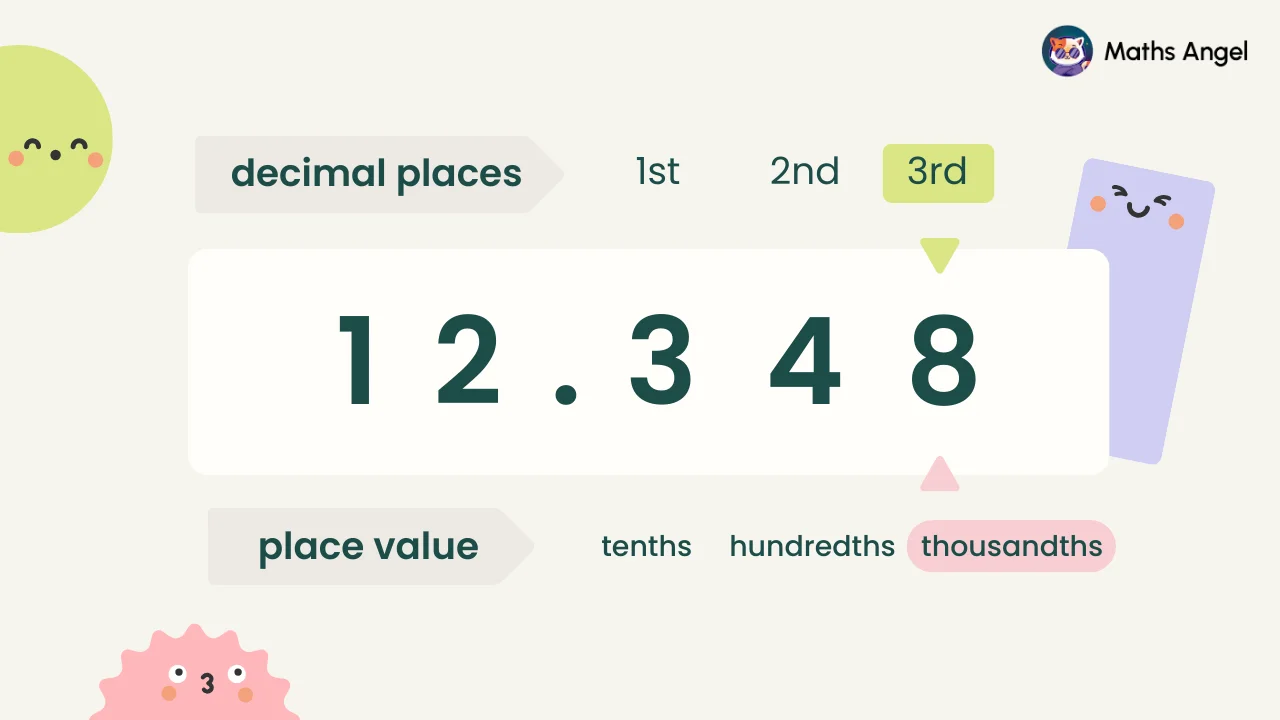
- The 1st, 2nd, and 3rd decimal places are tenths, hundredths, thousandths.
- For example, .
Rounding Decimals Rules
- Look at the digit one place to the right of the rounding place.
- If it is less than 5, round down. If it is 5 or more, round up.
- For example, 12.348 rounded to the nearest tenth is 12.3, because the digit in the hundredths place is 4, which is less than 5, so we round down.
Comparing Decimals
- Line up the decimal points first.
- Compare digits from left to right.
- The number with the larger digit first is greater.
Practice Questions
Test your understanding
Round 3.47 to 1 decimal place.
Correct! 🎉 +10 pointsCorrect! 🎉 Worth 10 XPNot quite right
One decimal place means one digit after the point, so we keep the tenths digit 4 and look at the digit to its right, the hundredths.
That digit is 7, which is 5 or more, so the 4 rounds up to 5. The answer is 3.5.
Which number is greater, 0.66 or 0.58?
Correct! 🎉 +10 pointsCorrect! 🎉 Worth 10 XPNot quite right
Both numbers have two decimal places, so compare digit by digit from the left.
The tenths are 6 and 5, and 6 is bigger than 5, so 0.66 is greater. In hundredths, 66 hundredths beats 58 hundredths. Once an earlier place decides it, the later digits do not matter.
Round 7.657 to 2 decimal places.
Correct! 🎉 +20 pointsCorrect! 🎉 Worth 20 XPNot quite right
Two decimal places means two digits after the point, so we keep 7.65 and look at the next digit, the thousandths.
That digit is 7, which is 5 or more, so the hundredths digit 5 rounds up to 6. The answer is 7.66.
Round 18.569 to the nearest hundredth.
Correct! 🎉 +20 pointsCorrect! 🎉 Worth 20 XPNot quite right
The nearest hundredth means two digits after the point, so we keep 18.56 and look at the next digit, the thousandths.
That digit is 9, which is 5 or more, so the hundredths digit 6 rounds up to 7. The answer is 18.57.
Which number is greater, 0.441 or 0.435?
Correct! 🎉 +20 pointsCorrect! 🎉 Worth 20 XPNot quite right
Both numbers have three decimal places, so compare digit by digit from the left.
The tenths are both 4, so move on: the hundredths are 4 and 3, and 4 is bigger than 3, so 0.441 is greater. The thousandths digits never come into it.
Round 9.895 to 2 decimal places.
Correct! 🎉 +30 pointsCorrect! 🎉 Worth 30 XPNot quite right
Two decimal places means two digits after the point, so we keep 9.89 and look at the next digit, the thousandths.
That digit is 5, so the hundredths digit rounds up: 9 becomes 10, which means writing 0 in the hundredths and carrying 1 into the tenths, so 8 becomes 9. The answer is 9.90, and the trailing zero is kept to show two decimal places.
Want to see the full working?
Interactive Activity
Master decimal rounding with this interactive challenge
Loading interactive widget...
Frequently asked questions
The questions students bump into most on this topic
Decimal places are the digits to the right of the decimal point. The first is the tenths place, the second the hundredths and the third the thousandths, so 12.348 is 12 + 0.3 + 0.04 + 0.008. Rounding “to 2 decimal places” means keeping just the first two of those digits.
Look at the digit one place to the right of the place you are rounding to. If it is below 5, round down: keep the digit and remove everything to its right. If it is 5 or more, round up: add 1 to the digit, then remove everything to its right. The rule is the same for tenths, hundredths or any decimal place.
Keep the first digit after the decimal point and look at the second. For 12.348, the first decimal digit is 3 and the next is 4, which is below 5, so round down: 12.3. If the next digit had been 5 or more, you would add 1 to the 3 instead. Rounding to 1 decimal place is the same as rounding to the nearest tenth.
Keep the first two digits after the decimal point and look at the third. For 12.348, the digits are 3 and 4, and the next is 8, which is 5 or more, so round up: add 1 to the 4 and remove the rest, giving 12.35. Rounding to 2 decimal places is the same as rounding to the nearest hundredth.
Write the decimals one under the other with the decimal points lined up, then compare the digits from left to right. The first place where they differ decides it. For 0.441 and 0.435, the tenths are both 4, but the hundredths are 4 and 3, so 0.441 is the bigger number.
What's next?
Found this one hard? Go one step back first. Feeling confident? Carry on to the next lesson.