Convert Fraction to Decimal Using Long Division
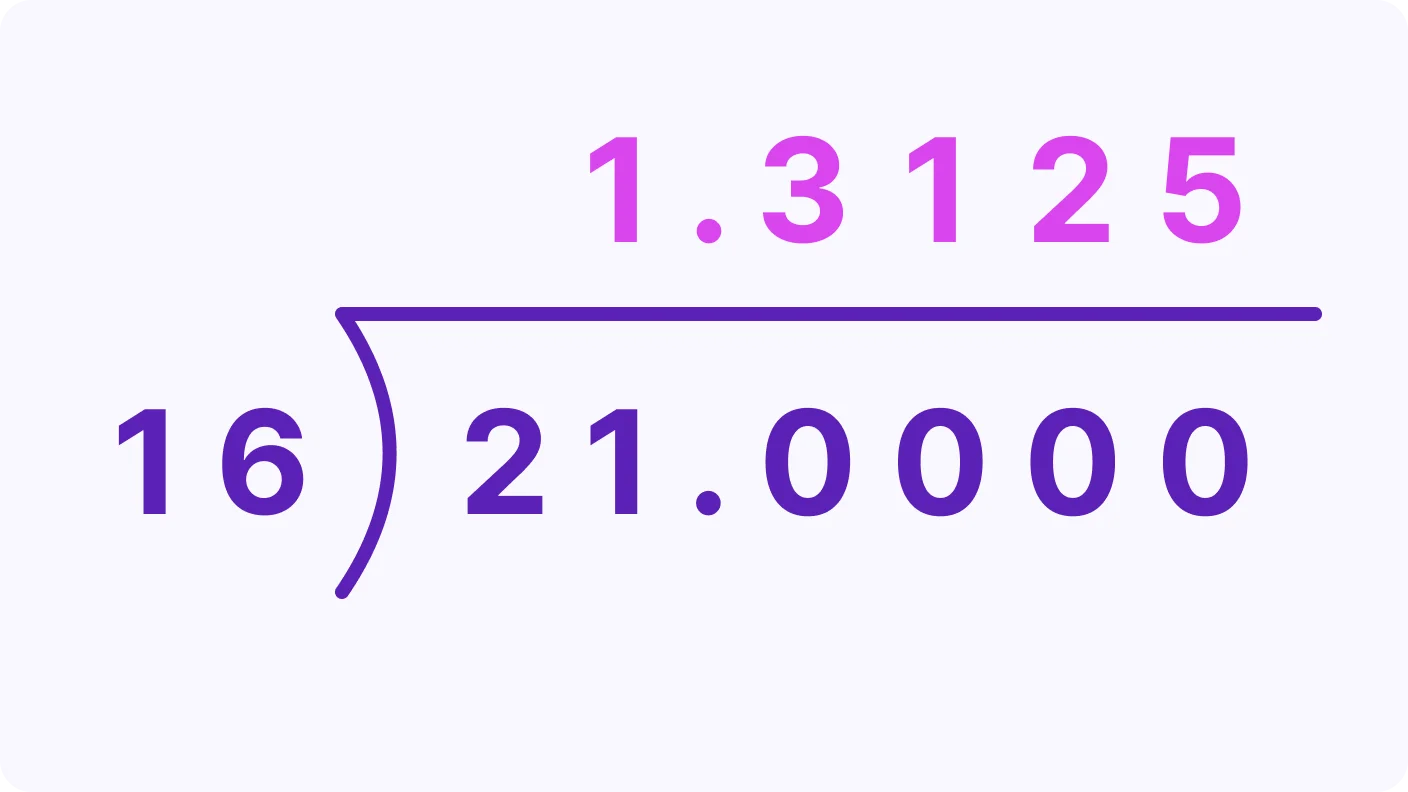
Convert a fraction to a decimal by dividing the numerator by the denominator, e.g. 21 ÷ 16 = 1.3125. It either ends as a terminating decimal or repeats forever as a recurring decimal.
Video Lesson
Watch and learn the basics
🎬 Did this video explain it clearly?
Flashcards
Review key concepts visually
%20Converting%20Fractions%20to%20Decimals.webp)
%20Fractions%20to%20Decimals%20Using%20Long%20Division.webp)
%20Terminating%20and%20Recurring%20Decimals.webp)
%20Fractions%20to%20Decimals%20using%20Long%20Division.webp)
How Do We Convert Simple Fractions to Decimals?
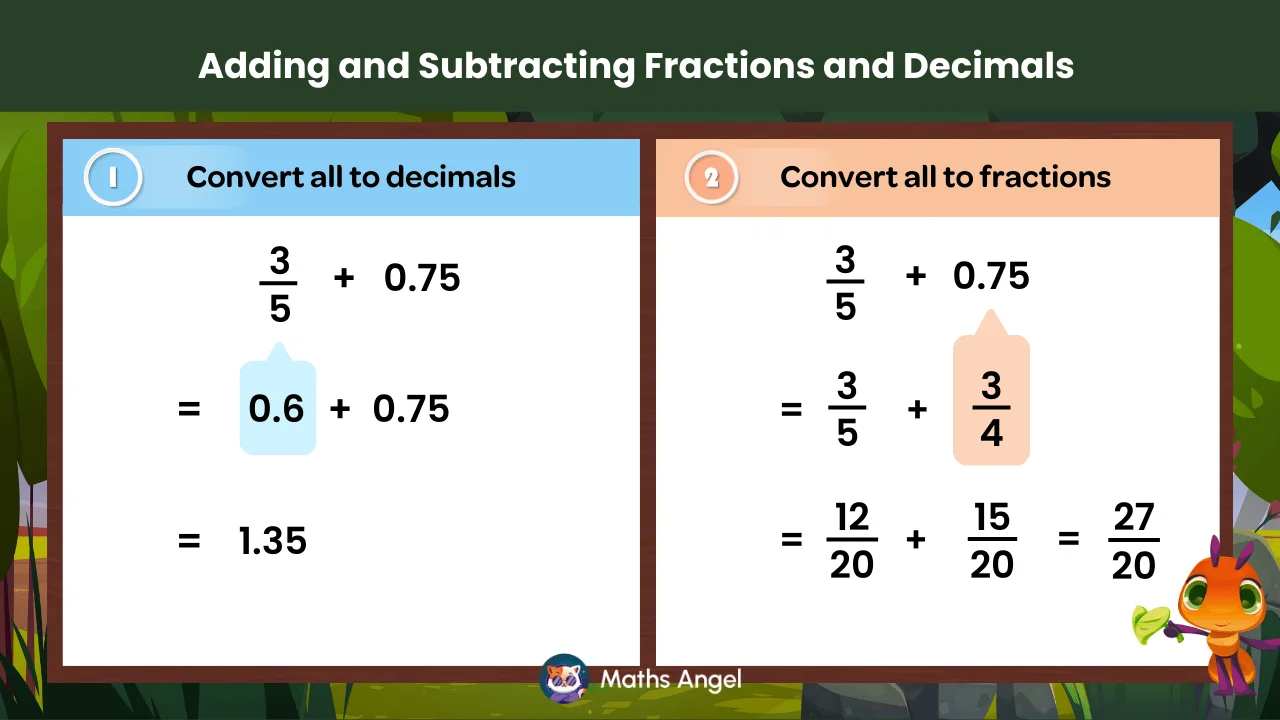
- Some fractions can be changed into decimals by rewriting them over 10, 100, or 1000.
- Example:
Converting Fractions to Decimals Using Long Division
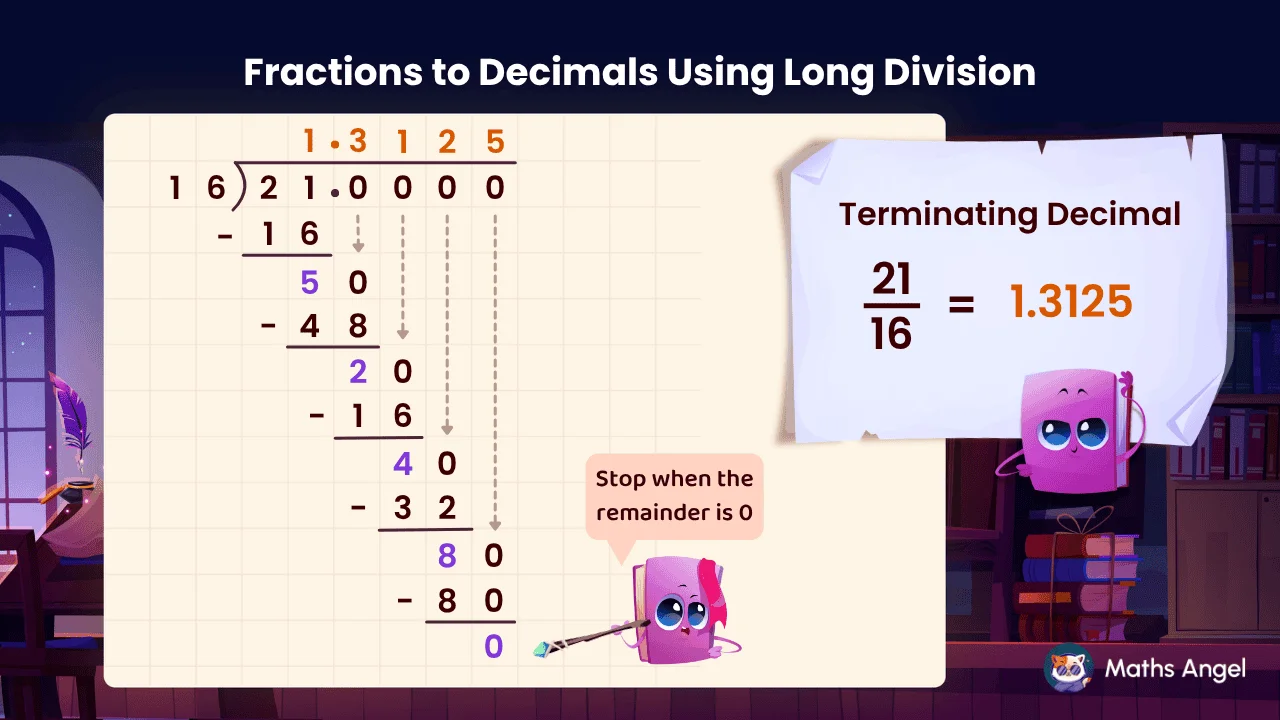
- Divide the numerator by the denominator.
- Stop dividing when the remainder becomes 0.
- For example,
What Are Terminating and Recurring Decimals?
- A terminating decimal ends after a fixed number of digits.
- A recurring decimal has digits that repeat forever.
How Do We Find Recurring Decimals Using Long Division?
- Stop dividing when you see the same remainder again.
- Example:
Practice Questions
Test your understanding
Convert to a decimal.
Correct! 🎉 +10 pointsCorrect! 🎉 Worth 10 XPNot quite right
Divide the numerator by the denominator: .
You can check it by scaling to hundredths: . Note that both the numerator and the denominator must be multiplied by 5, and that 55 hundredths is written 0.55, not 0.055.
What is as a decimal?
Correct! 🎉 +10 pointsCorrect! 🎉 Worth 10 XPNot quite right
Divide the numerator by the denominator: .
Checking by scaling to hundredths: . The answer is exact, so there is nothing to round or cut short.
What is as a decimal?
Correct! 🎉 +20 pointsCorrect! 🎉 Worth 20 XPNot quite right
Divide the numerator by the denominator: .
By long division, 8 goes into 7.000: exactly. The division terminates, so give all three decimal places rather than stopping early.
Convert to a decimal. Give the full recurring decimal - do not round or stop the division early.
Correct! 🎉 +20 pointsCorrect! 🎉 Worth 20 XPNot quite right
Divide 131 by 99. It goes in once with 32 left over, and continuing the division the digits repeat:
The remainder is not the decimal part - '1 remainder 32' is not 1.32. The recurring block is the two digits 32, so the value is written (or ). Because it never ends, stopped versions such as 1.32 and 1.3232 are not equal to the fraction.
What is the decimal equivalent of ?
Correct! 🎉 +20 pointsCorrect! 🎉 Worth 20 XPNot quite right
Divide the numerator by the denominator:
Every step of the division leaves a remainder of 7, so the digit 7 repeats forever: (or ). A stopped version such as 0.777 is not equal to - it is slightly smaller.
Convert to a decimal.
Correct! 🎉 +30 pointsCorrect! 🎉 Worth 30 XPNot quite right
Divide 87 by 16. It goes in 5 times with 7 left over, so .
Continuing the division, , so exactly. The remainder 7 is not '.7' - it must be divided by 16 to become the decimal part, and since the division terminates there is no need to stop it early.
Want to see the full working?
Interactive Activity
Visualising fraction to decimal conversion
Loading interactive widget...
Frequently asked questions
The questions students bump into most on this topic
If the denominator scales easily to 10 or 100, scale it: 2/5 = 4/10 = 0.4 and 3/5 = 6/10 = 0.6. For any other fraction, divide the numerator by the denominator with long division: 21/16 is 21 ÷ 16 = 1.3125. The division either stops, giving a terminating decimal, or repeats, giving a recurring one.
Write the fraction as a division and divide. For 21/16: 16 goes into 21 once, remainder 5. Put a decimal point after the 1, bring down a 0 to make 50 and carry on: 16 into 50 is 3, remainder 2; into 20 is 1, remainder 4; into 40 is 2, remainder 8; into 80 is 5, remainder 0. Stop at remainder 0: 21/16 = 1.3125.
A terminating decimal stops after a fixed number of digits: 21/16 = 1.3125 stops, because the long division reaches a remainder of 0. A recurring decimal has one or more digits that repeat forever: 41/12 = 3.41666…, because the division never reaches 0 and keeps producing the same remainder and the same digit.
Write the decimal up to the digit that starts repeating, then put a dot above each repeating digit. For 41/12 the division keeps giving 6, so the answer is 3.41 with a dot over the 6, meaning 3.41666… For 2/3, the division gives 6 forever, so it is 0.6 with a dot over the 6.
3/8 is 0.375: dividing 3 by 8 gives 0.375 with a remainder of 0, so it terminates. In the same way, 5/8 = 0.625 and 7/8 = 0.875. Fractions whose denominators scale to 10 or 100 are quicker: 3/4 = 75/100 = 0.75 and 3/5 = 6/10 = 0.6.
What's next?
Found this one hard? Go one step back first. Feeling confident? Carry on to the next lesson.