Adding and Subtracting Fractions and Decimals
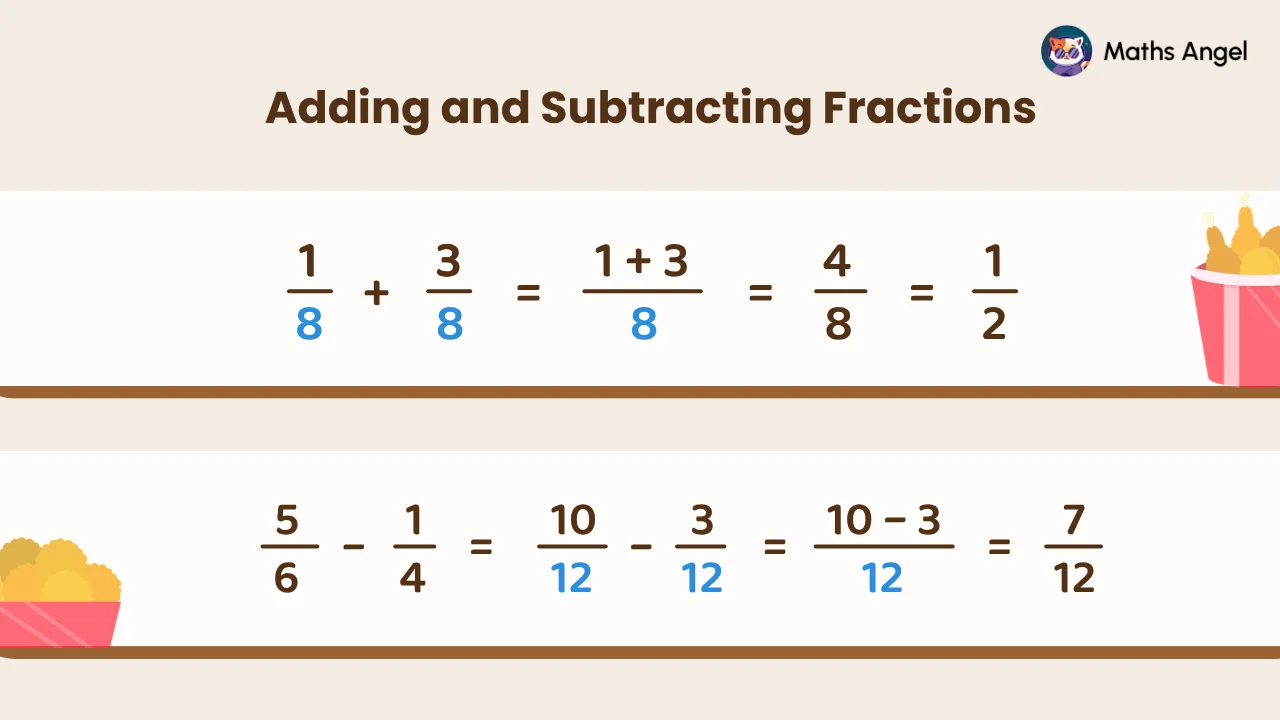
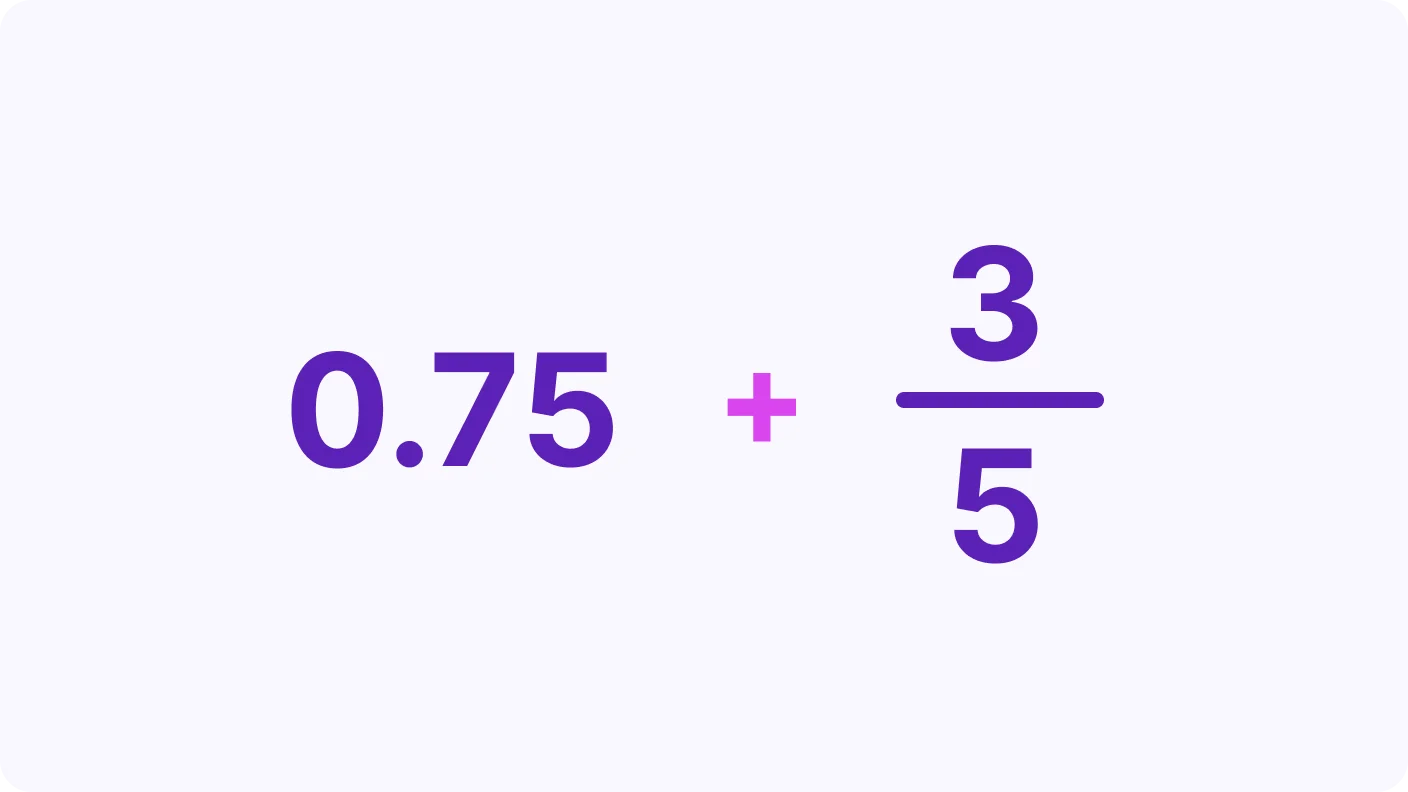
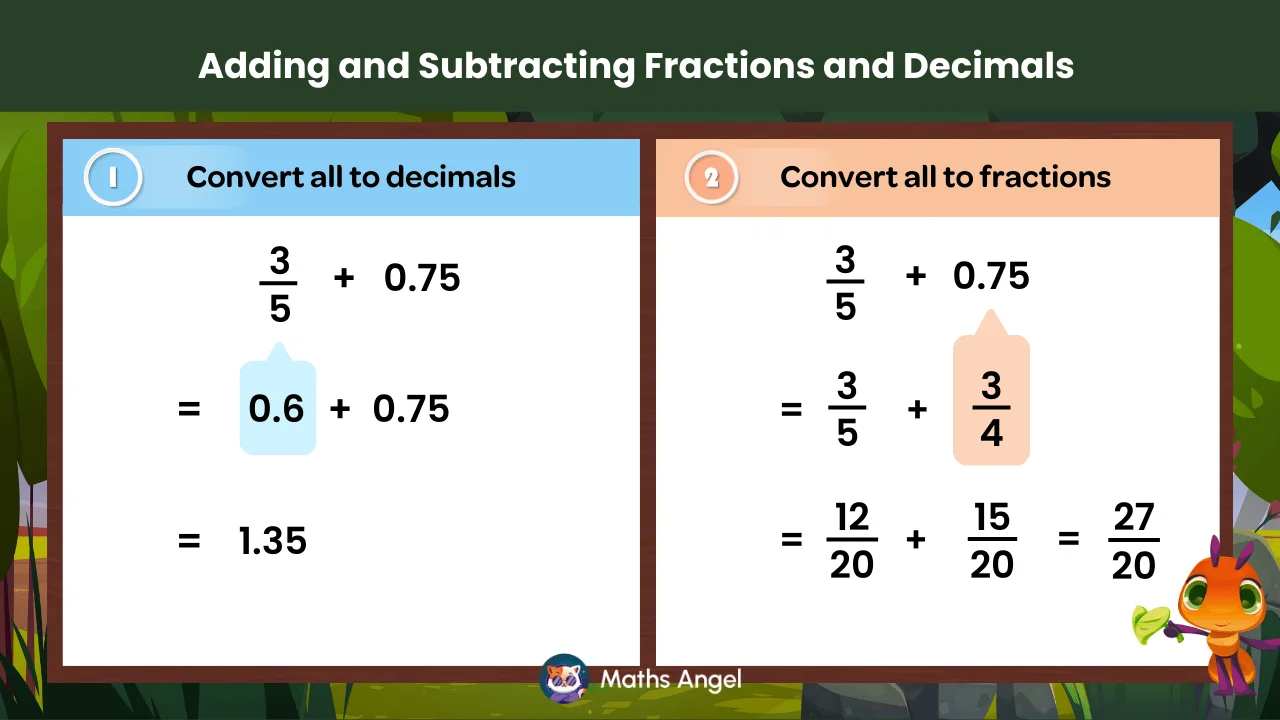
Adding and subtracting fractions and decimals means changing them into the same form. For example, 0.75 + 3/5 = 0.75 + 0.6 = 1.35. The decimal method is faster, while the fraction method gives an exact answer.
Video Lesson
Watch and learn the basics
🎬 Did this video explain it clearly?
Flashcards
Review key concepts visually
%20Decimal%20and%20Fraction%20Method.webp)
%20Decimal%20vs%20Fraction%20Method.webp)
%20Examples%20and%20Tips.webp)
Convert Everything to One Form
- Convert everything to decimals or to fractions before calculating.
- Example:
Which Method Should You Use?
- Decimals → faster because you can add or subtract directly
- Fractions → better for exact answers (no rounding).
When Should You Convert to Fractions Instead?
- Simplify the decimal part first if possible (e.g. ).
- If decimals do not end neatly, convert everything to fractions.
Practice Questions
Test your understanding
Add 0.4 and .
Correct! 🎉 +10 pointsCorrect! 🎉 Worth 10 XPNot quite right
A fraction bar means divide, so .
Now both numbers are decimals: .
The two parts make exactly one whole, because and .
Subtract 0.6 from .
Correct! 🎉 +10 pointsCorrect! 🎉 Worth 10 XPNot quite right
A fraction bar means divide, so .
Write 0.6 as 0.60 so the two numbers have the same number of decimal places, then line up the decimal points and subtract:
.
Work out . Give your answer as a decimal.
Correct! 🎉 +20 pointsCorrect! 🎉 Worth 20 XPNot quite right
Change the fraction into a decimal first: .
Now add, lining up the decimal points and filling the empty places with zeros: .
So .
Work out . Give your answer as a fraction in its simplest form.
Correct! 🎉 +20 pointsCorrect! 🎉 Worth 20 XPNot quite right
Write the decimal as a fraction: .
Use a common denominator of 10: .
Simplify by dividing top and bottom by 2: .
Work out . Give your answer as a fraction in its simplest form.
Correct! 🎉 +20 pointsCorrect! 🎉 Worth 20 XPNot quite right
Write the decimal as a fraction: .
Use a common denominator of 14: and .
Subtract the numerators: , which is already in its simplest form.
Work out . Give your answer as a fraction in its simplest form.
Correct! 🎉 +30 pointsCorrect! 🎉 Worth 30 XPNot quite right
Write the decimal as a fraction: .
The lowest common denominator of 10 and 12 is 60, so and .
Add the numerators: . As 43 is prime and is not a factor of 60, this is already in its simplest form.
Want to see the full working?
Interactive Activity
Practice adding and subtracting Fractions and Decimals
Loading interactive widget...
Frequently asked questions
The questions students bump into most on this topic
Change everything into one form first, then calculate. For 3/5 + 0.75, either turn the fraction into a decimal, 3/5 = 0.6, and add: 0.6 + 0.75 = 1.35; or turn the decimal into a fraction, 0.75 = 3/4, and add 3/5 + 3/4 = 12/20 + 15/20 = 27/20, which is also 1.35. Subtracting works the same way.
Decimals are usually faster, because you can add or subtract them directly. Fractions are better when a fraction does not make an exact decimal: 1/3 and 1/7 give long recurring decimals, so the decimal route would mean rounding. Check the fractions first: if every one converts exactly, use decimals; if not, convert everything to fractions.
Convert the decimal into a fraction instead, so nothing is rounded. For 1/3 + 0.25, write 0.25 as 1/4; the common denominator of 3 and 4 is 12, so 1/3 = 4/12 and 1/4 = 3/12, and the answer is 7/12. Working in decimals would mean 0.333… + 0.25, which can only be written approximately.
Combining the decimals you can in one step leaves fewer numbers to convert. In an expression such as 1/3 + 0.55 − 0.3, subtract 0.3 from 0.55 first to get 0.25; it becomes 1/3 + 0.25, which needs one conversion and one addition instead of two. Then convert 0.25 to 1/4 and add to get 7/12.
Because the denominator says how big each part is, and you can only add parts of the same size. Fifths and quarters are different sizes, so 3/5 + 3/4 cannot be added as they are. A common denominator is a shared one: the lowest common multiple of 5 and 4 is 20, so 3/5 = 12/20 and 3/4 = 15/20, which add to 27/20.
What's next?
Found this one hard? Go one step back first. Feeling confident? Carry on to the next lesson.