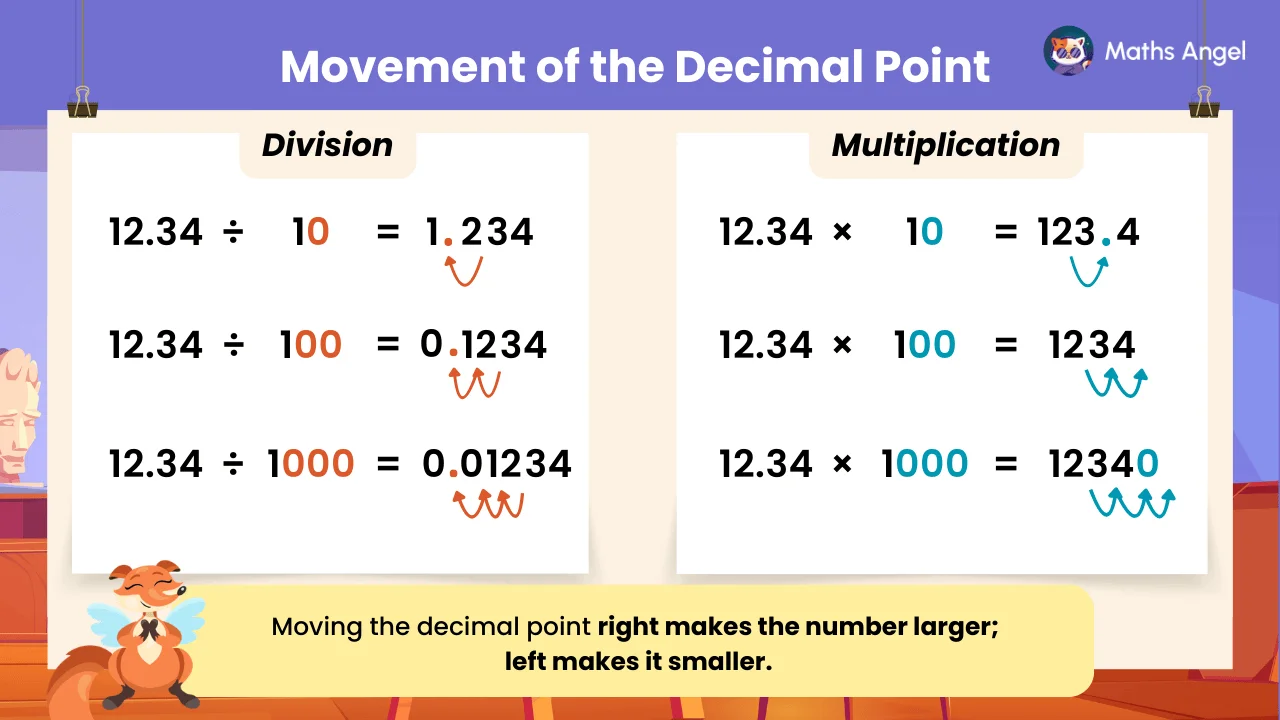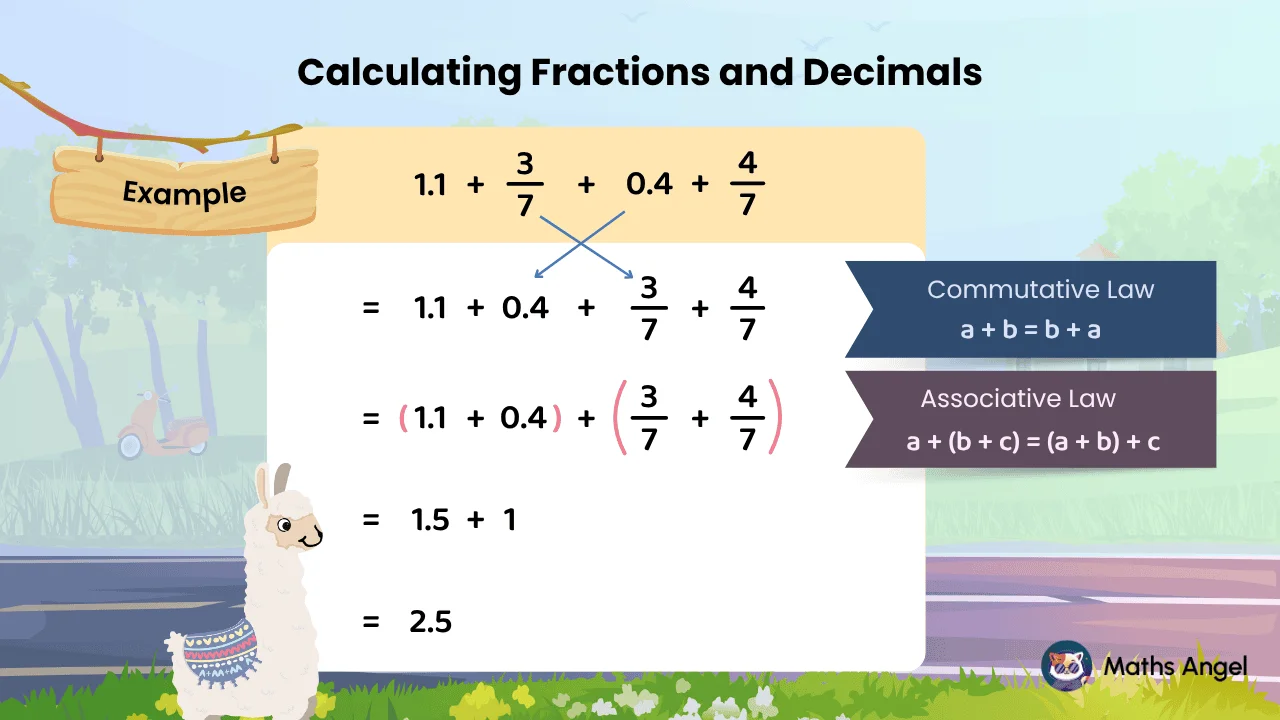
Multiplying Decimals
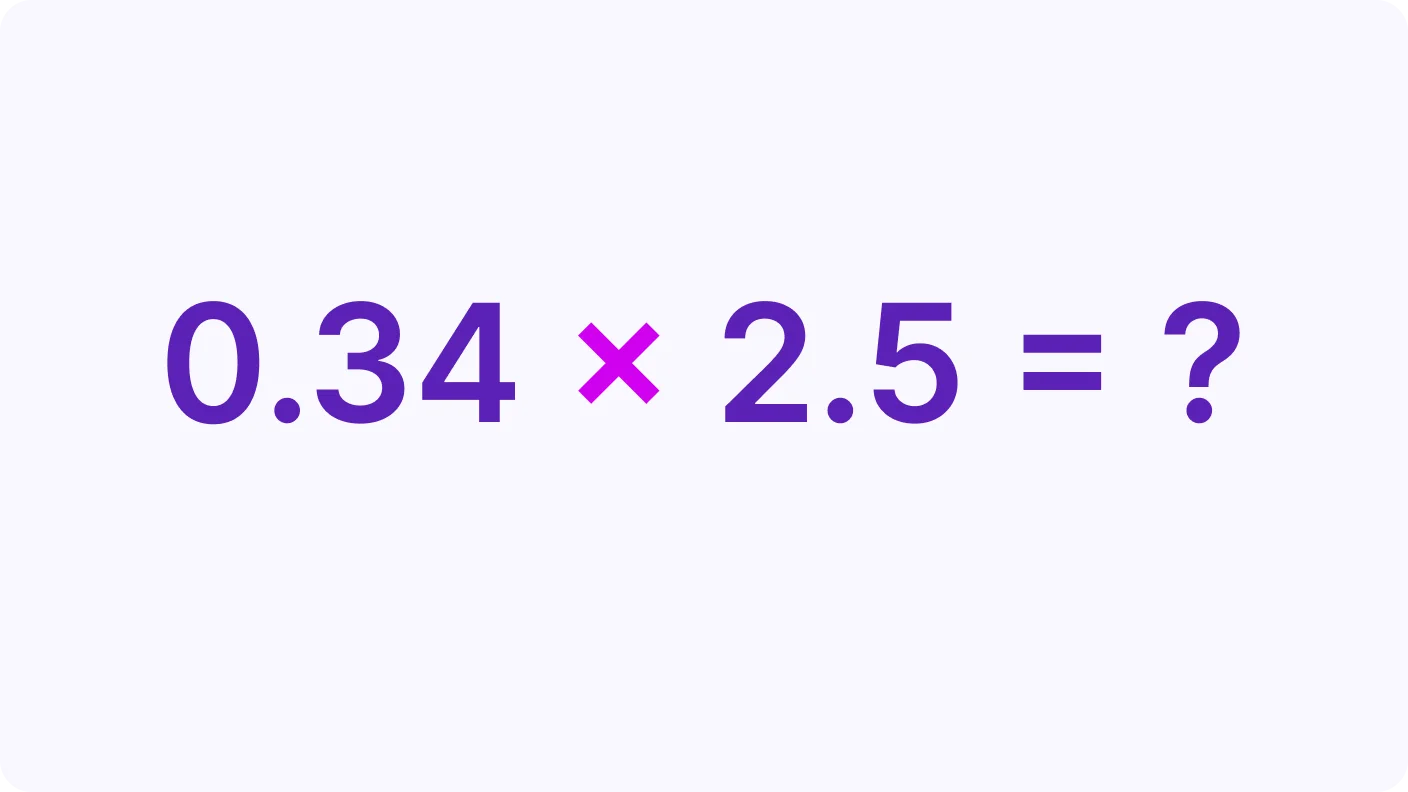
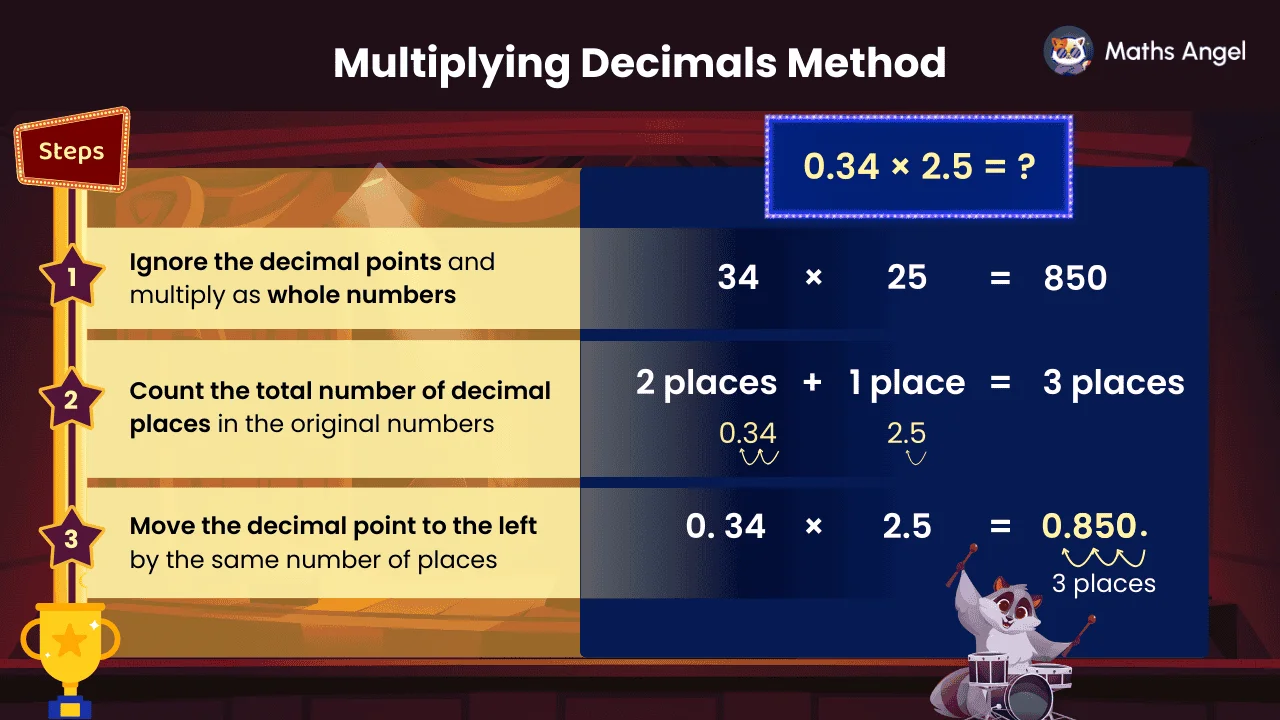
Multiplying decimals means ignoring the points and multiplying the digits as whole numbers. So 0.34 × 2.5 becomes 34 × 25 = 850. Then count the decimal places and move the point 3 places left to get 0.85.
Video Lesson
Watch and learn the basics
🎬 Did this video explain it clearly?
Flashcards
Review key concepts visually
%20Multiplying%20Decimals%20Method.webp)
%20Multiplying%20Decimals%20Practice.webp)
%20Multiplying%20Decimals%20Application.webp)
How Do We Multiply Decimals?
- First, ignore the decimal points and multiply as whole numbers.
- Then, count the total decimal places and move the decimal point left by that number of places.
Multiply Decimals: Example
- To find the area, multiply side lengths and .
- Calculate 55 × 26 first, then move the decimal point 2 places left.
Multiplying Decimals: Application
- In word problems, you often need to multiply decimals.
- Multiply as whole numbers first, then place the decimal point correctly.
Practice Questions
Test your understanding
What is 0.6 × 0.4?
Correct! 🎉 +10 pointsCorrect! 🎉 Worth 10 XPNot quite right
Ignore the decimal points and multiply the digits: .
Now count the decimal places in the question: one in 0.6 and one in 0.4, so two altogether. The answer needs the same two decimal places, so 24 becomes 0.24.
A quick check: multiplying by a number less than 1 makes the result smaller, so the answer must be smaller than 0.4, and 0.24 is.
What is 0.25 × 0.2?
Correct! 🎉 +10 pointsCorrect! 🎉 Worth 10 XPNot quite right
Ignore the decimal points and multiply the digits: .
Now count the decimal places in the question: two in 0.25 and one in 0.2, so three altogether. Putting three decimal places into 50 gives 0.050, which is written as 0.05.
A quick check: 0.2 is one fifth, and one fifth of 0.25 is 0.05.
What is ?
Correct! 🎉 +20 pointsCorrect! 🎉 Worth 20 XPNot quite right
Ignore the decimal points and multiply the digits: .
Now count the decimal places in the question: 2 in 0.75 and 2 in 0.08, so 4 altogether. The answer must have 4 decimal places, so 600 becomes 0.0600, which is written as 0.06.
Notice the answer is smaller than both numbers you started with: multiplying by a number less than 1 always makes a value smaller.
What is ?
Correct! 🎉 +20 pointsCorrect! 🎉 Worth 20 XPNot quite right
Ignore the decimal points and multiply the digits: .
Count the decimal places in the question: 1 in 3.2 and 1 in 1.5, so 2 altogether. Give 480 two decimal places: 4.80, written as 4.8.
Sense-check: 3.2 multiplied by 1.5 should be about half as much again as 3.2, and .
What is ?
Correct! 🎉 +20 pointsCorrect! 🎉 Worth 20 XPNot quite right
Ignore the decimal points and multiply the digits: .
Count the decimal places in the question: 1 in 1.6 and 2 in 3.75, so 3 altogether. Give 6000 three decimal places: 6.000, which is just 6.
Sense-check: 3.75 is close to 4, and , so an answer of 6 is sensible.
A car travels 15.2 kilometres per litre of fuel. How far can the car travel on 8.5 litres of fuel?
Correct! 🎉 +30 pointsCorrect! 🎉 Worth 30 XPNot quite right
Multiply the distance per litre by the number of litres: .
Ignore the decimal points and multiply the digits: . Count the decimal places in the question: 1 in 15.2 and 1 in 8.5, so 2 altogether. Give 12920 two decimal places: 129.20, written as 129.2 kilometres.
Sense-check: , so an answer close to 129 is sensible.
Want to see the full working?
Interactive Activity
Multiply decimals step-by-step
Loading interactive widget...
Frequently asked questions
The questions students bump into most on this topic
Three steps. First, ignore the decimal points and multiply the digits as whole numbers: for 0.34 × 2.5, work out 34 × 25 = 850. Second, count the decimal places in both numbers: 2 in 0.34 and 1 in 2.5, so 3 in total. Third, move the decimal point 3 places to the left in 850, which gives 0.85.
Multiply the digits as whole numbers first, then move the decimal point to the left by the total number of decimal places in the two numbers you started with. For 5.5 × 2.6: 55 × 26 = 1,430, there is 1 decimal place in 5.5 and 1 in 2.6, so the point moves 2 places left and the answer is 14.3.
Use the same three steps; a whole number simply has no decimal places. For 1.5 × 3: ignore the point and work out 15 × 3 = 45, count the decimal places, 1 in 1.5 and none in 3, then move the point 1 place left to get 4.5. The whole number never adds any places to count.
The same three steps work without a calculator, which is what non-calculator papers test. A taxi costs 6.5 pounds per kilometre and the trip is 8.12 km, so the cost is 6.5 × 8.12. Multiply 65 × 812 = 52,780, count 1 + 2 = 3 decimal places, then move the point 3 places left: 52.78 pounds.
What's next?
Found this one hard? Go one step back first. Feeling confident? Carry on to the next lesson.