Calculating Fractions and Decimals
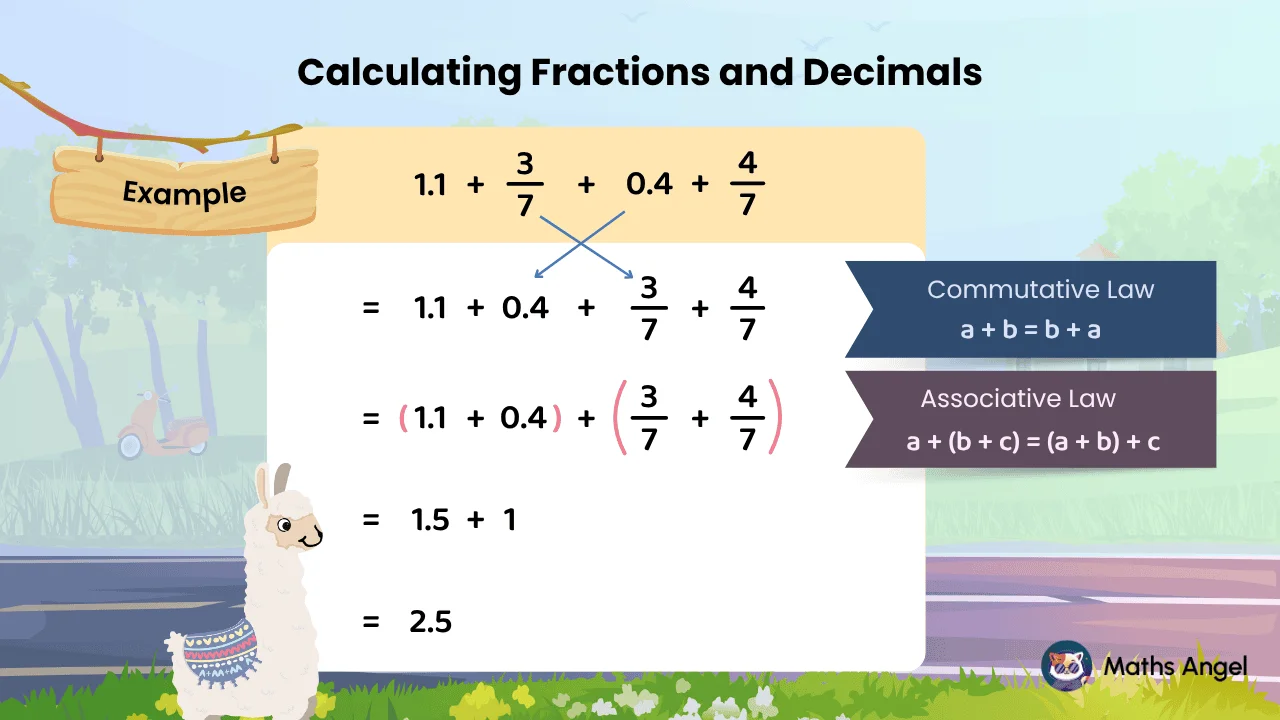
Calculating fractions and decimals is easier when you group the fractions and decimals separately. You work out each group first, then combine the results. The commutative law lets you swap the order when adding or multiplying.
Video Lesson
Watch and learn the basics
🎬 Did this video explain it clearly?
Flashcards
Review key concepts visually
%20Properties%20of%20Arithmetic%20(Formulas).webp)
%20Commutative%20and%20Associative%20Law%20in%20Addition.webp)
%20Commutative%20and%20Associative%20Law%20in%20Multiplication.webp)
%20Distributive%20Law%20with%20Decimals%20and%20Fractions%20.webp)
%20Distributive%20Law%20with%20More%20Terms.webp)
Properties of Arithmetic
- The commutative law means the order does not matter: and .
- The associative law means grouping does not matter: and .
What Is the Commutative Law?
- You can swap the order of numbers when adding or multiplying.
- The answer stays the same.
What Is the Associative Law?
- You can change the brackets when adding or multiplying.
- The grouping changes, but the answer stays the same.
How to Simplify Multiplication with Fractions and Decimals?
- When multiplying decimals and fractions, rearrange the numbers.
- Group fractions together and decimals together to calculate more easily.
How Does the Distributive Law Work with Multiple Terms?
- Factor out the common factor first.
- Simplify what is inside the brackets, then find the final answer.
Practice Questions
Test your understanding
Work out . Give your answer as a decimal.
Correct! 🎉 +10 pointsCorrect! 🎉 Worth 10 XPNot quite right
Add the two decimals: .
Add the two fractions: , and .
Now add the two results: .
Work out . Give your answer as a decimal.
Correct! 🎉 +10 pointsCorrect! 🎉 Worth 10 XPNot quite right
The fractions already share a denominator: .
The decimals give .
Now add the two results: .
Work out . Give your answer as a decimal.
Correct! 🎉 +20 pointsCorrect! 🎉 Worth 20 XPNot quite right
Give the fractions a common denominator: , so .
Then add: .
Work out . Give your answer as a decimal.
Correct! 🎉 +20 pointsCorrect! 🎉 Worth 20 XPNot quite right
The fractions share a denominator: .
The decimals give .
Now add the two results: .
Work out . Give your answer as a decimal.
Correct! 🎉 +20 pointsCorrect! 🎉 Worth 20 XPNot quite right
Multiply both terms inside the bracket by 6: and .
So the answer is .
Checking the other way round: , so the bracket is 0.8333... ..., and 6 × 0.6333... .
Work out . Give your answer as a fraction in its simplest form.
Correct! 🎉 +30 pointsCorrect! 🎉 Worth 30 XPNot quite right
Every term has a factor of , so factorise: .
Inside the bracket, work from left to right: , then .
So the answer is .
Want to see the full working?
Interactive Activity
Calculating fractions and decimals
Loading interactive widget...
Frequently asked questions
The questions students bump into most on this topic
Yes. The commutative law (order does not matter), the associative law (grouping does not matter) and the distributive law work on fractions and decimals exactly as they do on whole numbers. That is what makes mixed calculations easier: you can move the numbers around to put the fractions together and the decimals together before you work anything out.
Work out the fractions and the decimals separately, then combine them, instead of converting everything first. For 1.1 + 3/7 + 4/7 + 0.4, swap the terms so the decimals sit together and the fractions sit together: 1.1 + 0.4 = 1.5 and 3/7 + 4/7 = 1, so the total is 2.5. The same grouping works for multiplication.
Use it when the bracket is awkward to work out directly, or when several terms share a factor. For 6 × (2.3 − 5/6), multiply each term by 6: 6 × 2.3 = 13.8 and 6 × 5/6 = 5, so the answer is 13.8 − 5 = 8.8. Going the other way, factor out a shared 2/3 so the bracket becomes 1.5 + 1.7 − 0.2 = 3, and 2/3 × 3 = 2.
What's next?
Found this one hard? Go one step back first. Feeling confident? Carry on to the next lesson.